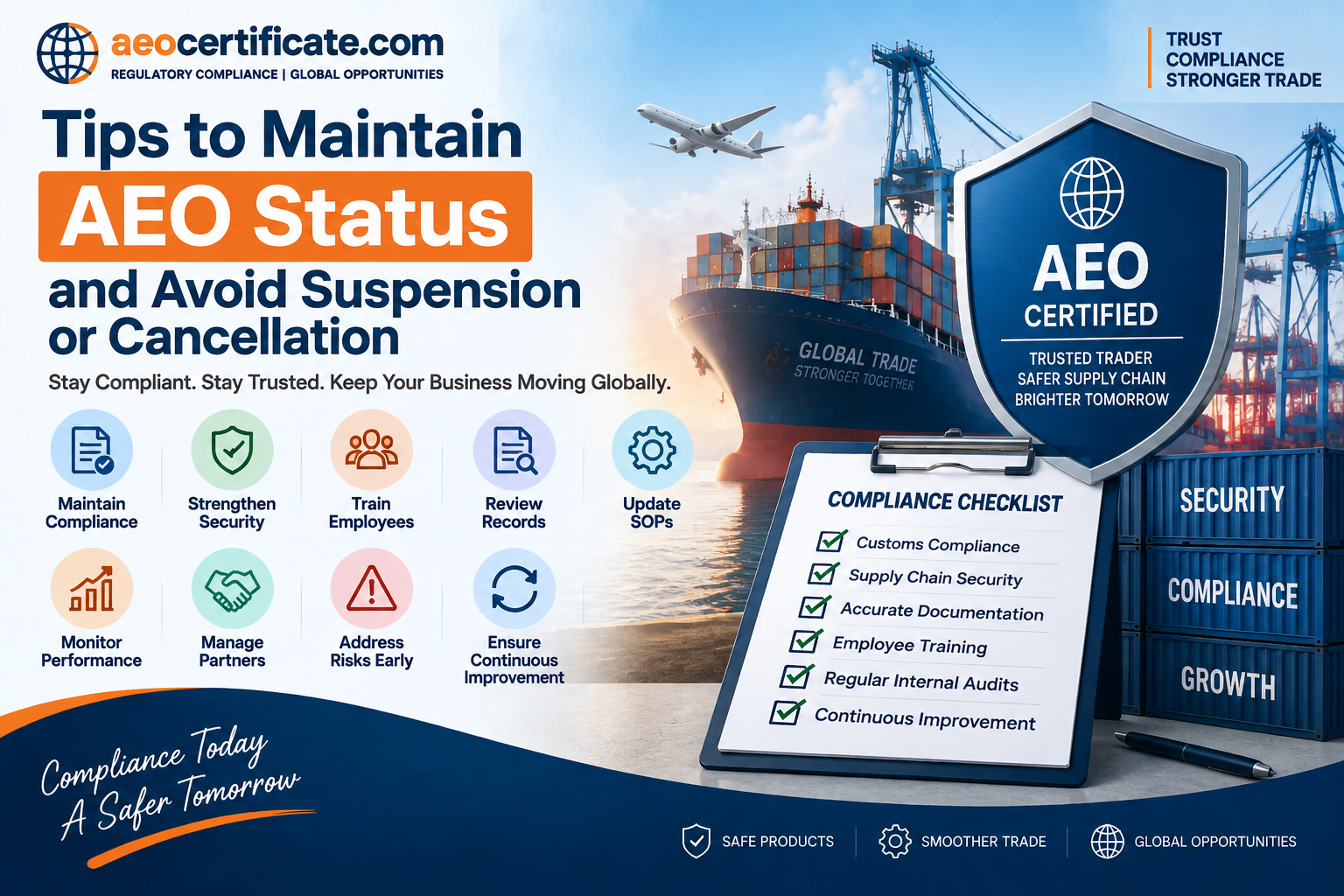
Obtaining Authorized Economic Operator (AEO) certification is a significant achievement for businesses involved in international trade. It represents the organization’s commitment towards customs compliance, supply chain security, transparent business practices, and effective internal control systems. However, receiving AEO certification is not the final step. Companies must continuously follow compliance practices to maintain AEO status and continue receiving the benefits associated with being a trusted trade partner.
AEO certification requires ongoing responsibility because customs authorities expect certified organizations to maintain the same level of compliance and security standards throughout the validity period. Any major compliance failure, incorrect declaration, weak internal control, or failure to meet AEO requirements may result in suspension or cancellation of the certification.
A structured compliance management system helps organizations Maintain AEO status, avoid regulatory issues, and ensure smooth international trade operations.
Understanding the Importance of Maintaining AEO Status
AEO certification provides businesses with recognition as trusted traders. However, this trust is based on continuous compliance and responsible business practices.
Companies must regularly monitor their customs procedures, documentation systems, security controls, and supply chain activities to ensure that they continue meeting AEO requirements.
To successfully maintain AEO status, organizations should focus on continuous improvement rather than treating AEO certification as a one-time achievement.
AEO-certified companies should establish internal mechanisms to review:
- Customs compliance performance
- Documentation accuracy
- Supply chain security
- Employee awareness
- Risk management systems
- Internal audit findings
Why Companies Need to Maintain AEO Status
AEO certification provides operational and compliance advantages, but these benefits depend on maintaining the required standards.
Failure to maintain compliance may affect:
- Customs facilitation benefits
- Business reputation
- International customer confidence
- Supply chain reliability
Organizations that actively manage their compliance systems can continue to maintain AEO status and strengthen their position in global trade.
1. Maintain Accurate Customs Documentation
One of the most important factors to maintain AEO status is ensuring accuracy and consistency in customs documentation.
Incorrect declarations, incomplete information, or repeated documentation errors can create compliance risks.
Companies should maintain proper control over documents such as
- Commercial invoices
- Packing lists
- Shipping bills
- Bills of Entry
- Certificates and licences
- Product classification records
A document verification process should be implemented before every import or export transaction.
Regular review of documentation helps organizations identify errors early and prevent compliance issues.
2. Conduct Regular Internal Compliance Audits
Internal audits play an important role in maintaining AEO compliance.
Companies should regularly evaluate whether their processes continue to meet AEO requirements.
Internal audits should review:
- Customs procedures
- Documentation practices
- Security controls
- Employee compliance
- Record maintenance
- Risk management procedures
Audit findings should be properly documented, and corrective actions should be implemented.
A continuous audit system helps organizations identify weaknesses and take preventive action to maintain AEO Status.
3. Strengthen Supply Chain Security
Supply chain security is one of the key areas considered under the AEO framework.
Companies should ensure that their supply chain remains secure from manufacturing to final delivery.
Security measures may include:
- Restricted access to sensitive areas
- Visitor management procedures
- CCTV monitoring
- Employee verification
- Shipment tracking systems
- Secure transportation arrangements
Companies should also evaluate the security practices of logistics partners, transporters, and service providers.
Maintaining strong security controls helps businesses continue to maintain AEO status and reduce supply chain risks.
4. Update Standard Operating Procedures (SOPs)
Business processes may change due to new technology, organizational restructuring, or changes in regulations.
Therefore, companies should regularly review and update their SOPs.
Important SOP areas include:
- Import and export procedures
- Document approval process
- Customs communication
- Warehouse operations
- Security management
- Risk handling procedures
Updated SOPs ensure that employees follow consistent processes and help organizations maintain AEO compliance.
5. Provide Regular Employee Training
Employees play an important role in maintaining AEO compliance.
Lack of awareness among employees can lead to:
- Documentation errors
- Security failures
- Incorrect procedures
- Compliance gaps
Companies should conduct regular training programs covering:
- AEO requirements
- Customs procedures
- Documentation practices
- Security policies
- Risk management
Training records should be maintained as evidence of employee awareness.
A trained workforce supports organizations in their efforts to maintain AEO status.
Common Reasons for AEO Status Suspension or Cancellation
Organizations may face risks to their AEO certification due to compliance failures.
Common reasons may include:
- Repeated customs violations
- Incorrect declarations
- Failure to maintain required security standards
- Lack of proper documentation
- Failure to implement corrective actions
- Significant changes without proper compliance review
Understanding these risks helps companies take preventive measures and continue to maintain AEO status.
Best Practices to Maintain AEO Status
Organizations should adopt a continuous improvement approach by:
- Reviewing compliance systems regularly
- Conducting internal audits
- Updating SOPs
- Training employees
- Monitoring business changes
- Maintaining proper records
- Reviewing supply chain security
These practices help organizations protect their certification and continue enjoying AEO benefits.
Benefits of Maintaining AEO Status
Companies that successfully maintain AEO status can continue to benefit from:
Improved Customs Relationship
AEO-certified companies maintain stronger trust with customs authorities.
Better Supply Chain Efficiency
Strong compliance systems improve operational reliability.
Enhanced Business Reputation
AEO status increases confidence among customers and international partners.
Reduced Compliance Risks
Continuous monitoring helps prevent regulatory issues.
Long-Term Business Growth
A secure and compliant supply chain supports international expansion.
AEO Audit Preparation Checklist for Certified Companies
Create a checklist format:
| Area | Verification |
| Documentation | Updated records available |
| Customs Compliance | Previous transactions reviewed |
| Security | Access controls implemented |
| Training | Employee records maintained |
| SOPs | Procedures updated |
Internal Audit Process
Internal audits are essential to continuously maintain AEO status after certification. Regular audits help organizations evaluate whether their customs compliance, documentation systems, and security procedures are working effectively.
Companies should conduct periodic internal reviews to identify gaps and implement corrective actions before they become major compliance issues.
Key Points:
- Conduct regular internal compliance audits.
- Review customs documentation and transaction records.
- Verify implementation of SOPs.
- Check supply chain security controls.
- Identify non-conformities and corrective actions.
- Maintain audit reports and records.
- Review previous audit findings and improvement actions.
- Ensure management involvement in compliance reviews.
A proper internal audit system helps organizations remain prepared for customs verification and supports continuous AEO compliance.
Supply Chain Security
Supply chain security is a key requirement for AEO-certified companies. Organizations must continuously ensure that their supply chain remains secure from unauthorized access, shipment manipulation, and potential risks.
Companies should maintain security measures such as access control systems, visitor management procedures, CCTV monitoring, employee verification, secure transportation arrangements, and monitoring of logistics partners. Regular evaluation of suppliers, transporters, and service providers is also important to ensure that all parties involved in the supply chain follow appropriate security practices.
Strong supply chain security helps companies protect their AEO certification and continue to maintain AEO status by demonstrating effective risk control.
SOP Management
Standard Operating Procedures (SOPs) provide a structured approach for maintaining consistent operations and compliance standards. Updated SOPs help employees follow correct procedures and reduce operational errors.
Companies should regularly review and update SOPs according to changes in business operations, regulations, and supply chain requirements.
Key Points:
- Develop SOPs for import and export activities.
- Maintain procedures for customs documentation.
- Create SOPs for shipment handling and security.
- Update SOPs whenever business processes change.
- Train employees on revised procedures.
- Maintain controlled versions of SOP documents.
- Ensure SOP implementation across departments.
- Regularly review SOP effectiveness.
Effective SOP management helps businesses continuously maintain AEO status and demonstrate compliance readiness.
Employee Training
Employees play a critical role in maintaining AEO certification because their actions directly impact customs procedures, documentation accuracy, and supply chain security. Organizations should provide regular training programs to ensure that employees understand AEO certification and their individual responsibilities.
Training should cover areas such as customs compliance, documentation procedures, security practices, risk management, and internal SOPs. Companies should maintain proper training records as evidence of employee awareness and competency.
A trained workforce reduces errors, improves compliance performance, and helps organizations continuously maintain AEO status.
Suspension Reasons & Prevention
AEO status may be suspended if an organization fails to maintain required compliance standards. Companies should understand possible risks and take preventive measures.
Common Reasons for Suspension:
- Repeated customs violations.
- Incorrect declarations.
- Poor documentation practices.
- Failure to maintain security standards.
- Non-compliance with AEO requirements.
- Failure to implement corrective actions.
- Lack of proper record maintenance.
- Weak internal control systems.
Prevention Measures:
- Conduct regular compliance reviews.
- Maintain accurate documentation.
- Monitor customs transactions.
- Implement corrective actions quickly.
- Strengthen security procedures.
- Conduct internal audits regularly.
A proactive compliance approach helps organizations avoid suspension and continue to maintain AEO status.
Renewal Preparation
AEO-certified companies should prepare continuously for renewal or reassessment. Renewal preparation should not begin only at the end of the certification period.
Key Points:
- Review existing AEO documents.
- Update company information.
- Maintain latest SOPs.
- Review audit reports.
- Update employee training records.
- Verify security systems.
- Review compliance history.
- Complete corrective actions.
Proper preparation ensures a smooth renewal process and helps organizations continue to maintain AEO status.
Best Practices to Maintain AEO Status
Successful AEO-certified companies follow continuous improvement practices to ensure long-term compliance.
Best Practices:
- Establish a dedicated AEO compliance team.
- Conduct regular internal audits.
- Maintain updated SOPs.
- Monitor customs transactions.
- Train employees regularly.
- Maintain proper documentation.
- Review supply chain security.
- Monitor compliance KPIs.
- Conduct management reviews.
- Implement corrective and preventive actions.
Final AEO Status Maintenance Checklist
Add before the conclusion:
✅ Maintain customs compliance
✅ Update SOPs regularly.
✅ Conduct internal audits
✅ Monitor risks
✅ Train employees
✅ Review security systems
✅ Maintain records
✅ Track compliance KPIs
Difference Between AEO Certification Maintenance and Renewal
Add comparison:
| Maintenance | Renewal |
| Continuous activity | Periodic process |
| Daily compliance | Formal review |
| Monitoring systems | Certification continuation |
AEO Compliance for Different Industries
Add industry-specific examples:
Manufacturing Industry
- Production records
- Raw material imports
Chemical Industry
- Hazardous goods control
Pharmaceutical Industry
- Quality documentation
Electronics Industry
- Product security
AEO Compliance for Importers and Exporters
Separate sections:
Importers:
- Import documentation.
- Supplier verification.
- Customs declarations.
Exporters:
- Export documentation.
- Shipment security.
- Logistics monitoring.
Monitoring Changes in Business Structure After AEO Certification
Changes in business operations can impact AEO compliance requirements. Companies should evaluate the compliance impact of any major organizational changes.
Such changes may include:
- Change in ownership or management
- Addition of new business locations
- Opening new warehouses
- Expansion into new markets
- Introduction of new products
- Changes in supply chain partners
Organizations should review whether such changes require updates to existing procedures, security measures, or communication with customs authorities.
Proper change management helps businesses avoid compliance risks and continue to maintain AEO status.
Record Retention and Data Management Requirements
Maintaining proper records to maintain AEO status is essential for demonstrating continued compliance with AEO requirements. Companies should establish record retention procedures to ensure important documents remain available when required.
Records may include:
- Customs declarations
- Shipment details
- Audit reports
- Training records
- Security inspections
- Corrective actions
- Compliance reviews
Proper record management improves maintain AEO status transparency and supports successful verification processes.
AEO Certification Benefits of Long-Term Compliance
Maintaining AEO certification provides long-term advantages to businesses engaged in international trade. Companies that continuously follow compliance practices can strengthen relationships with customs authorities and improve their supply chain reliability.
Long-term benefits include improved operational control, better business reputation, stronger customer confidence, reduced compliance risks, and improved readiness for international expansion.
A continuous commitment to compliance allows companies to successfully maintain AEO status and maximize the value of their certification.
Adding these sections will help your blog become a complete AEO Status Maintenance Guide (5000+ words) covering:
- Post-certification compliance
- Suspension prevention
- Cancellation avoidance
- Audit readiness
- Security management
- Technology
- Documentation
- Continuous improvement.
Conclusion
AEO certification is not a one-time compliance activity; it requires continuous monitoring, improvement, and commitment. Organizations must regularly review their customs procedures, documentation systems, security controls, and internal processes to successfully maintain AEO status.
By implementing strong compliance practices, conducting regular audits, maintaining accurate records, and training employees, businesses can avoid suspension or cancellation risks and continue benefiting from their trusted trader status.
A proactive compliance approach ensures that AEO-certified companies remain prepared for future challenges and maintain a secure, efficient, and reliable global supply chain.
Frequently Asked Questions
Q1. How can companies Maintain AEO Status after certification?
Companies can maintain AEO status through regular audits, accurate documentation, employee training, and continuous compliance monitoring.
Q2. Why can AEO status be suspended?
AEO status may be affected due to customs violations, incorrect declarations, poor documentation, or failure to meet compliance requirements.
Q3. What documents should companies maintain after AEO certification?
Companies should maintain customs records, SOPs, audit reports, security documents, and employee training records.
Q4. How often should AEO compliance be reviewed?
Companies should conduct regular reviews, internal audits, and compliance checks to ensure continuous adherence.
Q5. Can business changes affect AEO status?
Yes, changes such as ownership, location, products, or supply chain partners should be reviewed for compliance impact.
Q6. How can companies avoid AEO certification cancellation?
Organizations should maintain strong compliance systems, update procedures, and take corrective actions on time.
Q7. Why are internal audits important for AEO compliance?
Internal audits help identify gaps, improve processes, and support continuous efforts to maintain AEO status.