Author name: ELTTeam

Blog

How AEO Status Helps E-Commerce Exporters Get Through Customs Faster

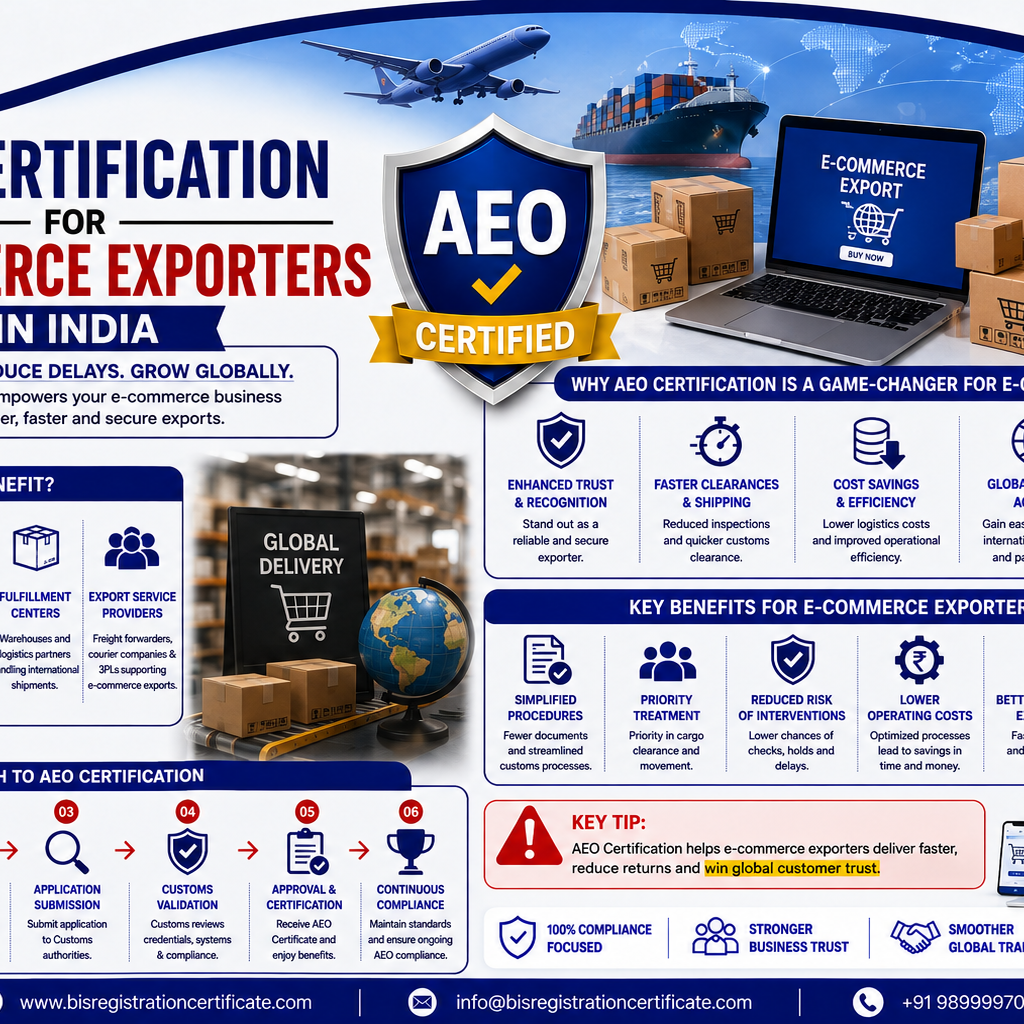
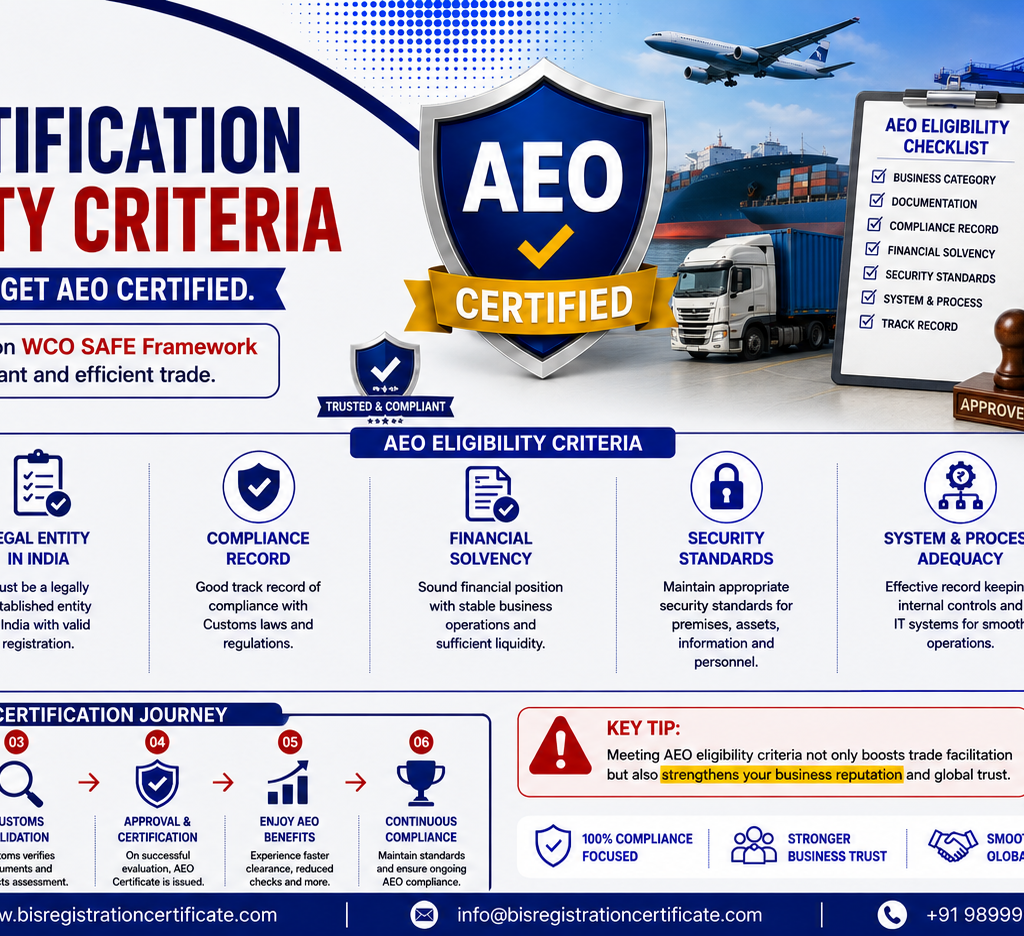
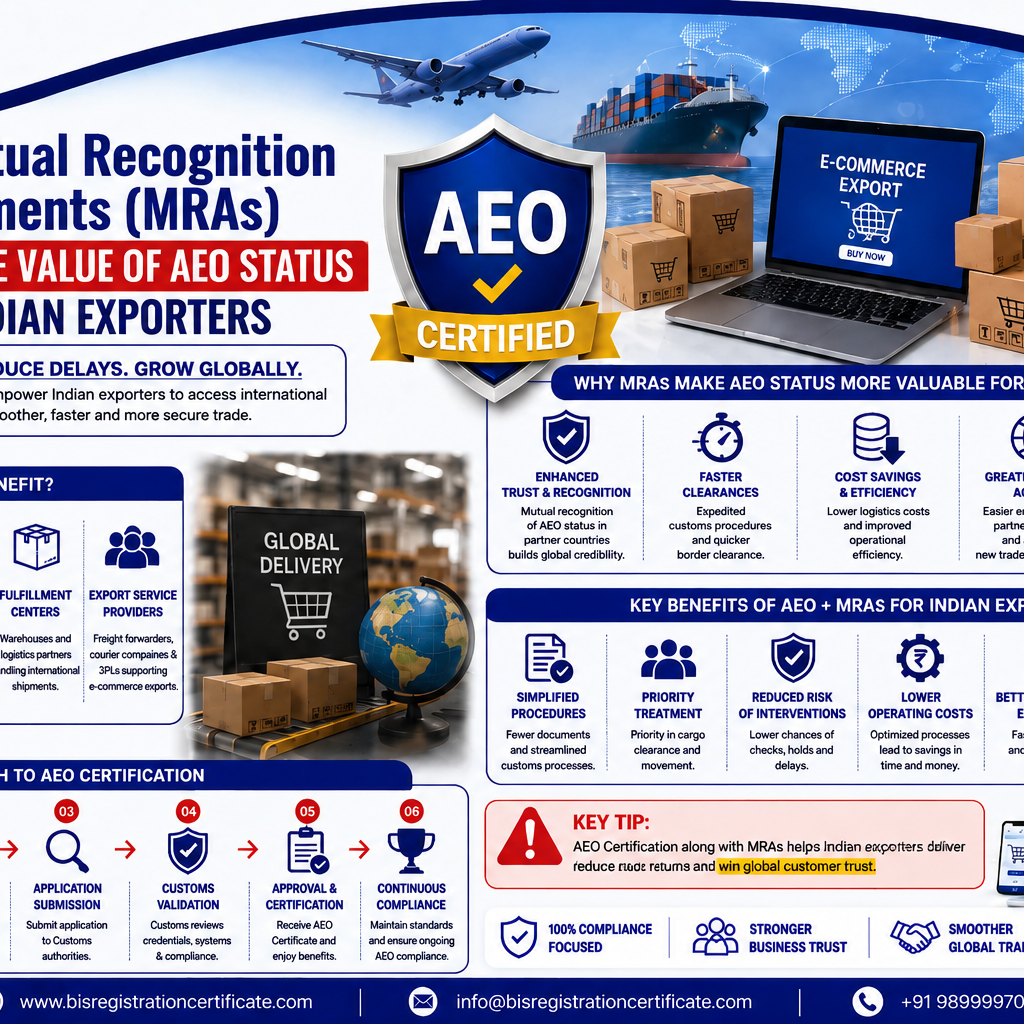
In the fast-paced world of e-commerce, customs delays and hefty clearing costs can have a big effect on company margins and customer happiness. The Authorized Economic Operator (AEO) Certification has changed the game in overcoming these problems, as it was set up by the Central Board of Indirect Taxes and Customs (CBIC) under the World Customs Organisation’s SAFE Framework. By obtaining AEO certification in India, e-commerce exporters demonstrate secure and compliant supply chain practices. The result is faster customs clearance, reduced inspection frequency, and lower operational costs, allowing businesses to stay competitive and efficient. AEO Certification and Its Impact on E-Commerce Exporters The world recognizes AEO Certification for businesses that meet the highest standards of compliance, security, and reliability in trade. The program is run by CBIC in India, and its goal is to build confidence between Customs and businesses that follow tight rules. This certification guarantees that e-commerce exporters will get preferential treatment at ports and airports, which accelerates the process of clearing products and reduces delays. It means that Customs thinks your shipments are low risk, which helps your logistics operations stay fast and reliable. How AEO Certification Enhances E-Commerce Exporter Operations AEO status might be a big deal for online exporters who handle thousands of shipments every day. It makes dealing with customs easier, cuts down on paperwork, and builds confidence with the authorities over time. Exporters with AEO certification are viewed as reliable business partners, allowing them to: Processing at ports and airports is a top priority. Fewer papers and physical checks Easier ways to have things cleared These benefits cut down on delays and costs right away, which means speedier deliveries and a better experience for customers. Why E-Commerce Exporters Need AEO Certification In e-commerce, being quick means being successful. Every late shipment can cost you sales, get you bad reviews, and break your confidence with clients. Exporters can avoid these risks by getting AEO certification, which makes logistics faster and more predictable. The accreditation gives your company more legitimacy, makes customers happier, and makes it a trusted exporter in global supply chains. Because of this, your business gets both a reputation and an operational edge. Steps to Apply for AEO Certification in India Step 1: Check to see whether you are eligible To apply for AEO certification in India, make sure your business fits CBIC’s requirements, which include being in business for at least three years, having a clean compliance record, and good supply chain management. Step 2: Get the papers ready Get documents like the GST, PAN, and IEC. Audited financial reports Policies for keeping the supply chain safe Application forms A, B, and C An AEO certification consulting service in India can aid you with document correctness and compliance reviews if you want professional help. Step 3: Fill out an online application Use the CBIC portal at aeoindia.gov.in to send in your AEO registration. Step 4: Review by Customs CBIC may check your application by looking over your documents or visiting your location. Step 5: Get your certification Your AEO certificate is good for 3 to 5 years after it is approved. This speeds up customs procedures for your business and gives you long-term benefits. AEO Certification Services for E-Commerce Exporters in India We help exporters in India get AEO certification at ELT Corporate. We examine their eligibility and give them the final certificate. Our professionals assist you: Full reviews of compliance and documentation Handle online applications and talk to customs officials Have immediate help with AEO certification in India to have it approved faster. You can now book AEO certification service with ELT Corporate and let experts take care of the details while you work on growing your business. AEO Registration Cost in India The cost of AEO registration in India depends on your level of certification (T1, T2, or T3) and the size of your organization. Hiring an AEO certification consulting agency in India may cost money, but it guarantees faster service and compliance without mistakes. For e-commerce exporters, the benefits far outweigh the cost. Faster delivery times, less delays, and happier customers all add up to a demonstrable return on investment (ROI). Conclusion AEO accreditation lets e-commerce exporters speed up customs processing, make paperwork easier, and boost their global reputation. This certification gives you faster customs clearance, fewer operating costs, and more trust from international partners. ELT Corporate, India’s most trusted AEO certification consulting firm, can help you acquire AEO certification in 60 days or less. We are experts in helping businesses achieve AEO accreditation swiftly and easily in India.

Why Professional AEO Consulting Saves Time and Reduces Risk
Blog

Why Professional AEO Consulting Saves Time and Reduces Risk

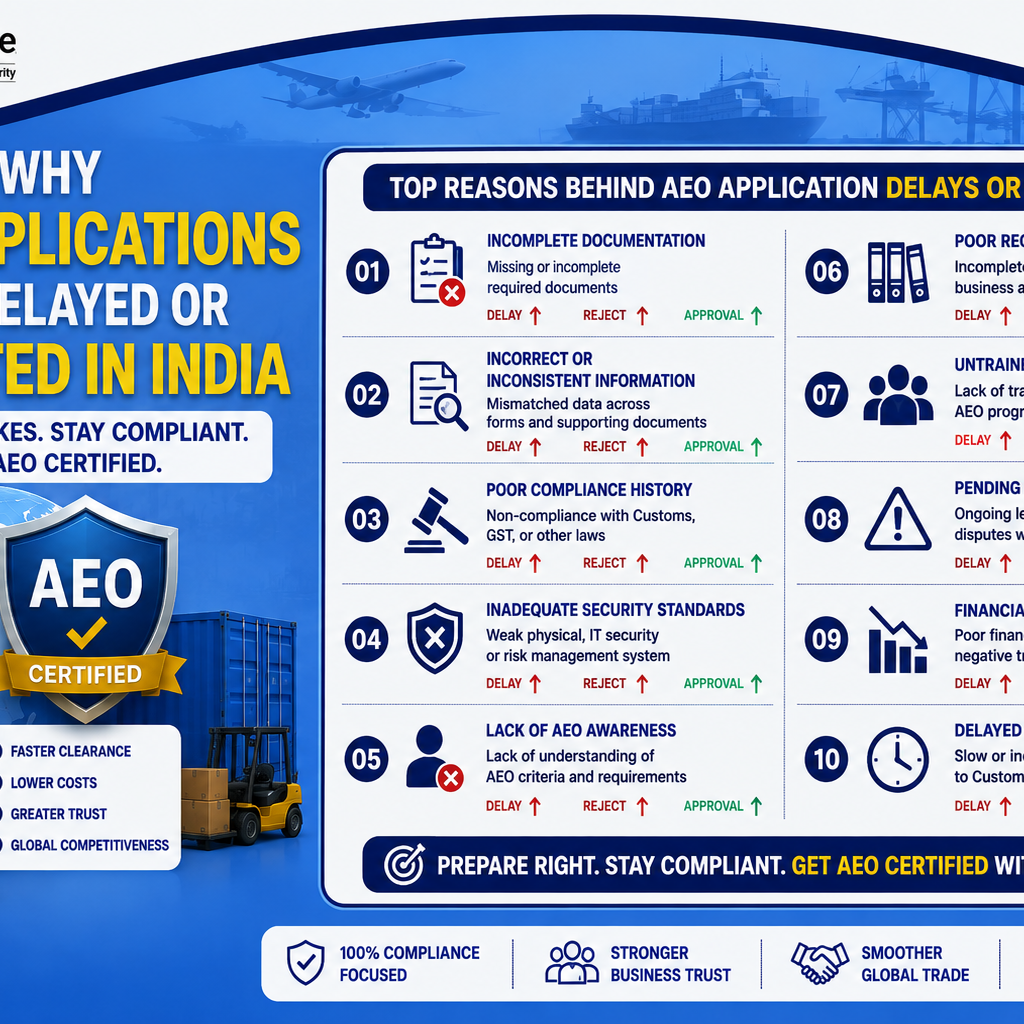
In today’s fast-paced global business environment, Authorized Economic Operator (AEO) certification has become an important trust mark for Indian businesses. It improves customs efficiency, enhances supply chain security and enhances global recognition. However, the path to AEO certification under the World Customs Organization (WCO) SAFE Framework and India’s Central Board of Indirect Taxes and Customs (CBIC) is not easy. This requires extensive documentation, risk assessment and coordination with customs authorities. That’s why many companies now rely on professional AEO consulting to save time, ensure accuracy, and minimize compliance risks. Understanding the AEO Certification Program The AEO programme, governed by CBIC Circular No. 33/2016-Customs (as amended by Circular 03/2018), recognizes businesses as safe and compliant trade partners. In India, four categories of certification are available: AEO-T1: Basic facilitation for importers/exporters. AEO-T2: Enhanced facilitation, deferred duty payment, and audit privileges. AEO-T3: Highest facilitation level for consistent compliance history. AEO-LO: For logistics operators (freight forwarders, custodians, CHAs, carriers, etc.). Validity (as per CBIC guidelines) AEO-T1/T2: 3 years AEO-T3/LO: 5 years Common Business Challenges While the AEO program is voluntary, it demands a high degree of preparedness. Companies often face: Missing or incomplete documentation (Annexures A/B/C). Difficulty in answering the Self-Assessment Questionnaire (SAQ). Gaps in internal SOPs for security, HR, and IT systems. Delays in customs queries or site audit readiness. These factors can lead to delayed approvals or rejection, extending the process far beyond the usual 3–6 month average timeframe (varies by case and customs zone). How Professional AEO Consulting Helps 1. Regulatory Expertise Professional advisors stay updated on CBIC circulars, Customs notifications and AEO portal guidelines. They ensure that your application conforms to every technical and documentation requirement – ​​avoiding costly errors. 2. Faster Documentation Consultants use verified templates and checklists for: Annexures A/B/C SOPs for cargo security, HR, and IT Self-Assessment Questionnaires This saves weeks of internal work and speeds up submission. 3. Mock Audit and Risk Assessment Before the official customs audit, AEO consultants perform an internal readiness review, checking: Access control and CCTV in warehouses Seal verification process Background verification of employees IT & data backup procedures This ensures that by the time CBIC officers visit, all potential non-compliances are already resolved. 4. Reduced Risk of Rejection CBIC rejects or queries many applications due to incomplete evidence or mismatched SOPs. Consultants verify that every SAQ answer is supported by physical proof, drastically reducing follow-ups and delays. 5. Liaison and Clarification Handling Consultants act as your communication bridge with customs authorities. They track file movement, respond to queries, and ensure compliance with timelines—so your team focuses on operations, not bureaucracy. 6. Sustainability and Renewal Support AEO validity lasts several years, but ongoing compliance is essential. Consultants help maintain certification through: Annual reviews Employee training SOP updates per new CBIC circulars (e.g., MSME AEO Package – Circular 54/2020) Example: Real-World Impact A logistics company in Mumbai applied for AEO-LO independently. The process stalled due to gaps in warehouse security and HR checks. After engaging a professional consultant, they implemented all CBIC-recommended controls, cleared their site audit, and obtained AEO-LO status within three months. Result: Faster customs clearance and lower inspection frequency, verified under CBIC’s facilitation program. Benefits of Hiring a Professional AEO Consultant Benefit Verified Outcome Faster Certification Prepared documentation & expert filing reduce turnaround time Reduced Risk Fewer customs objections or audit failures Cost Efficiency Avoids multiple re-submissions or inspection delays Continuous Support Post-certification monitoring and renewals Stronger Reputation Recognized by customs & international partners Why ELT Corporate At ELT Corporate, our compliance experts, lawyers, and auditors provide end-to-end AEO consulting services. We assist in: Eligibility evaluation & readiness audits Document drafting & submission Annexure A/B/C completion Mock audit and customs coordination Renewal & compliance maintenance With proven expertise in trade compliance, BIS, and ISO 28000, we help businesses achieve AEO Certification faster, smoother, and risk-free. Conclusion AEO certification offers huge benefits – faster withdrawals, cost savings, and international recognition – but only if your documents and systems are flawless. Hiring a professional AEO consultant saves valuable time, prevents rejections, and ensures that your business confidently meets each CBIC standard.

AEO T3 Explained
Blog

All About AEO T3 Certificate | Step-by-Step Registration Process

In international trade, certificates increase credibility, reduce compliance costs, and improve the ease of doing business. Of these, the Authorized Economic Operator (AEO) Certification is one of the most reputable, introduced by the World Customs Organisation (WCO) under a safe structure of standards and is implemented in India by CBIC.  The highest level under this scheme is the AEO-T3 certificate, provided to businesses with a strong record of compliance, safety and business facility. Let us understand what AEO T3 is, its benefits, eligibility and registration process What is AEO T3 Certification? AEO T3 is the top-tier certification under the AEO program. It is granted only to those importers/exporters who have maintained excellent compliance and security standards over a period of time. T3 provides the maximum trade facilitation benefits both in India and globally through Mutual Recognition Arrangements (MRAs). Also read: AEO Certificate for Exporters Eligibility Criteria for AEO T3 To qualify for AEO-T3, businesses must meet the following conditions: Must already be an AEO-T2 holder. Have at least 2 years of clean compliance record under AEO-T2. No major violation of Customs, GST, FEMA, or allied laws. Maintain robust internal control, security systems, and trade processes. Willingness to undergo regular audits and inspections. Key Benefits of AEO T3 Certification AEO T3 provides the widest range of benefits, not available to lower levels: Direct Port Delivery (Imports) – Clearance within 48 hours, reducing costs by ₹10K–20K per container. Direct Port Entry (Exports) – Cargo is directly sent to port terminals, avoiding CFS costs. Deferred Duty Payment – “Clear First, Pay Later” with consolidated monthly duty payment. 100% Bank Guarantee Waiver – Under Advance Authorisation & EPCG schemes. Faster Refunds & Incentives – Duty drawback within 72 hours, IGST refunds within 45 days. Self-Sealing with RFID E-Seals – Accepted globally under MRAs. Priority Clearance at Customs – Reduced inspection and faster movement. No Merchant Overtime Fee (MOT) – Customs clearance is free beyond office hours. Priority in Investigations/Disputes – Resolution within 6–9 months. International Recognition – Faster processing at foreign ports through MRAs. Post-Clearance Audit (PCA) – Only once every 3 years instead of frequent checks. Step-by-Step Registration Process for AEO T3 Step 1: Prerequisites Hold a valid AEO-T2 certificate. Ensure compliance records are clean for the past 2 years. Collect required documents (financial records, security procedures, compliance audit reports, etc.). Step 2: Online Application Visit the AEO Web Portal (CBIC). Log in with existing credentials used for AEO-T2. Fill in the Form AEO-T3 application. Step 3: Upload Documents Proof of AEO-T2 certificate. Compliance records (GST, Customs, FEMA). Security manuals & SOPs. Financial solvency documents (CA-certified). Step 4: Submission & Acknowledgement Submit the online application. Receive acknowledgement from Customs authorities. Step 5: Review & Audit CBIC conducts a detailed verification of compliance records. On-site visits and trade security checks may be carried out. Step 6: Approval & Grant of AEO T3 If found eligible, CBIC issues the AEO-T3 certificate. Valid for 5 years (subject to periodic review). Similarities Between AEO T2 & T3 Both provide: Faster customs clearance Deferred duty payment RFID self-sealing benefits Trade facilitation at ports But AEO-T3 goes further with a 100% BG waiver, global recognition, and the highest customs priority. Key Differences – AEO T2 vs AEO T3 Aspect AEO T2 AEO T3 Eligibility Fresh applicants can apply Must be AEO-T2 for 2 years Bank Guarantee 75% waiver 100% waiver Validity 5 years 5 years Global Recognition Limited Full recognition under MRAs Priority in Customs Medium Highest Conclusion The AEO T3 certificate represents the highest trust level that a business can receive in India’s customs structure. It ensures maximum trade facility, rapid approval, financial savings and global reliability through MRAs.  For businesses with a strong export-future profile, upgrading from AEO T2 to T3 provides a competitive edge in global trade. FAQ Q1. Who can apply for AEO T3? Only businesses already holding AEO-T2 status for at least 2 years with clean compliance records. Q2. What is the validity of AEO T3? AEO T3 is valid for 5 years. Q3. Is AEO T3 recognised globally? Yes. Through Mutual Recognition Arrangements (MRAs) with foreign customs authorities. Q4. How long does it take to get AEO T3? Generally, 3–6 months, depending on verification and audit clearance. Q5. What is the biggest financial benefit of AEO T3? 100% Bank Guarantee waiver under the Advance Authorisation and EPCG schemes, along with reduced clearance costs.

AEO (Authorized Economic Operator) vs Star Export House Certification – Detailed Comparison of Benefits
Blog

AEO (Authorized Economic Operator) vs Star Export House Certification – Detailed Comparison of Benefits

In international trade, certifications play a key role in reducing compliance costs, improving ease of business, and gaining government benefits. Two of the most recognised certifications available to Indian importers and exporters are: Authorised Economic Operator (AEO) Certification – introduced by the World Customs Organisation (WCO) under the SAFE Framework of Standards. Star Export House (Status Holder) Certification – introduced by the Government of India to boost exports. Though both schemes aim to enhance trade efficiency, their scope, eligibility, and benefits differ significantly. Let’s dive deeper into each. Authorised Economic Operator (AEO) Certification AEO certification is a global initiative that establishes an importer/exporter/logistics provider as a “secure and reliable trading partner.” It has three tiers for importers/exporters (T1, T2, and T3) and a single-tier AEO-LO for logistics operators. Application: Online via AEO Portal. Objective: Trade facilitation, customs simplification, global credibility, and faster clearances. Key Benefits of AEO (Not Available to Star Export House Holders) Direct Port Delivery (DPD) – Imports Clearance within 48 hours vs. 7–9 days in CFS model. Saves ₹10K–20K per container in handling, rent, and detention costs. Direct Port Entry (DPE) – Exports Factory-stuffed cargo moves directly to terminals. 70%–100% reduction in CFS costs. No Merchant Overtime Fees (MOT) AEO exporters don’t pay overtime charges for customs clearance beyond office hours. Email & SMS Alerts Real-time updates on consignment movement. Self-Sealing with RFID E-Seals (T2 and above) Reduced cost and global acceptance under MRAs. Deferred Duty Payment (T2 & T3) Clear First, Pay Later” facility with consolidated duty accounts. Faster Refunds & Incentives Duty Drawback within 72 hours of EGM. IGST refunds within 45 days. Priority in Investigations & Dispute Resolution Time-bound resolution (6–9 months). Post Clearance Audit (PCA) Simplified once in 3 years instead of transactional checks. Preferential Treatment & Trade Facilitation  MRAs with foreign customs reduce inspections and speed up global trade. Star Export House (Status Holder) Certification This certification is performance-based and awarded to exporters achieving a certain FOB/FOR value of exports: One Star – $3 million Two Star – $25 million Three Star – $100 million Four Star – $500 million Five Star – $2000 million Key Benefits of Star Export House (Not Available to AEO Holders) Bank Guarantee Exemption 100% exemption under the Advance/EPCG Scheme. (Whereas AEO T1: 50%, AEO T2: 75%, AEO T3: 100%). Establishment of Export Warehouse 2 Star and above holders can set up warehouses for exports. Export of Free-of-Cost Samples Entitlement to export samples within prescribed annual limits for promotion. Trade Promotion Opportunities Priority in participating in international trade fairs and buyer–seller meets organised by the government. Similarities Between AEO & Star Export House Both schemes: Provide recognition and credibility to exporters in the global market. Enhance ease of doing business through faster clearances and reduced compliance costs. Aim to improve India’s trade competitiveness. Key Differences – AEO vs Star Export House Aspect AEO Certification Star Export House Certification Basis Security & compliance-based Export performance-based Applicability Importers, Exporters, Logistics providers Only Exporters Global Recognition Yes (through MRAs) No (only India-specific) Customs Facilitation Priority clearance, DPD, DPE, deferred duty Not available Financial Benefits Duty deferment, MOT waiver, reduced CFS costs BG exemption, warehouse eligibility, free samples Eligibility Compliance check by Customs Minimum export turnover Conclusion  AEO Certification is more beneficial for import-heavy businesses as it provides duty deferment, customs priority, and international recognition under MRAs. Star Export House Certification is more suitable for export-oriented companies as it offers BG exemption, warehouse establishment, and free sample export facility. Since both certifications are not mutually exclusive, companies can apply for both to maximize their advantages. This dual certification ensures: Reduced costs Faster clearances Greater international credibility Competitive advantage in the global market FAQ Can a company hold both AEO and Star Export House certifications? Yes. Both certifications are independent and not mutually exclusive. Many businesses hold both to maximise benefits. Which certification is easier to obtain? Star Export House is performance-based and depends on export turnover. AEO requires strict compliance with customs/security checks but offers broader global recognition. Is the Star Export House certification recognised globally? No. It is specific to India and issued by DGFT. AEO, on the other hand, has international recognition through MRAs. What is the validity period of these certifications? AEO: Valid for 3 years (T1) / 5 years (T2, T3, and LO). Star Export House: Valid for the Foreign Trade Policy (FTP) period (generally 5 years). Can service exporters apply for Star Export House certification? Yes. Service exporters achieving the prescribed FOB/FOR value of exports are also eligible. What is the main financial benefit of Star Export House certification? 100% Bank Guarantee exemption under the Advance Authorisation and EPCG schemes.

Maintain the AEO Status to Avoid Cancellation
Blog

How to Maintain the AEO Status to Avoid Cancellation – Complete Guide

Authorized Economic Operator (AEO) is an international mark of certification and quality, indicating that a business complies with customs laws and follows global best practices in safe supply chains. In India, the AEO program is maintained by the Central Board of Indirect Taxes and Customs (CBIC) and is classified into levels AEO-T1, AEO-T2, AEO-T3, and AEO-Lo.  When obtaining AEO certification, rapid cargo clearance, low customs check, and high international acceptance, and high international acceptance, maintaining and renewing certification is equally important. Without proper compliance and timely renewal, your AEO position can be canceled, causing loss of profit.  This guide explains how to maintain your AEO position, and you should follow the steps to avoid cancellation. Why Maintaining AEO Status is Important? Continuous Enjoyment of Benefits – Ended or cancelled certificates means rapid approval, deferred duty payment and global recognition loss of AEO benefits. Compliance Requirement –Regular adherence to customs security standards ensures that your company remains reliable in international supply chains. Avoid Fresh Application – If the certificate lapses, you may need to re-apply from scratch, which takes time and it requires fresh investigation. Validity of AEO Certificates According to CBIC: AEO Tier Initial Validity Renewal Validity AEO-T1 3 years 3 years AEO-T2 3 years 5 years AEO-T3 5 years 5 years AEO-LO 5 years 5 years Renewal Timeline: AEO-T1 – Apply at least 30 days before expiry AEO-T2 – Apply at least 60 days before expiry AEO-T3 & AEO-LO – Apply at least 90 days before expiry Key Compliance Requirements to Maintain AEO Status Once given, the AEO Certificate holders have to inform the CBIC’s AEO program team within 14 days of any significant change, such as: Change in legal entity or ownership Change in business name or address Change in the nature of business Change in customs compliance officer Change in accounting/IT systems Change in international supply chain partners Any errors in customs-related records (CRM, logistics documents, etc.) must be corrected immediately and reported. Note: AEO status will not be affected if errors are: Reported honestly, Examined by the company, and Remedial actions are taken to prevent recurrence. Renewal Process for AEO Certificates Step 1: Prepare Before Expiry Start renewal at least 60 days before expiry Reassess your compliance with AEO standards Collect financial, operational, and customs-related records Step 2: Document Preparation Common renewal documents include: Covering letter for renewal Revalidation application form Updated GST returns & financial statements (last 3 years) Import/export transaction data Updated SOPs and security procedures Corrective action reports (if any) Self-declaration of continued compliance Additional (for AEO-T2 & T3): Internal/external audit reports Risk assessment reports Physical and IT security compliance status Employee training & background checks Business continuity plans Step 3: Filing the Application Submit renewal application to the AEO Programme Manager (Customs Commissionerate) Accepted formats: Email (PDF), online portal (if enabled), or physical filing Step 4: Scrutiny and Clarifications The AEO Cell may request clarifications or additional documentation AEO-T2 & T3 may require a site re-inspection Step 5: Approval and Issuance If compliant, CBIC will issue a renewed certificate The updated certificate will carry extended validity as per the tier Periodic Review of AEO Status The AEO Programme Team conducts periodic reviews to ensure compliance: AEO-T1 – Every 2 years AEO-T2 – Every 3 years AEO-T3 – Every 5 years AEO-LO – Every 5 years Failure to comply during review may lead to suspension of AEO benefits. What Happens If Renewal is Missed? Certificate expires automatically All AEO benefits (faster clearance, reduced checks, etc.) are suspended Organisation must apply as a fresh applicant Customs may impose additional scrutiny or penalties Common Mistakes to Avoid Common mistakes consist of delaying renewal till the ultimate week, filing incomplete files, now not informing CBIC of primary business adjustments, skipping internal audit reviews, and being unprepared for revalidation audits (specifically for AEO-T2 and T3). Such mistakes can lead to delays, extra scrutiny, or maybe cancellation of your AEO status. Tips for Smooth Renewal Maintain a centralised AEO compliance file Use a compliance calendar to track expiry and audits Conduct annual internal audits against AEO criteria Assign a dedicated compliance officer or consultant Attend CBIC awareness programs to stay updated Conclusion Maintaining and renewing your AEO certification isn’t always just a compliance formality—it’s a strategic necessity to preserve your enterprise reputation in global supply chains. By staying proactive, making ready files earlier, and following CBIC hints, you may avoid cancellation and keep enjoying the benefits of quicker, secure, and trusted global trade. FAQ Q1. When should you apply for an AEO certificate renewal? At least 30 days before expiry, however, begin getting ready 60 days in advance. Q2. What if you miss the renewal deadline? Your certificate will lapse, blessings will stop, and you need to reapply as a brand-new applicant. Q3. Do you need to submit all documents again? Yes, however, you could replace previously submitted files. Only revised or new compliance information should be highlighted.

AEO Certification in India
Blog

Documents Required for AEO Certification in India

Authorised Economic Operator (AEO) Certification is a reliable merchant program under the World Customs Organisation (WCO) safe structure implemented by the Indian Customs. It recognises businesses as reliable and safe participants in the international supply chain, providing benefits such as rapid customs withdrawal, low inspection, priority processing and international reliability. In India, there are four categories of AEO Certification: AEO-T1, AEO-T2, AEO-T3 → For Importers & Exporters AEO-LO → For Logistics Providers While the AEO T1 application can be filed online through the AEO portal, the application for T2, T3 and Lo needs to be presented manually at the Customs Office. This article explains a complete list of documents required for AEO certification in India, including special provisions for MSMEs. Read More: AEO Certificate for Importers Types of Documents Required Common Document Set (mandatory for all applicants) Application Form / Annexures (tier-specific) Additional Supporting Documents (process, security, solvency) A) Common Document Set Every applicant must prepare the following documents to support the AEO application: IEC Certificate GST Registration Certificate MSME Certificate (if applicable) Certificate of Incorporation / Partnership Deed / LLP Agreement PAN Card Copy of the company Audited Balance Sheets, Profit & Loss Accounts, and Income Tax Returns for the last 3 financial years Declaration on Company Letterhead, confirming solvency, compliance with Customs laws, and that the company has not been prosecuted under Customs/Excise/Service Tax/GST Acts List of Import Items with HSN codes and country of origin List of Export Items with HSN codes and country of export B) Application Forms / Annexures Depending on the AEO Tier, different annexures are required: AEO-T1 → Annexure 1 & Annexure 2 AEO-T2, AEO-T3, AEO-LO → Annexures A to E5 AEO-T3 Only → Annexure F (additional) AEO-T1 (MSME) → MSME Annexure 1 & MSME Annexure 2 (simplified set) AEO-T2 (MSME) → MSME Annexures 1, 2 & 3 (simplified set) C) Additional Supporting Documents Apart from the forms and common documents, applicants must also provide: Import–Export Process Map of goods movement Site Plan of the registered office, branches, warehouse, and manufacturing units, including security features like CCTV, restricted entry/exit, storage areas, and fire exits Solvency Certificate issued by a scheduled bank, along with an undertaking & declaration Safety & Security SOPs covering: Cargo handling & storage Warehouse & physical security IT / Data security controls HR policies (employee background checks, visitor controls, etc.) Tier-wise Document Requirements Tier Application Form / Annexures Common Documents Additional Documents MSME Relaxation AEO-T1 Annexure 1 & Annexure 2 IEC, GST, MSME (if any), Incorporation, PAN, 3 yrs audited financials, Declaration, Import/Export HSN lists Import–Export Process Map, Site Plan, Solvency Certificate with Undertaking & Declaration MSME Annexure 1 & 2 with reduced documents AEO-T2 Annexures A to E5 Same as above Import–Export Process Map, Site Plan, Solvency Certificate, Detailed Safety & Security SOPs MSME Annexures 1, 2 & 3 with reduced documents AEO-T3 Annexures A to E5 + Annexure F Same as above Import–Export Process Map, Advanced Safety & Security SOPs, Compliance Docs, Solvency Certificate Not Applicable AEO-LO (Logistics Operators) Annexures A to E5 Same as above Logistics Process Flow Map, Warehouse/Security Layout, Solvency Certificate Not Applicable Reduced Documentation for MSMEs To encourage small businesses under the Aatma Nirbhar Bharat Yojana, the Indian Customs has introduced simplified documentation for MSMEs applying for AEO T1 & T2. Tier Normal Applicant MSME Applicant AEO-T1 Annexure 1 & 2 + Full Document Set MSME Annexure 1 & 2 + Reduced Docs AEO-T2 Annexures A–E5 + Full Document Set MSME Annexures 1, 2 & 3 + Reduced Docs AEO-T3 Annexures A–E5 + Annexure F + Full Set Not Applicable AEO-LO    Annexures A–E5 + Full Set Not Applicable Why Proper Documentation Matters Ensures faster processing of the AEO application Demonstrates financial stability and compliance Minimises risk of rejection or delays Builds trust with Customs and international trade partners Conclusion Authorised Economic Operator (AEO) certification strengthens India’s trade ecosystem by identifying safe and compliant businesses. Documentary requirements, although detailed, ensure that only reliable institutions are certified. For MSMEs, low documentation routes make certification more accessible and obtainable. With correct preparation – Audit Financial, Solvency Certificate, SOP and Safety Documents – Business AEOs can secure the situation and enjoy rapid, safe and smooth global business.

Renewal Procedure for the AEO Certification
Blog

Renewal Procedure for the AEO Certification

Authorised Economic Operator (AEO) certification is an international mark of quality indicating that a business organisation meets customs law and best practice in a secure supply chain. The AEO programme in India is managed by the Central Board of Indirect Taxes and Customs (CBIC) and is divided into three tiers: AEO-T1, AEO-T2, and AEO-T3. While obtaining AEO certification is advantageous in various ways—faster clearance, reduced checks, and international acceptability—its renewal helps sustain these benefits. We take you through the AEO certification renewal process, from timing and paperwork to factors and suggestions for a hassle-free revalidation.  Why is AEO Certification Renewal Necessary? AEO certificates are temporary and, once this time is up, companies have to reapply for renewal so that they can remain certified. It is also obligatory because: Interfered benefits: Failing certificates lead to the withdrawal of the AEO benefits. Ongoing international worthiness: Renewal will mean that your company continues to be compliant and deserving of trust across global supply chains. Re-submission avoidance: Expiration of certification might entail re-submission of the entire AEO application process. Validity Period of AEO Certificates As per CBIC guidelines: AEO Tier Initial Validity Renewal Validity AEO-T1 3 years 3 years AEO-T2 3 years 5 years AEO-T3 5 years 5 years The renewal application should be submitted at least 30 days before expiry. AEO Certificate Renewal Documents Here is the list of documents that you require for the renewal process The documents are slightly different for the AEO Tier, but are mainly: Common Documents for AEO-T1, T2 & T3: Covering Letter for renewal Completed Revalidation Application Form Self-declaration of continued compliance with the original AEO criteria Information about any major change in operations, structure, or ownership Current record of import/export transactions in the past 3–5 years Most recent SOPs and internal audit reports Corrective Action Reports, if any, are released following the initial certification Evidence of updated or ongoing safety/security procedures Most recent GST returns Last 3 years’ financial statements In the case of AEO-T2 and AEO-T3: Internal/external auditor site visit reports Most recent risk assessment procedures Physical security and IT security compliance status Employee training and background check records Business Continuity Plans Step-by-Step AEO Certification Renewal Process Step 1: Preparation Before Expiry Initiate the renewal process 60 days before expiry. Verify the expiry date stated on your existing AEO certificate. Mark internally your compliance status against your original application. Step 2: Prepare the Amended Documents Mise en page and complete all the above documents. Enter correct information regarding import/export, GST, and other compliance parameters. Record any business address change, ownership, or organisational structure. Step 3: File the Revalidation Application The revalidation application should be filed with the AEO Programme Manager (Customs Commissionerate) by: Email (PDF copy of documents) Or online portal (if provided) Physical filing is permissible in some zones as well Upload all supporting documents in a well-organised zip folder or file with explanatory filenames. Step 4: Acknowledgement and Scrutiny The revalidation application will be received by the AEO Cell. They can seek additional clarification, documentation, or an actual visit (AEO-T2 and T3). Step 5: Compliance Verification / Site Visit (as applicable) CBIC may carry out a re-audit on-site for AEO-T2 and T3 You will need to make the customs authorities provide: Site access records Clarification on changes made in SOPs Documentation of IT compliance and security Step 6: Renewal Approval / Extended Validity Grant On successful re-assessment, CBIC issues the updated AEO certificate with extended validity. The certificate is issued online or on paper, as the case may be. The updated certificate has: New validity period Retention of AEO status (same Tier) Important Things to Remember Checklist ItemStatus Submit at least 30 days before expiry Verify no significant pending compliance Readiness for T2 and T3 re-audit Uniformity in document format Note down any internal or external changes What If an AEO Certificate Would Automatically Expire Because It Was Not Renewed? If renewal isn’t submitted or a late submission: The certificate is cancelled. AEO benefits are suspended from the date. The organisation must reapply for AEO certification from the ground again. Re-evaluation or a fine in certain situations may be imposed. Avoid These Common Errors Waiting until the last week for the application filing Inadequate documents Failure to report to CBIC in case of a change in business ownership, address, or compliance model Inadequately prepared internal audit reports Poor preparation for the revalidation visit AEO Renewal Tips for a Smooth Process Keep a centralised AEO-related compliance file. Keep a compliance calendar with reminders of AEO expiry, audit, and filing. Conduct internal audit checklists annually, at least to personally go through your AEO compliance. Keep one compliance officer or consultant to conduct renewals. Take AEO awareness seminars or programs conducted by CBIC to keep abreast. How ELT Corporate Can Help ELT Corporate is a compliance advisory and documentation service specialist for AEO certification levels compliance. Our experts provide: Revalidation document preparation support CBIC query answering support Proxy services for physical checks or re-inspection Risk mitigation guidance for seamless AEO continuity Make it less inconvenient for you to renew, so that you can concentrate on building your foreign trade base. Conclusion Revalidating your AEO certification is not a compliance activity itself—it’s a tactical step to maintain your competitive edge in international trade. An on-schedule, well-executed revalidation keeps you experiencing AEO advantages and places your organisation on the list of secure, efficient, and reliable trading partners in international supply chains. Familiarity with the AEO revalidation process and proactiveness will have you keep your certifications—and your business image. FAQ Q1. When should you apply for an AEO certificate renewal? You must apply not less than 30 days in advance of the expiry, but preparation must begin 60 days prior in order to provide ample time for documentation and scrutiny. Q2. What if you miss the AEO renewal due date? If you do not submit before the expiration date, you will forfeit all such benefits, including quicker clearance and reduced inspections, and will have to resubmit as a

Blog

Understanding the Difference Between AEO T1, T2, and T3 Certifications

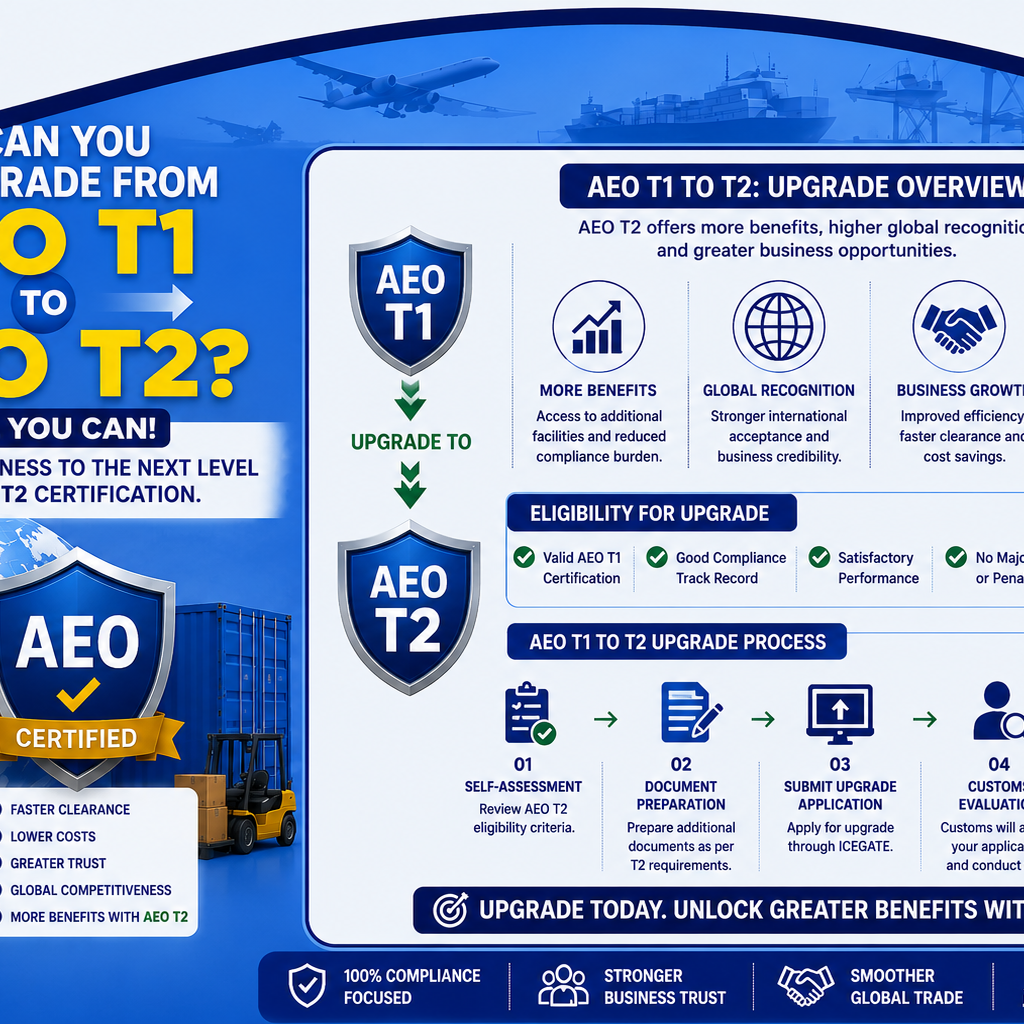
In the fast-paced world of international trade in the current era, businesses seek faster, smoother movement of goods across borders. Governments need to facilitate this process while maintaining safety, compliance, and legality. The Authorised Economic Operator (AEO) Certification does just that by recognizing businesses operating safe, compliant, and streamlined supply chain practices. In India, the AEO scheme is regulated by the CBIC (Central Board of Indirect Taxes and Customs) and has a purpose to deliver fast customs clearance, less inspection, and global acceptance for approved companies. What is AEO Certification? AEO (Authorised Economic Operator) is an international accreditation that shows your business: Complies with customs and tax laws Maintains a secure supply chain Has a strong track record of reliability and efficiency With an AEO certificate, your company enjoys: Quicker customs clearance Reduced inspections and documentation requirements Priority treatment at ports Greater credibility with trade partners Types of AEO Certification in India The AEO program in India has three levels of certification: AEO T1 – Entry Level Who can apply? Importers and exporters beginning their compliance journey Businesses with no major customs offences in the past 3 years Requirements: Import-Export Code (IEC), GST certificate, and financial records Clean compliance history with no fraud or penalties Benefits: Faster customs clearance Fewer documents required Lower security deposit/guarantee AEO T2 – Intermediate Level Who can apply? Businesses with strong internal systems and security processes Can apply directly without holding T1 Requirements: Robust security procedures at warehouses/offices Internal audits and compliance systems Audited accounts and clean customs record for at least 3 years Benefits: Faster clearances than T1 Much lower chance of inspections Better coordination with customs authorities Enhanced business reputation AEO T3 – Highest Level Who can apply? Only companies already holding AEO T2 (for at least 2 years) Large businesses with excellent compliance history Requirements: Advanced electronic & physical security systems Regular internal audits and compliance reviews No major violations in the last 5 years Strong financial health Benefits: Maximum customs facilitation with almost no delays Special privileges like deferred duty payments Dedicated customs officer for support International recognition under mutual agreements with other countries Comparison Table: AEO T1 vs T2 vs T3 Feature / Level AEO T1 (Entry) AEO T2 (Intermediate) AEO T3 (Highest) Eligibility Import/export firms, basic compliance Strong systems & security, direct application possible Must hold T2 for 2+ years Customs Record Clean for last 3 years Clean for last 3 years Clean for last 5 years Requirements Basic docs (IEC, GST, finance) Audited accounts, security checks Advanced systems, audits, strong financials Benefits Faster clearance, fewer docs Quicker clearance, fewer inspections, better reputation Priority treatment, duty deferment, global recognition Validity 3 years 3 years 5 years Which AEO Certificate Should You Choose? Start-ups & new exporters/importers → Begin with AEO T1 Growing, established businesses → Apply for AEO T2 for greater facilitation Large enterprises with global operations → Target AEO T3 for maximum benefits and international recognition FAQs on AEO Certification What is the main benefit of AEO certification? Faster customs clearance, reduced inspections, and enhanced global credibility. Is AEO mandatory for import-export companies? No. It is voluntary but highly recommended to gain a competitive edge. Can I apply directly for AEO T2 or T3? T2: Yes, you can apply directly. T3: Only after holding AEO T2 for at least 2 years with consistent compliance. How long does the process take? On average, 3–6 months depending on document submission and CBIC review. What is the validity of the certificates? AEO T1 → 3 years AEO T2 & T3 → 5 years (renewable upon compliance review) Conclusion AEO certification is not merely a tick-in-the-box compliance label; it enhances trust, credibility, and expedited trade facilitation. You may begin with T1, move to T2, or aspire to T3; AEO certification makes your supply chain robust and your business a trusted global trade partner. Should you be seeking AEO certification in India, our professionals at Elt Corporate can assist you with eligibility screening, documentation, and submission of your applications.  

AEO Certificate for Supply Chain Security in India
Blog

Enhancing Supply Chain Security through AEO

As the world speeds up today, international trade is a large aspect of how companies grow. However, such expansion is not without risk—goods are stolen, needed documents are produced, and illegal items are transported. So, how do businesses ensure that their products are transported safely from the manufacturer to the buyer? That’s where the AEO Certificate fits in. It makes businesses “trusted traders” to Customs and other authorities. Let’s understand. What is an AEO Certificate (Authorized Economic Operator)? AEO is short for Authorised Economic Operator. It’s a special certificate issued by the Indian Customs (CBIC) to businesses that comply with rules, maintain good internal processes, and are concerned with the security of their goods and workers. It is a part of a global system designed by the World Customs Organisation (WCO) to enable smoother and more secure trade across the globe. Types of AEO Certificates in India (T1, T2, T3, LO) AEO-T1: Foundational level for importers/exporters AEO-T2: Advanced level with visits to sites and additional checks AEO-T3: Highest-level, trusted firms AEO-LO: For logistics providers (such as transporters, warehouse operators, port handlers) How AEO Certificate Improves Supply Chain Security Supply chain is the entire process of a product, from the factory to the purchaser. It comprises transport, warehousing, customs inspections, etc. If only one step is compromised, it may result in: Stolen or adulterated goods Counterfeit or illegal merchandise is finding its way in Delays in delivery Loss of customer confidence That’s why keeping this chain secure and strong is extremely essential. How AEO Helps Keep Your Supply Chain Safe When a business becomes AEO certified, it’s known as a trustworthy and secure partner to trade with around the world. Here’s why AEO makes an impact: 1. Customs Business Check Customs verifies the following before awarding the AEO certificate: Your financial credibility Your history with Customs (whether you abide by rules) Security on your premises (such as cameras, ID checks) Data security measures (computer security) If your employees are trained and trustworthy Only serious and compliant businesses clear this check. 2. Secured Warehouses & Access Control AEO-certified businesses are required to: Secure storage points with CCTV and restricted access Make use of sealed containers and tamper-proof packaging Have records of who came in and when This minimizes the likelihood of smuggling or stealing. 3.  Improved Data & Document Control AEO businesses utilize computerised systems to: Prevent fraud or modifications to shipping documents Monitor commodities at each point Maintain accurate documentation They frequently utilise ERP software to manage trade and customs information securely. 4. Trained and Reliable Personnel AEO-certified company staff are: Trained on customs regulations and security procedures Screened their background to determine whether they work on sensitive duties Instructed on how to react in emergencies This constructs an effective and responsive staff. 5. Accelerated Customs Clearance AEO firms are reputed, therefore: Their cargo is inspected less frequently They receive quicker clearances in ports and airports They incur less in storage or penalty fees Time-sensitive products (such as medicine) arrive speedily This is cost-saving and risk-reducing. Benefits to Business from an AEO Certificate Benefit: How it Assists Less Customs Inspection, quicker clearances, fewer delays Direct Port Delivery: Not having to relocate goods to the warehouse first Deferred Duty Payment Pay duties later → Improved cash flow Worldwide Recognition Trusted by other nations → Smooth exports Competitive Advantage Perceived as secure and professional → Increased business Dedicated Customs Support: Easier complaint fixing and swift assistance from authorities AEO and India’s Global Push India is strongly promoting the AEO program to make trade easier. The government (CBIC) has simplified the process and keeps updating rules to help businesses apply easily. India also has partnerships (MRAs) with countries like Japan and South Korea, and is working on more deals with the US, EU, etc. This means if you’re AEO certified in India, you’re treated as trustworthy in many other countries too. Example: How AEO Benefited a Pharma Exporter Suppose a firm exports vaccines, which are perishable if not stored cold. If they are kept waiting at Customs or if the handling is poor, they get spoiled. After obtaining AEO: Their products were cleared quickly Warehouses were more secure Employees were better trained Result? Less wastage, improved brand image, and long-term contracts from international buyers. How to Get AEO Certified? Here’s an easy step-by-step: 1. Check Eligibility You should have processed a minimum of 25 customs consignments during the past year. You need to be active in exports and imports. 2. Gather Documents AEO Application Form (T1, T2, T3, or LO) PAN, IEC, GST, shipping records Information about staff, site, security, finances, and IT systems 3. Submit the Form Online at the CBIC AEO portal Or hand it over to your Customs officer 4. Verification & Visit For T2/T3/LO: Customs will visit and scrutinise your premises and documents. 5. Obtain the Certificate If approved, AEO status is given for 3 years Can be renewed before expiry Renewal of AEO Certificate Status under the Authorized Economic Operator (AEO) program remains active for thirty-six months from the date of issuance. Firms wishing to retain associated advantages must file a renewal application prior to lapse. The procedure is streamlined and can be accomplished electronically through the CBIC AEO portal. Upload a self-declaration attesting to continual adherence to AEO requirements. Include revised security, financial, and personnel information where modifications have occurred. Customs may carry out targeted verifications on Tier-2, Tier-3, or Logistics Operator certificate holders. A prompt renewal averts disruption of benefits that include expedited clearance, enhanced international standing, and a lower incidence of inspections. Conclusion Getting an AEO certificate is not just about following the rules—it’s about showing the world that your business is secure, responsible, and ready for international growth. If you’re an exporter, importer, or logistics provider, AEO helps you: Avoid delays Gain customer trust Get international recognition In the world of delays, dangers, and growing regulations, today’s world, AEO is not a choice—it’s the intelligent path forward. FAQ How does AEO certification make supply

AEO Certification in India – Types, Benefits & Application Guide
Blog

What is AEO? Types of AEO Certification and Its Benefits

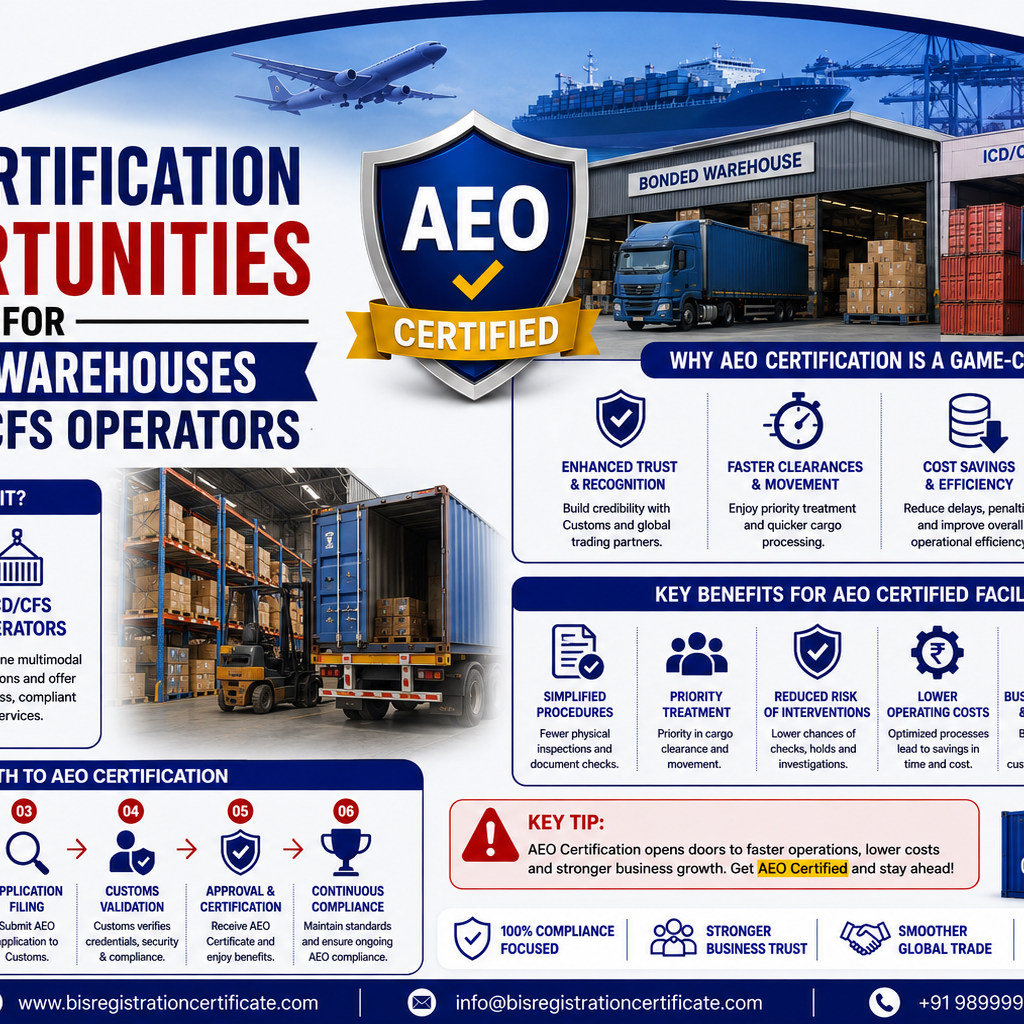
International trade in the contemporary world needs to be swift, protective, and follow all international compliance regulations. In order to assist with international trade, the community of nations established the Authorised Economic Operator (AEO) program. This program began within the World Customs Organisation (WCO) and is today implemented in India by the Central Board of Indirect Taxes and Customs (CBIC). The program’s main objectives focus on recognising businesses which ensure compliance with strict security and safety measures. This sharpens competition in the international and domestic environments, maximising returns for exporters, importers, and logistics service providers. What is AEO? AEO (Authorised Economic Operator) certificate. Think of it as a trust mark for businesses that operate cross-border trade—like importing, exporting, or trading in consignments. If your business follows the rules, keeps them secure, and is reliable, the government gives you this certificate. When you are certified AEO, your business is acknowledged by the customs authorities as reliable and safe. Therefore, they offer you special benefits like rapid clearing of goods, reduced checking, speedy documents, and high-priority port handling. This is how India promotes easier and more convenient foreign trade, through trusting and rewarding genuine firms. Legal Support and Framework  In India, AEO is being run by CBIC (Central Board of Indirect Taxes and Customs) on global parameters given by the World Customs Organisation (WCO). The programme legally started with a government notice by the title of Circular No. 33/2016-Customs, which depicted the persons who can apply, in what manner they should apply, and what they would get. India launched this program to enable import-export procedures in a smoother, faster, and transparent way, and make international trade equivalent overseas. It eliminates unnecessary paperwork and unnecessary delays at ports and customs. Who Can Apply? Any business organisation carrying out international trade and customs business can apply for AEO status. They are: Exporters Importers Logistics Providers Customs Brokers (CHAs) Warehouse Operators Freight Forwarders Terminal Operators The single requirement is that the applicant should have a clean history of compliance, good financial health, and quality record-keeping habits for the past 3 financial years. Types of AEO Certification in India India has three major levels of AEO certification with conditions of eligibility and benefits: 1. AEO-T1 (Tier 1) – Importers and Exporters Starting-level certification with straightforward documentation. Suitable for small and medium-sized importers or exporters. Online application process. Earliest processing time (usually 2–3 months). Advantages are reduced documentation, rapid clearance, and priority processing. 2. AEO-T2 (Tier 2) – Importers and Exporters For those who have greater quantities of trade and more sophisticated internal controls. Invites customs to an on-site inspection. More stringent examinations in respect of financial condition, compliance, and security needs. Offer additional advantage over T1, e.g., payment of duty in arrears, faster refunds, and direct port delivery (DPD). 3. AEO-T3 (Tier 3) – For Top-Tier Trusted Exporters/Importers For those companies that have had progressively enhanced compliance. Requires strong internal compliance and supply chain security. The highest level of trust and benefits to customs. Benefits include mutual recognition with other countries, prompt processing in all other countries across the globe, and discounting of bank guarantees. 4. AEO-LO (Logistics Operator) – For Other Stakeholders This category includes: Warehouse Operators Freight Forwarders Terminal/Customs Operators Customs Brokers Designed for end-to-end facilitation across the entire logistics chain. Benefits are fewer bank guarantees, exemption from the renewal process, and speedy client clearance. Advantages of the AEO Certification AEO certification provides many benefits compared to regular customs facilitation. It has a direct effect on the efficiency, credibility, and profitability of a firm involved in international trade.   1. Quick Customs Clearance Companies with an AEO certificate receive priority in customs processing. Quick clearance of goods at seaports, airports, and land borders. Less dwell time for cargo, saving demurrage and warehousing charges. 2. Lower Document and Physical Inspection Less documentation during the clearance stage. Minimum or no physical examination of cargo, especially in the case of AEO-T2 and AEO-T3 operators. 3. Delayed Duty Payments Certificate holders of AEO-T2 and T3 are relieved from paying customs duty at the time of delivery of cargo, which can enhance working capital and cash flow. 4. Direct Port Delivery (DPD) / Direct Port Entry (DPE) Enables importers and exporters to move merchandise directly from or to the port, with reduced handling time and cost. 5. Waiver of Bank Guarantees Relaxation or lowering of bank guarantees in certain customs procedures like warehousing, transhipment, and export promotion schemes. 6. Quicker Refunds and Drawbacks Early release of GST refunds, duty drawback, and other reimbursements due from customs. 7. Worldwide Recognition Mutual Recognition Arrangements (MRAs) with other countries like South Korea, UAE, and Japan make Indian AEOs properly recognised as good traders overseas as well. Ensures faster clearance at foreign borders, reduced checking, and better trade relations. 8. Building Brand Reputation and Credibility AEO status explicitly states that your company is dependable, secure, and compliant. Assists in gaining customers’ trust, making international alliances, and procuring new contracts. 9. Cost Savings Fewer delays, detention, warehousing fees, document preparation, and administrative expenses. Fewer penalties through better compliance mechanisms. 10. Dedicated Relationship Managers and Helpdesk CBIC offers priority assistance and grievance redressal to AEO organisations by subject matter expert nodal officers. Why Must You Apply for AEO? If your business entails import and export, obtaining an AEO certificate is more than following the rules—it’s a wise choice ahead of the curve. It saves you time, speeds up your shipments, and makes your company appear more trustworthy to business partners and customs officials alike. It is particularly valuable to companies shipping pharmaceuticals, electronics, medical equipment, auto components, or foodstuffs—where punctuality and security are absolutely of the essence. AEO status simplifies your trade and reduces the risk of losses or complications at customs. Conclusion In a world where customs procedures are being placed upon increasingly complex supply chains, the AEO scheme is an easy-to-navigate security and trade solution with equal ease. With the Indian Government’s focus on higher logistics efficiency, business ease, and global trade competitiveness,

Scroll to Top