Delhi is one of India’s most active e-commerce hubs. From Nehru Place electronics sellers to Karol Bagh fashion exporters, thousands of Delhi-based startups and SMEs import goods from China, the UAE, and Southeast Asia — or export products to markets across the world.
If your business regularly deals with customs clearance, you have almost certainly experienced the pain of delayed shipments, unexpected inspections, heavy demurrage charges, and unpredictable port timelines. AEO certification is one of the most effective tools introduced by the government to reduce these challenges. — but many Delhi startups do not know which tier to target: T1 or T2.
This guide answers that question directly. We compare AEO T1 and T2 across every dimension that matters for an e-commerce startup — eligibility, benefits, costs, timelines, and the specific scenarios where each tier makes sense. By the end, you will know exactly which certification to pursue and how to get started.
As of April 2026, 3,480 companies hold AEO-T1 status and 1,191 hold AEO-T2 in India. The gap tells its own story — T1 is accessible to most active importers and exporters, while T2 requires deeper compliance investment but delivers significantly higher rewards.
What Is AEO Certification and Why Does It Matter for E-commerce?
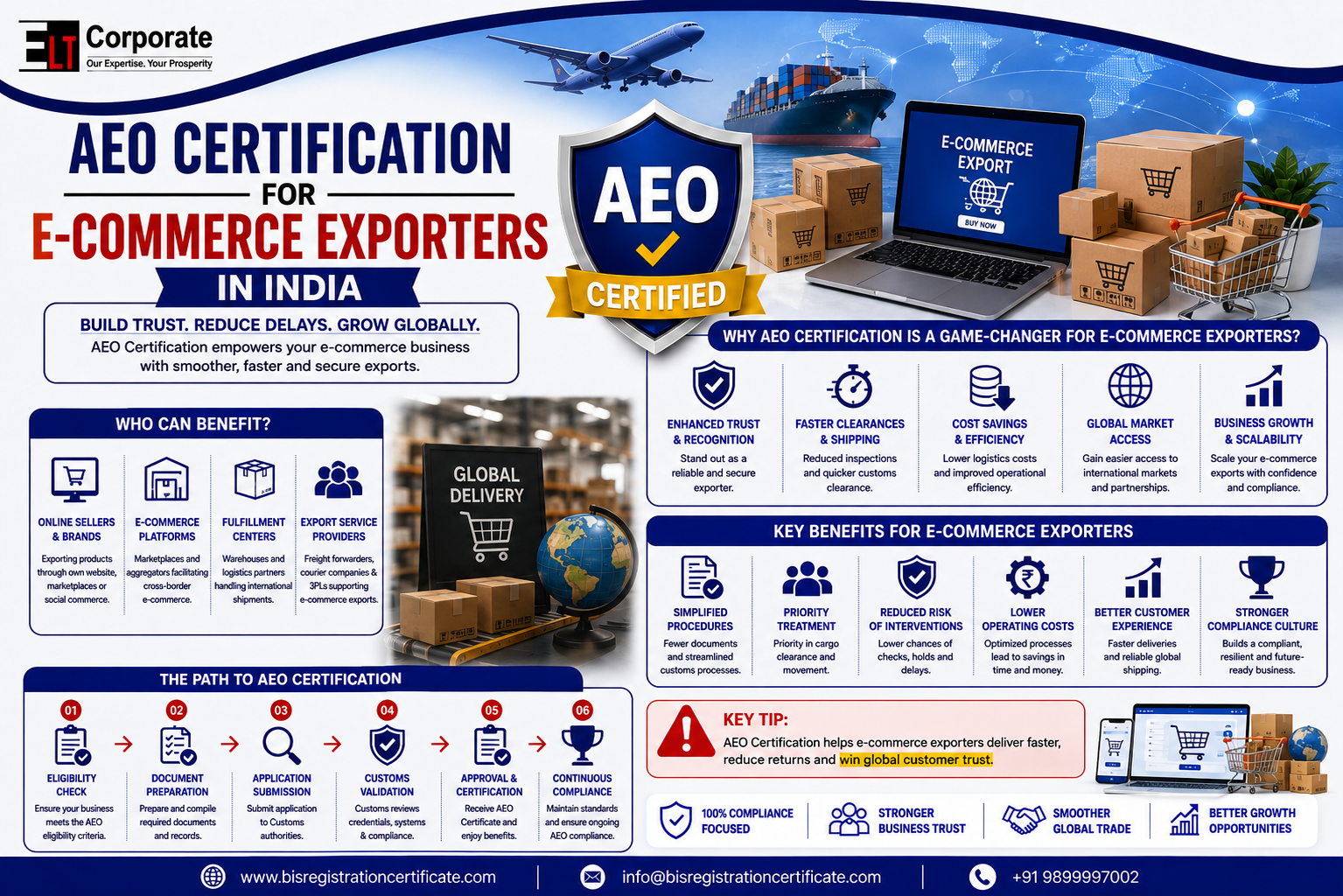
AEO — Authorized Economic Operator — is a certification issued by India’s Central Board of Indirect Taxes and Customs (CBIC) to businesses that meet strict standards of customs compliance, financial stability, and supply chain security.
For growing e-commerce companies startups, AEO certification is particularly valuable because it directly solves the three biggest pain points in cross-border trade:
- Slow customs clearance — AEO-certified shipments are more likely to be facilitated through faster clearance channels with reduced intervention, subject to RMS risk parameters.
- High costs at ports — demurrage, CFS handling, and bank guarantees add lakhs to your operational costs every year
- Unpredictable supply chain — AEO gives you priority treatment, Direct Port Delivery, and a dedicated CBIC support channel
In simple terms: AEO is the government’s way of saying your business is trusted. And trusted businesses get cleared faster, pay less, and have fewer headaches at every port and airport in India.
AEO T1 vs T2 — What Is the Core Difference?
Both T1 and T2 are issued to importers and exporters. The difference lies in the depth of verification, the benefits offered, and the compliance standards required.
| Factor | AEO T1 | AEO T2 |
| Verification Type | Document-based only | Documents + physical on-site audit by CBIC |
| Eligibility Threshold | 25 customs docs/year (10 for MSMEs) | 25 customs docs/year (10 for MSMEs) |
| Business Age Required | 3 Financial Years (waivable) | 3 Financial Years (waivable) |
| Approval Timeline | 15 days (T1 fast-track) to 2–3 months | 3–5 months (includes site audit) |
| Certificate Validity | 2 years | 3 years |
| Green Channel Access | Yes | Yes — higher priority |
| Direct Port Delivery (DPD) | Yes | Yes — priority |
| Deferred Duty Payment | No — duty paid upfront | Yes — pay duty AFTER goods cleared |
| Bank Guarantee Exemption | Reduced (partial) | 25% only — frees up 75% working capital |
| MRA Benefits (International) | Not applicable | Yes — India’s MRA partner countries |
| Post-Clearance Audit Frequency | Standard | Reduced — once in 2 years only |
| Dedicated CBIC Support | AEO Cell access | Priority AEO Cell + dedicated relationship |
| Self-sealing of Export Containers | Not available | Yes — faster export processing |
| Processing of Refunds/Drawback | Priority vs non-AEO | Faster than T1 |
AEO T1 — The Right Starting Point for Most Delhi E-commerce Startups
What You Get With AEO T1
AEO T1 is the entry-level certification and it is more powerful than most startups realise. Here is what it actually delivers for a Delhi-based e-commerce importer or exporter:
- Green Channel clearance — Your shipments are flagged as low-risk by CBIC’s RMS system. Instead of waiting in the Yellow or Red Channel queue, your goods move through automatically. For a startup importing electronics or fashion from China, this alone can reduce clearance time from 3–5 days to under 12 hours.
- Direct Port Delivery (DPD) for imports — Your containers move directly from the port terminal to your warehouse or fulfilment centre, bypassing the Container Freight Station (CFS). This eliminates CFS handling charges of Rs. 25,000–50,000 per container and removes 1–2 days from your supply chain.
- Direct Port Entry (DPE) for exports — Factory-stuffed containers get direct entry at ports. Your export consignments skip the CFS queue entirely and are loaded directly onto vessels. For Delhi exporters using ICD Tughlakabad or ICD Patparganj, this is a significant operational advantage.
- 24×7 customs clearance — AEO T1 status makes your consignments eligible for round-the-clock processing. No more waiting for the next business day for a customs officer to action your Bill of Entry.
- Exemption from merchant overtime charges — Customs processing outside business hours normally attracts overtime fees. AEO T1 holders are exempt, saving Rs. 5,000–15,000 per out-of-hours clearance.
- Priority customs query resolution — When you have a dispute or query with customs, AEO T1 businesses are given priority in the resolution queue.
Eligibility for AEO T1 — Can Your NCR businesses Qualify?
AEO T1 eligibility is more accessible than most startups assume. Here are the key requirements:
- Your business must be legally established in India with valid PAN, IEC (Importer Exporter Code), and GST registration
- You must have been in active business for at least 3 financial years — but this can be waived by the competent authority in deserving cases
- You must have handled at least 25 customs documents (Shipping Bills + Bills of Entry) in the previous financial year — reduced to just 10 for MSME-registered businesses
- No pending show-cause notices for fraud, smuggling, or clandestine removal of goods
- Basic internal controls and security measures for supply chain management
Good news for Delhi MSMEs: CBIC’s Liberalised MSME AEO Package significantly lowers the bar for small businesses. If your startup is MSME-registered, you only need 10 customs documents per year to qualify for T1 — and CBIC commits to a decision within 15 days of complete application.
AEO T1 Application Process — Step by Step
- Register on the CBIC AEO India portal at aeoindia.gov.in
- Prepare your application — 2 Annexures (simplified from earlier 7) with company documents, compliance history, and security measures
- Submit online — CBIC reviews the application at Zonal Customs level
- CBIC issues T1 certificate within 15 days of complete submission (for MSME-eligible cases)
- Enjoy T1 benefits immediately — Green Channel, DPD, DPE, 24×7 clearance
AEO T2 — When Your E-commerce Business Is Ready to Scale
What AEO T2 Adds Over T1
AEO T2 builds on everything T1 offers and adds three game-changing benefits that make a material difference to a growing e-commerce business:
-
Deferred Duty Payment — The Biggest Cash Flow Advantage in Trade
This is the single most powerful financial benefit in the entire AEO programme — and it is available only from T2 onwards.
Under standard customs procedure, you must pay your import duty before your goods are released. For a startup importing Rs. 50 lakhs of goods every month, you are permanently blocking Rs. 10–15 lakhs in duty payments at any given time.
With AEO T2, you clear your goods first and pay duty later — in a consolidated monthly batch. This effectively gives you a permanent 30-day interest-free credit line from the government on all your customs duties. For a Delhi e-commerce startup with Rs. 50 lakhs monthly imports, this could free up Rs. 8–15 lakhs in working capital that can instead be deployed into inventory, marketing, or operations.
Deferred duty payment is the equivalent of a free Rs. 10–15 lakh revolving credit line for an active Delhi importer. No bank, no interest, no collateral — just AEO T2 status.
-
Bank Guarantee Exemption — Free Up Locked Capital
Many customs procedures — including warehousing, advance authorisations, and export promotion schemes — require you to deposit a bank guarantee with customs. For AEO T2 holders, this requirement is reduced to just 25% of the standard amount. The remaining 75% stays in your business.
For a startup with Rs. 20 lakhs in typical bank guarantee requirements, T2 reduces this to Rs. 5 lakhs — freeing Rs. 15 lakhs that would otherwise be locked as collateral.
-
International MRA Recognition — Your AEO Status Works Abroad
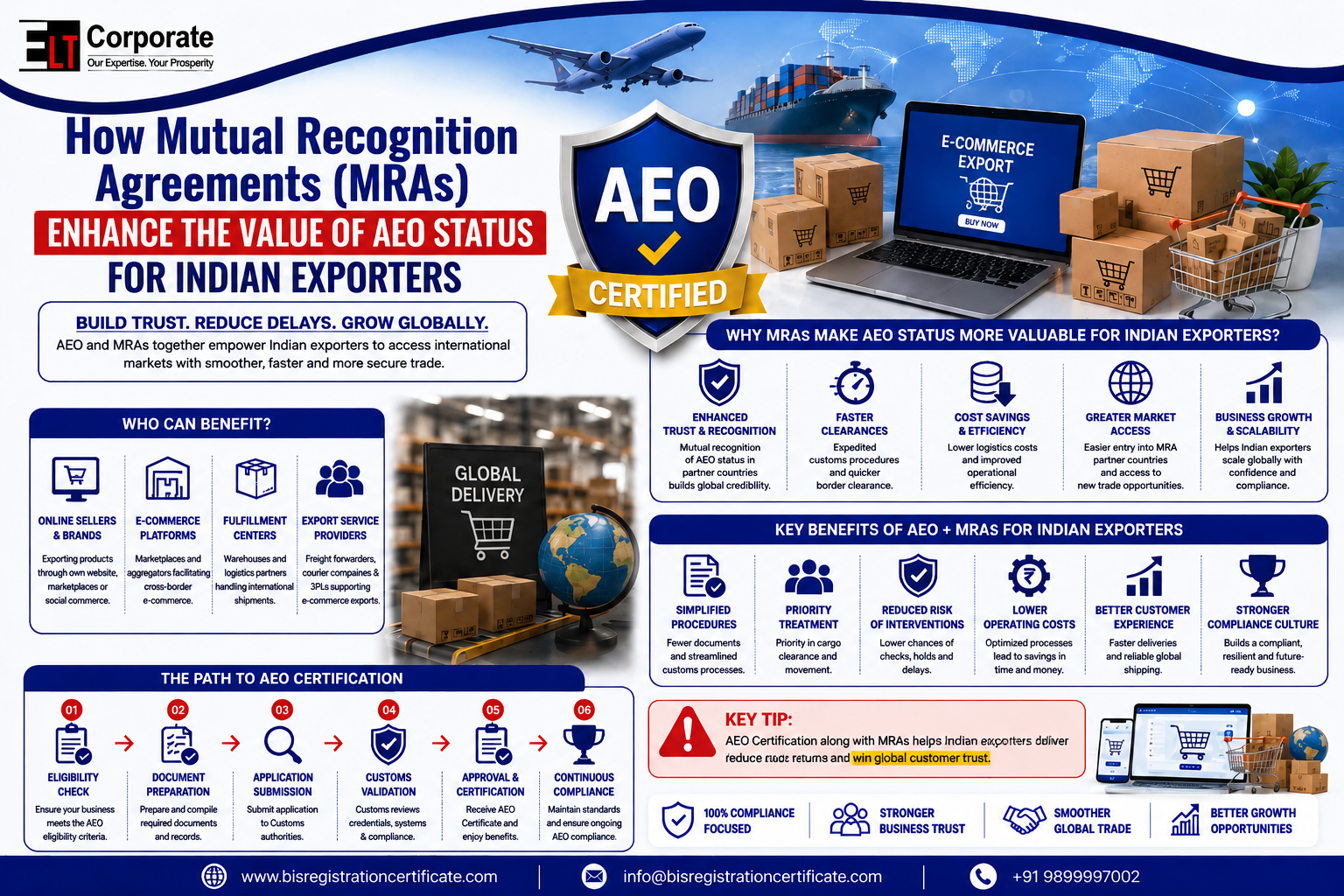
India has signed Mutual Recognition Arrangements (MRAs) with countries such as South Korea, Hong Kong, and others, with additional agreements under discussion.
For AEO T2 and T3 holders, these MRAs mean your Indian AEO status is recognised by the customs authorities of partner countries. When you export to Singapore or South Korea, your consignment is treated as coming from a trusted trader — with reduced inspections and faster clearance at the receiving end.
For Delhi exporters targeting Southeast Asian or East Asian markets — a major e-commerce opportunity — this is a significant competitive advantage.
AEO T2 Eligibility — What Is Additional Over T1
The eligibility requirements for T2 are broadly similar to T1, but the verification process is more rigorous:
- Same basic eligibility — PAN, IEC, GST, 3-year business history, 25 customs documents (10 for MSMEs)
- Strong internal controls and documented Standard Operating Procedures (SOPs) for security
- Audited financial accounts for previous 3 years demonstrating financial solvency
- Physical on-site audit by CBIC — customs officers visit your office/warehouse to verify your actual operations, records, and security systems
- Clean compliance record with no significant customs violations
AEO T2 Application Process
- Same online registration and initial document submission as T1
- CBIC reviews documents and schedules an on-site audit
- Customs officers visit your premises — typically your Delhi office or warehouse
- Post-audit review and any clarifications required
- T2 certificate issued — valid for 3 years
AEO T1 or T2 — Which Should Your Delhi Startup Choose?
The answer depends on three factors: your current trade volumes, your working capital situation, and how urgently you need the cash flow benefits. Here is a practical decision guide:
| Your Situation | Recommended Tier | Primary Reason |
| You have 10–25 customs docs/year and are MSME-registered | AEO T1 first | Quick win — 15-day approval, immediate Green Channel benefits |
| You import Rs. 10–30 lakhs/month and want faster clearance | AEO T1 | Green Channel + DPD solves your core problem immediately |
| You import Rs. 30 lakhs+ monthly and duty is blocking working capital | AEO T2 directly | Deferred duty payment alone justifies the T2 investment |
| You are growing and want to build compliance credibility over 1–2 years | Start T1, upgrade to T2 | T1 builds your RMS score; T2 unlocks full benefits |
| You export to South Korea, Singapore, or Hong Kong | AEO T2 | MRA recognition gives you trusted trader status at receiving customs |
| You are a new startup under 3 years old | AEO T1 (with waiver request) | T1 waiver for deserving cases; T2 requires stronger compliance history |
| You want maximum benefits and are ready for on-site audit | AEO T2 directly | Skip T1 and go straight to T2 — you can apply without holding T1 |
You do NOT need to get AEO T1 before applying for T2. You can apply directly for T2 if you meet the eligibility requirements. Many Delhi businesses with strong compliance records skip T1 entirely and go straight to T2 for the deferred duty and MRA benefits.
Why AEO Certification Matters Specifically for Delhi-Based E-commerce
Delhi has a unique advantage in the AEO context — the city is served by three major customs points that process enormous volumes of e-commerce trade:
- ICD Tughlakabad — India’s largest inland container depot, handling massive volumes of imports from China, UAE, and Southeast Asia. AEO T1 and T2 holders using Tughlakabad get priority processing and direct port delivery that reduces typical clearance from 3–4 days to same-day.
- ICD Patparganj — Major ICD for both imports and exports, heavily used by Delhi’s electronics, fashion, and consumer goods e-commerce sector. AEO exporters benefit from Direct Port Entry for factory-stuffed containers.
- Indira Gandhi International Airport Air Cargo Complex — Critical for fast-moving e-commerce goods — electronics, luxury items, time-sensitive shipments. AEO T1 and T2 holders consistently get 2–4 hour air cargo clearance versus 12–36 hours for non-AEO businesses.
For a Delhi startup importing fast-fashion from Guangzhou, electronics from Shenzhen, or beauty products from South Korea, the difference between AEO and non-AEO clearance at these three points can mean the difference between profitable festive-season inventory and missed market windows.
Cost of AEO Certification vs Return on Investment
What Does AEO Certification Cost?
AEO certification itself is a government programme with nominal CBIC application fees. The main cost involved is the professional fee for an AEO consultant who prepares your application, manages documentation, and coordinates with CBIC on your behalf.
Typical consultant fees range from Rs. 25,000–60,000 for T1 and Rs. 60,000–1.5 lakhs for T2, depending on business complexity. This is a one-time cost valid for 2 years (T1) or 3 years (T2).
What Is the Return on Investment?
For a typical Delhi e-commerce startup importing Rs. 25–50 lakhs per month, the annual savings from AEO certification include:
- CFS handling charges eliminated via DPD: Rs. 3–8 lakhs per year
- Demurrage savings from faster clearance: Rs. 2–5 lakhs per year
- Working capital freed from deferred duty (T2): Rs. 8–15 lakhs at any time
- Bank guarantee reduction (T2): Rs. 5–15 lakhs freed permanently
- Consultant/query response fees saved: Rs. 1–3 lakhs per year
- Penalty avoidance from on-time delivery: Varies by sector, often Rs. 2–10 lakhs
For a Delhi e-commerce startup with Rs. 30 lakhs monthly imports, AEO T2 certification typically In many cases, businesses observe ROI within a few months, depending on shipment volume and operations. The working capital benefit from deferred duty alone often covers the entire certification cost in the first month.
Documents Required for AEO T1 and T2 Application
| Document | AEO T1 | AEO T2 |
| PAN + IEC + GST Certificate | Required | Required |
| Certificate of Incorporation / Partnership Deed | Required | Required |
| Audited Financial Statements (3 years) | Required | Required + deeper review |
| List of Import/Export Items with HSN Codes | Required | Required |
| MSME Certificate (if applicable) | Required if MSME | Required if MSME |
| Standard Operating Procedures (SOPs) | Basic overview | Detailed — covers security, warehouse, IT |
| Customs Compliance History | Self-declaration | Verified by CBIC audit |
| IT Systems & Data Security Documentation | Basic | Detailed — CBIC reviews actual systems |
| Physical Premises Details | Not required | Required — site audit conducted |
| Security Plan for Supply Chain | Basic | Comprehensive — reviewed on-site |
Frequently Asked Questions
Can I apply for AEO T2 directly without getting T1 first?
Yes — you can apply directly for T2 without holding T1. There is no mandatory progression requirement. If you meet the T2 eligibility criteria and are ready for the on-site audit, you can skip T1 entirely.
My startup is less than 3 years old. Can I still apply?
The 3-year business history requirement can be waived by the competent authority for deserving cases. If your startup has a strong compliance record, active IEC, and demonstrates serious trade involvement, an experienced AEO consultant can help you present a waiver case to CBIC.
How long does AEO T1 actually take to get approved in Delhi?
For MSME-registered businesses submitting a complete application, In MSME cases with complete documentation, applications are often processed within 15 days, though timelines may vary. For other T1 applicants, 2 to 3 months is typical. Working with an experienced consultant who submits a complete, error-free application from day one is the single biggest factor in reducing approval time.
Do I need a physical office or warehouse for AEO T2?
You do not need to own physical infrastructure, but you must have a verifiable business address in Delhi or NCR that CBIC officers can visit. If you use third-party fulfilment centres (like Amazon FBA or third-party 3PL warehouses), your application must clearly document your supply chain and security arrangements at those locations.
Will AEO certification help me import from China faster?
Yes — significantly. For Indian importers/exporters sourcing from China through ICD Tughlakabad, AEO T1 and T2 certification routes your Bills of Entry to the Green Channel. Instead of random inspections and Yellow Channel delays that add 2–5 days, your China-origin goods are cleared within hours. Combined with advance Bill of Entry filing (24–48 hours before vessel/truck arrival), AEO-certified importers from China typically clear goods 3x to 5x faster than non-AEO competitors.
Start With What You Can Get — Then Scale Up
The smartest move for most Delhi e-commerce startups is to start with AEO T1 immediately — it is fast to get, cheap to obtain, and delivers real, measurable benefits from day one. The Green Channel routing, Direct Port Delivery, and 24×7 clearance will improve your supply chain immediately.
Once your T1 status is active and your RMS compliance score builds over 6 to 12 months, upgrade to T2. The deferred duty payment and bank guarantee exemption at T2 will then deliver the kind of working capital benefits that can genuinely change your unit economics — and the international MRA recognition will help you compete in global markets.
In Delhi’s competitive e-commerce landscape, AEO certification is no longer just a compliance formality. It is one of the most cost-effective operational advantages available to any import-export business.