
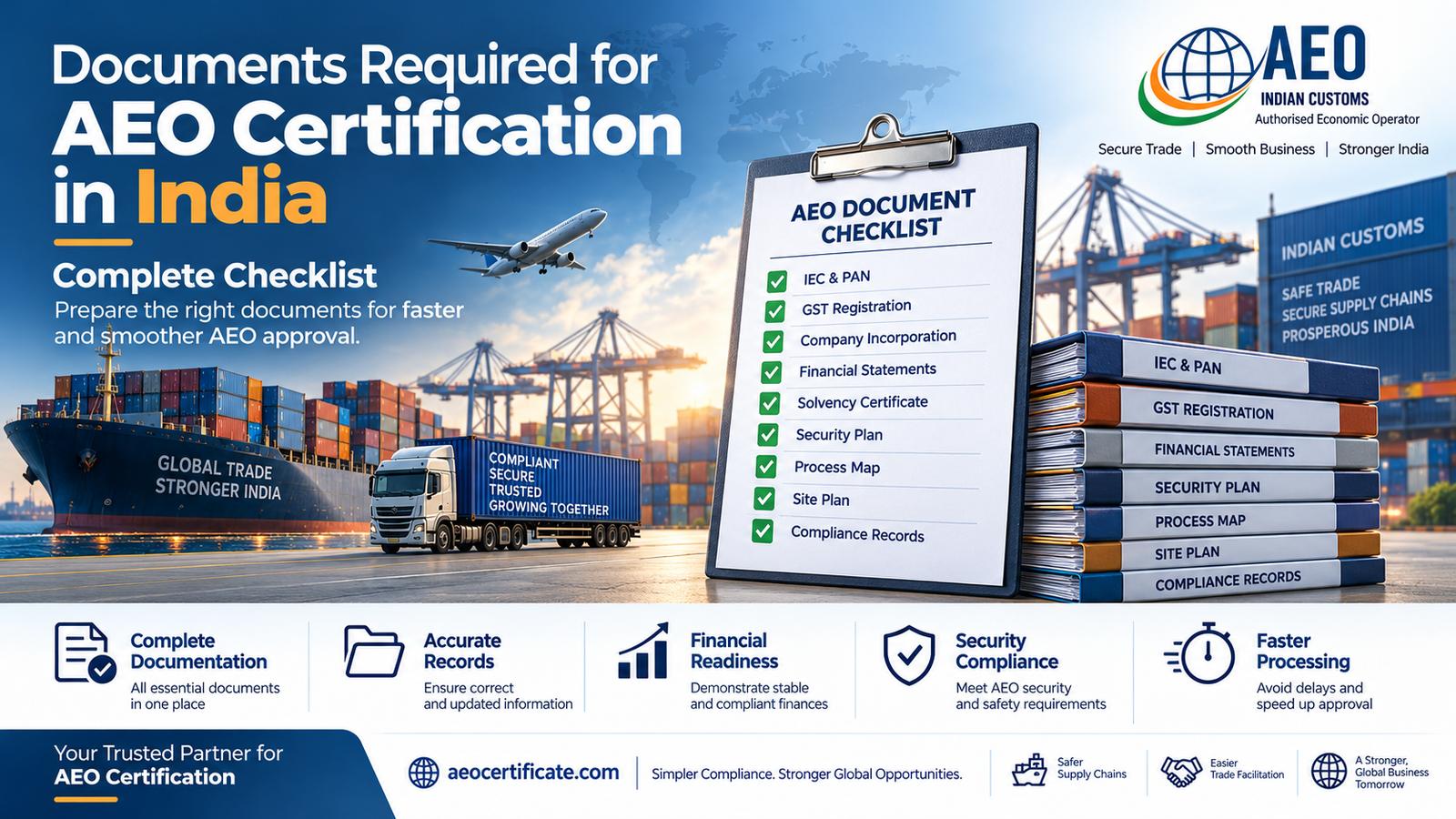
International trade involves several customs procedures, documentation requirements, and regulatory obligations. For importers, exporters, and logistics operators, obtaining Authorised Economic Operator (AEO) certification can significantly improve customs clearance efficiency and supply chain operations.
However, preparing accurate AEO Certification Documents is one of the most important steps in obtaining approval under the Indian Customs AEO Programme.
The Authorised Economic Operator Programme, administered by the Central Board of Indirect Taxes and Customs (CBIC), recognises businesses that demonstrate reliable customs compliance, financial stability, and secure international supply chain operations.
The documents required for AEO certification depend on the category of certification, such as AEO-T1, AEO-T2, AEO-T3, or AEO-LO.
This complete guide explains the AEO Certification Documents required in India, including application forms, supporting records, security documentation, financial statements, and the step-by-step application process.
What Are AEO Certification Documents?
AEO Certification Documents are the prescribed application forms, declarations, operational records, and supporting evidence submitted by businesses seeking recognition under India’s AEO Programme.
These documents help Customs authorities evaluate whether an applicant meets the eligibility, legal compliance, financial solvency, record management, and supply chain security requirements applicable to its certification category.
The Indian AEO Programme provides four categories:
- AEO-T1: Entry-level certification for eligible importers and exporters.
- AEO-T2: Advanced certification involving detailed compliance and security verification.
- AEO-T3: Highest-level certification for eligible existing AEO-T2 holders.
- AEO-LO: Certification for eligible logistics operators and other international supply chain service providers.
Each category has different documentation requirements. Therefore, businesses should identify the appropriate certification tier before preparing their AEO Certification Documents.
Why Are AEO Certification Documents Important?
Proper documentation plays an essential role in establishing a company’s credibility and eligibility under the AEO Programme.
Accurate AEO Certification Documents help businesses demonstrate:
- Compliance with applicable customs laws and procedures.
- Proper management of commercial and transportation records.
- Financial solvency and business reliability.
- Adequate internal control systems.
- Effective cargo and premises security arrangements, where applicable.
- Transparency in international supply chain operations.
Incomplete or inconsistent documentation may result in departmental queries, additional verification, or delays in certification.
Businesses should therefore conduct a documentation review before submitting their AEO application.
AEO Certification Documents Required for AEO-T1
AEO-T1 is designed for eligible importers and exporters seeking entry-level AEO certification.
The AEO-T1 application is submitted online through the official Indian Customs AEO portal.
The prescribed application includes two principal annexures:
Annexure 1 – General Details for AEO Certification Documents
Annexure 1 contains the applicant’s business details and information relevant to determining eligibility.
It covers matters such as the organization’s identity, business operations, customs-related activities, and other prescribed particulars.
Applicants should ensure that these details correspond with their IEC and other official registration records.
Annexure 2 – Compliance Information for AEO Certification Documents
Annexure 2 addresses important compliance criteria, including:
- General eligibility requirements.
- Legal compliance history.
- Management of commercial records.
- Financial solvency.
- Relevant internal compliance arrangements.
Unlike AEO-T2 and AEO-T3, AEO-T1 does not generally require the same detailed physical security verification process.
However, the applicant must satisfy all requirements applicable to AEO-T1 certification.
Detailed Explanation of AEO-T2 AEO Certification Documents
Annexure A – Application Form
The application form contains essential information about the applicant, its business activities, legal status, operational premises, and relevant Customs operations.
Annexure B – Security Plan
The security plan describes measures adopted to protect business premises, cargo, employees, and supply chain operations.
It may be supported by security policies, access control procedures, and incident management records.
Annexure C – Process Map
The process map explains how goods move through the company’s international supply chain.
It may illustrate procurement, manufacturing, warehousing, transportation, Customs clearance, and dispatch activities, as applicable.
Annexure D – Site Plan
The site plan illustrates the relevant business premises, including entry and exit points, cargo storage areas, loading and unloading locations, and other security-sensitive areas.
Annexure E1 – General Compliance
This annexure addresses general eligibility and the applicant’s relevant business operations.
Annexure E2 – Legal Compliance
Applicants provide information about their legal compliance history, including relevant Customs proceedings and Show Cause Notices.
Annexure E3 – Commercial and Transport Records
This annexure covers systems for maintaining accurate commercial and transport documentation, including appropriate record access and controls.
Annexure E4 – Financial Solvency
Applicants demonstrate financial reliability using the prescribed declarations, supporting records, and solvency certification.
Annexure E5 – Safety and Security
This annexure addresses physical security, cargo security, employee security, business partner controls, and other applicable supply chain security arrangements.
Proper completion of these AEO Certification Documents helps prepare businesses for departmental scrutiny and verification.
AEO Certification Documents Required for AEO-T3
AEO-T3 represents the highest certification category available to eligible importers and exporters.
Companies seeking AEO-T3 status must already hold AEO-T2 certification and meet the prescribed upgrade conditions.
The AEO Certification Documents for AEO-T3 generally include Annexures A, B, C, D, E1, E2, E3, E4, and E5, along with Annexure F.
Annexure F – Business Partner Details
Annexure F contains information about relevant international supply chain business partners.
Applicants should also maintain their existing AEO-T2 certificate details and evidence supporting their eligibility for the upgrade.
Businesses must ensure that their compliance records, operational procedures, and security documentation remain current.
AEO Certification Documents for AEO-LO
AEO-LO certification is intended for eligible international logistics and supply chain operators.
Applicants may include customs brokers, freight forwarders, warehouse operators, custodians, transport operators, and other qualifying logistics service providers.
The prescribed AEO-LO application generally includes Annexures A, B, C, D, and E1 to E5.
Depending on the nature of the business, supporting AEO Certification Documents may include:
- Customs Broker Licence, where applicable.
- Relevant warehousing or operational authorizations.
- Transport and logistics operating procedures.
- Cargo security and tracking arrangements.
- Records management procedures.
- Financial solvency documentation.
- Security and business premises information.
The exact supporting documents depend on the logistics activity and the applicant’s applicable regulatory requirements.
Financial Solvency Requirements for AEO Certification Documents
Financial solvency is an important component of the AEO certification assessment.
Applicants must demonstrate their financial reliability in accordance with the relevant CBIC requirements.
For AEO-T1 and AEO-T2, the prescribed framework permits a solvency certificate from the statutory auditor or an eligible independent chartered accountant, subject to the applicable conditions.
For AEO-T3 and AEO-LO, a solvency certificate from the applicant’s statutory auditor is required under Circular No. 3/2018-Customs.
Companies should maintain accurate audited financial records and ensure that financial information is consistent across submitted AEO Certification Documents.
Step-by-Step Submission of AEO Certification Documents
Step 1: Select the Appropriate AEO Category
Determine whether the business qualifies for AEO-T1, AEO-T2, AEO-T3, or AEO-LO certification.
Step 2: Review Eligibility
Assess business history, customs transactions, legal compliance, financial solvency, and operational requirements.
Step 3: Prepare the Documents
Complete the prescribed application annexures and collect supporting records.
Step 4: Register on the AEO Portal
Visit https://www.aeoindia.gov.in/ and complete the applicant registration process using official business details.
Step 5: Submit the Application
Complete the applicable filing process and upload the required AEO Certification Documents. Follow any additional submission instructions specified for the chosen tier.
Step 6: Departmental Review
The AEO authorities review the application and may request clarifications or additional documentation.
Step 7: Verification and Approval
For categories requiring physical verification, the competent authority may conduct an assessment of relevant business premises and security procedures.
After satisfactory evaluation, certification may be granted.
Importance of Accurate Documentation for AEO Certification Documents
Accurate documentation is essential for obtaining Authorised Economic Operator certification in India. The Central Board of Indirect Taxes and Customs (CBIC) examines the information provided by applicants to assess their compliance history, financial reliability, and supply chain security.
Businesses must ensure that all AEO Certification Documents are complete, accurate, and consistent with their actual operations.
For example, company details mentioned in the application should match the information available in the Importer Exporter Code (IEC), GST registration, and other official business records.
Similarly, financial statements, commercial records, and security procedures should accurately reflect the applicant’s business activities.
Proper documentation helps reduce unnecessary departmental queries and supports a smoother application process.
Customs Compliance Records Required for AEO Certification Documents
Customs compliance is one of the key eligibility requirements under the Indian AEO Programme.
Applicants should maintain appropriate records demonstrating their compliance with applicable Customs laws and regulations.
Important records may include:
- Bills of Entry for imported goods.
- Shipping bills for exported goods.
- Commercial invoices and packing lists.
- Customs duty payment records.
- Import and export licences, where applicable.
- Records of Customs notices, investigations, and proceedings.
- Relevant correspondence with customs authorities.
- Records of voluntary disclosures and corrective actions.
These records help establish whether the applicant has maintained satisfactory Customs compliance.
For AEO Certification Documents, businesses should also maintain an internal system for verifying the accuracy of customs declarations and identifying potential compliance errors.
Security Plan Requirements for AEO Certification Documents
Security documentation is particularly important for AEO-T2, AEO-T3, and AEO-LO applicants.
A security plan describes the measures implemented by a company to protect its premises, cargo, employees, and international supply chain operations.
An effective security plan should address:
Physical Security: Protection of business premises through appropriate fencing, access controls, surveillance, and security arrangements.
Cargo Security: Procedures for identifying, inspecting, handling, and protecting cargo against tampering, theft, or unauthorized interference.
Employee Security: Appropriate employee identification, recruitment verification, and access permissions.
Information Security: Protection of commercial information, electronic records, and Customs-related documentation.
Business Partner Security: Procedures for assessing the reliability and security arrangements of relevant logistics and supply chain partners.
Preparing an appropriate security plan is an important part of the AEO Certification Documents required for higher certification tiers.
How to Prepare a Process Map for AEO Certification Documents
A process map explains the movement of goods and related information throughout a company’s international supply chain.
It helps Customs authorities understand the AEO Certification Documents business’s operating model and identify the points at which security and compliance controls are implemented.
For a manufacturing exporter, the process map may cover:
- Procurement of raw materials.
- Receipt and verification of materials.
- Manufacturing and quality inspection.
- Finished goods storage.
- Preparation of export documentation.
- Cargo packing and dispatch.
- Transportation to the Customs location.
- Customs clearance and international shipment.
For an importer, the process may cover overseas procurement, shipment tracking, Customs clearance, receiving, warehousing, and distribution.
The process map should accurately reflect the company’s actual operations rather than a generic workflow.
A properly prepared process map improves the quality of AEO Certification Documents and supports departmental verification.
Site Plan Preparation for AEO Certification Documents
A site plan is an important supporting document for AEO Certification Documents applicants undergoing detailed security verification.
It illustrates the physical layout of the business premises and identifies important operational and security-sensitive areas.
Depending on the nature of the business, a site plan may include:
- Main entry and exit gates.
- Warehouse and storage locations.
- Manufacturing and packing areas.
- Loading and unloading zones.
- Security checkpoints.
- Visitor access points.
- Cargo inspection areas.
- Restricted access locations.
- CCTV monitoring arrangements.
The site plan should be consistent with the company’s actual premises and documented security procedures.
Clear and accurate site plans help demonstrate to AEO Certification Documents that the applicant maintains appropriate physical security arrangements.
Common Mistakes While Preparing AEO Certification Documents
Businesses should avoid common documentation errors that may delay approval.
Incorrect Company Details: Inconsistencies between IEC, GST, and application records can create verification difficulties.
Incomplete Annexures: Missing information or unanswered questions may result in departmental queries.
Outdated Financial Information: Incomplete financial records can affect solvency assessment.
Insufficient Security Documentation: AEO-T2, AEO-T3, and AEO-LO applicants must appropriately document their security controls.
Poorly Prepared Process Maps: Process maps should clearly reflect actual business operations.
A pre-submission review of AEO Certification Documents can reduce these issues.
How ELT Corporate Helps Prepare AEO Certification Documents
Preparing AEO applications requires a clear understanding of Customs regulations, compliance criteria, security requirements, and prescribed documentation.
ELT Corporate Pvt. Ltd. provides professional consultancy assistance for AEO certification in India.
Our services include:
- AEO eligibility assessment.
- Preparation and review of application annexures.
- Documentation gap analysis.
- Security plan and process map preparation assistance.
- Financial documentation review.
- Application filing assistance.
- Departmental query handling.
- Support during applicable customs verification.
- AEO certification upgrade and renewal assistance.
ELT Corporate helps businesses organize their AEO Certification Documents and prepare for the applicable regulatory assessment.
Conclusion
Preparing complete and accurate AEO Certification Documents is essential for obtaining Authorised Economic Operator certification in India.
Whether applying for AEO-T1, AEO-T2, AEO-T3, or AEO-LO, businesses must understand their applicable documentation requirements and maintain satisfactory compliance records.
Proper documentation can help reduce application errors, improve regulatory preparedness, and support a more efficient certification process.
ELT Corporate Pvt. Ltd. provides professional assistance with AEO applications, documentation, regulatory coordination, and certification upgrades.
Frequently Asked Questions
Q1. What are the main AEO Certification Documents required in India?
The required documents depend on the certification category. AEO-T1 uses its prescribed two-annexure application, while AEO-T2, AEO-T3, and AEO-LO involve more detailed annexures and supporting evidence.
Q2. Are security plans mandatory for AEO certification?
Detailed security plans are part of the documentation for AEO-T2, AEO-T3, and AEO-LO. The requirements for AEO-T1 differ.
Q3. Is financial documentation necessary?
Yes. Financial solvency is an important eligibility criterion under the AEO Programme.
Q4. Can businesses submit AEO Certification Documents online?
Yes. The official AEO portal supports electronic application processes. Applicants should follow the current tier-specific submission instructions.
Q5. Is there a government fee for AEO certification?
No government application fee is charged for AEO certification under the Indian Customs AEO Programme.