
International trade involves much more than shipping products across borders. Businesses must manage customs documentation, maintain accurate records, follow regulatory requirements, and ensure their supply chains remain secure.
For companies handling regular imports and exports, even a small compliance mistake can result in shipment delays, additional costs, or unnecessary scrutiny from customs authorities.
This is where AEO Audit with Continuous Monitoring becomes important.
The Authorised Economic Operator (AEO) program recognizes businesses that demonstrate reliable customs compliance, financial soundness, and appropriate supply chain security practices.
However, obtaining AEO certification is only one part of the process. Businesses must continue maintaining the standards that supported their certification.
For companies considering AEO registration in India, understanding the role of audits and continuous monitoring can help them build a stronger compliance system and maintain long-term customs benefits.
What Is an AEO Audit with Continuous Monitoring?
An AEO registration in India is an assessment of a company’s customs compliance, business records, internal controls, and supply chain security practices against the applicable requirements of the AEO program.
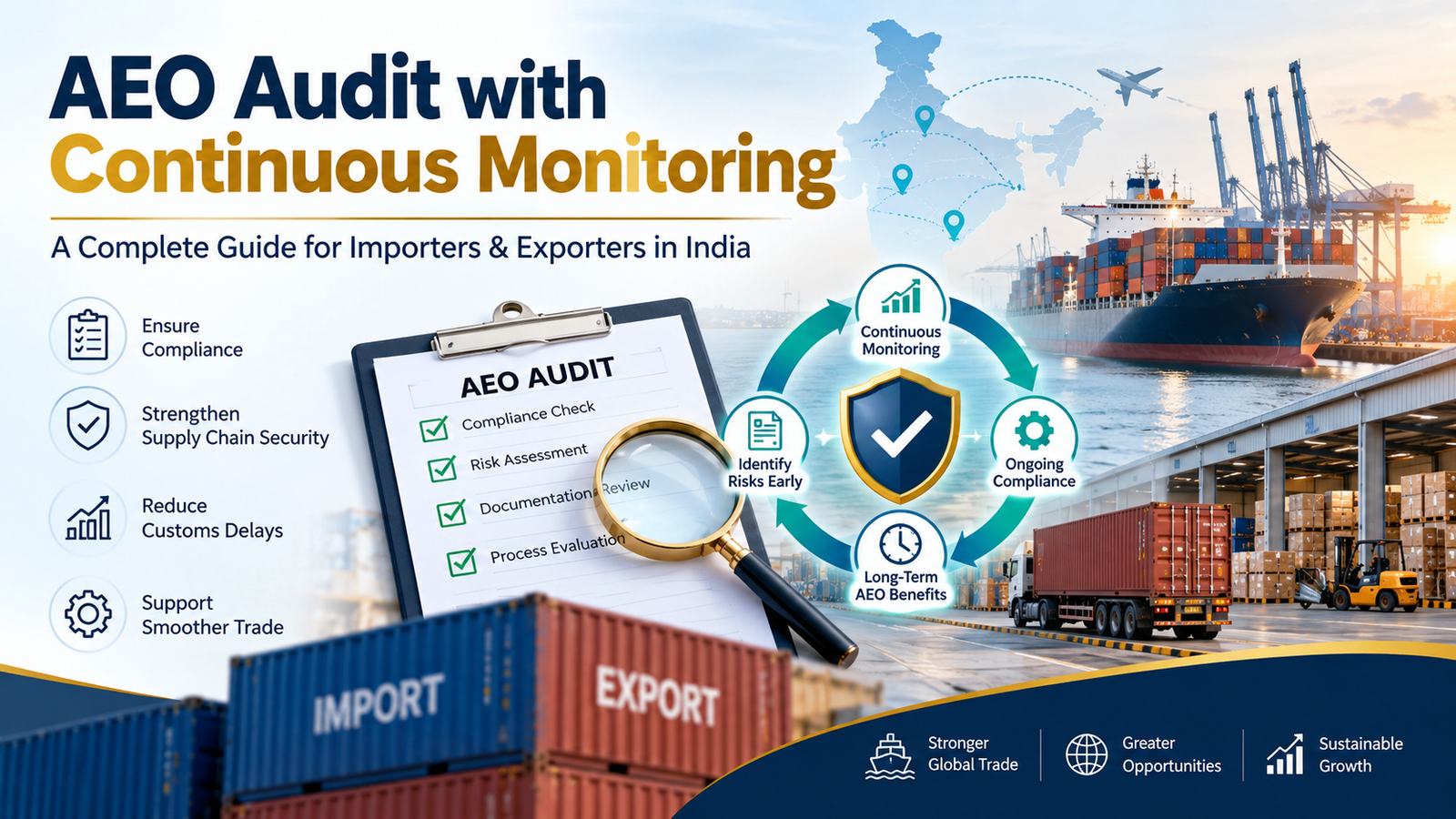
Continuous monitoring refers to the ongoing review of these practices to ensure that the business continues meeting the relevant standards after certification.
In simple terms, an AEO audit with continuous monitoring means a company has established appropriate compliance practices, while continuous monitoring helps ensure those practices are consistently followed.
For example, imagine an Indian exporter that regularly ships automotive components to European customers.
The company has obtained AEO certification after demonstrating suitable documentation procedures, customs compliance, and cargo security arrangements.
Six months later, the company changes its warehouse location and introduces a new logistics service provider.
These changes may affect its supply chain security arrangements. Through continuous monitoring, the company can identify potential risks, update its internal procedures, and evaluate whether any information must be communicated to the relevant customs authorities.
This proactive approach helps maintain AEO audit with continuous monitoring compliance and reduces the possibility of problems during subsequent customs verification.
Why Is Continuous Monitoring Important for AEO-Certified Businesses?
AEO certification is not simply a one-time approval. It represents an ongoing commitment to maintaining reliable customs and supply chain practices.
Businesses that complete AEO registration in India should establish internal systems to monitor their compliance performance throughout the certification period.
Continuous monitoring is important for several reasons.
1. Maintaining Customs Compliance
Import and export regulations, customs procedures, and business operations may change over time.
Regular compliance reviews help businesses AEO audit with continuous monitoring identify potential gaps in customs declarations, tariff classifications, valuation practices, and documentation.
2. Reducing Supply Chain Risks
International shipments may involve manufacturers, transporters, warehouses, customs brokers, and freight forwarders.
Monitoring these activities helps AEO audits with continuous monitoring of businesses to identify security vulnerabilities and take preventive action.
3. Supporting AEO Status Retention
AEO-certified businesses must continue satisfying applicable program requirements.
Proper monitoring helps AEO audits with continuous monitoring to ensure companies remain prepared for customs verification, reassessment, and renewal-related requirements.
4. Improving Operational Efficiency
A well-maintained AEO audit with a continuous monitoring compliance system can reduce documentation errors, improve coordination between departments, and support faster resolution of customs-related issues.
5. Building Trust with Business Partners
AEO status demonstrates that a business has been assessed against recognized customs compliance and security standards.
Maintaining those standards can strengthen AEO audits with continuous monitoring confidence among customers, logistics partners, and other international trade stakeholders.
Key Areas Covered Under an AEO Audit
An AEO registration in India audit generally examines multiple aspects of a company’s operations. The scope and depth of assessment depend on the applicable AEO tier and the relevant customs requirements.
Customs Compliance History
Customs authorities may require AEO registration in India and the company’s compliance record, including customs-related violations, declarations, and applicable regulatory obligations.
Businesses should regularly examine their AEO audit with continuous monitoring of import and export documentation to identify inconsistencies.
Financial Solvency
Financial stability is an important consideration under the AEO program.
Companies may need to demonstrate financial soundness through relevant financial statements and supporting records.
Continuous monitoring can help AEO audit with continuous monitoring identify financial risks that may affect ongoing eligibility.
Cargo and Premises Security
Supply chain security is an important element of higher-tier AEO assessments.
Relevant controls may include:
- Restricted access to warehouses and cargo-handling areas.
- Appropriate cargo inspection and sealing procedures.
- Security arrangements for storage and transportation.
- Visitor management and employee identification.
- Procedures for reporting security incidents.
Business Partner Security
A company’s supply chain may involve several external service providers.
Businesses should assess relevant AEO registration in India risks associated with transporters, warehouse operators, freight forwarders, and other supply chain partners.
Recordkeeping and Internal Controls
Accurate documentation supports customs compliance and helps businesses respond effectively to verification requests.
Companies should maintain appropriate AEO registration in India records relating to import and export transactions, customs declarations, invoices, shipping documents, and internal compliance checks.
How Does the AEO Audit and Continuous Monitoring Process Work?
The exact procedure depends on the company’s AEO audit with continuous monitoring tier in India, its operational profile, and the requirements applicable to its certification.
However, a practical compliance monitoring program generally follows these steps.
Step 1: Conduct an Initial Compliance Assessment
The first step is to evaluate existing business practices against the applicable AEO requirements.
For companies planning an AEO audit with continuous monitoring, this assessment can identify gaps before submitting an application.
The review may cover customs documentation, financial records, operational procedures, and supply chain security controls.
Step 2: Identify Compliance Gaps
Once the assessment is complete, the company should identify areas requiring improvement.
Common gaps may include incomplete AEO registration in India, outdated internal procedures, inadequate staff awareness, or insufficient documentation of security controls.
For example, a company may have CCTV surveillance in its warehouse but lack a documented procedure for reviewing and retaining relevant security records.
Identifying such gaps early allows the AEO audit, with continuous monitoring of the business, to introduce suitable corrective measures.
Step 3: Implement Corrective Actions
The company should prepare a corrective action plan for identified deficiencies.
Depending on the issue, actions may AEO audit with continuous monitoring may include revising standard operating procedures, improving recordkeeping, introducing security controls, or providing employee training.
Each corrective action should have a responsible person and a defined completion timeline.
Step 4: Establish a Continuous Monitoring System
After implementing the necessary improvements, the company should develop an internal monitoring schedule.
The frequency of reviews should reflect AEO registration in India, operational risks, business changes, and applicable customs requirements.
For example, a business may conduct monthly documentation checks, quarterly internal compliance reviews, and periodic supply chain security assessments.
These are suggested internal AEO audit with continuous monitoring, not a universal government-prescribed audit schedule.
Step 5: Review Findings and Maintain Evidence
Monitoring activities should produce clear records of observations, corrective actions, and follow-up reviews.
Maintaining this evidence can help AEO registration in India demonstrate that the company has an active compliance management system.
Step 6: Prepare for Customs Verification
Customs authorities may conduct verification or reassessment in accordance with the applicable AEO framework.
Companies with AEO audit with continuous monitoring maintain updated records and ensure that responsible personnel understand their compliance obligations.
AEO Continuous Monitoring Checklist for Businesses
Companies can use the following practical checklist to evaluate their internal compliance arrangements.
| Monitoring Area | Recommended Internal Review |
| Customs documentation | Verify accuracy and completeness of declarations. |
| Import and export records | Check supporting invoices, shipping documents, and transaction records. |
| Financial records | Review financial stability and relevant supporting documents. |
| Warehouse security | Assess access controls and cargo security arrangements. |
| Business partners | Review relevant supply chain security risks. |
This checklist is intended for internal monitoring and should AEO registration in India be adapted to the company’s applicable AEO tier and regulatory requirements.
Common Challenges Businesses Face During AEO Audits
Although AEO certification offers valuable benefits, businesses may experience challenges while implementing and maintaining compliance systems.
Incomplete Documentation
Missing invoices, shipping records, or inconsistent AEO audit with continuous monitoring of customs declarations can create difficulties during compliance assessments.
Maintaining an organized digital document management system can help reduce these issues.
Lack of Employee Awareness
Employees involved in customs documentation, warehouse operations, and logistics may not always understand their responsibilities under the AEO program.
Regular training helps ensure that AEO registration in India compliance requirements are followed in daily operations.
Changes in Business Operations
Warehouse relocation, changes in management, new logistics partners, or changes in operational procedures may affect previously assessed AEO registration in India controls.
Companies should review such changes to the AEO audit with continuous monitoring and determine whether they require updates to their compliance arrangements or communication with customs authorities.
Weak Internal Monitoring
Some businesses with AEO registration in India focus heavily on obtaining certification but do not establish a structured system for maintaining compliance afterwards.
A practical internal monitoring program helps prevent this gap.
Role of Technology in AEO Audit with Continuous Monitoring
Technology can make customs compliance monitoring more efficient, particularly for businesses handling large shipment volumes.
Digital systems can help companies with AEO audit with continuous monitoring, document monitoring, corrective action monitoring, and maintaining records of internal reviews.
For example, an importer handling hundreds of shipments every month may use an internal compliance dashboard to identify missing documents or unusual declaration patterns.
Useful technology-based practices include:
- Automated document verification workflows.
- Digital customs compliance checklists.
- Centralized storage of shipping records.
- Compliance dashboards and reporting systems.
- Alerts for pending corrective actions.
- Electronic records of employee training.
Technology does not replace the company’s responsibility to maintain compliance, but it can make monitoring more consistent and easier to manage.
For businesses pursuing AEO registration in India, implementing appropriate digital controls can also support readiness for the application assessment.
AEO Audit Requirements for Different Certification Tiers
India’s AEO program includes different AEO audit with continuous monitoring certification tiers for eligible importers and exporters, along with a separate category for eligible logistics service providers.
The compliance assessment requirements vary depending on the applicable category.
| AEO Category | General Compliance Focus |
| AEO-T1 | Customs compliance, documentation, and applicable eligibility requirements |
| AEO-T2 | More extensive compliance assessment, including applicable security and internal control requirements |
| AEO-T3 | Higher-level certification involving additional eligibility and compliance conditions |
| AEO-LO | Requirements applicable to eligible logistics operators, including relevant security and operational controls |
Companies should not assume that every AEO audit with continuous monitoring involves identical audit procedures.
For example, the assessment of a higher-tier applicant may involve more extensive verification of supply chain security arrangements than the assessment applicable to AEO-T1.
Businesses planning AEO registration in India should first determine the appropriate certification category based on their operations and eligibility.
Benefits of AEO Audit with Continuous Monitoring
A structured monitoring system can provide practical advantages beyond preparing a company for customs verification.
Reduced compliance errors: Regular reviews can identify documentation mistakes before they become recurring problems.
Better shipment planning: Stronger internal coordination can reduce avoidable delays arising from incomplete documentation.
Improved risk management: Businesses can identify potential customs and supply chain risks at an earlier stage.
Stronger internal accountability: Defined responsibilities help employees understand who is responsible for maintaining specific compliance controls.
Readiness for reassessment: Updated records and monitoring reports can support the company’s preparation for applicable verification requirements.
Long-term business confidence: Consistent compliance practices can improve trust among customers, suppliers, and logistics partners.
The actual customs facilitation benefits available to a company depend on its AEO category and the prevailing Indian Customs provisions.
How Often Should Businesses Conduct AEO Compliance Reviews?
There is no single internal audit frequency that is appropriate for every business.
The monitoring schedule should depend on shipment volumes, operational complexity, risk exposure, and applicable regulatory obligations.
A company with frequent international AEO audit with continuous monitoring shipments may benefit from monthly documentation reviews and quarterly internal compliance assessments.
A smaller business with fewer shipments may adopt a different review schedule based on its operational risks.
However, internal AEO registration in India reviews should not be confused with formal customs verification, reassessment, or renewal requirements.
Companies should always follow the applicable official AEO guidelines for maintaining their certification.
How Can Professional AEO Consultants Help?
Managing AEO compliance requires an AEO audit with continuous monitoring and an understanding of customs procedures, documentation standards, and relevant supply chain controls.
Professional consultants can assist businesses in evaluating their existing systems and preparing for the applicable AEO assessment.
For companies seeking AEO registration in India, consulting support may include:
- Preliminary eligibility and gap assessment.
- Preparation and review of AEO application documentation.
- Assistance with compliance procedures and internal controls.
- Review of applicable supply chain security arrangements.
- Support in addressing customs queries.
- Guidance on ongoing compliance monitoring and reassessment readiness.
However, certification decisions remain with the competent customs authorities.
Why Choose ELT Corporate for AEO Compliance Support?
At ELT Corporate, we understand that obtaining AEO certification is an important step, but maintaining compliance is equally essential.
Our team assists importers, exporters, and eligible logistics businesses with AEO-related documentation, compliance assessments, application support, and ongoing regulatory guidance.
Whether your company is applying for an AEO audit with continuous monitoring for the first time or reviewing its existing compliance arrangements, our objective is to help you understand the applicable requirements and develop practical solutions.
Businesses looking for professional assistance with AEO registration in India can connect with ELT Corporate for guidance on the certification process and related compliance obligations. Website: https://aeocertificate.com/
Conclusion
AEO Audit with Continuous Monitoring plays an important role in helping importers and exporters maintain reliable customs compliance and secure supply chain practices.
While obtaining AEO certification can provide access to applicable customs facilitation benefits, maintaining the necessary standards requires consistent attention.
Regular documentation reviews, effective internal controls, employee training, and timely corrective actions can help businesses remain prepared for future verification.
For companies considering AEO registration in India, developing a strong compliance monitoring system from the beginning can support both certification readiness and long-term operational efficiency.
AEO compliance should not be treated as a one-time exercise. It is an ongoing business responsibility that supports safer, more reliable international trade.
Frequently Asked Questions
Q1. What is an AEO audit in India?
An AEO audit or assessment involves reviewing a company’s compliance with applicable customs, financial, operational, and supply chain security requirements under the Indian AEO program.
Q2. What is an AEO audit with continuous monitoring?
An AEO audit with continuous monitoring helps businesses maintain customs compliance, supply chain security, and AEO certification requirements.
Q3. Is an AEO audit mandatory in India?
AEO applicants must undergo the applicable assessment process. Audit and verification requirements vary according to the AEO audit with continuous monitoring tier.
Q4. What is continuous monitoring in AEO certification?
Continuous monitoring involves regularly reviewing customs records, security measures, and internal compliance procedures to maintain AEO standards.
Q5. How often is an AEO audit conducted?
AEO audit frequency depends on the AEO certification tier, applicable customs requirements, and the company’s compliance risk.
Q6. What documents are required for an AEO audit?
Common documents include customs declarations, shipping records, financial statements, security procedures, and internal compliance reports.