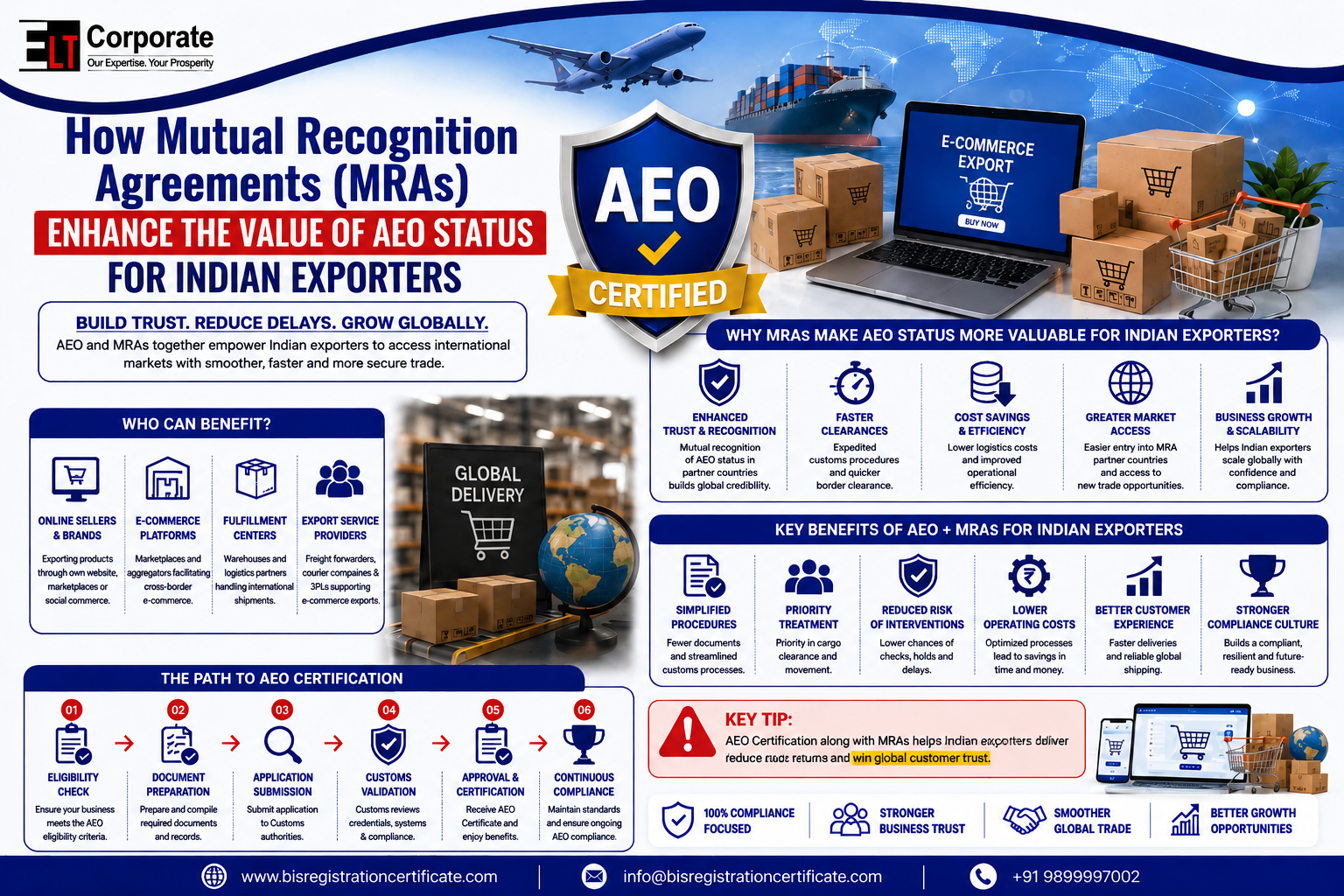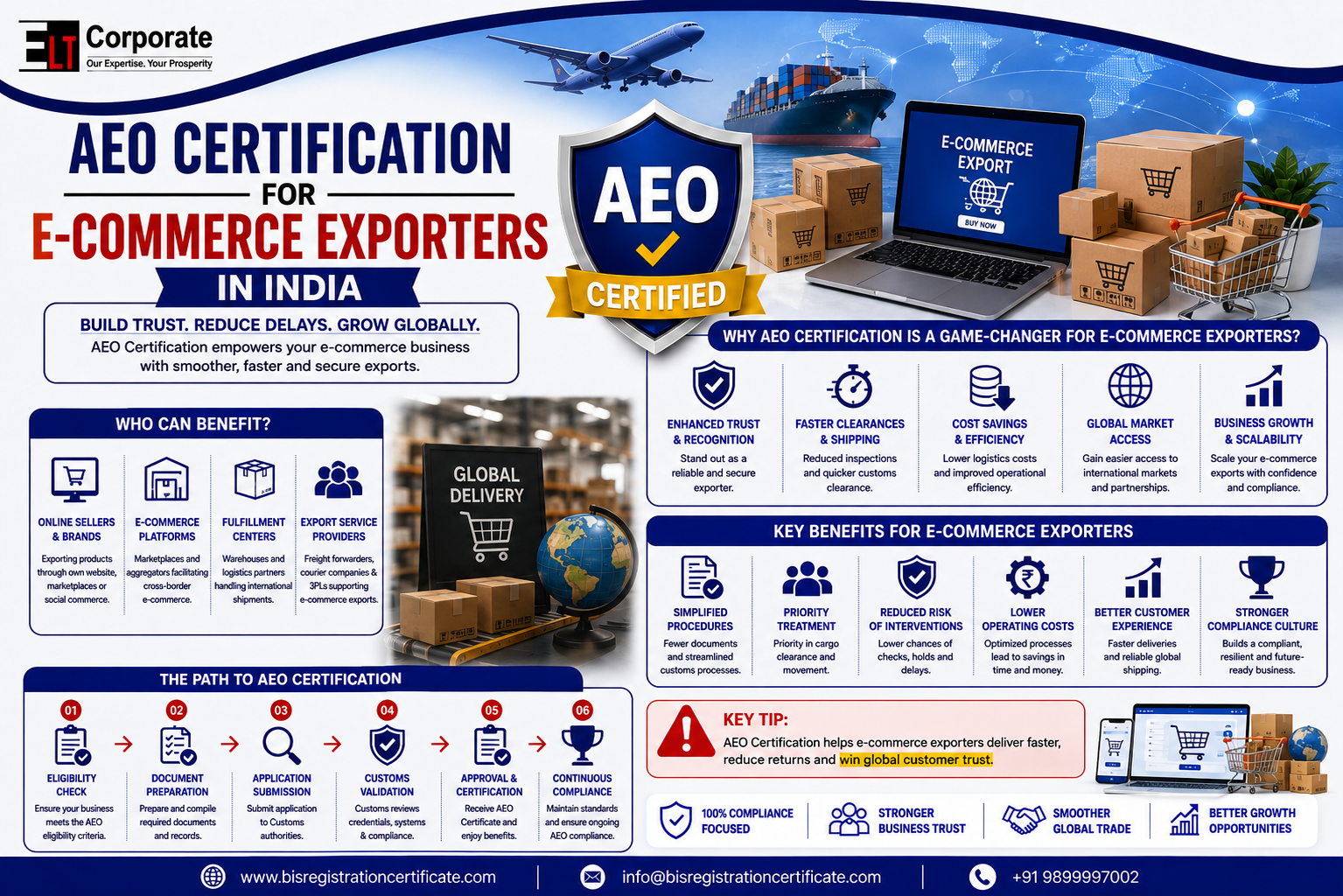
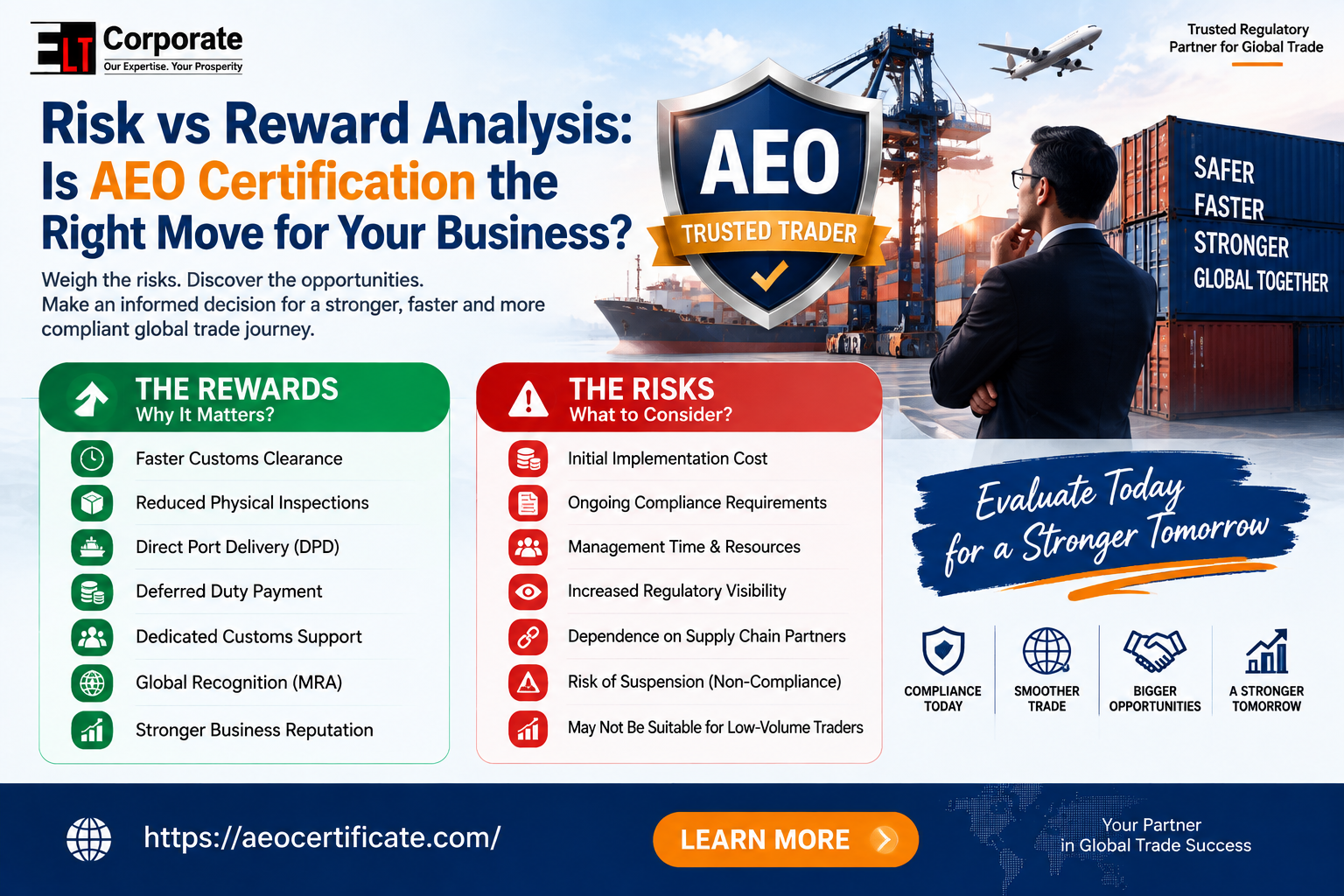
Every importer, exporter, customs broker, and international trade professional is talking about AEO Certification Benefits because businesses are looking for ways to make customs faster, make supply chains safer, and get an edge in trade.
The Authorised Economic Operator (AEO) Certification program that Indian Customs started gives trusted businesses benefits, such as quicker customs clearance, fewer inspections, the ability to pay duties later, and better trust with world trade partners.
A business gets it and then ignores it. AEO certification needs money for compliance systems, paperwork, safety steps, internal checks, and constant monitoring.
So before you apply, a business must look at the picture. AEO Certification benefits the cost, the risks, and the long‑term business value.
Understanding AEO Certification and Its Business Impact
AEO certification is a partnership between customs authorities and businesses that follow compliance standards and have secure supply chain practices.
Many businesses think AEO certification is an approval process. It is actually about creating a long-term compliance system that includes:
- Standard Operating Procedures (SOPs)
- Internal compliance checks
- Security management systems
- Employee awareness programs
- Vendor and supply chain monitoring
- Management-level supervision
AEO Certification Benefits: Understanding the Reward Side
1. Faster Customs Clearance
One of the AEO Certification benefits is faster processing of import and export shipments.
AEO-certified businesses receive priority treatment under customs procedures. This means they get priority handling when goods arrive at ports or inland container depots.This benefit is especially valuable for:
– companies
– Medical device importers
– Electronics businesses
– Automotive manufacturers
– Businesses dealing with time-sensitive shipments
For companies that AEO Certification benefits each year, even a small drop in clearance time can make a big difference. It helps cut down on:
– Demurrage charges
– Detention costs
– Warehouse expenses
– Supply chain delays
For businesses that only send AEO Certification benefits, the financial impact may not be as strong. Faster clearance might help. The savings could be smaller.
2. Reduced Physical Examination of Shipments
Another important AEO Certification benefits examination under the Risk Management System (RMS).
Physical inspections can cause:
- Delays in getting clearance
- Extra costs for handling
- Risks of damaging the packaging
- Disruptions in operations
For companies that handle expensive or delicate items, less frequent inspections offer a lot of value in their operations.
Businesses that import or export a lot generally get benefits because the savings add up across many shipments.
3. Direct Port Delivery (DPD) and Self-Sealing Benefits
For AEO holders, direct AEO Certification benefits can make a big difference in how efficiently goods move.
These benefits help companies:
- Avoid handling at the container freight station.
- Cut down on the number of times goods are moved.
- Make it easier to plan when products go out.
- Keep the number of times cargo is touched to a minimum.
For big companies that are close to major ports, this can be one of the best advantages of getting AEO Certification.
4. Improved Cash Flow Through Deferred Duty Payment
If you hold an AEO Certification benefits, you can enjoy deferred duty payment benefits. This lets you keep cash on hand and use it wisely. The benefit is not about lowering the amount of customs duty you owe. This benefit is particularly useful for:
- Importers who bring in expensive goods
- Businesses that import regularly
- Companies that handle peaks in demand
The benefit is not about lowering the amount of customs duty you owe. It is about paying that duty, which gives you more time to use your money.
5. Dedicated Customs Relationship Support
AEO Certification benefits may receive support from customs authorities, and I have seen many AEO-certified businesses benefit.
This support can help AEO-certified businesses resolve:
- Documentation queries
- Classification issues
- Procedural concerns
Businesses with product portfolios often find this support valuable.
AEO Certification Benefits and Risks: Looking at the Investment Side
Even though the benefits are good, companies need to know what comes with AEO certification.
1. Cost of Preparing the Application
Fees that the government charges are usually not the main cost.
The main money spent is on:
- Help from consultants
- Making the paperwork
- Creating operating procedures
- Involving workers inside the company
- Improving security systems
Companies should think if the AEO Certification Benefits are worth all these initial costs.
2. Continuous Compliance Maintenance
AEO Certification Benefits monitoring. Businesses must maintain:
– Updated SOPs
– Internal audits
– Security controls
– Employee training
– Vendor monitoring
– Compliance records
A mistake is to treat AEO certification as a one‑time project. The real value comes when businesses keep strong compliance systems running all the time.
3. Management Time and Internal Resources
I see that AEO certification needs help from:
- Management teams
- Compliance departments
- Logistics teams
- Finance departments
- Warehouse teams
For small businesses without dedicated compliance resources, AEO Certification Benefits may become challenging.
Risks Associated With AEO Certification
Risk 1: Application Delays or Rejection
If the documentation is incomplete, if there are gaps in compliance, or if the security systems are not strong enough, the approval process may be delayed.
Businesses can reduce this risk through:
- Pre-application gap analysis
- Compliance review
- Proper documentation preparation
Risks Associated With AEO Certification
Risk 2: Increased Regulatory Visibility
AEO-certified businesses operate under compliance expectations.
Material changes, such as:
- Ownership changes
- Compliance issues
- Operational modifications
- may require reporting.
Businesses must be prepared for increased responsibility. AEO Certification.
Risk 3: Supply Chain Partner Dependency
AEO compliance also depends on partners such as
– Customs brokers
– Freight forwarders
– Warehousing partners
– Suppliers
AEO Certification Benefits supply chain partner can impact overall AEO status.
Risk 4: Suspension or Cancellation Impact
Loss of AEO status can affect:
– Business reputation
– Customer confidence
– Supply chain credibility
Therefore, businesses should apply for AEO Certification Benefits.
Risk 5 — Suspension or Cancellation Consequences
If your AEO status is suspended or cancelled due to a compliance failure (yours or a partner’s), the reputational consequence can exceed the simple loss of facilitation benefits. A publicly known AEO certification benefits customers and suppliers by signalling your broader compliance posture.
A reputational risk that did not exist before you held (and lost) the certification. This is a genuine asymmetry: the reputational upside of holding AEO certification benefits modest and gradual; the reputational downside of losing it can be sharper and more visible.
How to Decide Whether AEO Certification Is Right for Your Business?
The decision depends on different factors. Businesses That Should Consider AEO Certification:
✔ Your company handles imports or exports.
✔ Customs delays affect business operations.
✔ You have significant shipment volumes.
✔ You work with multinational customers.
✔ You already maintain compliance systems.
✔ Supply chain reliability is important for your business.
These businesses are more likely to achieve strong returns from AEO Certification Benefits.
Businesses That Should Wait Before Applying
AEO certification may not be the choice right away if:
- Shipment volume is very low.
- Compliance documentation is weak.
- There is no internal compliance ownership.
- Customs operations are minimal
These businesses should first strengthen their compliance foundation.
AEO Certification Benefits: Cost-Benefit Evaluation Framework
Before applying, businesses should evaluate AEO Certification Benefits because knowing the numbers helps you decide. Potential Benefits:
- Improved cash flow
- Better customer confidence
- International trade advantages
- Potential Costs:
- Application preparation expenses
- Compliance system development
- Employee training
- Audit requirements
- Ongoing monitoring
If the annual value generated through AEO Certification Benefits is greater than the compliance investment, then it becomes a strategic business decision.
Trade Corridor Relevance
Strong case for AEO: Significant trade with South Korea, Hong Kong, Taiwan, or the USA (MRA benefit realization) or high-value AEO Certification Benefits examination/clearance speed materially affects cost or service levels.
Weaker case for AEO: Trade concentrated in corridors without MRA coverage and cargo types where time/examination sensitivity is low.
Factor 6 — Competitive and Procurement Context
Strong case for AEO: Your customers, buyers, and AEO Certification Benefits or formally evaluate supply chain compliance credentials (common in pharma, electronics, automotive, and multinational supply chains).
Weaker case for AEO: Your market is price-driven with limited buyer interest in compliance credentials, and AEO certification would not materially influence sales or procurement outcomes.
What “Not Now” Can Look Like—A Legitimate Choice
AEO Certification Benefits is not right for every business, at every stage. A legitimate, defensible decision can be to delay pursuit of AEO certification while you:
- Build a 3-year (minimum) clean compliance track record if your trade history is shorter or troubled
- Develop foundational SOPs and internal compliance practices that you would need regardless of AEO—simply because they are good business practice
- Grow your trade volume to a point where the facilitation benefits clearly outweigh the compliance infrastructure investment
- Build internal compliance capacity (even a single dedicated person) before taking on the governance obligations of certification
Choosing to delay is not AEO Certification Benefits the financially and operationally sound choice for businesses not yet ready to sustain the ongoing obligations.
Documentation Required for AEO Certification
I am writing this guide so that businesses can understand which documentation is needed to obtain AEO Certification benefits. Documentation must show that a business follows customs rules, is financially stable, and keeps its supply chain secure.
1. Business & Legal Documents
- Certificate of Incorporation / Partnership Deed / Proprietorship Proof
- PAN Card of the Company
- GST Registration Certificate
- IEC (Import Export Code)
- Company Profile
- Details of Directors / Partners / Key Management Personnel
2. Customs Compliance Documents
- Import/export transaction details (past 3 years)
- Bill of Entry and Shipping Bill details
- Customs duty payment records
- Details of Customs Brokers (CHA)
- Details of Show Cause Notices (SCNs) penalties or adjudication proceedings
- Customs compliance history
What “Yes, Now” Looks Like—When the Case is Clear
Conversely, the case for pursuing AEO certification now is strongest when you can answer “yes” to most of the following:
- You experience real, quantifiable customs friction costs (demurrage, detention, examination delays) that AEO facilitation would directly reduce
- Your annual trade volume is substantial enough that even modest per-shipment savings compound into meaningful annual value
- You already have, or can readily build, the basic compliance documentation and security infrastructure for AEO Certification Benefits.
- You have organizational capacity (a person, a team, or a committed management sponsor) to sustain ongoing compliance governance
- Your compliance history is clean, or any past issues are resolved and explainable
Conclusion
AEO certification benefits can give an advantage to businesses that work with international trade on a regular basis. Faster customs checks, fewer inspections, better cash flow, and more trust from partners can really help make the supply chain work better.
Aeo certification is not just about getting a stamp of approval. It means staying focused on keeping records, managing security, doing regular checks inside the company, and making sure the business follows customs rules all the time.
Companies that send a lot of shipments deal with customs often. Want to grow abroad? You can get the most out of AEO Certification Benefits.
Before applying, businesses should think about how much they trade, how ready they are to follow rules, and what they want to achieve in the future. This will help them decide if AEO certification fits with their plan to grow.
Frequently Asked Questions
Q.1 What are the main AEO Certification benefits?
The main AEO Certification benefits include customs clearance, fewer inspections, stronger supply chain security, and better cash flow.
Q.2 Is AEO Certification mandatory?
No AEO certification is mandatory. It is a program, but it offers big advantages for importers and exporters who qualify.
Q.3 Who can apply for AEO Certification?
Importers, exporters, manufacturers, logistics providers, and other businesses involved in the supply chain can apply for AEO certification.
Q.4 Does AEO Certification reduce customs duty?
No AEO certification does not lower customs duty. However, it may allow eligible businesses to delay duty payments under certain conditions.
Q.5 How long does AEO Certification remain valid?
AEO Certification benefits stay valid as long as the business continues to meet all AEO requirements and stays compliant.
Q.6 Is AEO Certification for small businesses?
Yes, small businesses that regularly engage in trade can benefit from AEO Certification benefits if they keep up with compliance standards.
Q.7 What documents are required for AEO Certification?
Required documents include company information, IEC, GST certificate, customs records, financial statements, standard operating procedures, and security-related documents.