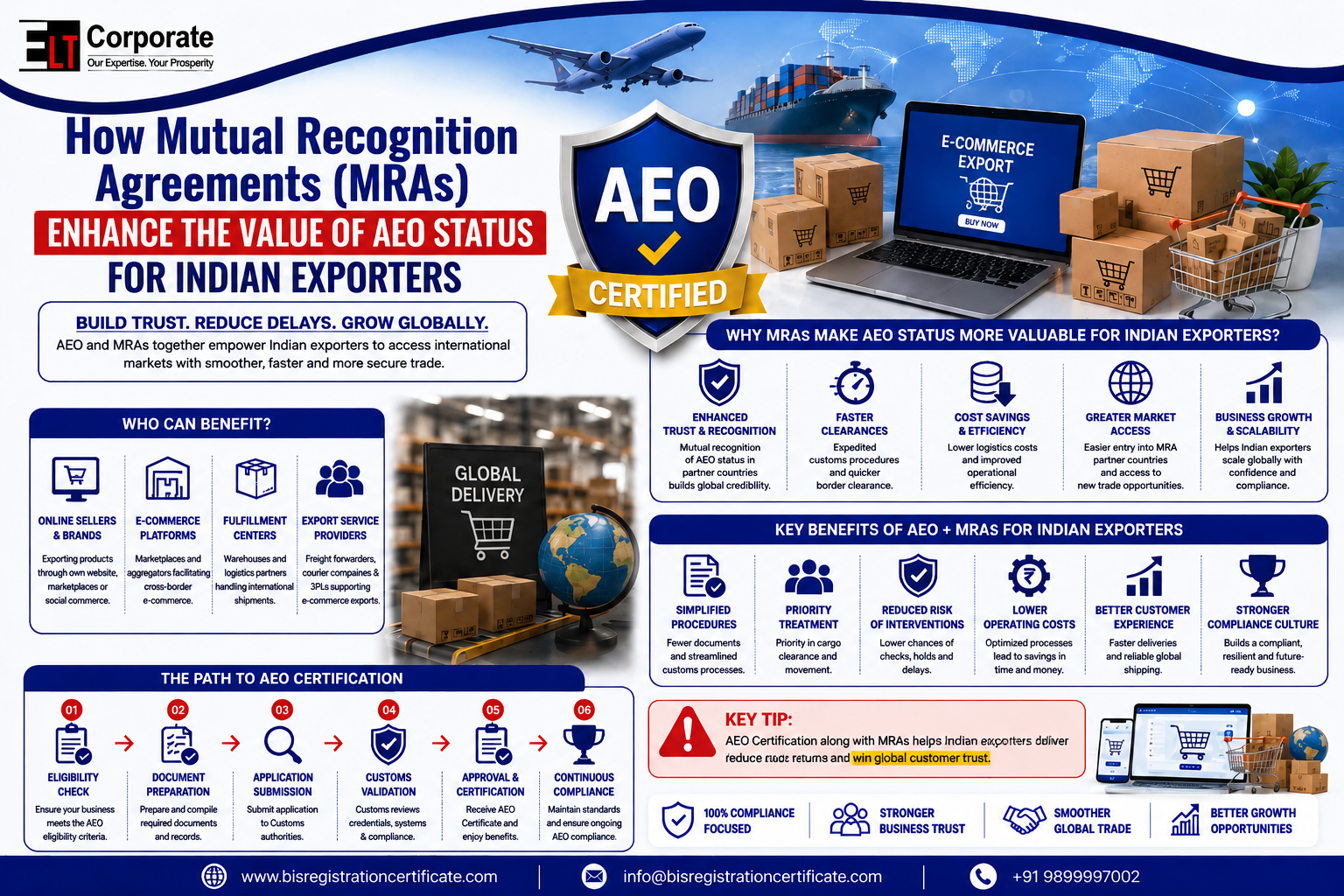
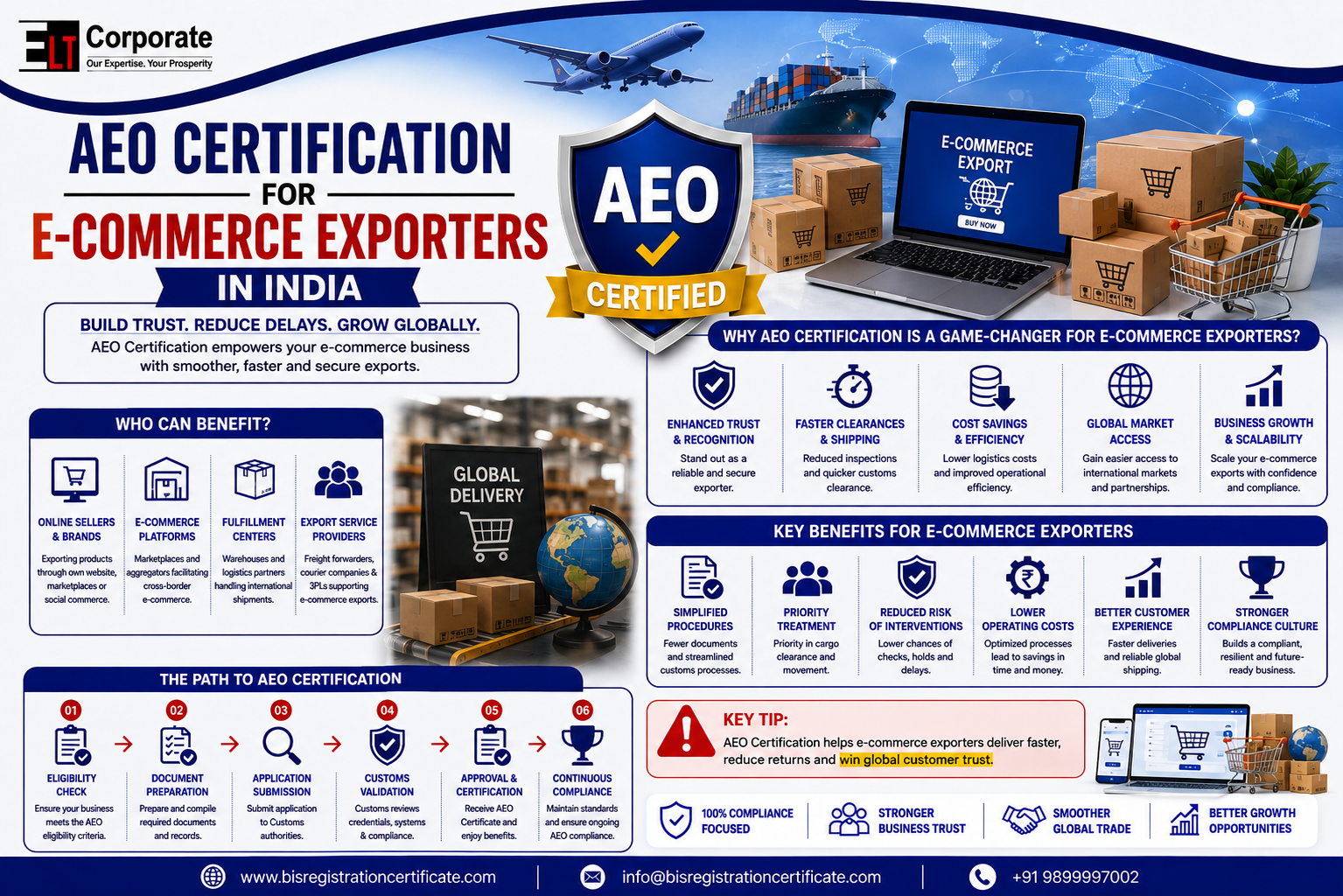
The rise of cross-border e-commerce has enabled Indian firms to reach customers from across the globe through online marketplaces. However, cross-border e-commerce requires compliance with various customs-related procedures, protocols, and responsibilities. Businesses can get the AEO certification for e-commerce exporters offered under the Indian Customs’ Authorized Economic Operator program to facilitate the ease of conducting international trade.
The AEO certification program helps online e-commerce sellers gain credibility as trusted partners by displaying compliance with customs regulations. The AEO authentication program helps people and firms involved in the process of cross-border e-commerce become easily recognized as customs-compliant operations.
For exporters in the e-commerce space, the AEO certification for e-commerce exporters status will facilitate the conduct of trade across borders by easing shipment processes and building trust with business partners and customers.
What is AEO Certification for E-Commerce Exporters?
AEO certification for e-commerce exporters is a recognition from Indian Customs that is granted to a relevant business that engages in international trade. It is issued to companies that comply with prescribed compliance and security requirements.
An e-commerce exporter can sell products via international marketplaces, direct online stores, and cross-border shipping channels. Although the business is conducted electronically and online, it still has to comply with customs requirements, export documentation requirements, procedures in logistics, and supply chain security requirements.
The AEO Program identifies companies that are considered reliable businesses since they maintain:
- Compliance with customs regulations
- Documentation systems
- Financial stability
- Security of supply chain management
- Internal control procedures
- Risk management systems
Companies obtaining AEO status are treated as trusted partners by Customs and can get trade facilitation benefits.
Why Do E-Commerce Exporters Need AEO Certification?
E-commerce exporters encounter different issues than regular exporters. They have to deal with:
- Many international shipments
- Courier exports
- Returns
- Documentation
- Global market conditions
- Quick delivery requirements
Hassles with customs can have devastating effects on customer service.
AEO Certification for E-Commerce Exporters proves beneficial for e-commerce exporters, as it enables them to establish compliance-oriented processes and enhances their export business.
Major reasons why e-commerce exporters should consider AEO certification:
| Challenge Faced by E-Commerce Exporters | How AEO Certification Helps |
| Shipment clearance delays | Faster customs processing |
| Frequent documentation requirements | Better record management systems |
| International customer expectations | Improved reliability and trust |
| Supply chain risks | Stronger security controls |
| Increasing export volumes | Better operational efficiency |
Benefits of AEO Certification for E-Commerce Exporters
Faster Customs Clearance
One of the key benefits of AEO certification for e-commerce exporters is enhanced customs facilitation. Organizations holding AEO status are viewed as trustworthy enterprises, enabling them to have more efficient customs activities, which results in a lesser number of delays in export procedures.
In e-commerce operations, where customer satisfaction is highly influenced by the speed of delivery, faster customs processing gives an edge over competitors.
Improved Business Credibility
Trust plays a significant role in global e-commerce. International customers, marketplaces, and logistical partners prefer businesses that comply with rules and regulations.
AEO Certification for e-commerce exporters improves business credibility by proving that the exporter works according to documented procedures, secures the supply chain, and follows customs regulations. Having this certificate increases the confidence of international stakeholders in the business.
Better Supply Chain Management
E-commerce exports require the participation of several actors, among which we can mention manufacturers, warehouses, courier companies, shipping companies, and customs authorities. Weaknesses in the supply chain may lead to risks, such as delays in shipments, loss of goods, and non-compliance problems.
Using an AEO Certificate for E-commerce Exporters, it is possible to streamline the supply chain by applying security measures, monitoring shipments, and defining responsibilities among different parties involved in the exporting process.
Reduced Compliance Risks
Several e-commerce exporters encounter problems as a result of missing documentation, wrong statements, absence of internal processes, and insufficient knowledge regarding compliance.
Acquiring AEO Certification for E-commerce Exporters encourages businesses to formulate appropriate Standard Operating Procedures (SOPs), keep records accurate, and practice risk management procedures. The result is alleviation of compliance risks and enhancement of export processes.
Eligibility Criteria for AEO Certification for E-Commerce Exporters
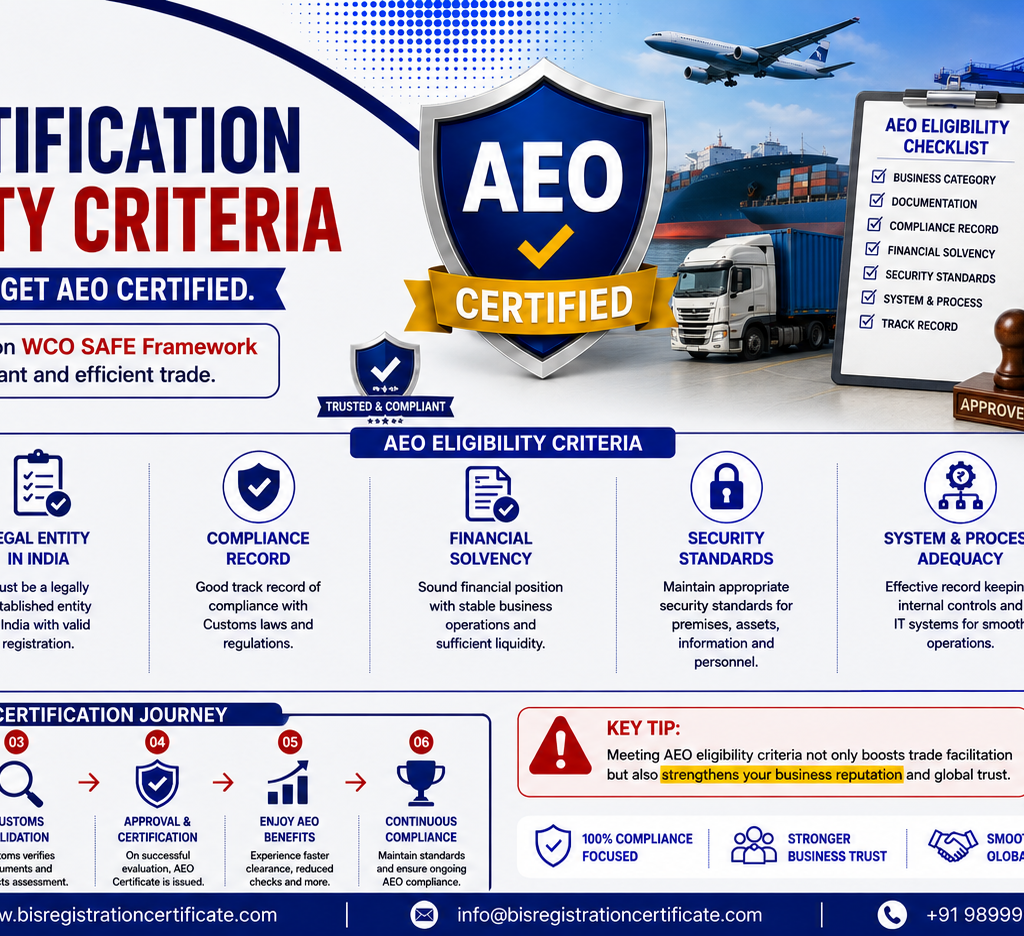
In order to receive AEO recognition, e-commerce exporters have to meet prescribed eligibility criteria, which are set by customs departments. These requirements guarantee that reliable and compliant firms can obtain recognition under the AEO Programme.
The main eligibility criteria for AEO Certification for E-Commerce Exporters consist of a customs compliance record, financial standing, proper documentation systems, and the effectiveness of internal control and security measures in the supply chain.
Customs Compliance History
The requirement of having a good customs compliance history plays an important role in achieving AEO Certification for e-commerce exporters. Businesses must show that they adequately adhered to customs law, made correct declarations, properly classified goods, and complied with export regulations.
Customs regulatory authorities examine the applicant’s history in the field of responsible trade and whether the business adopted sufficient measures to avoid such violations.
Proper Documentation and Record Maintenance
Documentation is essential in international trade. Exporters engaged in e-commerce have to keep records related to shipments, invoices, export declarations, clients’ records, and logistics.
In line with the AEO Certification of E-Commerce Exporters, organizations should show that their records are kept in an organized manner, are accessible, and comply with legal requirements. Documentation allows customs authorities to check the transparency of operations.
Financial Stability
Another factor that is considered in the AEO assessment process is financial stability. Customs authorities favor businesses with stable financial status and the ability to continue operations properly.
In the case of applying for AEO certification for e-commerce exporters, businesses may need to provide documents such as financial statements, tax reports, etc., which prove their economic stability and the sustainability of their services.
AEO Certification Process for E-Commerce Exporters
The procedure for achieving AEO certification for e-commerce exporters consists of several steps—
Step 1: Eligibility Evaluation
To begin with, a company must check whether it fulfills the compliance and operational criteria to qualify.
Conducting a well-structured gap analysis at this stage helps to identify a lack of documentation, dubious processes, or any other area to be improved.
Step 2: Document preparation and SOPs
Documents are to be prepared by the shipper, including:
- Customs procedures
- Security measures
- Risk management systems
- Ways of record-keeping
- Step 3: Sending an application
The application is sent through the AEO portal, which includes supporting documents.
Step 4: Checking by customs authorities
The information that has been provided is reviewed by customs authorities, which check whether the systems, records, and controls meet the requirements.
Step 5: Receiving AEO certificate
If the evaluation is successful, the AEO status is granted to the interested companies.
Common Challenges Faced by E-Commerce Exporters While Applying for AEO Certification
There are a number of challenges encountered by online exporters, such as the following:
Absence of proper SOPs
Small businesses often don’t keep written processes, and this can lead to difficulties during checking.
Ineffective record management
Lost export documents or insufficient information may lengthen the time of the certification process.
Weak security systems
Sometimes companies fail to pay enough attention to warehouse security, data protection, and access control.
Lack of compliance knowledge
Without specialized consulting, it might be difficult to understand customs requirements in detail.
Role of an AEO Certification Consultant for E-Commerce Exporters
Functions of an AEO Certification Consultant for E-Commerce Exporters. An experienced consultant can facilitate the various stages of the certification process.
AEO Certification Consultant for E-Commerce Exporters can assist in:
- Assessing eligibility
- Identifying compliance gaps
- Preparing documentation
- Drafting SOPs
- Creating security systems
- Providing application support
- Preparing for customs audit
With the right support, exporters can avoid frequent errors and enhance their odds of obtaining certification.
AEO Certification for MSME E-Commerce Exporters
Several e-commerce exporters are small and medium companies; the MSME category of enterprises can also take advantage of AEO certification by becoming more trustworthy and thus running their export business better.
Benefits of AEO Certification for E-Commerce Exporters for MSMEs:
- Enhancing international trust
- Boosting customs activities
- Structuring business processes
- Expanding into foreign markets
Thus, e-commerce exporters can gain a serious competitive advantage by acquiring AEO certification when entering foreign markets.
Importance of SOPs for AEO Certification for E-Commerce Exporters
Standard Operating Procedures (SOPs) enable companies to ensure that they are functioning in an organized way. E-commerce exporters are involved in a number of shipments; therefore, procedures should be written to guarantee uniformity in operations.
With regard to AEO Certification for E-Commerce Exporters, it is necessary for businesses to create SOPs in relation to:
– Export papers
– Export processing
– Customs communication
– Risk management
– Data security
– Responsibilities of personnel
Properly written SOPs allow Customs authorities to see that the company conducts its internal work effectively.
AEO Certification Security Requirements for E-Commerce Exporters
Security is one of the main aspects of AEO Certification for e-commerce exporters, who need to protect their products, information, and systems against unauthorized access.
Security measures may include:
- Warehouse security
- Employee verification
- Access control
- Video surveillance
- Data protection policies
- Loading the goods safely
The adoption of these measures will help consolidate the application of AEO certification for e-commerce exporters.
Advantages of AEO Certification for Small E-Commerce Export Companies
Small e-commerce exporters usually encounter difficulties competing with global online vendors. They may become more successful if they obtain certification.
By achieving AEO Certification for E-commerce Exporters, small businesses can:
- Boost customer trust
- Establish structured export activities
- Decrease risks of compliance issues
- Improve relations with international partners
- Be ready for business growth
How to Prepare Your E-Commerce Business for AEO Certification
The first step in the process is to carry out an extensive assessment of compliance and determine what needs to be improved.
The following are the steps for preparing your AEO Certification for E-commerce Exporters:
- Reviewing the history of customs compliance
- Organizing export documentation
- Creating standard operating procedures
- Training employees
- Installing security systems
- Conducting internal audits
In order to ensure that your company is completely prepared for customs certification.
Difference Between Normal Exporters and AEO-Certified E-Commerce Exporters
An ordinary exporter could successfully execute export transactions without setting up compliance systems, procedures, or security measures.
Conversely, companies with AEO Certification for E-commerce Exporters demonstrate a higher level of compliance, operational control, and supply chain security. AEO-certified exporters are acknowledged as trustworthy businesses by Customs authorities, which brings certain operational benefits.
| Normal Exporters | AEO Certified Exporters |
| Basic export compliance | Advanced compliance systems |
| Limited documentation controls | Proper record management |
| Reactive risk management | Defined risk management procedures |
| Basic security practices | Strong supply chain security |
AEO Certification for E-Commerce Exporters Selling Through Online Marketplaces
Many businesses in India are choosing to export their products over the internet, through various platforms like international websites, independent sites, and e-commerce channels. It can take a lot of effort to export goods efficiently.
When it comes to frequent trade in goods, exporters must be well aware of the proper procedures, be on top of their shipments, and ensure that they have all the paperwork correctly done.
AEO certification for e-commerce exporters allows online platforms to build an infrastructure to work properly in terms of exporting goods. With the right practices in place, exporters will be able to ship their goods with minimum issues and risks.
For online sellers that are ready to grow, the AEO certification serves as an important step toward turning small businesses into worldwide-recognized exporting companies.
AEO Certification Checklist for E-commerce Exporters
Exporters must assess their readiness before applying for certification through the right checklist.
Checklist for AEO Certification for E-commerce Exporters:
✅ Valid Import Export Code (IEC)
✅ Proper GST and business registration
✅ Strong customs compliance record
✅ Complete export documents
✅ Standardized procedures for export operations
✅ Security procedures in place
✅ Employee training details
✅ Risk management practices
✅ Data protection systems
✅ Financial stability details
Completing this checklist helps businesses find gaps and prepare well enough before submitting applications.
Documents Required for AEO Certification for E-Commerce Exporters
The process of acquiring AEO Certification for e-commerce exporters requires certain significant documents from the businesses that prove their ability to meet all customs requirements, confirm financial security, show the existence of operational controls, and provide an account of their supply chain security practices.
Since the exporters engage in constant international shipments using courier companies, marketplaces, and logistics service providers, proper documentation remains of key importance in getting approval for the AEO application.
Business Registration and Legal Documents
These documents generally include:
- Certificate of Incorporation (for companies)
- Partnership Deed (for partnership firms)
- LLP Agreement (for LLPs)
- Proprietorship registration documents (if applicable)
- PAN Card of the business entity
- GST Registration Certificate
- Import Export Code (IEC)
- Company profile and business details
These documents help customs authorities verify the legal existence of the exporter and understand the nature of business activities.
The Significance of Export Documentation Management in AEO Certification
Documentation is the essence of international trade; e-commerce exporters deal with various documents ranging from commercial invoices to shipping bills, product details, packing lists, courier documents, and customer information.
Poor documentation leads not only to customs inquiries but also to shipment delays, fines, and compliance issues.
An AEO Certification for E-commerce Exporters calls for the need for a well-structured documentation system whereby all export documents are recorded, readily accessible, and available for verification at any required time.
The presence of strong documentation systems acts as proof of transparency and control in operations, two of the major criteria taken into consideration during the AEO certification process.
Conclusion
The documentation process is essential to acquiring AEO Certification for e-commerce exporters. Customs authorities assess not just the documents submitted by the exporter but also whether they have sufficiently established compliance systems that work properly.
By keeping their records organized, including export documentation, standard operating procedures (SOPs), security controls, financial documents, and risk management systems, e-commerce exporters increase readiness for AEO certification.
A proper structure of documentation will help businesses be successful in obtaining certification and solidify their role as trustworthy players in international trade.
Frequently Asked Questions
Q1. What does AEO Certification entail for e-commerce exporters?
The term “AEO Certification” stands for “Authorized Economic Operator.” It refers to the kind of accreditation given to e-commerce entities engaged in exports.
Q2. Are e-commerce traders able to receive AEO Certification in India?
Yes, if the e-commerce exporter meets all required eligibility criteria for AEO certification, it will be able to obtain it, whether it operates with other countries.
Q3. Does AEO Certification have to be obtained by e-commerce exporters?
AEO Certification is non-compulsory. Even if there are a number of advantages of AEO certification, it is not a legal requirement for e-commerce exporters.
Q4. What are the advantages of AEO Certification?
AEO provides improved customs clearance, reduced compliance risks, security of the supply chain, enhanced credibility, and effective operations.
Q5. What documentation is required for AEO Certification for E-Commerce Exporters?
The most common documents include the following: IEC (Import-Export Code), GST registration, business license, proof of exports, reports, audits, and a description of practices.