
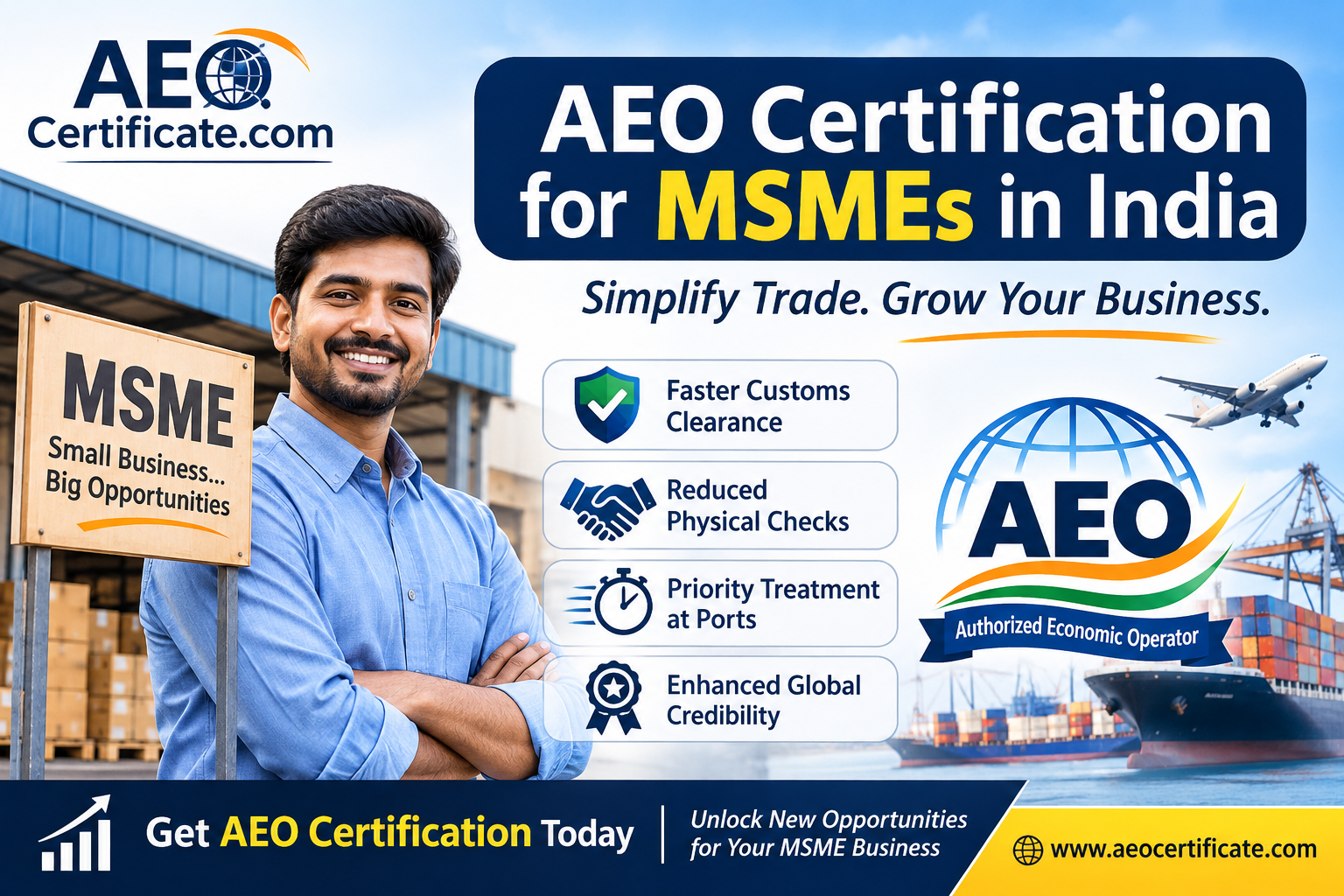
India’s Micro, Small, and Medium Enterprises (MSMEs) play a significant role in manufacturing, international trade, and economic development. Many AEO Certification for MSMEs in India support small and medium-sized businesses that import raw materials, machinery, components, and finished goods while exporting products to international markets.
However, managing customs procedures, documentation, shipment clearance, compliance requirements, and working capital can be challenging for growing businesses. Delays in customs clearance may affect production schedules, inventory planning, delivery commitments, and overall business costs.
To support compliant businesses involved in international trade, the Central Board of Indirect Taxes and Customs (CBIC) operates the Authorised Economic Operator (AEO) Programme. AEO Certification for MSMEs in India provides eligible businesses with access to customs facilitation benefits and encourages stronger compliance and supply chain security.
The program is particularly relevant to manufacturers, importers, exporters, and eligible logistics operators that want to improve their international trade operations.
In 2026, the introduction of the Eligible Manufacturer Importer (EMI) deferred customs duty facility has also created an important opportunity for eligible manufacturing businesses. This development makes it useful for MSMEs to understand the relationship between AEO certification, customs compliance, and the new manufacturer-importer facility.
What Is AEO Certification for MSMEs in India?
The Authorised Economic Operator (AEO) Programme is a voluntary customs compliance and supply chain security programme administered by CBIC.
Under this program, eligible businesses involved in the international supply chain can receive recognition as trusted trade partners after satisfying the applicable eligibility and compliance requirements.
AEO Certification for MSMEs in India is relevant to eligible small and medium-sized businesses that undertake customs-related activities, including importing, exporting, manufacturing, and providing logistics services.
The program encourages businesses to establish and maintain:
- A satisfactory customs compliance record.
- Proper business and transaction documentation.
- Effective record-management procedures.
- Financial solvency.
- Appropriate internal controls.
- Supply chain security arrangements, wherever applicable.
- Clearly assigned compliance responsibilities.
AEO certification is voluntary. Businesses should evaluate the relevant eligibility conditions before selecting a certification category.
Why Is AEO Certification Important for MSMEs?
MSMEs often operate with limited working capital, smaller teams, and tight delivery schedules. Import delays or unexpected AEO certification for MSMEs in India customs-related requirements can create additional pressure on their operations.
For example, a manufacturer importing electronic components may depend on regular shipments to maintain production. If imported materials are delayed, the company may face production interruptions and difficulty meeting customer commitments.
Similarly, an exporter may need predictable customs procedures to meet international delivery schedules.
AEO Certification for MSMEs in India can help eligible businesses improve customs facilitation and develop more organized compliance systems.
Some important reasons for considering AEO certification include:
1. Improved Customs Clearance
Eligible AEO entities receive customs facilitation according to their certification category and applicable provisions. This can help reduce routine interventions and improve the predictability of cargo clearance.
2. Better Working Capital Planning
Customs facilitation measures and applicable deferred duty payment benefits can support better financial planning. Businesses should identify which facilities apply to their particular category rather than assuming every benefit is available to every AEO entity.
3. Stronger Compliance Management
Preparing for AEO certification encourages businesses to review their customs records, internal procedures, security arrangements, and responsibilities.
4. Improved Supply Chain Reliability
A structured compliance system can help businesses identify documentation gaps, improve coordination, and manage supply chain risks.
5. Better International Trade Credibility
AEO recognition can demonstrate that a business has been assessed under the applicable customs framework. It may support confidence among customers, suppliers, and international trade partners.
Types of AEO Certification Available in India
Before applying, businesses should identify the appropriate AEO category. The Indian AEO Program provides different categories based on business activities and eligibility.
AEO-T1 Certification
AEO-T1 is an entry-level certification for eligible importers and exporters.
It is suitable for businesses that meet the AEO certification for MSMEs in India, which prescribe general, legal compliance, record management, and financial solvency requirements.
AEO-T1 can be a practical starting point for MSMEs that want to participate in the AEO Program and improve their customs facilitation status.
AEO-T2 Certification
AEO-T2 is intended for eligible businesses that AEO certification for MSMEs in India demonstrates stronger compliance systems and applicable supply chain security arrangements.
The assessment includes verification requirements, including premises-related verification as prescribed.
Businesses seeking a higher level of customs facilitation should evaluate whether their existing procedures and security controls meet the applicable AEO-T2 requirements.
AEO-T3 Certification
AEO-T3 is the higher AEO tier available to eligible existing AEO-T2 entities that meet the prescribed conditions.
It is designed for businesses that demonstrate sustained compliance and satisfy the relevant requirements for progression to this tier.
AEO-LO Certification
AEO-LO is intended for eligible logistics operators involved in the international supply chain.
Depending on their activities and eligibility, applicants may include:
- Customs brokers.
- Freight forwarders.
- Custodians.
- Terminal operators.
- Warehouse operators.
- Other qualifying logistics service providers.
MSMEs operating in logistics and supply chain services should assess whether AEO-LO is the appropriate category instead of applying under the importer-exporter tiers.
AEO Certification Eligibility for MSMEs in India
Eligibility depends on the type of applicant and the AEO category selected. MSMEs should not assume that their Udyam registration alone makes them eligible for AEO certification.
Applicants need to review the AEO certification for MSMEs in India prescribed requirements and demonstrate that their business operations meet the relevant customs compliance standards.
Important eligibility considerations include:
1. Business Registration and Identity
The applicant should maintain valid business registration and identification records. Details provided in the application should be consistent with the company’s official records.
2. Customs Compliance Track Record
Businesses should review their customs-related compliance history, including applicable declarations, transactions, and pending matters.
A satisfactory compliance record is an important part of demonstrating readiness.
3. Financial Solvency
Applicants must satisfy the financial solvency requirements applicable to their certification category.
Financial statements and other supporting evidence may be required to demonstrate the business’s financial position.
4. Proper Record Management
MSMEs should maintain organized records relating to imports, exports, customs declarations, transactions, suppliers, and business operations.
Records should be accessible, accurate, and capable of supporting verification.
5. Documented Business Procedures
Businesses should establish written procedures for important activities such as:
- Import and export documentation.
- Goods receipt and dispatch.
- Supplier and customer management.
- Record retention.
- Access control.
- Handling compliance issues.
- Reporting and escalation of discrepancies.
6. Security Arrangements
For AEO-T2, AEO-T3, and AEO-LO, relevant safety and security requirements apply. These may include premises security, access controls, cargo handling procedures, and other measures according to the prescribed criteria.
AEO-T1 applicants must also meet their applicable eligibility and compliance requirements but should not assume that all higher-tier security requirements apply identically.
AEO Certification Application Process for MSMEs
The application process requires preparation, document submission, assessment, and compliance with the applicable verification requirements.
The general process is explained below.
Step 1: Identify the Appropriate AEO Category
First, identify whether the business should apply under AEO-T1, AEO-T2, AEO-T3, or AEO-LO.
An importer or exporter may consider the relevant T1 or T2 category, while a qualifying logistics operator should review AEO-LO requirements.
Step 2: Conduct an Eligibility Assessment
Review the applicable eligibility conditions, legal compliance history, financial solvency, and record-management arrangements.
For higher-tier applications, assess whether the required security controls are established and operating effectively.
Step 3: Organize Business and Compliance Records
Collect the required AEO certification for MSMEs in India company documents, financial records, customs information, and operational evidence.
Ensure that company names, addresses, registration details, and other information are consistent across documents.
Step 4: Prepare Internal Procedures
Review existing business procedures and identify gaps.
Where required, prepare or improve SOPs covering customs documentation, record management, security, access control, and operational responsibilities.
Step 5: Submit the Online Application
Complete the relevant application through the official Indian Customs AEO portal:
Select the appropriate category, enter the required information, and upload supporting documents according to the portal instructions.
Benefits of AEO Certification for MSMEs in India
One of the main reasons businesses explore AEO Certification for MSMEs in India is the possibility of receiving customs facilitation benefits.
The benefits available depend on the certification category and applicable conditions.
1. Faster Cargo Clearance
Eligible AEO entities can receive higher levels of customs facilitation, which may help reduce cargo release time.
This is important for businesses that depend on regular imports of raw materials, machinery, components, or finished goods.
2. Direct Port Delivery and Direct Port Entry
Eligible businesses may benefit from Direct Port Delivery (DPD) for imports and Direct Port Entry (DPE) for exports, subject to applicable conditions and operational requirements.
These facilities can help improve cargo movement and reduce certain handling steps.
3. Reduced Bank Guarantee Requirements
AEO certification provides category-based reductions in bank guarantee requirements, subject to prescribed exceptions.
For eligible MSME AEO-T1 entities, the official AEO framework provides an additional reduction in the applicable bank guarantee requirement.
The actual amount and applicability should be checked against the relevant customs provision.
4. Priority Customs Facilitation
AEO entities may receive priority treatment and facilitation according to their certification level and the applicable customs framework.
This can support more predictable import and export operations.
5. Better Internal Compliance
The preparation process encourages businesses to establish documented procedures and maintain organized records.
These improvements can also support internal audits, supplier coordination, and operational monitoring.
6. International Recognition
India participates in Mutual Recognition Arrangements with certain partner customs administrations.
Subject to the applicable arrangement and eligibility conditions, AEO recognition may provide facilitation benefits in partner countries.
7. Improved Business Confidence
AEO certification can help businesses demonstrate their commitment to customs compliance and secure supply chain practices.
This may be useful when building relationships with international buyers, suppliers, and logistics partners.
Important 2026 Update: Eligible Manufacturer Importer (EMI) Scheme
One important development for manufacturers in 2026 is the introduction of the Eligible Manufacturer Importer (EMI) facility.
Under this initiative, eligible manufacturer-importers can obtain AEO certification for MSMEs in India clear imported goods without paying customs import duty at the time of clearance. Instead, the applicable duty is paid later according to the prescribed deferred payment framework.
The facility became available from 1 April 2026 and is scheduled to remain in force until 31 March 2028, subject to the applicable rules and conditions.
The scheme is intended to support manufacturing activity, improve liquidity, and encourage businesses to move towards higher AEO compliance standards.
Who Can Benefit from the EMI Scheme?
The facility is intended for approved AEO certification for MSMEs in India manufacturer-importers that satisfy the prescribed criteria.
The eligibility framework includes requirements relating to:
- Manufacturer and importer status.
- Valid Import Export Code.
- Customs and GST compliance.
- Financial standing.
- Import-export transaction history.
- Other conditions specified by CBIC.
The 2026 government guidance specifies a minimum of 25 EXIM documents in the preceding financial year, reduced to 10 for MSMEs, along with other eligibility requirements.
Applicants should verify the current conditions and supporting evidence requirements before applying.
How Does EMI Help Manufacturers?
The EMI facility can help eligible AEO certification for MSMEs in India manufacturers by allowing them to defer customs duty payment rather than paying it at the time of import clearance.
Potential operational advantages include:
- Better cash flow planning.
- Improved working capital management.
- More predictable import operations.
- Better inventory planning.
- Support for manufacturing continuity.
- Encouragement to strengthen customs compliance.
Is EMI the Same as AEO Certification?
No. EMI approval and AEO certification are related to customs facilitation, but they are not the same approval.
The EMI facility is a separate, time-limited pathway for eligible manufacturer-importers. The government has described it as a transition measure encouraging manufacturers to obtain higher AEO accreditation.
An EMI approval should not be represented as an AEO certificate. Businesses must satisfy the relevant requirements for each program.
Common AEO Compliance Mistakes MSMEs Should Avoid
Businesses preparing for AEO Certification for MSMEs in India should identify potential gaps before submitting their applications.
Some common mistakes include:
1. Incomplete Documentation
Missing financial records, inconsistent business details, or incomplete customs information can lead to additional queries.
How to avoid it: Prepare a document checklist and verify the accuracy of every submission.
2. No Written SOPs
Some MSMEs follow internal procedures but do not maintain written documentation.
How to avoid it: Prepare practical SOPs for import-export operations, record management, security, and compliance responsibilities.
3. Weak Record Management
Poorly organized records can make it difficult to demonstrate compliance during assessment.
How to avoid it: Maintain updated digital and physical records with clear responsibility for record retention.
4. Ignoring Security Requirements
Applicants seeking higher AEO tiers may underestimate the importance of premises and supply chain security.
How to avoid it: Review the applicable security checklist and maintain evidence that the prescribed controls are implemented.
5. Selecting the Wrong AEO Category
Applying under an unsuitable category can create unnecessary preparation work.
How to avoid it: Assess business activities and eligibility before beginning the application.
6. Not Monitoring Post-Certification Requirements
Obtaining certification does not mean that compliance responsibilities end.
How to avoid it: Monitor applicable declarations, updates, renewals, and changes to business information. Follow the latest official instructions for the relevant category.
Documents Required for AEO Certification for MSMEs in India
Documentation is an important part of the AEO Certification for MSMEs in India application process. Incomplete, inconsistent, or outdated records can result in clarification requests and processing delays.
The exact checklist depends on the applicant’s category and current official requirements.
Commonly relevant documents and records may include:
| Document or record | Purpose |
| Certificate of Incorporation or Business Registration | Establishes the legal identity of the business |
| PAN details | Identifies the applicant for tax and business records |
| GST registration details | Supports verification of applicable GST information |
| Import Export Code (IEC) | Relevant to eligible importer-exporter applicants |
Depending on the category, additional declarations, certificates, records, and supporting documents may be required.
Businesses should always use the latest checklist available on the official AEO India portal.
How ELT Corporate Helps with AEO Certification
Preparing an AEO certification for MSMEs in India requires an understanding of customs compliance, documentation, financial records, and supply chain procedures.
ELT Corporate provides consultancy and documentation support to businesses exploring AEO certification in India.
Our support can include:
- AEO eligibility assessment.
- AEO-T1 certification consultancy.
- AEO-T2 certification consultancy.
- AEO-T3 certification guidance.
- AEO-LO consultancy for eligible logistics operators.
- Application preparation and filing support.
- Guidance on applicable customs compliance requirements.
Our objective is to help businesses understand the relevant requirements, organize their documentation, and prepare for the applicable application and assessment process.
To learn more, visit ELT Corporate AEO Certification Services and explore the available consultancy support.
Conclusion
AEO Certification for MSMEs in India can be an important step for eligible businesses looking to strengthen customs compliance and improve their international trade operations.
From faster customs facilitation and applicable bank guarantee benefits to better record management and supply chain security, the program encourages businesses to develop more reliable operational systems.
The 2026 Eligible Manufacturer Importer facility also makes it important for manufacturing MSMEs to review their customs compliance readiness and understand the available deferred duty framework.
However, businesses should remember that eligibility and benefits vary according to the certification category and applicable government provisions. Proper assessment, accurate documentation, and ongoing compliance are essential.
If your business is planning to apply for AEO certification, connect with ELT Corporate for guidance on eligibility, documentation, and the application process.
Frequently Asked Questions
Q1. Can MSMEs apply for AEO Certification in India?
Yes. Eligible MSMEs involved in importing, exporting, or qualifying for international supply chain activities meet the prescribed conditions.
Q2. Is AEO certification mandatory for MSMEs?
No. AEO certification is voluntary. However, eligible businesses may choose to apply to access the applicable customs facilitation benefits.
Q3. Which AEO category is suitable for small businesses?
AEO-T1 may be an appropriate starting category for eligible importers and exporters.
Q4. What documents are required for AEO certification?
Commonly relevant documents include business registration details, PAN, GST information, IEC where applicable, financial statements, and customs records.
Q5. Does AEO certification reduce customs clearance time?
Eligible AEO entities may receive customs facilitation designed to improve cargo release time.