
International trade involves several customs procedures, regulatory requirements, documentation checks, and security measures. For importers, exporters, manufacturers, and logistics companies, managing these requirements efficiently is essential for smooth business operations. One important initiative introduced by Indian Customs to support compliant businesses is the Authorized Economic Operator (AEO) Programme.
Understanding the AEO Certification Requirements is the first step for businesses planning to obtain AEO status in India. The program recognizes businesses that maintain a strong compliance history, proper documentation, financial stability, and reliable supply chain security practices.
AEO Registration in India allows eligible businesses to access various customs facilitation benefits, including faster customs clearance, reduced examination requirements, and certain bank guarantee benefits, subject to the applicable AEO tier and conditions.
Whether you are an importer, exporter, manufacturer, customs broker, or logistics service provider, understanding the eligibility criteria and documentation requirements can help you prepare a complete application.
In this guide, we explain the AEO Certification Requirements, eligibility conditions, documents, registration procedure, and important considerations for businesses applying for AEO certification in India.
What Is AEO Certification in India?
Authorized Economic Operator (AEO) certification is a voluntary trade facilitation program administered by the Central Board of Indirect Taxes and Customs (CBIC), Government of India.
It recognizes businesses involved in international trade and the supply chain that demonstrate compliance with customs regulations and maintain appropriate operational and security controls.
The primary objective of the AEO registration in India is to strengthen international supply chain security while facilitating legitimate cross-border trade.
Businesses receiving an AEO Certificate may enjoy benefits such as:
- Faster customs clearance for eligible consignments.
- Reduced frequency of routine customs examinations, subject to risk assessment.
- Reduced bank guarantee requirements, as applicable.
- Priority customs processing for eligible transactions.
- Access to certain deferred customs duty payment facilities, subject to applicable conditions.
- Improved recognition as a compliant international trade partner.
These benefits depend on the certification category and applicable customs provisions.
Role of AEO Certification in Faster Customs Clearance
Customs clearance is an essential part of international trade, but delays in documentation checks, cargo examination, and regulatory procedures can affect import-export operations. AEO Certification for Faster Customs Clearance helps eligible businesses access customs facilitation benefits under India’s Authorized Economic Operator Programme.
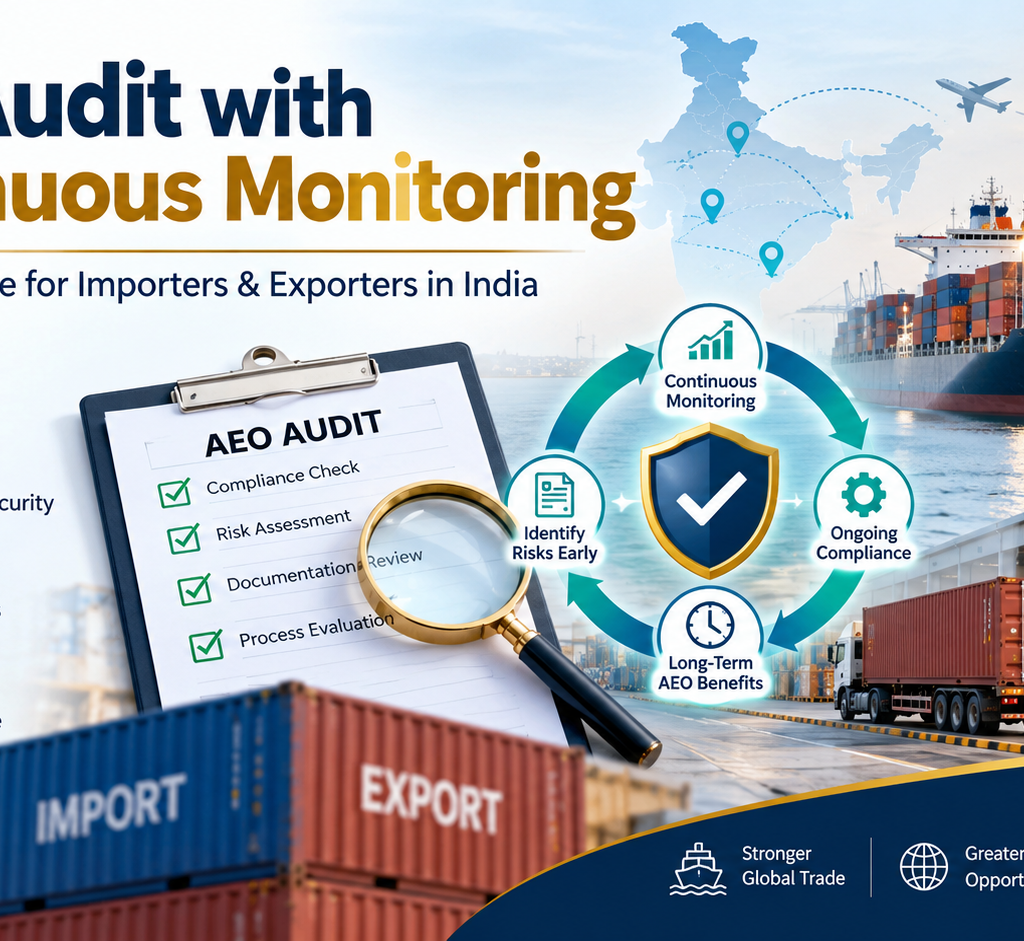
This blog will explain how AEO certification supports smoother customs procedures, reduces routine examination requirements based on risk assessment, and provides priority processing for eligible consignments. It will also cover the role of AEO T1, T2, and T3 certification categories in improving customs efficiency and how businesses can benefit from AEO registration in India.
AEO Certification Requirements: Who Is Eligible?
Before applying, businesses should understand the basic AEO eligibility criteria. Applicants must satisfy the requirements applicable to their business activities and the AEO category selected.
The following types of businesses may be eligible:
1. Importers and Exporters
Businesses regularly involved in importing or exporting goods can apply for AEO certification under the applicable importer/exporter categories.
They should maintain appropriate customs records, demonstrate legal compliance, and meet the prescribed financial and operational requirements.
2. Manufacturers and Traders
Manufacturing and trading companies involved in international supply chain activities can also explore AEO Registration in India, provided they fulfil the applicable eligibility conditions.
3. Logistics Service Providers
Eligible logistics businesses play an important role in international supply chains. Depending on their activities, they may apply under the AEO Certification Requirements Logistics Operator (AEO-LO) category.
Examples include
- Freight forwarders.
- Customs brokers.
- Warehouse operators.
- Custodians and terminal operators.
- Other eligible logistics service providers.
4. Businesses With a Strong Compliance Record
Applicants should demonstrate that they follow applicable customs laws and maintain reliable business records.
They should also establish documented procedures and assign responsibilities for compliance and record management.
How AEO Certification Helps Indian Exporters
Indian exporters must follow various customs regulations, maintain accurate trade documentation, and ensure smooth international supply chain operations. AEO Certification for Indian Exporters can help eligible businesses improve customs compliance, strengthen international trade credibility, and access applicable customs facilitation benefits.
This blog will explain how AEO certification supports Indian exporters through faster processing of eligible consignments, reduced routine customs interventions, applicable bank guarantee benefits, and improved supply chain security. It will also discuss the eligibility criteria, documents required, application procedure, and advantages of obtaining an AEO Certificate for export-oriented businesses.
Types of AEO Certification in India
The Indian AEO Program provides different certification categories depending on the applicant’s business activities and level of operational readiness.
AEO T1 Certification
AEO T1 is an entry-level certification generally available to eligible importers and exporters.
Businesses must satisfy the applicable AEO Certification Requirements, including general eligibility, legal compliance, record management, and financial solvency requirements.
It provides customs facilitation benefits, including reduced bank guarantee requirements and faster processing for eligible consignments.
AEO T2 Certification
AEO T2 is designed for businesses with stronger compliance systems and more developed operational controls.
Applicants must satisfy additional prescribed AEO Certification Requirements, including applicable security and internal control conditions. Physical verification by the AEO Programme Team is part of the process.
It provides enhanced facilitation benefits compared with T1.
AEO T3 Certification
AEO T3 is an advanced certification category available to eligible existing AEO Certification Requirements holders who satisfy the prescribed conditions.
It provides a higher level of customs facilitation, including complete bank guarantee exemption in specified circumstances.
AEO-LO Certification
AEO-LO is intended for eligible logistics operators participating in international supply chains.
Customs brokers, warehouse operators, custodians, and other qualifying logistics service providers can explore this category.
Selecting the appropriate category is an important part of meeting the AEO Certification Requirements.
AEO T2 vs AEO T3: Which Certification Is Better?
AEO certification plays an important role in improving customs facilitation and strengthening international trade compliance for Indian businesses. However, choosing between AEO T2 and AEO T3 certification can be confusing for importers and exporters. This blog will explain the major differences between AEO T2 and AEO T3, including eligibility criteria, documentation requirements, security standards, application procedures, and customs benefits.
It will also discuss how businesses can qualify for AEO T3 certification after obtaining AEO T2 status and what additional compliance requirements they need to fulfill. By understanding these differences, businesses can select the appropriate certification level according to their operational requirements and trade activities.
AEO Certification Requirements: Important Eligibility Conditions
Businesses should evaluate the following areas of AEO Certification Requirements before submitting their applications.
1. Legal and Regulatory Compliance
The applicant should maintain a satisfactory compliance record and demonstrate adherence to applicable customs and other relevant legal requirements.
2. Financial Solvency
Businesses must meet the prescribed financial solvency requirements for the relevant AEO Certification Requirements. Financial statements and supporting financial information may be examined.
3. Proper Record Management
Applicants should maintain accurate and accessible records relating to imports, exports, customs transactions, accounting, and business operations.
4. Standard Operating Procedures (SOPs)
Documented SOPs should explain how AEO Certification Requirements, business activities, compliance responsibilities, and relevant operational processes are managed.
5. Supply Chain Security
For categories requiring detailed security controls, businesses should establish appropriate measures relating to premises, access management, cargo handling, personnel, and information security.
6. Defined Management Responsibilities
Businesses should identify responsible personnel for AEO Certification Requirements for customs compliance, security management, and record maintenance.
These requirements should be supported by actual records and evidence rather than documentation prepared only for the application.
AEO Certification and Supply Chain Security Requirements
Supply chain security is an important AEO Certification Requirement part of international trade because goods pass through multiple stages, including manufacturing, storage, transportation, and customs clearance. AEO Supply Chain Security Requirements help businesses establish appropriate security measures to protect cargo, business premises, employees, and trade-related information.
This blog will explain the important security practices associated with AEO certification, including employee verification, visitor management, warehouse security, cargo handling procedures, access control, information security, and incident reporting. It will also discuss how businesses can prepare security policies and Standard Operating Procedures (SOPs) to meet the applicable AEO Certification Requirements in India.
Documents Required for AEO Registration in India
Preparing the correct documentation is one of the most important parts of the AEO registration process.
The exact checklist depends on the AEO Certification Requirements applicant’s business type, certification category, and applicable CBIC requirements.
Commonly relevant documents and records include:
1. Business Registration Documents
- Certificate of Incorporation or business registration proof.
- PAN card of the business entity.
- GST registration certificate.
- Importer Exporter Code (IEC).
- Details of directors, partners, or proprietors, as applicable.
- Registered office and business premises details.
2. Financial Documents
- Audited financial statements.
- Balance sheets and profit and loss statements.
- Financial solvency supporting documents.
- Relevant financial declarations or certificates, wherever prescribed.
AEO Registration Process in India: Step-by-Step Guide
Once the eligibility conditions and supporting documents are ready, businesses can proceed with the application.
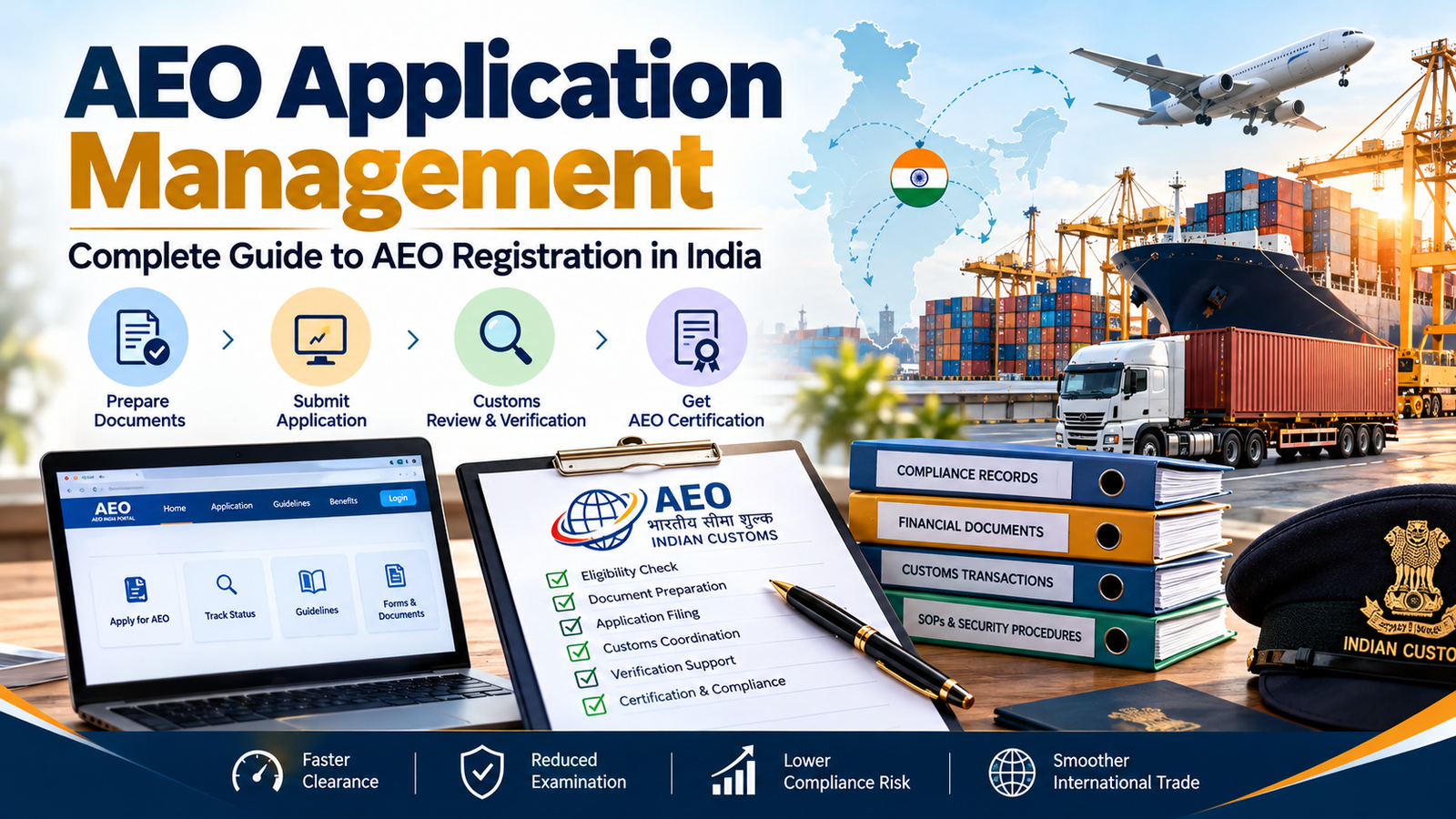
Step 1: Check Eligibility
Review the applicable AEO Certification Requirements and determine whether the business qualifies for AEO T1, T2, T3, or AEO-LO.
Step 2: Prepare Required Documents
Collect business registration documents, AEO Certification Requirements documents, financial records, IEC details, customs transaction records, and other supporting documents.
Ensure that the information is accurate and consistent across all records.
Step 3: Complete the Online Registration
Create an applicant account through the official AEO Certification Requirements India portal and provide the required business information.
The applicant should ensure that the entity name and IEC details match the official records.
Step 4: Submit the Application
Select the applicable certification category, complete the AEO Certification Requirements application form, and upload the required supporting documents.
Review all details before submitting the application.
Step 5: Application Scrutiny and Verification
The AEO Program Team reviews the application and may request additional information or clarification.
For categories requiring verification, the team AEO Certification Requirements may visit the applicant’s premises to assess relevant records, procedures, operational activities, and security controls.
Step 6: Certification Decision
After reviewing the application and completing the applicable verification process, the competent authority communicates its decision.
Eligible applicants receive their AEO certification.
Benefits of Obtaining an AEO Certificate
Obtaining an AEO Certificate can help businesses improve their international trade operations.
Important benefits include:
- Faster Customs Clearance: Eligible shipments may receive priority facilitation.
- Reduced Bank Guarantee: Applicable AEO categories receive reduced bank guarantee requirements.
- Improved Trade Efficiency: Reduced routine interventions can support smoother cargo movement.
- Better Business Credibility: AEO recognition demonstrates a commitment to customs compliance and supply chain security.
- Priority Processing: Eligible customs transactions may receive preferential processing.
- International Recognition: Mutual Recognition Arrangements (MRAs) can provide facilitation in partner countries, subject to applicable arrangements.
The actual benefits depend on the certification category and relevant customs provisions.
Common Mistakes to Avoid During AEO Registration
Even eligible businesses can experience delays if their applications AEO Certification Requirements contain incomplete information or insufficient supporting evidence.
Avoid these common mistakes:
- Submitting incomplete or outdated business documents.
- Providing inconsistent IEC, GST, and company details.
- Maintaining SOPs without evidence of implementation.
- Ignoring applicable customs compliance requirements.
- Failing to maintain proper import and export records.
- Not preparing relevant security controls for categories that require them.
- Delaying responses to clarification requests.
Proper preparation can help businesses make the AEO registration in India process more organized and efficient.
Why Choose Professional Assistance for AEO Certification?
Understanding the documentation and compliance requirements can be challenging, particularly for businesses applying for the first time.
Professional AEO consultancy can help businesses identify the appropriate certification category, review eligibility, organize supporting documents, prepare SOPs, and coordinate application-related requirements.
An experienced compliance consultant can also help identify documentation gaps and prepare businesses for the applicable verification process.
For businesses planning AEO registration in India, professional guidance can make the application process more structured and reduce avoidable documentation errors.
Conclusion
Understanding the AEO Certification Requirements is essential for importers, exporters, manufacturers, and logistics service providers planning to obtain AEO recognition in India.
From eligibility assessment and financial solvency to customs compliance, documentation, SOPs, and supply chain security, every requirement plays an important role in the certification process.
Choosing the correct AEO category and preparing accurate supporting documents can help businesses approach the application process with greater confidence.
If your business is planning to apply for an AEO Certificate, start by reviewing the applicable eligibility conditions and organizing the required documentation.
Need assistance with AEO registration in India? Connect with an experienced compliance consultant to understand your eligibility, documentation requirements, and application process.
Frequently Asked Questions
Q1. What are the AEO Certification Requirements in India?
Businesses must meet applicable legal compliance, financial solvency, record management, and operational requirements.
Q2. Who can apply for AEO Registration in India?
Eligible importers, exporters, manufacturers, traders, and logistics AEO Certification Requirements service providers involved in international supply chains in relevant categories.
Q3. What documents are required for AEO certification?
Commonly relevant documents include IEC, PAN, GST registration, business registration proof, financial statements, customs records, and applicable SOPs and security documents.
Q4. What are the different types of AEO certification?
The main categories are AEO T1, AEO T2, AEO T3, and AEO-LO
Q5. Is there any government fee for AEO registration?
The Indian Customs AEO application process does not charge an application fee.
Q6. How long does AEO certification take?
The timeline depends on the category and completeness of the application. The official portal provides indicative timelines, including 30 days.