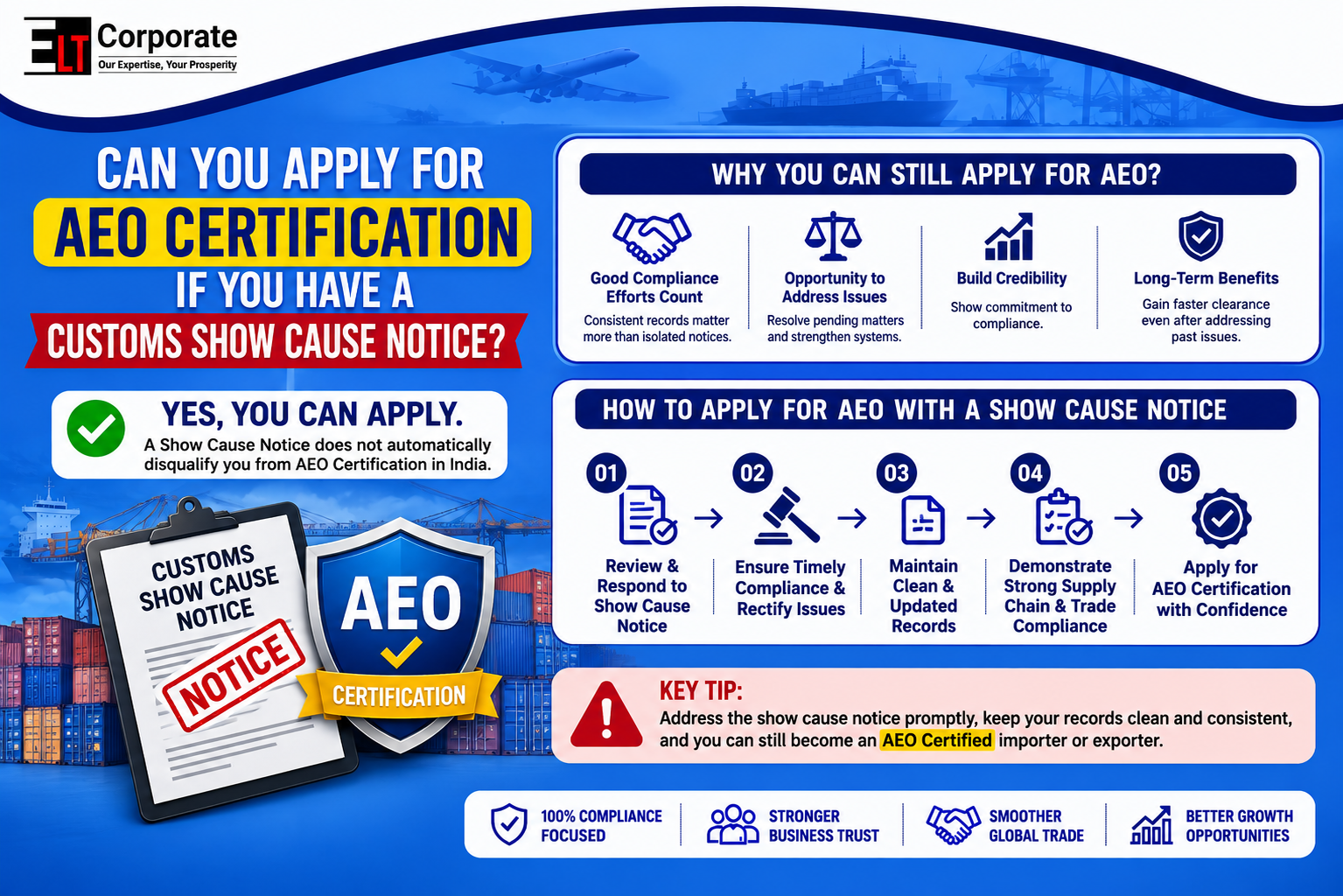
AEO Certification with a Customs Show Cause Notice is possible in certain cases, and having a Customs Show Cause Notice does not automatically make a business ineligible for AEO status.
Many importers and exporters are concerned about whether they can apply for AEO Certification when a Customs Show Cause Notice is pending. The answer depends on the nature of the notice, the allegations involved, the disputed amount, the date of the notice, and whether any prosecution or legal proceedings are involved.
For AEO Certification with a Customs Show Cause Notice, businesses should carefully review their Customs compliance history before filing an application. The Indian AEO Programme considers legal and Customs compliance while evaluating applicants, including relevant Show Cause Notices, disputed Customs duty, and prosecution-related matters.
Eligibility for AEO Certification with Customs Show Cause Notice
AEO stands for Authorised Economic Operator. It is a compliance program managed by Indian Customs for companies that are part of the international supply chain. The program is meant to find businesses that’re reliable and follow the rules. These businesses then get benefits from Customs. Importers and exporters can usually get AEO status in levels such as
- AEO-T1
- AEO-T2
- AEO-T3
Other companies that are part of the supply chain might be eligible for AEO-LO status. The exact rules for being eligible are in the papers. The checks required depend on the specific category. One of the things looked at when someone applies for AEO is the company’s legal and customs compliance history.
Can You Apply for AEO Certification with a Customs Show Cause Notice?
The answer is yes, you can still apply in some cases.
A Customs Show Cause Notice does not mean you cannot get AEO certification. The important thing is what the notice says. There is a rule, Circular No. 33/2016-Customs, that talks about this. It says that some show cause notices are more serious than others.
If you have a notice that says you did something bad, like fraud or smuggling, you might not be able to get AEO certification. This is because the rule says that you should not have any of these notices in the last three years. If your notice is not that serious, you can still apply for AEO certification.
The people who give AEO certification will look at your case. Decide. So it really depends on what your notice says and how serious it is. AEO certification with a Customs Show Cause Notice is possible; it just depends on the facts of your case. You can apply for AEO certification with a Customs Show Cause Notice, but you have to wait and see what happens.
Which Customs Show Cause Notices Can Create a Serious Problem?
| Type of Issue | Possible Impact on AEO Application | Suggested Action |
| Classification dispute | May be considered based on facts | Provide complete case details. |
| Valuation dispute | May require review | Explain the dispute and documents. |
| Exemption-related issue | Depends on the nature of the case | Submit the legal position and case status. |
| Documentation error | May be manageable if properly explained | Show corrective action. |
| Duty demand | The amount and nature of the dispute are important. | Calculate the disputed duty ratio. |
What happens if the show cause notice is for a customs dispute?
The thing is, not every customs dispute is about fraud or smuggling. A business might get a show cause notice for things like customs valuation or how imported goods are classified. There are reasons too, such as:
- exemption notification interpretation
- differential customs duty
- Drawback
- not following the right procedures
- differences in documents
- Other customs disputes where people do not agree on what something means.
If the show cause notice is not for something serious, just getting the notice does not mean the application will be rejected automatically. Customs will look at what the dispute’s about and how much money is involved. They have a way to figure this out, which is explained in Circular No. 33/2016. It is based on how much customs duty or drawback is in question.
Importance of AEO Certification
The AEO Certification also takes into account whether there are any ongoing or contemplated prosecutions against the applicant or its senior officers. This aspect is distinct from a regular claim or technical issue. In cases where there are any ongoing prosecutions, the company needs to thoroughly assess the case prior to submitting the AEO application.
Does Customs Duty Demand Affect AEO Certification?
For SCNs other than the serious categories specifically mentioned in the AEO Certification, the amount involved is also important. Under Circular No. 33/2016-Customs, if the ratio of disputed duty demanded or drawback demanded or sought to be denied in relevant SCNs during the preceding period.
The total duty paid and drawback claimed during that period is more than 10%, the nature of the cases is reviewed, and the AEO Program Manager decides on the issue or continuance of AEO Certification. This means that companies should not only collect copies of their SCNs. They should also calculate the financial impact of those notices before filing.
Simple Example
- Suppose a company has paid substantial customs duty during the relevant period and has one classification dispute involving a relatively small amount.
- The company should calculate the ratio prescribed under the AEO framework and provide complete information regarding the dispute.
- On the other hand, if the disputed amount is substantial compared with the total duty paid or drawback claimed, the matter may require closer examination by the AEO Programme Manager.
What is a dropped SCN for AEO certification?
A dropped SCN is when the customs authority looks at the case, and the claim in the notice is not proven. This happens when the customs authority does not agree with the claim after checking everything. This is very important for AEO certification.
The customs authority says that if an SCN is dropped or if the company wins the case, then it should not be considered when checking whether the company is following the rules. This is according to Circular No. 33/2016-Customs. It talks about the rules in Paras 3.2.1, 3.2.2, and 3.2.3. For example, let us say the customs authority sends an SCN to a company saying that the company did not value its goods correctly:
- The company replies to the SCN. Sends documents to support its claim.
- After checking everything, the customs authority agrees with the company. Drops the case.
- This is different from a case where the SCNs are still pending, and no decision has been made.
- For AEO certification, a dropped SCN is very different from a pending SCN.
- The AEO certification process looks at dropped SCNs and pending SCNs in different ways.
- Dropped SCNs for AEO certification are not considered when checking whether a company is following the rules.
- This is important for companies that want to get AEO certification.
- AEO certification is important for companies that want to show that they are following the rules.
- Dropped SCNs are a part of the AEO certification process.
Customs Case Summary for AEO Certification
Before preparing an AEO application, businesses should prepare a simple summary of their customs disputes.
| Information | Details to Maintain |
| SCN Number | Notice reference number |
| Date | Date of SCN |
| Customs Authority | Authority issuing the notice |
| Issue | Classification, valuation, exemption, etc. |
| Amount | Duty/drawback amount disputed |
| Allegation | Nature of allegation |
| Reply Status | Filed or pending |
It helps the management team and the consultants figure out if the company is really ready for AEO filing. The management team and the consultants need to know this to make decisions about AEO filing.
AEO Certification Support by ELT Corporate
They provide help for AEO-T1, AEO-T2, AEO-T3, and AEO-LO Certification in India. This means they can help you understand which AEO category is right for you. They can also review whether you are eligible and look at your customs compliance history.
They will help you prepare and review the documents you need. They can assist you with your AEO applications. Make sure you have the right Standard Operating Procedures in place. If you have any questions, they will answer them. They will also guide you through the certification process.
If your business has received a Customs Show Cause Notice, ELT Corporate can review your compliance position before you apply for AEO Certification. You can visit the AEO Certification Services page to learn more about what they can do for you. The service page for ELT Corporate lists the types of certification they can help with, including AEO-T1, AEO-T2, AEO-T3, and AEO-LO certification assistance.
What If the Customs Case Has Already Been Decided in Your Favour?
This is really good for you. It can make a difference for the person who applied. The information after points 3.2.1 to 3.2.3 of Circular No. 33/2016 says that customs cases where Show Cause Notices have been dropped or decided in favour of the applicant by the people who make decisions or the appellate authorities are handled differently when it comes to checking if the rules are being followed. So companies should keep copies of certain things, such as:
- Show Cause Notices
- Replies that were submitted
- What was said during hearings
- Orders-in-Original
- Appellate orders
- Orders that stop the proceedings
- Proof that payments were made, if that is necessary
- What lawyers think about the situation or statements that explain things
These papers can help the customs people understand what is really going on and how serious the situation is. They can see that the customs case has already been decided in your favour. This can make things easier for the customs case that has already been decided in your favour.
Can an Appeal Help in AEO Certification?
This is different from a situation with AEO Certification, where the notice has been cancelled. If the company has already received a decision and has appealed it, then the case is at a different stage. The company should keep all the documents, including:
- SCN
- Reply
- The original decision
- Appeal papers
- Any order to stop the decision from being carried out, if there is one
- What is happening with the appeal?
- Supporting documents from lawyers
The company needs to think about how this situation affects their eligibility for AEO. They should look at the rules for AEO. See where they stand with their case. The official AEO questions and answers say that if a company’s application for AEO is rejected, they can apply again when they have fixed the problems that caused the rejection. The company should look at the AEO criteria.
AEO Certification Documents for Customs SCN
Any business that has received a Customs Show Cause Notice and wishes to apply for AEO Certification should retain complete records of the notice and of the proceedings connected with it. Among the important documents may be:
- Copy of the Customs Show Cause Notice
- Reply filed against the Show Cause Notice
- Details of the SCN number and date
- Name of the customs authority issuing the notice
- Nature of the dispute or allegation
- Details of classification or valuation disputes
- Details of exemption-related disputes
- Amount of duty or drawback involved
- Current status of the Show Cause Notice
- Order passed by the customs authority
It is necessary for businesses to keep an accurate summary of each customs dispute, including the SCN number, the date, the issuing authority, the issue, the disputed amount, and the allegation and reply status.
Conclusion
The fact that a business has received a Customs Show Cause Notice does not mean that it is impossible for it to apply for AEO Certification. The effect of the notice will depend on the nature of the allegation, the amount in question, the present status of the case, and whether or not a serious offence or prosecution is involved.
Before submitting an AEO application, companies should carefully go over all existing and previous customs disputes and keep complete supporting documents; disputes relating to classification, valuation, and documentation may be treated differently from serious claims such as fraud, forgery, or smuggling. Good documentation, clear disclosure, and solid Customs compliance records can aid companies in making their compliance position more clearly known when going through the AEO Certification process.
Frequently Asked Questions
Q1. Can I apply for AEO Certification if I have a Customs Show Cause Notice?
Yes. Having a Customs Show Cause Notice does not automatically result in rejection of an AEO Application. Customs considers the nature of the notice, allegation, amount involved, and status of the case.
Q2. Does every Customs Show Cause Notice affect AEO Certification?
No. The impact depends on the type of dispute. A classification, valuation, or documentation issue may be assessed differently from allegations involving fraud, forgery, smuggling, or other serious offences.
Q3. What documents should be kept for a Customs Show Cause Notice?
Businesses should maintain the SCN, reply, case status, disputed amount, authority details, orders, appeal documents, and other supporting records.
Q4. Does the amount involved in the Show Cause Notice matter?
Yes. For certain SCNs, the amount of disputed duty or drawback compared with the total duty paid or drawback claimed may be relevant during the AEO Certification assessment.
Q5. What happens if the Show Cause Notice has been dropped?
A dropped SCN is different from a pending SCN. According to the material provided, a notice that has been dropped or decided in favour of the company is treated differently while evaluating Customs compliance.
Q6. Can a pending appeal affect AEO certification?
Yes. If an order has been passed and the company has filed an appeal, the current status of the appeal and supporting documents should be reviewed before filing the AEO application.
Q7. Should all customs disputes be disclosed in the AEO application?
Businesses should maintain complete and accurate information about relevant Customs disputes so their compliance position can be properly assessed.
Q8. Can a company reapply if its AEO application is rejected?
According to the material provided, a company may apply again after correcting the issues that resulted in the rejection and reassessing its eligibility under the AEO criteria.
.