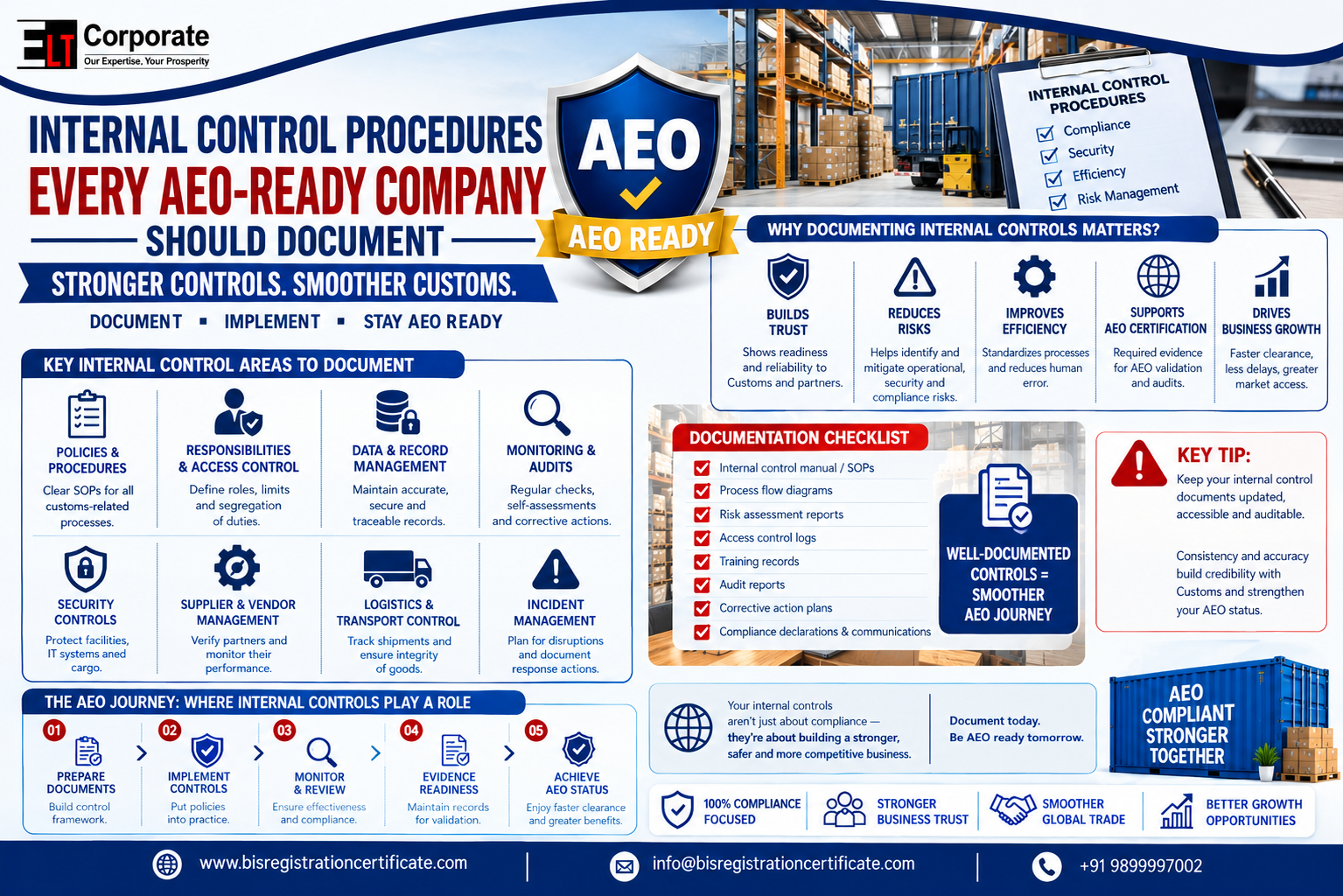
CBIC’s AEO Program checks your business not by what you do, but by whether you can prove what you do consistently and in a way that AEO Internal Control Procedures to the finish of your trade. During the AEO assessment, a visit and regular checks by CBIC’s AEO Programme Management Team (APMT) look for proof of documented procedures—written, approved, put into action, and kept up.
If your company has customs rules but cannot show them in written form, it will have a hard time with the AEO assessment. If your company writes down rules but does not follow them, the inspectors will see it during the visit. The only steady way to keep the AEO certificate is to have a compliance plan where what is written and what is done match exactly.
This guide lists every internal control step that a company is ready for, which AEO should write down organized by category. It explains why each step is needed, what it should include, and how it should be kept up. I hope this guide helps you keep your AEO certification strong.
The Relationship Between AEO Internal Control Procedures and AEO Certification
Before you start looking at the procedure inventory, it is important to know what CBIC wants when it asks for documented controls.
What CBIC Assesses
– A good system for managing transport records: AEO record-keeping must be organized, easy to find, and easy to audit.
– Internal control and compliance procedures: An AEO must have written processes that make sure customs rules are followed everywhere in the AEO.
– Security standards: An AEO must have written procedures for physical, personnel, cargo, and IT security.
– Financial solvency: An AEO must have written procedures showing AEO Internal Control Procedures and pay duties on time.
Why Documentation Matters More Than Intent
Many businesses follow customs rules perfectly. But following rules because of instinct, habit, or an expert’s skill is not a systematic way. AEO Internal Control Procedures. That means procedures must be:
Written down: So that any trained person can use them, not just the one expert who knows the process.
Approved: By management, showing that the organization is committed.
Communicated: So all relevant staff know what is expected.
Followed: Every time, not when it is convenient.
Reviewed: Regularly to keep up with new regulations and changes in how we work.
Audited: Inside the organization so that weak spots are fixed by AEO Internal Control Procedures.
A documented procedure is what separates a culture of compliance from compliance that happens by accident.
CATEGORY 1. CUSTOMS COMPLIANCE PROCEDURES
This is the closely watched category in AEO evaluation. Every process that deals with how your customs declarations are made, checked, submitted, and fixed must be written down.
Procedure 1.1. Customs Declaration Preparation and Review SOP
Purpose: To make sure every import Bill of Entry and export Shipping Bill submitted on your behalf is correct. Follow AEO Internal Control Procedures when it is sent.
What to write down:
- Who starts the process of preparing the declaration (the customs or logistics team, or based on CHA instructions)
- The information that is needed. Invoice, packing list, bill of lading or air waybill, certificate of origin, import licence, MSDS (for dangerous goods), and any special documents for the product
- How the HS code (ITC HS classification) is decided for each product. Including who has the power to confirm the classification
- How the value declared is checked. Transaction value versus customs valuation methods
Why it is important for AEO: Misclassifying HS codes and making valuation mistakes are the common reasons for customs problems.
Procedure 1.2. HS Code Classification Procedure
Purpose: To create a written process for correctly putting all imported and exported goods into the right category under the ITC HS (Indian Trade Classification Harmonised System).
Who is allowed to decide and check HS classifications?
The way the classification is done. How the tariff schedule, classification rules, General Rules of Interpretation (GRIs), chapter notes, and explanatory notes are used
- How to use binding tariff information, customs advance rulings, or earlier classification decisions
- The way to AEO Internal Control Procedure rulings for unclear products
- How the decisions about classification are kept. The classification register or database
- The way classifications are changed when tariff schedules are updated (usually with every Union Budget)
- How CHA is told about the confirmed classifications
Why it’s important for AEO: HS code errors. Even if they are not meant to be. Can lead to missing duties, fines, and SCNs. A written classification procedure shows AEO Internal Control Procedures in a supported way. Not by chance.
Procedure 1.3. Procedure for Customs Valuation
To make sure that the customs value is the Internal AEO Internal Control Procedures value or the correct alternative method as per the Customs Valuation Rules.
What to document:
- How additional costs are added to the transaction value. Such as freight, insurance, commissions, royalties and assistance.
- Situations that lead to using other methods of valuation (Rules 4 through 9).
- How the prices on invoices are checked against purchase orders and contract prices.
- A record of the decisions made for each import.
Procedure 1.4. Country of Origin Determination and Certificate of Origin (CoO) Procedure
To make sure that the country is the Internal AEO Internal Control Procedures origin (CoO) used for duty claims under India’s FTAs is genuine, valid, and properly applied.
What to document:
- How the origin of each imported product is found. Product‑specific rules (PSRs) that are applied
- Process to check the authenticity and validity of CoOs that are received from suppliers
- Process to handle expired, incorrect, or disputed CoOs
- Record of CoOs that are received and applied by shipment
Why it matters for AEO: Incorrect preferential duty claims that are based on invalid CoOs can lead to large post‑import duty demands and penalties. A documented CoO verification procedure is required.
CATEGORY 2 FINANCIAL RECORD-KEEPING PROCEDURES | AEO Internal Control Procedures
To make sure that every payment for goods in the country is properly recorded, matches what was said on the customs forms, and follows the rules set by the Foreign Exchange Management Act.
Procedure 2.1—Trade Finance and Import Payment Documentation Procedure. AEO Internal Control Procedures
To make sure that every payment for goods that are brought into the country is properly recorded, matches what was said on the customs forms, and follows the rules set by the Foreign Exchange Management Act.
- Process for creating and checking letters of credit or payment terms
- How the amount paid is checked against the invoice and the customs forms
- A record of every single import payment that happens
Why it matters for AEO: Trade-based AEO Internal Control Procedures watch out for. Having matched records of import payments shows that your trade finance is honest.
Procedure 2.2 Trade Records Retention Procedure. AEO Internal Control Procedures
To establish a documented approach to retaining all trade-related records for the periods required by law. What to document:
Physical and electronic storage arrangements: Filing system, document management system, backup procedures
Access control: Who can access retained records, and how is access authorized?
Retrieval procedure: How records are retrieved for internal audit, CBIC audit, or legal proceedings
Destruction schedule: When and how records past their retention period are destroyed
Business continuity: How records are protected against loss (fire, flood, system failure)
Why it matters for AEO: CBIC requires that AEO-certified businesses maintain an “appropriate system of managing commercial records.” And that these records are accessible for customs audits at any time.
Procedure 2.3. Anti‑Bribery and Code of Conduct Procedure. AEO Internal Control Procedures
To establish enforceable ethical standards for AEO Internal Control Procedures in trade operations. This procedure with customs officials and trade partners.
What to document
- The company’s anti‑bribery policy.
- Reporting mechanism.
- Consequence framework.
- Training requirement.
- Third‑party due diligence.
Why it matters for AEO
AEO evaluation includes an assessment of the company’s standards and code of conduct. An anti‑bribery procedure is specifically referenced in CBIC AEO documentation requirements.
CATEGORY 3 SUPPLY CHAIN SECURITY PROCEDURES AEO Internal Control Procedures
The purpose of this procedure is to carefully check and manage physical security at every company location, including factories, warehouses, offices, and loading or unloading areas. What to document:
- List of all premises that must be checked for physical security.
- Plan for fixing any physical security problems that are found and keep track of the fixes.
- Record of every physical security check and the results that were found.
Why it matters for AEO: Physical security of premises is a main AEO requirement. A written physical security check procedure shows that the company handles physical security in a way not just in response to problems.
Procedure 3.2 Cargo Integrity Security Procedure. AEO Internal Control Procedures
To stop tampering, contamination, or smuggling AEO Internal Control Procedures throughout the supply chain.
What to document:
Seal verification procedure at destination—how seals are checked on receipt; what makes a seal intact versus tampered
Cargo handover documentation—who accepts and signs for cargo at each transfer point in the supply chain?
Driver and vehicle pre‑clearance procedure—for road transport of high‑value or sensitive cargo
Why it matters for AEO: Cargo security is a defining element of AEO Internal Control Procedures. WCO SAFE Framework supply chain security standards.
Procedure 3.3 Access Control Procedure. AEO Internal Control Procedures
To control and document who has access to which AEO Internal Control Procedures, preventing access to cargo, high‑security areas, and sensitive data.
What to document:
- The access control system in use includes electronic access cards, biometric systems, key management, and guard posts
- Access log maintenance explains how entry and exit records are kept and stored.
- The visitor management procedure covers registration, escort rules, ID verification, and visitor log.
- Periodic review of access rights audits access rights to make sure they stay appropriate
Why it matters for AEO: Access control documentation is a site visit. Inspectors want proof that your access control system is organized, logged, and managed, not AEO Internal Control Procedures.
AEO Internal Control Procedures Documentation Manual
This document is meant to set out written AEO Internal Control Procedures. It includes compliance procedures, security steps, and governance systems.
This manual includes the following areas:
- Customs Compliance Procedures
- Financial & Record Management Controls
- Supply Chain Security Procedures
- Organizational Governance Procedures
- Document Control Procedures
ORGANIZATIONAL AND MANAGEMENT PROCEDURES | AEO Internal Control Procedures
To define the governance structure of the AEO compliance program. Including roles, responsibilities, escalation paths, and management review.
What to document:
Designation of an AEO Compliance Officer (or equivalent). Name, role, authority, and responsibilities
Escalation procedure: How compliance issues are escalated from the operational level to senior management
Reporting structure: What compliance metrics and exception reports are reviewed by management and how often
Why it matters for AEO: CBIC evaluators look for AEO Internal Control Procedures commitment to compliance. Not just operational compliance at the working level. A governance procedure demonstrates that compliance is owned at the top.
Conclusion
Well‑structured internal control procedures are not a load that the AEO program forces. They are an operational asset. This asset cuts mistakes, AEO Internal Control Procedures keep compliance steady in many sites, and give a clear audit trail that shields the business when CBIC shows up.
Companies that put effort into an active and well-maintained internal control documentation program do more than get AEO certification. They create a compliance base that grows in worth over time. This base cuts their customs duty risk, steadies their supply chain, and builds their standing as a partner in international trade.
Frequently Asked Questions
Q1. How many internal control procedures does CBIC require for AEO certification?
CBIC’s AEO guidelines do not specify a fixed number of procedures. The requirement is that you have documented procedures covering all the areas assessed in the AEO criteria.
Q2. Do procedures need to be in a specific format or template prescribed by CBIC?
No specific format is mandated. Procedures should be clear, practical, and reflective of actual operations. A standard format—document title, number, version, and scope for CBIC evaluation.
Q3. Can smaller businesses with limited compliance staff meet the AEO documentation requirements?
Yes. AEO-T1—the entry-level tier—is specifically designed for SMEs. The documentation requirements are proportionate to the scale and complexity of the business.
Q4. How often should AEO internal control procedures be reviewed?
At minimum, all procedures should be reviewed annually. Any procedure affected by a regulatory change (new CBIC circular, amended Customs Act provision, or revised EXIM policy).
Q5. Should internal control procedures be submitted to CBIC as part of the AEO application?
Procedures are not typically submitted as part of the initial AEO application—but they must be available and presented during the site visit.
Q6. Can we use a third-party consultant to develop our AEO internal control procedures?
Yes. Many businesses engage regulatory consultants to develop their initial AEO procedure documentation—particularly for the more technical areas.