Ahmedabad is one of the fastest-growing logistical and trading centers in India. It empowers the textile and chemical trade exports and supports the supply chain for pharmaceuticals, engineering goods, and even e-commerce. Logistics companies that are located in or around the city often handle the customs clearance for the imports and exports that are frequently conducted through the city’s ICDs, customs ports and customs airports. For better customs due processing and overall operational efficiency many logistics companies in Ahmedabad are seeking customs Authorised Economic Operator or AEO certification.
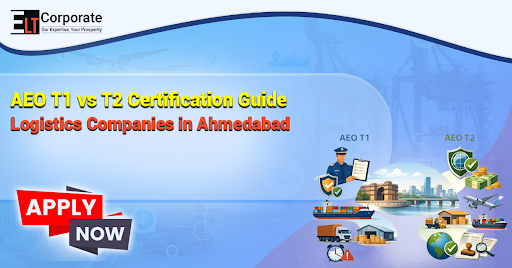
Of the different levels, AEO T1 and AEO T2 are the most pertinent to the logistics companies. This guide explains the differences between T1 and AEO T2 and the respective benefits and the eligibility and how logistics companies in the city of Ahmedabad can determine which is the most appropriate.
What Is AEO Certification?
The Authorised Economic Operator (AEO) programme, introduced by Indian Customs under CBIC, recognises businesses that demonstrate a strong record of customs compliance, financial solvency, and secure supply chain practices.
AEO-certified companies are treated as low-risk entities, which results in faster customs clearance and fewer regulatory checks.
Why AEO Certification Matters for Logistics Companies in Ahmedabad?
For logistics companies, AEO certification helps to:
- Reduce customs clearance time
- Minimise physical inspections and document checks
- Improve delivery timelines for clients
- Lower operational and warehousing costs
- Build trust with exporters, importers, and international partners
In a competitive logistics market like Ahmedabad, AEO certification also acts as a business credibility marker.
AEO Certification Levels in India
Indian Customs grants AEO certification in different tiers based on compliance maturity:
- AEO T1 – Entry-level certification
- AEO T2 – Advanced certification with higher facilitation
- AEO T3 – Highest level (mainly for large exporters/importers)
Logistics companies generally apply for AEO T1 or AEO T2, depending on their scale and compliance readiness.
What Is AEO T1 Certification?
AEO T1 is the entry-level AEO certification for logistics companies that have a satisfactory compliance record and basic internal controls.
Key Features of AEO T1
- Simplified application process
- Limited documentation review
- No mandatory on-site verification in most cases
- Faster customs clearance compared to non-AEO entities
Benefits of AEO T1 for Logistics Companies
- Reduced customs examination
- Priority processing of consignments
- Faster cargo release
- Improved coordination with customs authorities
Validity of AEO T1
- Valid for 3 years, subject to continued compliance
Who Should Choose AEO T1?
- Small to mid-sized logistics companies
- First-time AEO applicants
- Companies with limited but consistent trade activity
What Is AEO T2 Certification?
AEO T2 is an advanced certification level designed for logistics companies with a strong compliance history, sound financial systems, and mature internal controls.
Key Features of AEO T2
- Detailed document review
- Mandatory on-site verification by Customs in most cases
- Assessment of supply chain security and risk management
Benefits of AEO T2 for Logistics Companies
- All AEO T1 benefits
- Significantly reduced physical inspections
- Priority treatment at ports, ICDs, and air cargo complexes
- Deferred payment of customs duty (where applicable)
- Reduced requirement for bank guarantees
- Faster processing of refunds and claims
What is the Validity of AEO T2?
- Valid for 3 years, with periodic compliance monitoring
Can Companies Apply Directly for AEO T2?
Yes, direct application for AEO T2 is permitted. However, Customs generally prefers:
- A proven compliance track record, or
- Prior AEO T1 certification (recommended but not mandatory)
Comparison – AEO T1 vs AEO T2
| S.No. | Parameter | AEO T1 | AEO T2 |
| 1. | Certification Level | Entry-Level | Advanced |
| 2. | Compliance Requirement | Moderate | High |
| 3. | On-Site Verification | Usually not required | Generally mandatory |
| 4. | Customs Examination | Reduced | Further reduced |
| 5. | Bank Guarantee Waiver | Limited | Significant |
| 6. | Deferred Duty Payment | Not available | Available |
| 7. | Refund Processing | Faster | Faster |
| 8. | Validity Period | 3 Years | 3 Years |
How Logistics Companies in Ahmedabad Should Choose Between AEO T1 and T2?
Choose AEO T1 If:
- You are applying for AEO for the first time
- Your compliance systems are still developing
- Your trade volumes are moderate
Choose AEO T2 If:
- You have strong internal controls and documentation
- You handle high-volume or time-sensitive cargo
- You want deeper customs facilitation and predictability
Application Process for AEO Certification
- The application is filed online through the ICEGATE portal
- Required documents include compliance records, financial statements, and security policies
- Customs conducts verification and issues certification upon approval
Conclusion
For logistics companies in Ahmedabad, AEO T1 and AEO T2 certifications provide a structured path to improved customs facilitation and operational efficiency. AEO T1 is ideal for companies starting their compliance journey, while AEO T2 is suited for mature logistics operators seeking greater speed, predictability, and reduced regulatory burden.
Selecting the right AEO tier depends on business scale, compliance readiness, and long-term growth plans. With proper preparation, AEO certification can become a strong competitive advantage in the logistics sector.
Is AEO certification mandatory for logistics companies?
No, it is voluntary but highly beneficial for regular trade operations.
Can logistics companies apply directly for AEO T2?
Yes, but strong compliance history is generally expected.
Does AEO certification reduce customs duty?
No, it does not reduce duty, but it allows deferred payment and faster processing.
Is AEO certification valid across India?
Yes, AEO benefits apply at all customs locations nationwide.
How long does AEO approval take?
Approval timelines vary, but complete and accurate applications are processed faster.