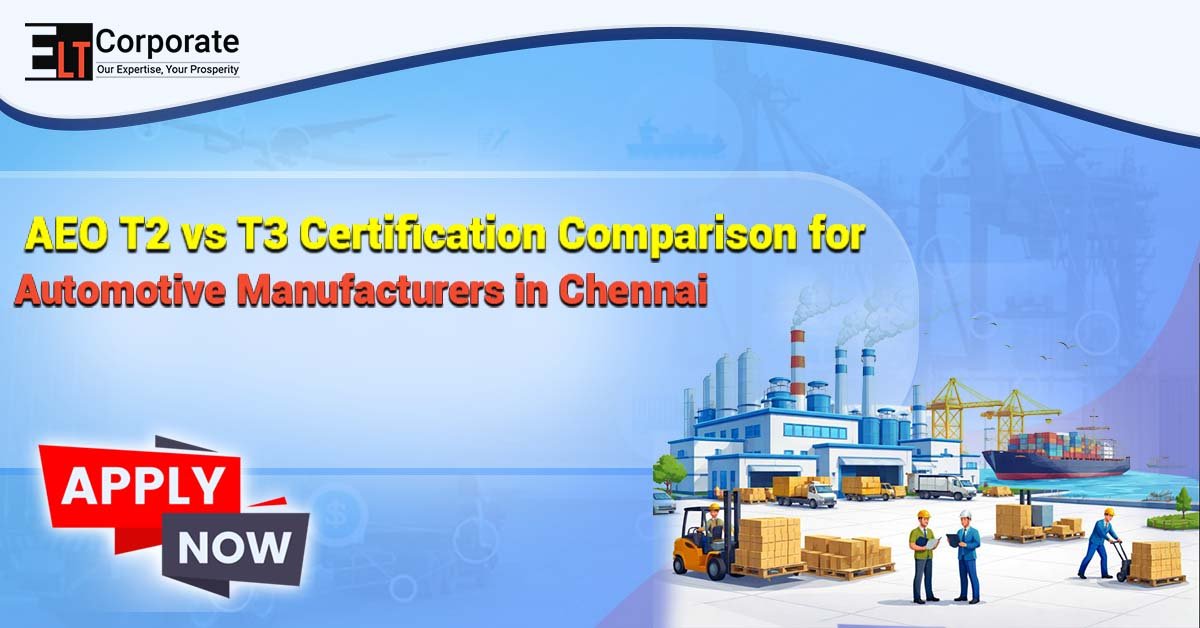
Chennai houses one of the largest automotive production facilities in the country and also handles a considerable amount of cross-border trade in automotive parts, modules, and complete vehicles in addition to being involved in the export and import of fully finished automotive vehicles. These businesses do, however, encounter significant complications, which stem from customs delays, border inspections, and compliance challenges with production schedules and global supply obligations. This is the key area where the AEO certification is of great use. The Authorised Economic Operator (AEO) program advanced by Indian Customs provides trusted manufacturers with operational efficiencies delivered by faster clearances and reduced inspections. Of the various operational tiers, AEO T2 and AEO T3 certifications apply to the mid-sized and large automotive manufacturers based in the city.
What Is AEO Certification, and Why Does It Matter for Automotive Manufacturers?
The AEO program offers certification to importers and exporters who demonstrate a level of customs compliance that suggests they are low-risk to customs, in addition to robust supply chain practices that safeguard their business from financial fraud and compromise.
In Chennai, AEO certification helps automotive manufacturers to:
- Eliminate delays caused by congestion at the ports
- Advances the effectiveness of Just in Time (JIT) supply chains
- Decrease costs related to logistics and warehousing
- Increase the level of global customer trust
- Facilitate continued growth in exports over time
The tiers of AEO Certification: Where T2 and T3 Fit
The Indian Customs Department assigns three tiers of AEO Certification based on a firm’s international trading activities:
- AEO T1 – Entry Level Recognition
- AEO T2 – Advanced Level Recognition
- AEO T3 – Highest Level of Facilitation and Trust
Due to having significantly more complex logistics and higher trade activities in their supply chains, most manufacturers in the automotive sector aim for AEO T2 or T3.
What Does AEO T2 Certification Mean?
AEO T2 certification means that the firm is for intermediate-advanced level certification that has a strong, proven record of compliance, and has established sufficient and appropriate internal controls over their operations. Certification involves a partial review of documentation, as well as on-site verification of the company’s business premises.
Key Benefits of AEO T2 for Automotive Manufacturers
- Reduced customs examination and scanning
- Priority clearance at ports and ICDs
- Deferred payment of customs duty
- Reduced requirement for bank guarantees
- Faster processing of refunds and claims
- Eligibility for Mutual Recognition Agreement (MRA) benefits with partner countries
What is the Validity of AEO T2 Certification?
AEO T2 certification is generally valid for 3 years, subject to periodic compliance monitoring.
Who Should Choose AEO T2?
- Automotive component exporters
- Manufacturers with consistent import/export activity
- Companies looking for faster clearance but not yet ready for top-tier compliance obligations
What Is AEO T3?
AEO T3 is the highest level of AEO certification available to importers and exporters. It is granted to businesses that demonstrate exceptional compliance history, mature internal systems, and supply chain security.
In most cases, applicants are expected to have prior AEO T2 certification or equivalent compliance credentials.
Key Benefits of AEO T3 for Automotive Manufacturers
- All AEO T2 benefits, plus enhanced facilitation
- Minimal or waived routine physical inspections
- Complete waiver of bank guarantees in most cases
- Acceptance of self-certified documents
- Priority treatment during system disruptions
- Faster customs refunds and rebates
- Stronger recognition under international MRAs
What is the Validity of AEO T3 Certification?
AEO T3 certification is generally valid for 5 years, making it ideal for long-term exporters.
Who Should Choose AEO T3?
- Large automotive OEMs
- High-volume exporters and importers
- Companies with global supply chains and strict delivery timelines
- Businesses aiming for maximum customs predictability
Difference between AEO T2 vs AEO T3
| S.No. | Parameter | AEO T2 | AEO T3 |
| 1. | Certification Level | Advanced | Highest |
| 2. | Compliance Requirement | High | Very High |
| 3. | Physical Verification | Mandatory | Risk-based |
| 4. | Customs Examination | Reduced | Minimal |
| 5. | Bank Guarantee Waiver | Partial | Almost full |
| 6. | Deferred Duty Payment | Allowed | Allowed |
| 7. | Self-Certified Documents | Limited | Accepted |
| 8. | Refund Processing | Faster | Fastest |
| 9. | MRA Benefits | Available | Strong global acceptance |
| 10. | Validity Period | 3 Years | 5 Years |
Why AEO Certification Is Especially Important in Chennai
Chennai handles large volumes of automotive exports through seaports, air cargo, and ICDs. Even small delays can disrupt:
- Production schedules
- Dealer commitments
- International contracts
AEO T2 or T3 certification helps manufacturers maintain predictable clearance timelines, reduce port dependency, and strengthen India’s image as a reliable automotive exporter.
How Automotive Manufacturers Can Decide Between AEO T2 and T3
Choose AEO T2 if:
- Your compliance systems are strong but still evolving
- You want faster clearance without top-tier obligations
Choose AEO T3 if:
- You have mature compliance systems
- You export at scale and require minimal customs intervention
- You want maximum trade facilitation and global recognition
Conclusion
For automotive manufacturers in Chennai, AEO T2 and AEO T3 certifications are powerful tools that improve supply chain efficiency, reduce customs friction, and support global expansion. While AEO T2 offers strong facilitation for growing exporters, AEO T3 delivers maximum trust, speed, and predictability for large-scale manufacturers.
Choosing the right AEO tier depends on trade volume, compliance maturity, and long-term export strategy. With proper guidance and documentation, AEO certification can become a key competitive advantage in the automotive sector.
Is AEO certification mandatory for automotive manufacturers?
No, it is voluntary but highly beneficial for frequent importers and exporters.
Can a company apply directly for AEO T3?
Usually no; prior AEO T2 certification or equivalent compliance history is expected.
Does AEO certification reduce customs duty?
No, it does not reduce duty but allows deferred payment and faster processing.
Are AEO benefits valid across all Indian ports?
Yes, AEO benefits apply nationwide across customs locations.
Does AEO certification help exports outside India?
Yes, Mutual Recognition Agreements provide facilitation in partner countries.