
If you run a small or medium enterprise involved in import or export — or a startup that has begun cross-border trade — you have probably come across the term AEO certification. And you have probably also assumed it is designed for large corporations, not for businesses of your size.
That assumption is no longer accurate. In December 2020, the Central Board of Indirect Taxes and Customs (CBIC) introduced its flagship Liberalised MSME AEO Package — specifically designed to bring smaller businesses into the AEO programme with significantly relaxed eligibility criteria, simplified documentation, and faster decisions.
CBIC’s Liberalised MSME AEO Package is a voluntary compliance programme which enables swifter customs clearance for accredited stakeholders in the global supply chain — importers, exporters, logistic service providers, and custodians.
This guide covers every benefit of AEO certification that is specifically valuable for SMEs and startups — the financial advantages, the operational improvements, the market positioning gains, and the strategic long-term impact — with concrete numbers where available.
First: What Changed for SMEs — The Liberalised MSME AEO Package
The original 2016 AEO programme was designed with larger trading companies in mind. The eligibility bar — 25 customs documents, 3 years of operations, multiple compliance annexures — excluded most SMEs and early-stage exporters. CBIC acknowledged this gap and addressed it directly.
On 15 December 2020, the CBIC vide Circular No. 54/2020-Customs introduced and promoted the Liberalised MSME AEO Package, encouraging all eligible MSMEs to obtain advantages of faster customs clearances and the related benefits.
Here is what changed specifically for MSMEs:
| Eligibility Criterion | Standard Requirement | MSME Relaxation |
| Minimum customs documents per year | 25 Shipping Bills / Bills of Entry | 10 documents (at least 5 per half-year) |
| Years of customs-related business | 3 financial years | 2 financial years |
| AEO-T1 decision timeline | 30 working days | 15 days from complete electronic submission |
| AEO-T2 decision timeline | 6 months | 3 months |
| Documentation complexity | Multiple complex annexures | 2 simplified annexures for T1, 3 for T2 |
| Bank Guarantee (AEO-T1) | 50% of non-AEO requirement | 25% of non-AEO requirement |
| Bank Guarantee (AEO-T2) | 25% of non-AEO requirement | 10% of non-AEO requirement |
Prerequisites: You must hold a valid MSME certificate from the Ministry of MSME (Udyam Registration), and maintain active MSME status throughout the validity of your AEO certification.
Benefit 1: Faster Customs Clearance — Every Shipment, Every Port
For SMEs and startups, customs delays hit harder than they do for large companies. You have less buffer inventory. You have tighter delivery commitments. A shipment stuck at the port for an extra week is not an inconvenience — it is a cash flow problem and a customer relationship risk.
AEO-certified companies get priority clearance. They have fewer document inspections, less cargo inspection, and quicker release of cargo. Your goods advance above others, particularly in peak port congestion or system overload. Even a small decrease in clearance time would make an impact on supply chain planning.
What this means in practice for SMEs:
- Your shipments are flagged as low-risk in CBIC’s automated risk management system
- Fewer routine document checks — same documents are not repeatedly requested
- Reduced cargo examination frequency — your containers are not routinely selected for physical inspection
- Priority processing at all customs stations across India — not just your primary port
For a startup shipping 15–20 consignments per year, even saving 2–3 days per shipment adds up to 30–60 days of recovered time annually — time that translates directly into faster delivery, better buyer relationships, and lower demurrage risk.
Benefit 2: Significantly Reduced Bank Guarantee Requirements
For SMEs and startups, capital is always constrained. Every rupee locked up in bank guarantees is a rupee not available for inventory, operations, or growth. This is where AEO certification delivers one of its most immediate and tangible financial benefits.
MSME AEO holders benefit from further reduction or waivers in bank guarantee requirements — with MSME AEO-T1 holders paying just 25% of the non-AEO requirement.
The financial impact compounds with tier:
| Business Type | Bank Guarantee Requirement | Capital Freed (Example: ₹10L BG) |
| Non-AEO business | 100% of required amount | — |
| MSME AEO-T1 | 25% of non-AEO requirement | ₹7.5 lakhs freed |
| MSME AEO-T2 | 10% of non-AEO requirement | ₹9 lakhs freed |
| AEO-T3 (any size) | Complete waiver | ₹10 lakhs freed |
For a startup managing ₹10–50 lakhs in bank guarantee obligations, these reductions are not marginal — they are working capital transformations that directly enable business growth without additional financing.
Benefit 3: Direct Port Delivery (DPD) and Direct Port Entry (DPE)
Direct Port Delivery of imports ensures just-in-time inventory management by manufacturers, allowing clearance from the wharf directly to the warehouse. Direct Port Entry is allowed for factory-stuffed containers intended for export by AEO-certified companies.
For SMEs and startups, DPD and DPE solve two specific operational problems:
DPD for importers: Your imported raw materials, components, or finished goods move directly from the port to your warehouse — bypassing the Container Freight Station (CFS) queue entirely. This eliminates CFS handling charges (₹8,000–₹25,000 per container depending on port and operator) and the associated dwell time. For manufacturing SMEs importing inputs, just-in-time delivery without CFS stops directly improves production planning and reduces inventory carrying costs.
DPE for exporters: Your factory-stuffed export containers get Direct Port Entry — moving to the port without waiting in common yard queues. For startups with tight export timelines, this reduces the risk of missing vessel cut-off times and the resulting delays, freight rebooking costs, and buyer penalties.
Benefit 4: Priority Duty Drawback and Faster Refunds
AEO certification enables faster dispersal of drawback amounts. For SMEs that depend on duty drawbacks as a significant component of their export economics, faster refunds directly improve the cash flow cycle.
Consider the typical SME exporter’s refund timeline:
- Without AEO: Duty drawback claims processed in standard queue — 60–120 days from filing to credit
- With AEO-T1/T2: Priority drawback processing — typically 30–45 days
- AEO-T3: Committed 45-day refund cycle for all indirect tax refunds
For a startup exporting ₹50 lakhs per quarter with a 3% drawback rate, that is ₹1.5 lakhs per quarter in refunds. Getting those refunds 30–60 days faster is equivalent to accessing an interest-free ₹1.5 lakh working capital line — with no bank application required.
Benefit 5: Deferred Duty Payment — Cash Flow Game Changer (AEO-T2 and T3)
AEO-T2 and T3 certified companies benefit from deferred payment of duties — paying customs duties after goods are cleared, not in advance. This retains more capital at the time it is most needed.
For importing SMEs and startups, this benefit fundamentally changes the economics of import-based business:
- You clear your goods without paying duty upfront
- You can sell or use the goods before the duty payment is due
- The effective credit period on duty amounts directly reduces your working capital financing requirement
For a startup importing ₹1 crore of goods per month with 20% customs duty, deferred duty payment means ₹20 lakhs per cycle that does not need to be financed before clearance. At a working capital loan rate of 12% annually, this saves approximately ₹2.4 lakhs per year in financing costs — without any additional credit facility.
Benefit 6: SION Self-Declaration — Critical for Advance Authorisation Users
Under Para 4.07A of the Foreign Trade Policy, AEO exporters can self-declare Standard Input Output Norms (SION) when they are not officially notified.
This benefit is particularly valuable for manufacturing SMEs and startups that import raw materials and components duty-free under Advance Authorisation — to produce goods for export. When SION is not officially notified for your product, the normal process requires approaching the Norms Committee at DGFT — a process that can take months.
With AEO status, you can self-declare SION, eliminating the Norms Committee wait entirely. For startups launching new product lines with unlisted SION, this can cut the Advance Authorisation cycle by 3–6 months — directly enabling faster export ramp-up.
Benefit 7: FTA and PTA Origin Certificate Self-Certification
AEO certification enables acceptance of self-certified copies of PTA/FTA origin-related or any other required certificates for clearance.
For SMEs and startups leveraging India’s Free Trade Agreements — with ASEAN, South Korea, UAE, Japan, or others — claiming preferential duty rates at the destination requires submitting origin certificates with each shipment. Normally, these must be attested or notarized per each country’s requirements.
With AEO status, self-certified copies are accepted — eliminating per-shipment attestation costs and administrative time. For an SME making 30–50 FTA-covered shipments per year, this is a meaningful operational and cost saving.
Benefit 8: Reduced Compliance Burden and Fewer Audits
AEO status alleviates the compliance burden. Indian Customs identifies AEO-certified businesses as low-risk. Therefore, such businesses benefit from simplified procedures and fewer interventions. In most cases, businesses might also be exempted from routine post-clearance audits. This saves in-house teams’ time and cost incurred for compliance consultants, documentation personnel, and manual coordination.
For startups with lean teams — where the founder or a small compliance team is managing all regulatory interactions — this reduction in routine customs interface is not just cost-saving. It is time-saving that gets redirected to business building:
- Fewer ad-hoc document requests during clearance
- Reduced frequency of Post-Clearance Audits (PCA)
- Fewer manual interventions from customs officers on routine shipments
- Access to a dedicated customs officer as single point of contact (AEO-T2 and above)
Benefit 9: Global Recognition Through MRAs — Compete Like a Large Company
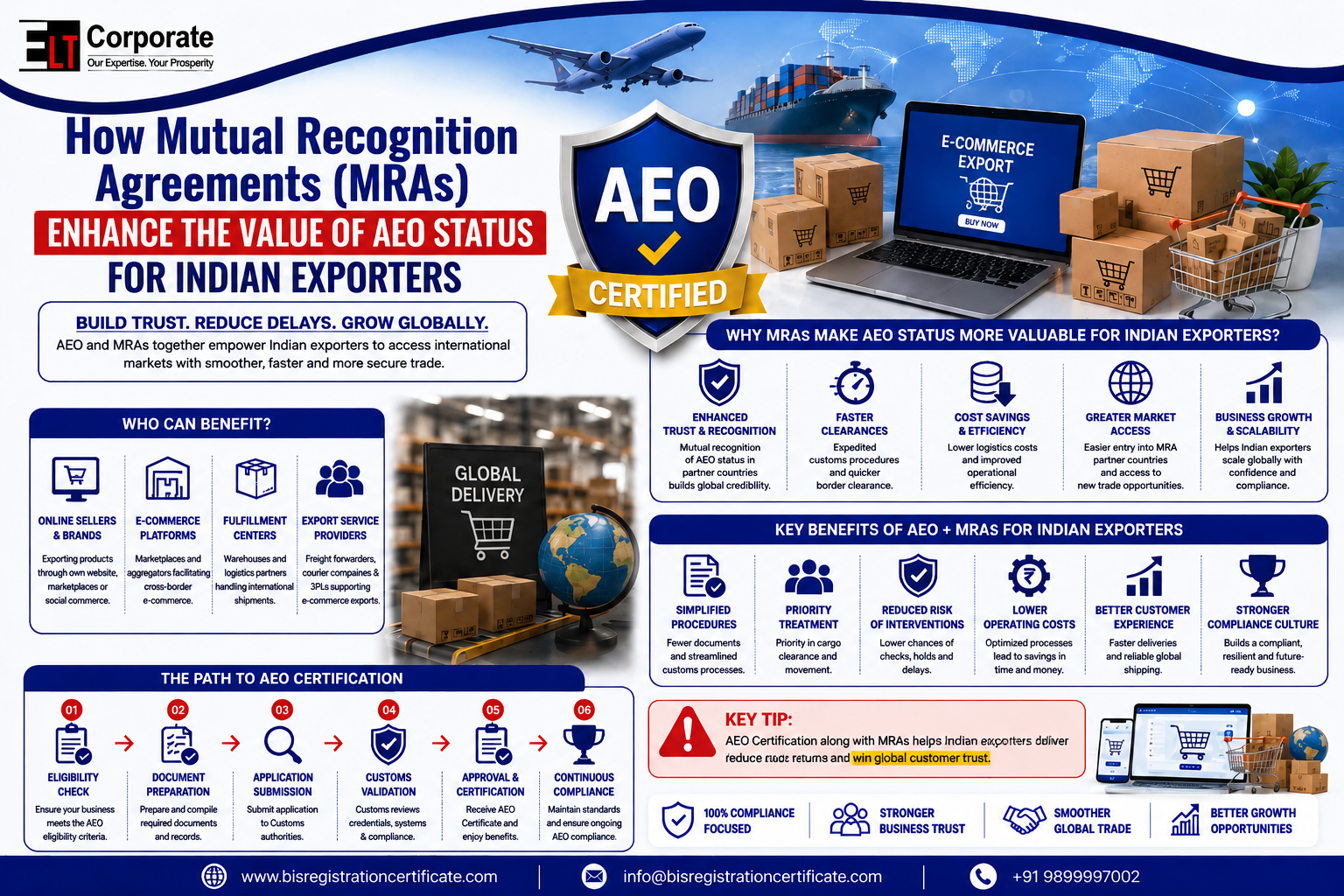
India has already entered MRAs with South Korea, UAE, Hong Kong, and Taiwan. Negotiations are in progress with other nations like the US and some EU nations. If you are AEO certified in India, your business would be entitled to quicker clearance and improved treatment in partner nations as well. Singapore MRA was signed in May 2025.
For SMEs and startups, this international recognition levels the playing field against larger competitors in these markets:
- Your shipments to South Korea, Hong Kong, and Singapore face fewer inspections on arrival
- Your risk profile with international buyers’ customs authorities improves — affecting the speed of their receiving processes
- In procurement evaluations from international buyers, AEO certification signals the same compliance standard their home-market AEO-certified suppliers carry
A startup exporting to South Korea competes on equal customs footing with a large Korean domestic supplier’s Indian counterpart — because the MRA ensures both are treated as trusted traders at the destination customs.
Benefit 10: Market Credibility and Business Development Advantage
This benefit is harder to quantify but strategically significant for startups: AEO certification is a verifiable trust credential.
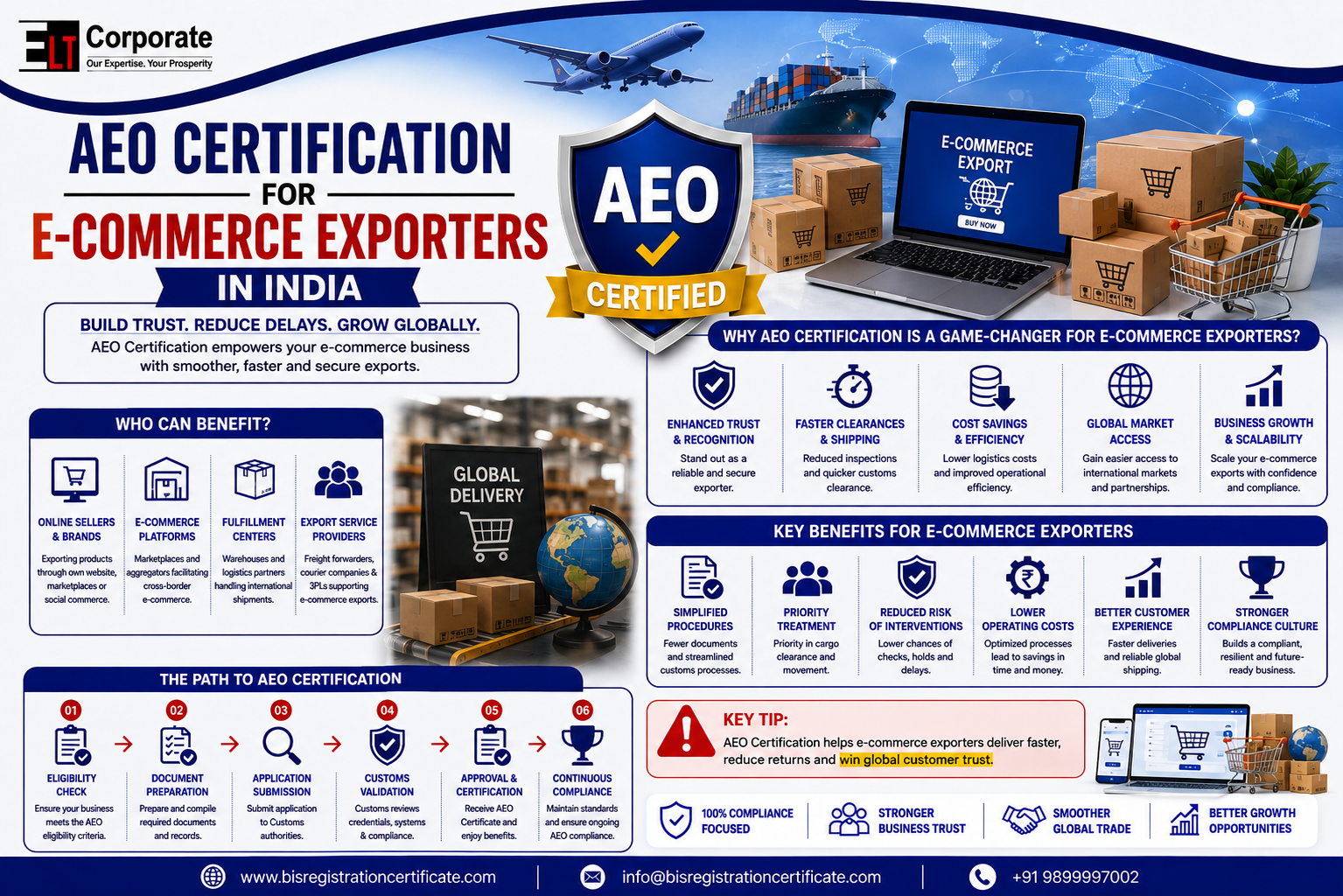
As an MSME with exports or imports, obtaining AEO certification can be one of the most effective means of minimising operational friction and maximising profit margins. AEO is no longer a nice-to-have. It’s a business lever that can provide a true competitive advantage in a highly competitive global economy.
Specific business development advantages for SMEs and startups:
- Enterprise client procurement: Large buyers increasingly require suppliers to demonstrate compliance credentials. AEO certification is one of the few verifiable customs compliance credentials available to smaller Indian businesses
- AEO-T3 supply chain inclusion: Businesses pursuing AEO-T3 status must demonstrate that their key partners are AEO certified. SMEs with AEO status become preferred partners for T3-aspirant larger companies
- International partnership credibility: Foreign distributors, buyers, and JV partners treat AEO-certified Indian businesses differently — it signals institutional seriousness about compliance
- Banking and financing: AEO status is beginning to influence trade finance terms — some banks offer better rates to AEO-certified businesses as a reflection of lower compliance risk
The MSME Eligibility Checklist: Are You Ready?
If you are an MSME or startup, check these boxes before applying:
- Valid Udyam Registration Certificate (MSME certificate) from Ministry of MSME — must be active throughout AEO validity
- Valid IEC (Import Export Code) — active and current at DGFT
- Valid GST registration — all returns filed, no outstanding dues
- Minimum 10 customs clearance documents in the last financial year (at least 5 per half-year)
- Minimum 2 financial years of customs-related business operations
- Positive net worth in the previous financial year
- Clean compliance record — no significant SCNs involving fraud, misclassification, or suppression in the last 3 years
For startups specifically: If you have been exporting or importing for 2 years and have handled at least 10 customs documents in the last financial year — you likely already qualify for AEO-T1 under the MSME package. The application is free. CBIC commits to decide on an AEO-T1 application within 15 days of complete electronic submission for MSMEs. You could have your certification within a month of a complete submission.
What AEO Certification Costs — And Why the ROI Is Clear
| Cost Component | Amount |
| Government application fee | Zero — AEO application is free |
| Internal preparation time | Varies — 2–6 weeks for a well-supported application |
| Regulatory consulting fee (if used) | ₹25,000–₹75,000 for MSME T1 — varies by consultant |
Against these costs, consider the measurable financial return for a typical SME exporter shipping 30 consignments per year:
- Bank guarantee reduction (MSME T1 — 75% waiver): ₹5–15 lakhs of capital freed
- Faster drawback (30–60 days faster): ₹50,000–₹2 lakhs in effective interest saving annually
- Reduced CFS charges (DPE/DPD): ₹2.4–7.5 lakhs per year (₹8,000–₹25,000 per container × 30 consignments)
- Deferred duty (T2 — if applicable): ₹1–5 lakhs in annual financing cost savings
The total measurable annual benefit for an SME typically ranges from ₹8–25 lakhs per year — significantly exceeding the one-time preparation cost in the first year alone.
Updates That Make AEO Even More Valuable for SMEs
- On-Arrival Movement Regulations: CBIC has notified new Customs regulations allowing AEO-T2 and T3 importers to store and clear goods on arrival at their own authorised premises — cutting warehouse dwell time and eliminating demurrage costs for importing SMEs
- Singapore MRA: India signed a Mutual Recognition Arrangement with Singapore — a key market for Indian SME exporters in textiles, food processing, and electronics
- Gems and Jewellery sector AEO extension: The Centre has extended AEO status to the gems and jewellery sector, aiming to boost ease of doing business by streamlining export operations and reducing costs — indicating CBIC’s continued push to expand AEO across more SME-dominated sectors
The Bottom Line
AEO certification was once perceived as a large-company programme. The Liberalised MSME AEO Package has changed that permanently. With a free application, 15-day decisions for MSME T1, and benefits that directly address the specific pain points of smaller businesses — working capital, customs delays, compliance burden, and market credibility — AEO certification is now one of the most accessible and high-ROI programmes available to Indian SMEs and startups involved in international trade.
The businesses that apply now build a competitive moat that grows more valuable every year — as India’s MRA network expands, as more buyers require AEO-certified supply chains, and as CBIC’s digital compliance infrastructure makes AEO benefits increasingly operational.
Start your application today. The government fee is zero. The benefits are real. And under the MSME package, you could be certified in less than a month.
Need Help Getting AEO Certified as an MSME or Startup?
We help SMEs and startups across India get AEO certified under the Liberalised MSME AEO Package — efficiently and without errors:
- Eligibility assessment — confirm you qualify before spending any time on documentation
- Udyam certificate verification and MSME package eligibility check
- Simplified annexure preparation (Annexures 1 and 2 — MSME package)
- Compliance gap analysis and remediation guidance
- AEO portal submission and query handling
- Post-certification benefit activation — bank guarantee reduction, DPE/DPD, drawback priority
Free eligibility assessment for MSMEs and startups. Talk to our AEO team today →