Earning AEO Certification from CBIC represents months of preparation, documentation, and organisational discipline. Businesses that understand the long-term Benefits of AEO Certification know that maintaining compliance is as important as obtaining certification.
Unlike a one-time qualification or a static registration, AEO status is subject to ongoing CBIC oversight, periodic reviews, mandatory change disclosures, and the constant risk that a single compliance lapse — yours or a supply chain partner’s — can trigger suspension or cancellation. Businesses that treat AEO certification as a “set and forget” achievement frequently find themselves unprepared when CBIC conducts a periodic review, or worse, discover a compliance gap only after it has already resulted in a violation.
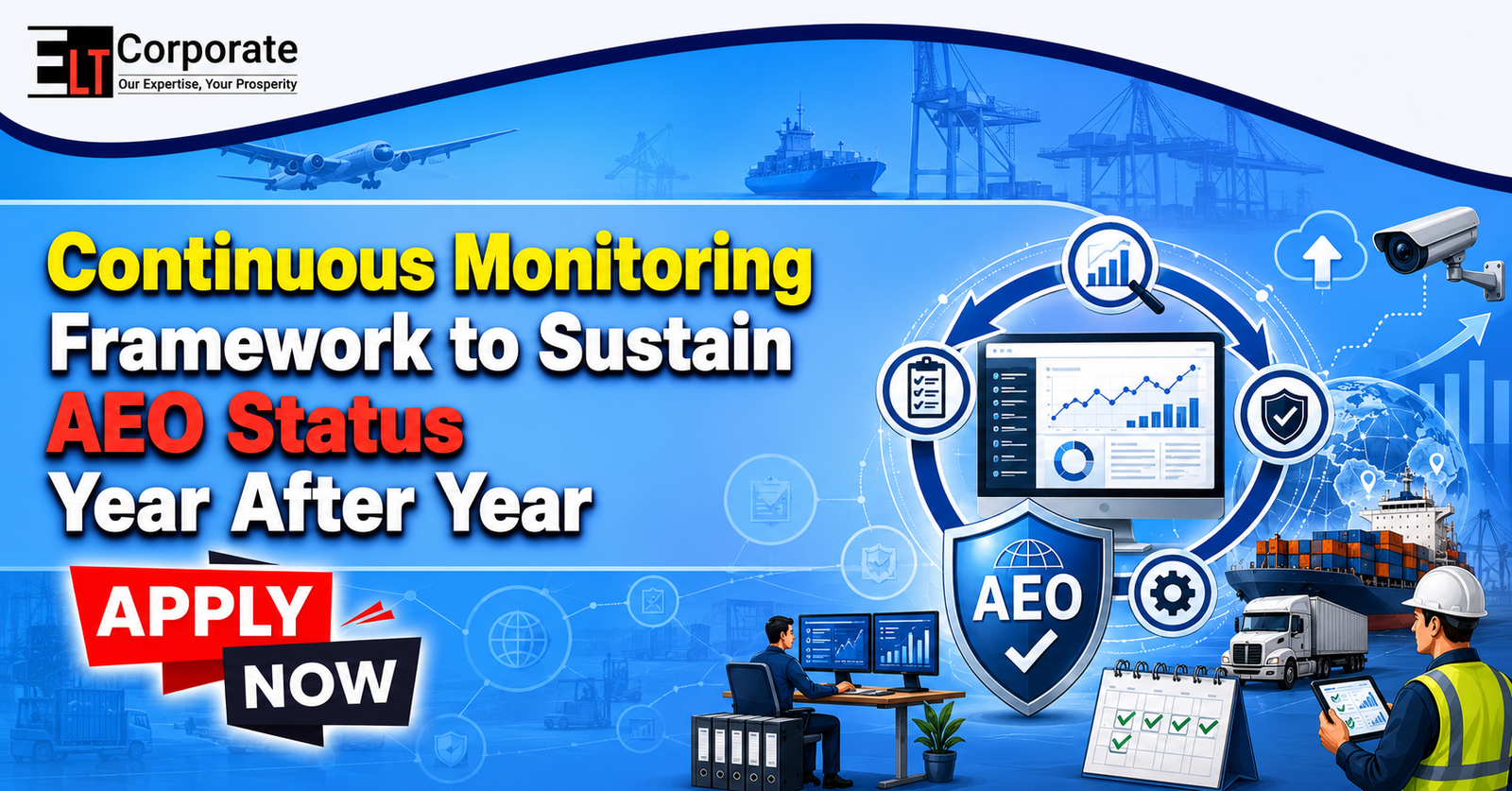
This guide provides a comprehensive continuous monitoring framework — a structured, year-round system of checks, reviews, and governance activities designed to ensure that your AEO status remains valid, defensible, and beneficial for the full duration of your certificate, and through every subsequent renewal cycle.
Why Continuous Monitoring is a Structural Requirement, Not a Best Practice
CBIC’s AEO Programme is explicitly designed around the principle of ongoing compliance, making Customs Compliance Management a critical requirement for certified businesses.
Periodic Review by CBIC CBIC’s AEO Programme Management Team (APMT) conducts periodic reviews of certified businesses — assessing whether the compliance and security standards that justified certification continue to be met. These reviews can include document requests, data analysis of your ongoing trade declarations, and in some cases, follow-up site visits.
Mandatory Material Change Disclosure AEO holders are required to proactively notify CBIC of material changes — new Show Cause Notices, ownership changes, significant operational shifts, security incidents — within defined timeframes. This is not a passive requirement; it demands an active internal system capable of identifying when a material change has occurred and triggering the notification process.
Renewal Requirements AEO certificates are valid for a defined period (typically 5 years), after which the AEO Renewal Process requires demonstrating continued compliance rather than simply re-submitting the original application.
Tier Upgrade and Downgrade Mechanisms CBIC’s framework allows for tier upgrades (T1 to T2, T2 to T3) based on demonstrated compliance maturity over time — and, conversely, can result in downgrade or suspension if compliance standards deteriorate. Both directions of this mechanism depend on CBIC’s ongoing visibility into your actual performance, not your certification-day snapshot.
Given this structural reality, a continuous monitoring framework is not an optional enhancement to your AEO programme — it is the operating system that keeps your certification alive and defensible.
The Four Pillars of Continuous AEO Monitoring
A comprehensive continuous monitoring framework rests on four interconnected pillars, each operating on its own rhythm but feeding into a unified governance structure.
Pillar 1 — Transactional Monitoring (Continuous / Real-Time)
Day-to-day verification of customs transactions strengthens Import Export Compliance and supports long-term Customs Clearance Facilitation benefits.
Pillar 2 — Periodic Internal Review (Monthly / Quarterly)
Regular reviews ensure continuous Customs Compliance Management and help businesses retain their Authorised Economic Operator Status.
Pillar 3 — Annual Comprehensive Audit (Yearly)
A full-scope internal audit, conducted at least annually, that mirrors the rigour of a CBIC compliance review — testing every AEO criterion systematically.
Pillar 4 — Governance and Escalation (Continuous, Event-Driven)
The management oversight structure that reviews monitoring outputs, makes decisions on corrective action, and ensures material changes are identified and disclosed promptly.
Each pillar is detailed below with specific monitoring activities, frequency, responsible parties, and documentation expectations.
PILLAR 1 — TRANSACTIONAL MONITORING
1.1 — Real-Time Declaration Accuracy Checks
What to monitor: Every Bill of Entry and Shipping Bill filed on your behalf, checked against source documents before or immediately after filing.
Specific checks:
- HS code classification matches your approved classification register
- Declared value matches the verified transaction value (commercial invoice, purchase order)
- Country of origin and any preferential duty claims are supported by valid documentation
- Quantity and description match the actual shipment
- Applicable licences (EXIM, BIS, drug, etc.) are correctly referenced where required
Frequency: Every transaction, ideally before filing; at minimum, within 24–48 hours of filing for retrospective verification.
Responsible party: Customs/logistics team member designated for declaration review, with oversight from the Compliance Officer.
Documentation: A transaction log or checklist record for each declaration, noting verification completion and any discrepancies identified and corrected.
1.2 — Duty Payment Reconciliation
What to monitor: Every duty payment made, reconciled against the corresponding Bill of Entry assessment.
Specific checks:
- Duty amount paid matches the assessed amount
- Payment is made within the required timeframe
- Any duty deferment (for AEO-T2/T3) is correctly applied and tracked against its repayment schedule
Frequency: Per transaction, with monthly reconciliation against your accounting records.
Responsible party: Finance team, with periodic review by the Compliance Officer.
1.3 — Cargo Security Event Logging
Effective cargo monitoring is a key component of Supply Chain Security, one of the core pillars of the AEO framework.
Specific checks:
- Seal numbers recorded at application and verified at each handover point
- Any seal discrepancy (broken seal, mismatched seal number) immediately flagged and investigated
- Container/vehicle inspection records completed for each shipment
Frequency: Per shipment, continuously.
Responsible party: Logistics/warehouse team, with discrepancies escalated immediately to the Compliance Officer.
1.4 — Access Control Log Review
What to monitor: Daily access logs for all premises with cargo, IT systems, or sensitive document access.
Specific checks:
- Unusual access patterns (after-hours access, repeated failed access attempts, access by terminated employees)
- Visitor log completeness and escort compliance
Frequency: Daily automated review (where electronic access systems are in place) with weekly manual summary review.
Responsible party: Security/facilities team, with monthly summary reporting to the Compliance Officer.
PILLAR 2 — PERIODIC INTERNAL REVIEW
2.1 — Monthly Compliance Dashboard Review
What to review:
- Summary of transactional monitoring exceptions identified during the month (HS code corrections, value discrepancies, duty payment issues)
- Cargo security incidents (if any) and their resolution status
- Any customs queries or correspondence received during the month
- Status of any open corrective action items from previous reviews
Who attends: Compliance Officer, customs/logistics team lead, and (for smaller organisations) the designated management sponsor.
Output: A monthly compliance summary report — even a one or two-page document — that creates a contemporaneous record of ongoing monitoring activity. This record becomes valuable evidence of continuous compliance management if CBIC conducts a review.
2.2 — Quarterly Trade Statistics and Pattern Review
What to review:
- Trade volume and value trends — identifying any significant shifts in trading patterns that may require CBIC notification (new product categories, new countries of origin, significant volume changes)
- Top supplier/buyer list — verifying it remains current and flagging any new high-volume partners requiring due diligence
- EXIM licence utilisation status — tracking progress against export obligations (Advance Authorisation, EPCG) to ensure no compliance gaps are emerging
- HS code classification register — reviewing for any products that have been added or for which classification practice should be reconsidered
Who attends: Compliance Officer, finance team, and senior operations representative.
Output: A quarterly trade pattern report feeding into both internal governance and, where relevant, material change assessment.
2.3 — Quarterly Security Systems Spot-Check
What to review:
- Physical inspection of CCTV coverage and functionality at all premises
- Test of access control system functionality
- Pest control treatment records (where relevant to manufacturing/storage premises)
- Review of any security incidents logged during the quarter and verification that corrective actions were implemented
Who conducts: Facilities/security team, with sign-off by the Compliance Officer.
Output: Quarterly security systems checklist with photographic evidence where practical, retained for audit purposes.
2.4 — Quarterly Supply Chain Partner Performance Check
What to review:
- Performance of key customs brokers, freight forwarders, and warehouse operators against the compliance criteria established at onboarding
- Any compliance incidents attributable to specific partners during the quarter
- Status of AEO-LO or equivalent trusted trader certification for key partners (any changes, suspensions, or renewals)
Who conducts: Compliance Officer, with input from logistics/procurement team.
Output: Updated partner compliance register reflecting current status.
2.5 — Quarterly Training Compliance Check
What to review:
- Verification that all personnel in customs/trade-relevant roles have current, up-to-date training records
- Identification of new hires requiring induction training
- Tracking of any scheduled refresher training due in the upcoming quarter
Who conducts: HR/Compliance Officer jointly.
Output: Updated training matrix showing current status for all relevant personnel.
PILLAR 3 — ANNUAL COMPREHENSIVE AUDIT
3.1 — Full AEO Criteria Self-Assessment
Annual audits should evaluate compliance against AEO Eligibility Criteria and verify all AEO Documentation Requirements remain current.
Customs Compliance Audit Component:
- Sample-based review of a representative set of Bills of Entry / Shipping Bills filed during the year — testing HS classification accuracy, valuation accuracy, and documentation completeness
- Review of all SCNs, queries, and penalties received during the year, and verification that each was properly disclosed (where required) and resolved
- Verification that EXIM licence obligations remain on track
Financial Controls Audit Component:
- Review of updated financial statements and solvency position against the standards required for your AEO tier
- Verification that duty payment timeliness has been maintained throughout the year
- Review of record-keeping completeness — sampling whether required records (5-year retention) are genuinely retrievable, not merely assumed to exist
Security Audit Component:
- Full re-assessment of physical security at all premises (not just the spot-checks conducted quarterly)
- Comprehensive review of access control logs for the full year, looking for patterns that quarterly spot-checks may have missed
- Full review of cargo security incident history and corrective action effectiveness
- IT security audit — including penetration testing or vulnerability assessment where appropriate to your risk profile
Governance Audit Component:
- Review of management review meeting records — verifying that senior management oversight has been genuinely active, not merely nominal
- Verification that all required SOPs have been reviewed within their scheduled review cycle (typically annual) and updated for any regulatory changes during the year
- Review of the material change notification log — verifying that any qualifying changes during the year were identified and disclosed to CBIC within required timeframes
3.2 — Supply Chain Partner Annual Re-Assessment
Beyond the quarterly performance check, conduct a full annual re-assessment of all high-impact supply chain partners:
- Refresh due diligence documentation (licence validity, regulatory standing, AEO/trusted trader status)
- Conduct or commission updated site visits for partners handling significant cargo volumes
- Reference checks with other clients where relevant
- Formal re-scoring against your partner compliance criteria
3.3 — Mock CBIC Review Exercise
One of the most valuable annual activities is a mock review — simulating how your organisation would respond if CBIC’s APMT initiated a periodic compliance review or pre-renewal evaluation:
- Assign an internal team (or external consultant) to act as the “reviewer,” requesting documents and asking questions exactly as CBIC would
- Test whether your team can produce required documents within a reasonable timeframe
- Test whether personnel across different functions (customs, security, finance) can coherently explain the procedures they are supposed to follow
- Identify any gaps between documented procedure and actual practice — the single most common finding in real CBIC reviews
3.4 — Mock Recall / Traceability Exercise
If your AEO status relates to goods where traceability matters (and it generally does, for both import compliance and supply chain security purposes), conduct an annual mock recall exercise:
- Select a sample batch/shipment and test how quickly your organisation can trace its complete history — from supplier/origin through customs clearance to final distribution
- Measure the time taken and identify any gaps in the traceability chain
- Document the exercise and any improvements identified
3.5 — Annual Management Review
The annual audit culminates in a formal management review meeting — bringing together senior leadership, the Compliance Officer, and key functional heads to:
- Review the complete findings of the annual audit
- Assess overall AEO compliance health against a defined scorecard or rating
- Approve a Corrective Action and Preventive Action (CAPA) plan for any findings, with named owners and deadlines
- Review whether the organisation’s AEO tier remains appropriate (consider upgrade or confirm current tier is right-sized)
- Approve the compliance programme’s budget and resourcing for the coming year
- Formally document the meeting — minutes, attendees, decisions, and action items — as primary evidence of management commitment
PILLAR 4 — GOVERNANCE AND ESCALATION
4.1 — Defined Escalation Triggers
A continuous monitoring framework is only as effective as its escalation discipline. Define clear triggers that mandate escalation beyond routine review:
Immediate escalation to Compliance Officer and senior management:
- Any new Show Cause Notice or customs penalty
- Any confirmed cargo security breach (tampering, theft, unauthorised access to sensitive cargo)
- Any significant IT security incident involving customs or trade data
- Any indication that a key supply chain partner has had their licence suspended, revoked, or is under investigation
- Any internal discovery of a significant, systemic declaration error (e.g., a misclassification affecting multiple past shipments)
Escalation requiring formal CBIC notification assessment:
- Change in business name, legal structure, or ownership
- Change of key management personnel relevant to the AEO application (compliance officer, key directors)
- Significant change in the nature of goods traded or trading volumes
- Change of principal customs station
- Insolvency proceedings, merger, acquisition, or demerger
- Any of the “immediate escalation” events above, once assessed as material
4.2 — Material Change Assessment Procedure
Not every operational change requires CBIC notification — but every potentially qualifying change should go through a defined assessment procedure to determine whether it does:
- Identification: The change is identified (through monitoring, management awareness, or HR/legal processes)
- Assessment: The Compliance Officer (with legal input where relevant) assesses whether the change meets the definition of a “material change” under AEO programme guidelines
- Decision: A documented decision is made — notify CBIC, or document the rationale for why notification is not required
- Notification: If required, the notification is prepared and submitted within the prescribed timeframe (typically 30 days)
- Record: The complete assessment, decision, and any notification submitted are logged in the material change register
4.3 — The Compliance Steering Committee
For organisations with meaningful trade volume and AEO-T2/T3 ambitions, establishing a small Compliance Steering Committee — meeting quarterly, chaired by a senior executive sponsor — provides the governance backbone for the continuous monitoring framework:
Typical composition: Compliance Officer (chair or secretary), Head of Logistics/Supply Chain, Head of Finance, a senior IT/security representative, and an executive sponsor (CFO, COO, or equivalent).
Typical agenda:
- Review of the quarter’s monitoring outputs (from Pillars 1 and 2)
- Status of any open CAPA items
- Review of any material change assessments conducted during the quarter
- Forward look at upcoming regulatory changes, renewal timelines, or planned business changes that may have AEO implications
Why this matters: CBIC evaluators specifically look for evidence of senior management engagement with compliance — not just operational-level activity. A documented, regularly convened steering committee is strong evidence of genuine organisational commitment, distinct from a compliance programme that exists only at the working level.
4.4 — Regulatory Change Monitoring
A dedicated, ongoing process for monitoring regulatory changes that could affect your AEO compliance obligations or procedures:
- Designated responsibility (within the Compliance Officer’s role or a specific team member) for monitoring CBIC circulars, Customs Act amendments, Union Budget duty rate changes, and AEO programme guideline updates
- A defined process for assessing the impact of identified changes on your SOPs, classification register, or compliance procedures
- A tracking log of regulatory changes identified, their assessed impact, and the internal procedure updates made in response
Building Your Monitoring Calendar — A Practical Template
To operationalise the four pillars, build an annual monitoring calendar that schedules every recurring activity:
Continuous (Daily/Per-Transaction):
- Declaration accuracy checks (Pillar 1.1)
- Duty payment verification (Pillar 1.2)
- Cargo security event logging (Pillar 1.3)
- Access control monitoring (Pillar 1.4)
Monthly:
- Compliance dashboard review (Pillar 2.1)
Quarterly:
- Trade statistics and pattern review (Pillar 2.2)
- Security systems spot-check (Pillar 2.3)
- Supply chain partner performance check (Pillar 2.4)
- Training compliance check (Pillar 2.5)
- Compliance Steering Committee meeting (Pillar 4.3)
Annually:
- Full AEO criteria self-assessment (Pillar 3.1)
- Supply chain partner annual re-assessment (Pillar 3.2)
- Mock CBIC review exercise (Pillar 3.3)
- Mock recall / traceability exercise (Pillar 3.4)
- Annual management review (Pillar 3.5)
- SOP review and update cycle
- Regulatory change impact review (cumulative annual summary)
Event-Triggered (As Needed):
- Material change assessment (Pillar 4.2) — triggered by any qualifying event
- Immediate escalation response — triggered by any defined escalation trigger (Pillar 4.1)
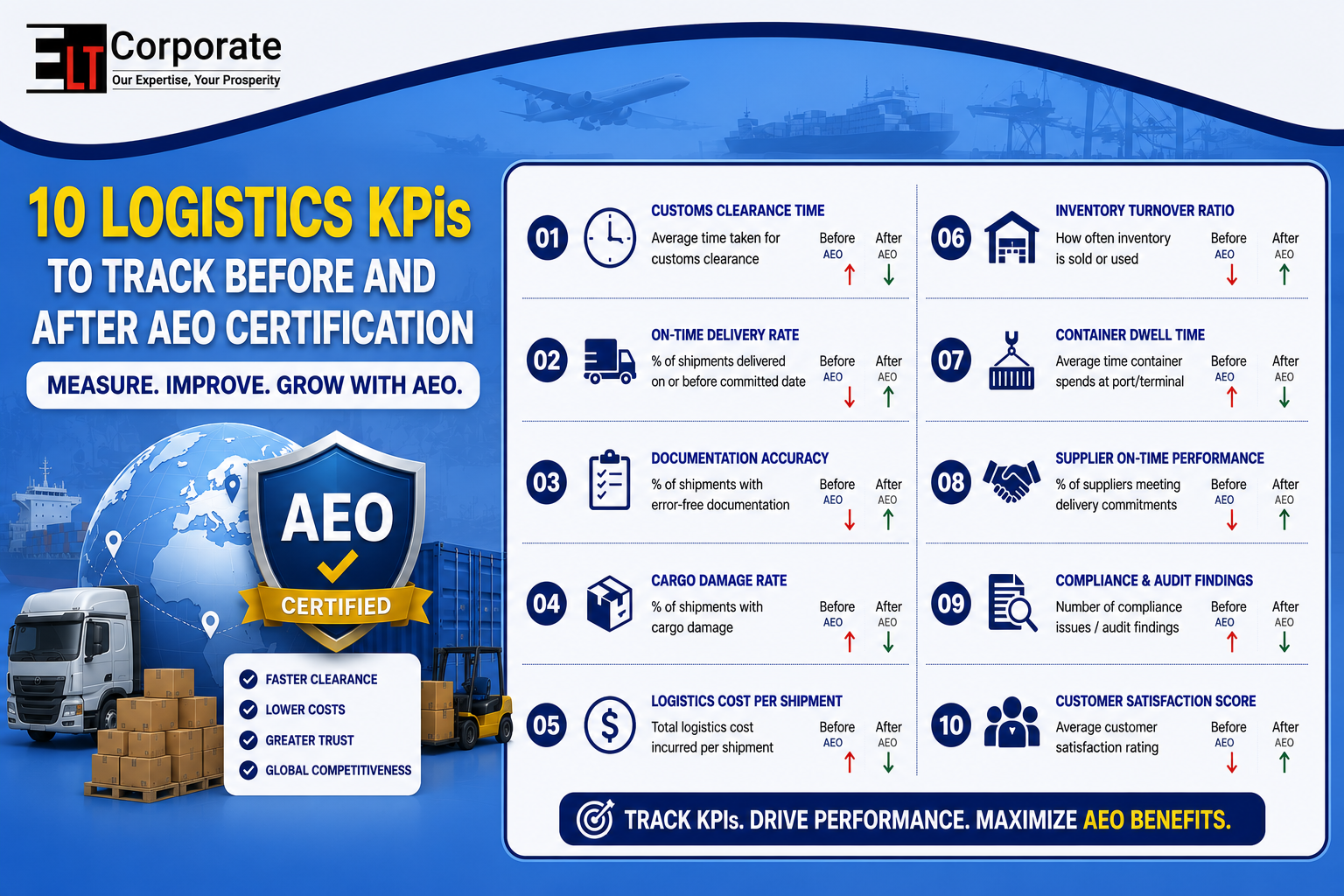
Key Performance Indicators (KPIs) for Sustained AEO Compliance
Quantifying your continuous monitoring framework’s effectiveness helps demonstrate (both internally and to CBIC, if requested) that your compliance programme is genuinely active and improving over time. Consider tracking:
- Declaration accuracy rate — percentage of declarations filed without post-filing correction needed
- Query/SCN frequency — number of customs queries or SCNs received per year, tracked for trend (declining trend is the goal)
- Examination rate — your actual physical examination rate at customs, tracked over time (should remain low and stable for AEO holders)
- Cargo security incident rate — number of security incidents (seal discrepancies, tampering, access violations) per year
- Training completion rate — percentage of relevant personnel current on required training
- CAPA closure timeliness — percentage of corrective actions closed within their target deadline
- Material change notification timeliness — percentage of required notifications submitted within the prescribed timeframe
- Partner compliance score trend — aggregate compliance scoring of key supply chain partners, tracked over time
Reviewing these KPIs at the quarterly Compliance Steering Committee and annual management review creates a data-driven narrative of your compliance programme’s health — far more persuasive (to both internal stakeholders and CBIC, if ever questioned) than a simple assertion of compliance.
Common Pitfalls That Undermine Continuous Monitoring
Treating the framework as a documentation exercise rather than an operational discipline Building beautiful monitoring templates that are never actually filled in consistently is worse than having no framework at all — it creates a false paper trail that collapses under scrutiny.
Compliance Officer isolation If the Compliance Officer is the only person aware of or engaged with the monitoring framework, it cannot function — transactional monitoring (Pillar 1) in particular requires distributed ownership across customs, logistics, finance, and security teams.
No real consequence for monitoring findings If quarterly and annual reviews consistently identify issues but no corrective action is genuinely implemented (CAPAs opened but never closed), the monitoring framework becomes a record of known, unaddressed problems — which is more damaging in a CBIC review than having fewer, but resolved, findings.
Monitoring fatigue from over-engineering Conversely, building an excessively elaborate monitoring framework that consumes disproportionate time relative to the organisation’s actual trade complexity can lead to monitoring fatigue — checklists completed mechanically without genuine engagement. Right-size the framework to your AEO tier and actual operational complexity.
Failure to update the framework as the business evolves A monitoring framework designed for your business as it existed at certification can become outdated as you add new product lines, enter new markets, or change suppliers. The framework itself should be reviewed and adjusted — at minimum during the annual comprehensive audit — to reflect your current operations.
Frequently Asked Questions
Q1. Do we need a dedicated, full-time compliance officer to run this monitoring framework?
Not necessarily, particularly for AEO-T1 businesses with moderate trade volumes. A fractional compliance role — combined with clear allocation of monitoring responsibilities across existing customs, logistics, and finance staff — can effectively run the framework, provided there is a single accountable person coordinating the overall programme. For AEO-T2/T3 businesses with higher trade complexity, a dedicated compliance resource becomes increasingly important.
Q2. How much of this framework do we need to show CBIC, versus simply maintain internally?
You are not typically required to proactively submit your continuous monitoring records to CBIC. However, they must be available and presented during any periodic review, renewal evaluation, or investigation CBIC initiates. The framework’s value lies in being ready to demonstrate genuine, sustained compliance whenever CBIC asks — not in routine reporting to CBIC.
Q3. What happens if our annual self-assessment identifies a serious compliance gap — should we disclose this to CBIC proactively?
This depends on the nature of the gap. If the gap relates to a qualifying “material change” (as defined under AEO programme guidelines) or reveals a violation that itself triggers disclosure obligations, proactive disclosure is generally the safer and more defensible course — self-identified and self-disclosed issues are typically viewed far more favourably by regulators than issues discovered independently by CBIC. For gaps that are purely internal process weaknesses (not violations), the priority is prompt remediation through your CAPA process, with disclosure assessed on a case-by-case basis, ideally with input from a qualified compliance or legal advisor.
Q4. Can smaller AEO-T1 businesses realistically sustain all four pillars of this framework?
Yes, with appropriate scaling. AEO-T1 businesses should focus the framework’s rigour proportionate to their actual trade volume and complexity — meaning lighter-touch monthly/quarterly reviews and a streamlined annual audit, rather than the full intensity appropriate for a large AEO-T3 multinational. The four pillars remain conceptually relevant at any scale; what changes is the depth and resourcing of each activity.
Q5. How do we know if our monitoring framework is “good enough” for CBIC’s standards?
There is no published certification or scorecard for monitoring framework adequacy. The most reliable indicators are: (1) your framework consistently identifies and resolves issues before they become violations, (2) your team can readily produce monitoring records and explain procedures when tested (including in a mock review exercise), and (3) your actual compliance performance (examination rates, query frequency, SCN history) trends positively over time. Engaging a qualified regulatory consultant for periodic independent assessment of your framework provides external validation.
Q6. Should our continuous monitoring framework be different for AEO-LO (logistics operator) certification compared to AEO-T1/T2/T3?
The four-pillar structure remains broadly applicable, but the specific content shifts — AEO-LO businesses (customs brokers, freight forwarders, warehouse operators) should place particular emphasis on cargo security monitoring (Pillar 1.3), client service quality and accuracy (analogous to declaration accuracy for customs brokers), and security infrastructure monitoring (Pillar 2.3), given that their AEO certification is fundamentally about the security and reliability of services provided to their AEO-certified clients.