Every business involved in international trade wants the same thing — faster movement of goods, fewer delays, lower costs, and partners who trust them.
Yet most importers and exporters in India spend thousands in demurrage charges, lose business to customs delays, and struggle to compete with larger, more established global players. The difference, in many cases, comes down to one certification: AEO — Authorized Economic Operator.
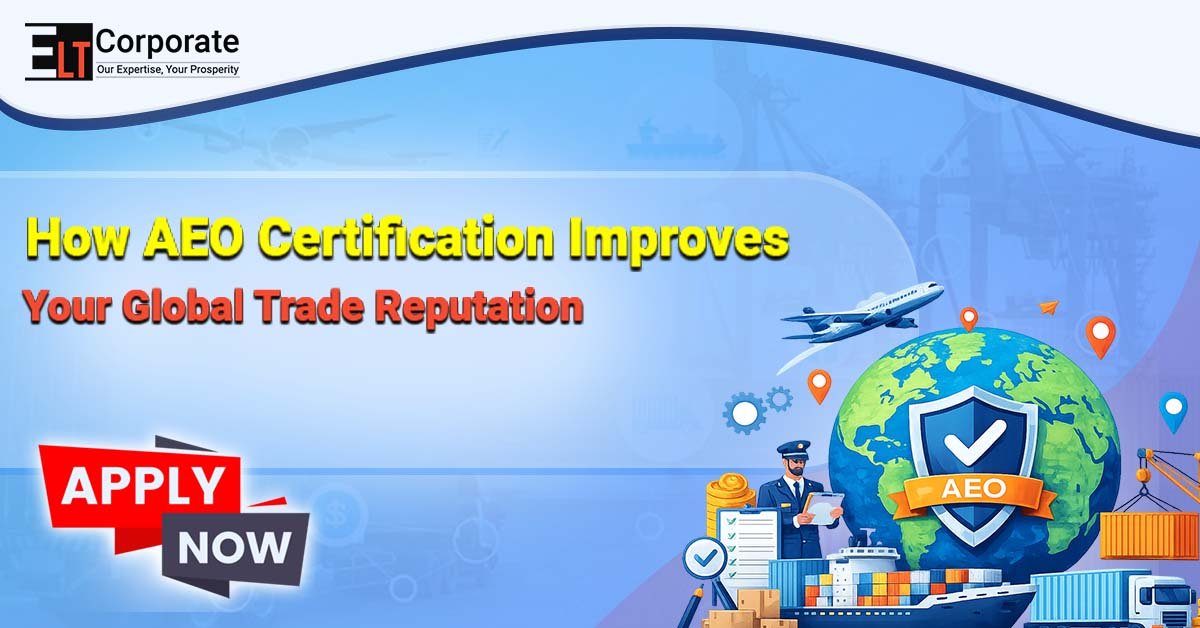
AEO certification, introduced in India by CBIC in 2016 and aligned with the World Customs Organization’s SAFE Framework, is not just a compliance badge. It is a globally recognised signal that your business operates with integrity, security, and professionalism. And in today’s competitive trade environment, that signal translates directly into business growth, stronger partnerships, and a reputation that opens doors worldwide.
In this blog, we break down exactly how AEO certification improves your global trade reputation — and why 2026 is the right time to get certified.
What Is AEO Certification — and Why Does It Matter?
AEO stands for Authorized Economic Operator. It is a certification granted by a country’s customs authority to businesses that meet strict standards in supply chain security, customs compliance, financial solvency, and recordkeeping.
In India, the AEO programme is administered by the Central Board of Indirect Taxes and Customs (CBIC). It follows a three-tier structure for importers/exporters (T1, T2, T3), along with a separate AEO-LO category for logistics operators:
| Tier | Who It Is For | Key Benefit |
| AEO-T1 | Importers & Exporters (entry level) | Faster clearance, reduced documentation |
| AEO-T2 | Importers & Exporters (after on-site audit) | Fewer physical inspections, deferred duty payment |
| AEO-T3 | Advanced level for businesses demonstrating strong compliance maturity and established customs track record | Maximum facilitation + international MRA recognition |
| AEO-LO | Logistics operators, warehouses, carriers | Simplified procedures for logistics chain |
AEO certification is not just about clearing customs faster. It is about being recognised — by governments, customs authorities, and business partners worldwide — as a company that operates with the highest standards of compliance and security.
5 Ways AEO Certification Directly Improves Your Global Trade Reputation
-
You Become a Verified “Trusted Trader” in the Eyes of Global Customs
When your business holds AEO status, you are officially classified as a low-risk, trusted trader by customs authorities. This is not a self-declaration — it is a government-verified credential.
This status has an immediate and measurable impact on how your shipments are treated at borders worldwide. AEO-certified shipments receive priority lanes, reduced physical inspections, pre-arrival clearance, and expedited processing — all of which signal to your buyers and suppliers that you are a reliable, professional partner.
For your trading partners, working with an AEO-certified business means fewer delays, more predictable delivery schedules, and reduced supply chain risk. That is a powerful reputation advantage over non-certified competitors.
-
AEO Acts as a Quality Mark — Like ISO, But for Trade Compliance
Think of AEO certification the way you think of ISO 9001 for quality management. It is an independently verified, internationally recognised standard that tells the world: this business meets the highest benchmarks.
In tender processes, vendor evaluations, and partnership discussions, AEO certification increasingly appears as a preferred criterion — especially when dealing with large multinational buyers, European companies, or government procurement.
Businesses without AEO certification are at a significant disadvantage in these situations, regardless of how competitive their pricing or product quality may be.
AEO certification serves as a quality mark that demonstrates a commitment to security and compliance — helping businesses secure more contracts with global partners. — Drip Capital, 2026
-
Mutual Recognition Agreements (MRAs) Extend Your Reputation Globally
One of the most powerful — and least understood — aspects of AEO certification is the network of Mutual Recognition Agreements (MRAs) that India has established with other countries.
An MRA means that India’s AEO certification is formally recognised by the customs authority of another country. When you export to an MRA partner country, your AEO status follows you — giving you the same trusted trader benefits at their border as you receive in India.
India’s current and expanding MRA network includes:
- South Korea and Hong Kong — active MRAs
- Singapore — MRA signed May 2025
- South Africa — MRA signed July 2025
- USA, UAE, and Taiwan — negotiations actively underway
- ASEAN nations — regional ASEAN AEO MRA framework in place
This means an Indian exporter with AEO-T3 status who ships to Singapore may be subject to reduced customs scrutiny and risk assessment — their AEO certification is accepted as proof of trustworthiness. That is not just an operational benefit. It is a reputational signal that travels with every shipment.
-
AEO Reduces Costs — Which Strengthens Your Commercial Reputation
Reputation is built not just on trust but on reliability and financial stability. AEO certification contributes to both by significantly reducing operational costs associated with cross-border trade.
Key cost reductions that AEO-certified businesses enjoy:
- Reduced likelihood of demurrage and storage costs due to faster clearance
- Deferred duty payment options (AEO-T2 and T3) — improving cash flow
- Lower insurance premiums due to reduced supply chain risk
- Fewer administrative overheads from simplified documentation
- Avoided costs of customs examinations — Costs associated with inspections and delays may be reduced
When your business consistently delivers on time, with lower landed costs and no customs surprises, your reputation as a dependable trade partner grows organically. Buyers come back. Contracts renew. Referrals happen.
-
AEO Gives You Preferential Treatment That Competitors Simply Cannot Match
In global trade, speed is a competitive advantage. AEO-certified businesses generally experience faster and more predictable clearance compared to standard processing timelines.
This operational edge translates into a reputation edge. Your clients know that choosing you means:
- Shipments that arrive on time, every time
- No unexpected customs holds or inspections
- Direct Port Delivery (DPD) and Direct Port Entry (DPE) for imports and exports
- Priority customs grievance resolution — your issues get addressed first
- A supply chain partner that reduces their own risk and liability
This level of reliability is what separates commodity suppliers from preferred, long-term partners in the eyes of international buyers.
AEO vs. Non-AEO: The Reputation Gap Is Growing
| Factor | AEO-Certified Business | Non-AEO Business |
| Physical inspection rate | Significantly reduced | Regular, random inspections |
| International recognition | MRAs | No reciprocal benefits |
| Global partner trust | Verified, government-backed | Self-declared only |
| Duty payment flexibility | Deferred payment (T2/T3) | Upfront payment required |
| Tender & contract eligibility | Often preferred in vendor evaluation and procurement processes | May face disadvantage in competitive evaluation |
| Supply chain risk profile | Low risk — classified officially | Standard or high risk |
| Cost of customs delays | Reduced compared to standard processing | High — unpredictable |
Who Should Get AEO Certified?
AEO certification is relevant for any business involved in the international movement of goods. In India, the following types of entities are eligible:
- Importers and exporters of any size
- Manufacturers exporting goods abroad
- Customs brokers and freight forwarders
- Logistics and warehouse operators (AEO-LO)
- Carriers and shipping companies
- Port and airport operators
There is no minimum turnover requirement. Businesses of all sizes — from SMEs to large corporations — can apply, provided they meet the compliance and security standards.
Government initiatives are actively promoting AEO adoption in India. As more businesses get certified, the gap between AEO and non-AEO businesses will widen. Getting certified now gives you a first-mover advantage in your sector.
The AEO Certification Process in India — What to Expect
The AEO application is filed online through the CBIC’s AEO portal. Here is a simplified overview of the process:
Step 1: Eligibility Check
Verify your compliance history, financial records, and security practices against AEO criteria.
Step 2: Document Preparation
Compile all required documentation — business records, customs compliance history, security protocols, and financial statements.
Step 3: Online Application
Submit your application through the CBIC AEO portal with supporting documents.
Step 4: Customs Review
CBIC conducts a detailed review of your application. For T2 and above, an on-site physical audit is conducted.
Step 5: Certification Grant
Upon approval, your AEO certificate is issued. For T1, this is primarily document-based. T2 and T3 involve progressively deeper validation.
Step 6: Ongoing Compliance
AEO status requires maintained compliance. Periodic reviews ensure continued eligibility and can lead to tier upgrades.
Common Mistakes That Delay AEO Certification
- Incomplete customs compliance history — any unresolved disputes or penalties can delay approval
- Weak security documentation — vague or undocumented security protocols are a common rejection reason
- Financial records not in order — AEO requires demonstrated financial solvency
- Applying at the wrong tier — businesses often overestimate readiness for T2 or T3
- Attempting the process without regulatory guidance — the application is detailed and errors are costly
Working with an experienced AEO consultant significantly reduces processing time and the risk of rejection.
Why Indian Exporters and Importers Cannot Afford to Wait
India’s trade ambitions are significant. With a target of USD 2 trillion in exports by 2030, the government is actively supporting businesses that demonstrate compliance and security through the AEO programme.
At the same time, India’s MRA network is expanding rapidly. Every new MRA — Singapore, South Africa, the upcoming USA agreement — adds another country where your AEO certification will give you a reputational and operational edge.
The businesses that get certified today will be the preferred trade partners of tomorrow. Those that wait will find the competitive gap increasingly difficult to close.
AEO certification is increasingly becoming a competitive advantage for serious exporters and importers. It is the new baseline for global trade credibility — and in 2025, the window to gain first-mover advantage is still open.
Get AEO Certified With Expert Guidance — ELT Corporate
At ELT Corporate, we have helped hundreds of Indian importers, exporters, and logistics operators obtain AEO certification — from entry-level T1 to the highest T3 status.
Our team handles every step: eligibility assessment, documentation, portal submission, coordination with CBIC, and ongoing compliance support. We know what the customs authorities look for — and we make sure your application is complete, accurate, and approved as fast as possible.