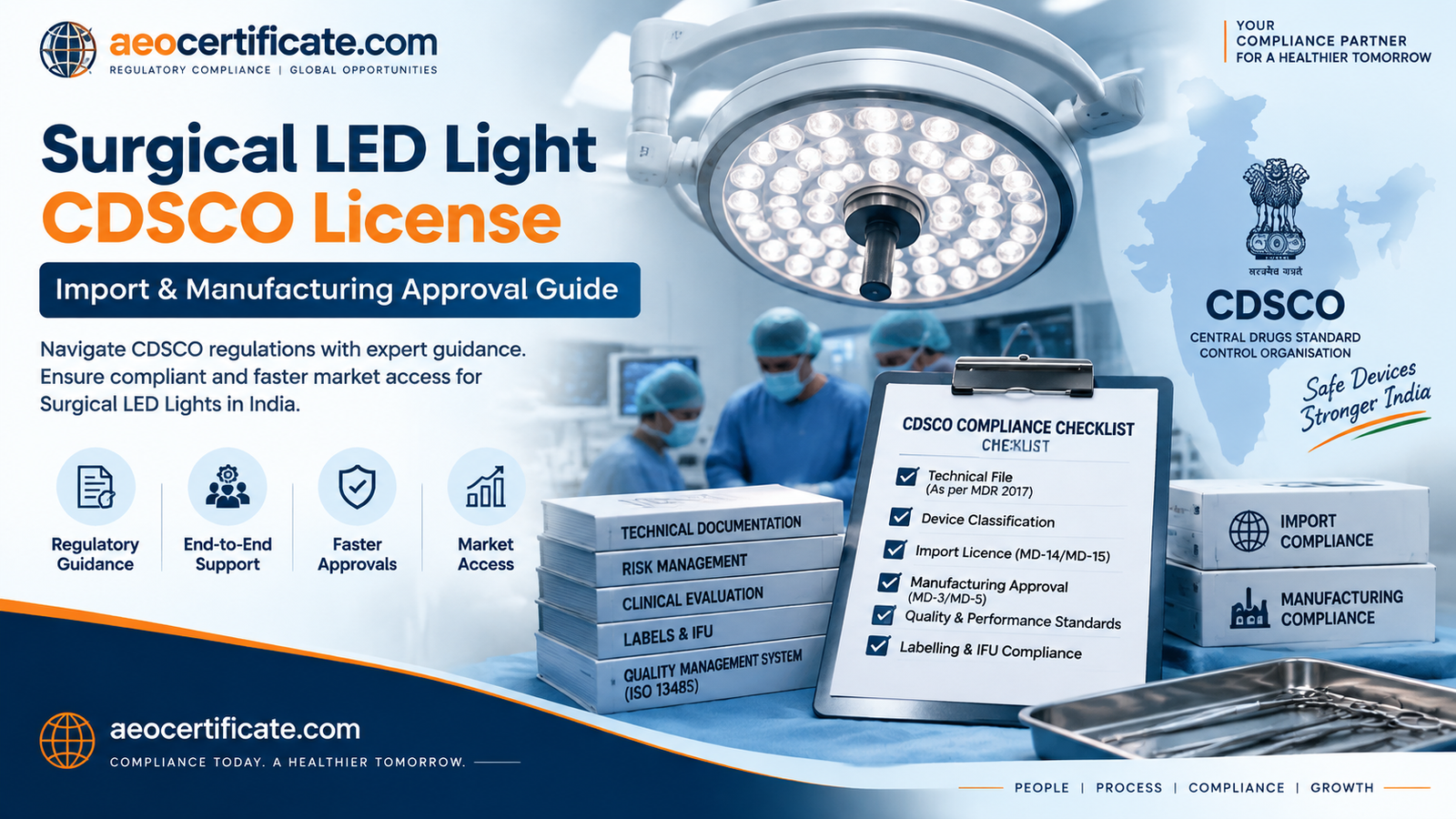
Surgical LED Light CDSCO License — Import & Manufacturing Approval Guide

Surgical lights are an essential, every-day fixture in every operating theatre, procedure room, emergency department, and examination suite across India’s healthcare infrastructure. Modern LED-based surgical lighting systems — prized for their superior illumination quality, energy efficiency, reduced heat output, and long operational lifespan — have rapidly become the standard of choice, replacing older halogen-based systems across hospitals and surgical centres of all sizes.

Whether you are a foreign manufacturer of surgical LED lighting systems seeking to enter the Indian market, an Indian importer of international surgical lighting brands, or a domestic manufacturer developing surgical illumination equipment, CDSCO registration is a mandatory legal requirement under the Medical Devices Rules, 2017 (MDR 2017). Importing, manufacturing, distributing, or selling a surgical LED light without a valid CDSCO licence is a criminal offence under the Drugs and Cosmetics Act, 1940.

We provide complete CDSCO registration services for surgical LED lights — covering both the import licence pathway (Form MD-14 / MD-15) and the manufacturing licence pathway (Form MD-5 / MD-6) — with end-to-end expert support from device classification through licence issuance and ongoing post-market compliance.

What is CDSCO Registration for Surgical LED Lights?

CDSCO registration is the formal process through which the Central Drugs Standard Control Organisation (CDSCO), functioning under the Ministry of Health and Family Welfare, Government of India, evaluates a surgical lighting device and grants a Market Authorisation (Medical Device Licence) permitting its commercial manufacture or import for sale in India.

All applications are filed through the CDSCO SUGAM online portal (sugam.gov.in):

  • Form MD-14 — Application for Import Licence (for surgical LED lights manufactured outside India)
  • Form MD-5 — Application for Manufacturing Licence (for surgical LED lights manufactured in India)

Upon successful evaluation and approval:

  • Form MD-15 — Import Licence is issued
  • Form MD-6 — Manufacturing Licence is issued

Both licence types are device-specific, manufacturer-specific, and valid for 5 years from the date of issue.

What is a Surgical LED Light — Device Scope

A surgical light (also referred to as an operating light or surgical illumination system) is a medical device intended to illuminate the surgical site and surrounding area during surgical procedures, examinations, and other medical interventions — providing the surgeon and surgical team with accurate, shadow-free, and colour-rendering-accurate visualisation of the operative field.

Surgical LED Light Configurations Covered Under CDSCO Registration

Ceiling-Mounted Surgical Light Systems The most common configuration in modern operating theatres — single-head or dual-head (twin-dome) LED light systems mounted on ceiling-fixed pendant arms, providing wide-area, adjustable, shadow-minimised illumination over the surgical field. Often integrated with sterile handle controls allowing the surgeon to adjust light position, focus, and intensity directly.

Wall-Mounted Surgical Light Systems LED surgical lights mounted on wall-fixed articulating arms — commonly used in smaller procedure rooms, minor operating theatres, and facilities with space or structural constraints that limit ceiling-mounted installation.

Mobile / Portable Surgical LED Lights Floor-standing, wheeled surgical lights that can be repositioned as needed — used in emergency departments, labour rooms, minor procedure areas, field hospitals, and facilities requiring flexible lighting deployment without fixed installation.

Examination LED Lights Lower-intensity LED lighting systems used for general medical examination purposes — in outpatient departments, dermatology clinics, ENT examination rooms, and general physician consultation rooms. Distinct from full surgical-grade lights in intensity, beam characteristics, and intended use.

Integrated Surgical Light and Camera Systems Advanced surgical light heads with integrated HD or 4K camera systems — enabling simultaneous illumination and video capture/streaming of the surgical field for teaching, recording, and telemedicine purposes.

Surgical Light with Integrated Display / Boom Systems Surgical lighting systems integrated into larger operating theatre boom and pendant systems, alongside medical gas outlets, electrical outlets, and equipment mounting arms.

Headlamp / Loupe-Mounted Surgical Illumination Wearable, head-mounted LED surgical illumination devices — used particularly in ENT, dental, and microsurgical procedures where direct, surgeon-controlled illumination angle is required.

Regulatory Classification of Surgical LED Lights Under MDR 2017

Device Type Risk Class Licensing Authority TPA Required
Examination LED light (outpatient / clinic use) Class A State Licensing Authority (SLA) No
Mobile / portable surgical LED light Class B State Licensing Authority (SLA) / CDSCO Generally not required
Ceiling-mounted surgical LED light (standard OT) Class B CDSCO (Central) Generally not required
Wall-mounted surgical LED light Class B CDSCO (Central) Generally not required
Surgical LED light with integrated camera system Class B / C CDSCO (Central) Depends on integrated functionality
Headlamp / loupe-mounted surgical illumination Class A / B State Licensing Authority (SLA) / CDSCO Generally not required
Surgical light integrated into OT boom/pendant system Class B CDSCO (Central) Generally not required

Classification note: Most standalone surgical LED lights are classified as Class A or Class B medical devices under MDR 2017 — reflecting their relatively low inherent risk profile as non-invasive illumination devices that do not directly contact the patient or deliver therapeutic energy. However, surgical lights integrated with camera systems, recording functions, or other active electronic features may attract a higher classification depending on the specific functionality and intended use. Our regulatory team conducts a formal, device-specific classification analysis for every application to determine the correct pathway.

Who Needs CDSCO Surgical LED Light Registration?

  • Foreign OEMs exporting surgical LED lighting systems to India — international brands such as Steris (Skytron), Getinge (MAQUET), Trumpf Medical, Dr. Mach, Stryker, Drägerwerk, Brandon Medical, and others must appoint an Indian Authorised Agent (IAA) to file the import licence application
  • Indian importers and distributors of international surgical lighting brands
  • Domestic manufacturers of surgical LED lights and examination lighting systems manufactured in India
  • Hospital equipment and OT (operating theatre) integration companies supplying complete OT setups including surgical lighting
  • Medical equipment distributors supplying hospitals, nursing homes, and ambulatory surgical centres
  • Dental and ENT equipment companies distributing headlamp and procedure lighting systems
  • Hospitals and healthcare facilities procuring surgical lighting directly — must purchase only CDSCO-registered devices
  • MedTech startups developing innovative surgical illumination or integrated lighting-camera systems for the Indian market

Complete Document Checklist for Surgical LED Light CDSCO Registration

SECTION A — Indian Applicant / IAA Documents

  1. Application in Form MD-14 (Import) or Form MD-5 (Manufacturing) Accurately completed application filed through the CDSCO SUGAM portal with correct applicant, manufacturer, and device details.
  2. Business Registration Certificate Certificate of Incorporation, Partnership Deed, LLP Agreement, or equivalent proof of the Indian entity’s legal existence.
  3. Import Export Code (IEC) Valid IEC from DGFT — mandatory prerequisite for import licence applications.
  4. GST Registration Certificate Valid GSTIN of the applicant entity.
  5. Authorisation Letter from Foreign Manufacturer Formally notarised and apostilled letter from the overseas manufacturer appointing the Indian entity as Indian Authorised Agent (IAA), explicitly listing all surgical LED light models and configurations covered.
  6. Indian Authorised Agent (IAA) Agreement Formal agreement defining the IAA’s regulatory responsibilities under MDR 2017 in India — covering vigilance reporting, label compliance, and post-market obligations.
  7. Affidavit / Undertaking by Indian Applicant Sworn affidavit by proprietor / directors declaring compliance with MDR 2017 and accuracy of all submitted information.
  8. Power of Attorney (if filing through regulatory consultant) Duly executed POA authorising the consultant to file and manage the application.

SECTION B — Device Technical Documents

  1. Device Description and Intended Use Comprehensive document covering:
  • Full device name, model number(s), and all configurations/variants in the application (ceiling-mounted, wall-mounted, mobile, examination light)
  • Light source technology — LED type, arrangement, and optical design
  • Intended use — surgical illumination, examination illumination, procedure lighting
  • Intended clinical environment — operating theatre, examination room, emergency department, labour room, ambulatory surgical centre
  • Intended users — surgeons, surgical nursing staff, biomedical engineers (for maintenance)
  • Description of all system components — light head(s), mounting/suspension system, sterile handle (if applicable), control panel, integrated camera (if applicable), power supply
  • Description of adjustability features — focus adjustment, intensity adjustment, colour temperature adjustment, light field diameter adjustment
  • Description of integrated features — camera, recording, display, connectivity (where applicable)
  1. Technical Specifications Detailed performance specifications including:

Illumination Performance:

  • Illuminance level (lux) at defined working distance — typically specified at 1 metre distance from the light source
  • Illuminance adjustability range (minimum to maximum lux)
  • Light field diameter (d10) — the diameter of the illuminated field at 50% of maximum illuminance
  • Light field diameter (d50) — the diameter at 10% of maximum illuminance
  • Colour temperature (Kelvin) and adjustability range
  • Colour Rendering Index (CRI / Ra) — critical for accurate tissue colour discrimination during surgery
  • Depth of illumination — the depth over which adequate illumination is maintained (important for deep cavity procedures)
  • Shadow dilution / shadow management performance — particularly relevant for multi-head and twin-dome configurations
  • Irradiance and thermal output at the surgical site (heat generated at the patient/wound site — a key LED advantage over halogen)
  • Light field homogeneity

Mechanical and Mounting Specifications:

  • Mounting type (ceiling pendant, wall-mounted arm, mobile floor stand)
  • Range of motion / articulation
  • Sterile handle specifications (autoclavable, single-use, or disposable cover compatibility)
  • Weight and dimensions of light head(s)
  • Counterbalance and positioning stability specifications

Electrical Specifications:

  • Power supply voltage and frequency
  • Power consumption
  • Battery backup specifications (for mobile units)
  • IP rating (ingress protection, relevant for cleaning/disinfection compatibility)

Integrated Camera Specifications (where applicable):

  • Camera resolution (HD, Full HD, 4K)
  • Field of view
  • Recording and streaming capabilities
  • Connectivity interfaces (HDMI, network, DICOM compatibility)
  1. Essential Principles Checklist (Schedule III — MDR 2017) Demonstration of how the surgical LED light satisfies each applicable Essential Principle of Safety and Performance under Schedule III of MDR 2017 — with references to standards, test reports, and technical evidence for each principle.
  2. Risk Management File (ISO 14971:2019) Complete risk management documentation covering:
  • Risk management plan
  • Hazard identification specific to surgical lights:
    • Inadequate illumination leading to compromised surgical visualisation
    • Excessive heat output at the surgical site (thermal injury risk, particularly relevant for comparison with older halogen technology)
    • Mechanical failure of mounting/suspension system (light head falling or destabilising)
    • Electrical hazards
    • Light flicker affecting visual perception during procedures
    • Glare or discomfort affecting surgical team performance
    • Contamination risk from non-sterile components in the sterile field (particularly the sterile handle interface)
    • Camera/recording data security risks (for integrated systems)
  • Risk estimation and evaluation for each hazard
  • Risk control measures and verification of effectiveness
  • Residual risk assessment
  • Benefit-risk analysis
  1. Software Documentation (IEC 62304) — where applicable For surgical LED lights with electronic control systems, integrated cameras, or connectivity features:
  • Software description and architecture (intensity control, colour temperature control, camera/recording functions)
  • Software safety classification per IEC 62304
  • Software verification and validation records
  • Cybersecurity assessment for networked/connected systems (particularly relevant for integrated camera and recording systems)
  1. Usability Engineering File (IEC 62366-1) Documentation of the usability engineering process:
  • Intended use environment — operating theatre (sterile field considerations), examination room
  • User population analysis — surgeons (sterile-gloved use of handle controls), surgical nursing staff, non-sterile control panel operators
  • Use-related hazard identification — incorrect light positioning, inadvertent contamination of sterile field through handle interface, control panel operation errors
  • Formative and summative usability evaluations
  • Residual use-related risk assessment
  1. Photobiological Safety Assessment A specific and important technical document for LED-based surgical lighting — demonstrating that the device does not pose photobiological hazards to the patient (particularly for prolonged exposure during long surgical procedures) or to the surgical team. This assessment typically references IEC 62471 (Photobiological safety of lamps and lamp systems), evaluating:
  • Blue light hazard
  • UV radiation hazard (LED sources are generally very low UV emission, but assessment is still required)
  • Thermal hazard to the eye and skin
  • Risk group classification of the light source

SECTION C — Test Reports and Standards Compliance

All test reports must be issued by NABL-accredited laboratories or internationally accredited laboratories (ILAC MRA members).

  1. IEC 60601-1 — General Safety and Essential Performance The foundational standard for all electrically powered medical devices — covering electrical safety, mechanical safety (critical for mounted/suspended lighting systems), thermal safety, and essential performance requirements.
  2. IEC 60601-1-2 — Electromagnetic Compatibility (EMC) Particularly relevant for surgical lights with electronic dimming controls, integrated cameras, or connectivity features operating in the electromagnetically complex operating theatre environment alongside electrosurgical units, monitors, and other active equipment.
  3. IEC 60601-2-41 — Particular Requirements for the Basic Safety and Essential Performance of Surgical Luminaires and Luminaires for Diagnosis This is the primary product-specific standard for surgical lights — specifying particular requirements including:
  • Illuminance level requirements and measurement methodology
  • Light field diameter (d10, d50) specifications and measurement
  • Colour temperature and colour rendering index requirements
  • Irradiance limits at the surgical site (thermal output control)
  • Shadow management performance requirements (for multi-head systems)
  • Mechanical stability and mounting safety requirements
  • Sterile handle safety and functionality requirements

Compliance with IEC 60601-2-41 is the most important single performance standard for surgical LED light CDSCO registration — covering both the optical performance and mechanical safety aspects unique to surgical illumination devices.

  1. IEC 62471 — Photobiological Safety of Lamps and Lamp Systems Specifies the photobiological safety assessment methodology and risk group classification for light sources — critical for demonstrating that the LED surgical light does not pose blue light hazard, UV hazard, or thermal hazard risks to patients or surgical staff.
  2. IEC 60601-1-6 — Usability General usability requirements for medical electrical equipment — complements the IEC 62366-1 usability engineering file.
  3. IEC 60601-1-8 — Alarm Systems (where applicable) For surgical lights with integrated alarm or status indication features (e.g., bulb/LED failure alerts, battery status alerts on mobile units).
  4. IEC 62304 — Medical Device Software (where applicable) For surgical lights with electronic control systems, integrated cameras, or software-managed dimming/colour control features.
  5. IEC 62366-1 — Usability Engineering Evidence of usability validation — particularly relevant for sterile handle interface design and control panel design.
  6. ISO 10993 Series — Biocompatibility (for Sterile Handle / Patient-Adjacent Components) For sterile handles and any components designed for direct contact within the sterile field — biocompatibility assessment of materials in accordance with ISO 10993, addressing relevant endpoints based on the nature and duration of contact.
  7. IEC 60598 Series — Luminaires (General Lighting Safety, where referenced) General luminaire safety standards may be referenced for specific construction and electrical safety aspects, in conjunction with the medical-device-specific IEC 60601-2-41 standard.

SECTION D — Quality Management System Documents

  1. ISO 13485:2016 Certificate Valid ISO 13485 QMS certificate from an accredited certification body — scope must cover surgical lighting equipment or medical device manufacturing.
  2. QMS Overview Summary of the manufacturer’s quality management system.
  3. Post-Market Surveillance (PMS) Plan Documented plan for collecting and reviewing real-world performance data — covering data sources, review frequency, and corrective action thresholds.
  4. Vigilance Procedures Procedures for detecting and reporting serious incidents — including mechanical failures (light head detachment, suspension arm failure), electrical incidents, or significant illumination performance failures affecting surgical outcomes.
  5. Periodic Safety Update Report (PSUR) — if available For devices already marketed internationally.

SECTION E — Clinical / Performance Evaluation Documents

  1. Performance Evaluation Report For surgical lights, a comprehensive performance evaluation demonstrating:
  • Illumination performance meets the claimed specifications and is consistent with IEC 60601-2-41 requirements
  • Comparative performance data against established surgical lighting benchmarks (where relevant for marketing or clinical claims)
  • Thermal performance data — demonstrating the LED light’s reduced heat output advantage where such claims are made
  • For integrated camera systems — image quality and clinical usability performance data
  1. Clinical Evaluation Report (CER) — where clinical claims are made For surgical lights making specific clinical performance claims (e.g., specific advantages in particular surgical specialties, integration with image-guided surgery), a CER referencing relevant clinical literature and performance data supporting these claims.

SECTION F — Labelling and Instructions for Use

  1. Device Label (Schedule V — MDR 2017) Compliant label including:
  • Device name and model
  • Manufacturer’s name and address
  • Country of manufacture
  • IAA’s name and address
  • UDI
  • Manufacturing date
  • Applicable symbols (ISO 15223, IEC 60601)
  • Electrical specifications
  • Light source type and replacement information (if applicable)
  1. Instructions for Use (IFU) / Technical Manual Comprehensive documentation covering:
  • Intended use and clinical applications
  • Installation requirements (for ceiling/wall-mounted systems) — structural load requirements, mounting specifications, electrical connection requirements
  • Operating instructions — light positioning, intensity adjustment, colour temperature adjustment, sterile handle use and sterilisation/disposal procedures
  • Camera and recording system operation (where applicable)
  • Cleaning and disinfection procedures for all components, including sterile handle reprocessing or disposable handle cover use
  • Preventive maintenance schedule
  • LED module replacement procedures (where field-replaceable)
  • Troubleshooting guide
  • Technical specifications (complete, including all photometric data)
  • Spare parts and accessories list
  • Disposal and recycling guidance (relevant for electronic waste / LED component disposal)

SECTION G — Documents from Foreign Manufacturer (Import Applications)

  1. Free Sale Certificate (FSC) / Market Authorisation From the competent authority in the manufacturer’s home country:
  • USA: FDA 510(k) clearance for surgical lights
  • European Union: CE Certificate under EU MDR 2017/745 from an EU Notified Body
  • Australia: TGA ARTG registration
  • Canada: Health Canada Medical Device Licence

Must be apostilled / legalised by the Indian Embassy.

  1. Manufacturing Licence of Foreign Facility Proof of manufacturing site authorisation.
  2. GMP Compliance Certificate ISO 13485 certificate or equivalent.
  3. Site Master File (SMF) Comprehensive manufacturing facility description.
  4. Declaration of Conformity Formal manufacturer declaration of MDR 2017 conformity and Essential Principles compliance.

Step-by-Step CDSCO Registration Process for Surgical LED Lights

Step 1 — Free Regulatory Assessment and Classification

Our team reviews your surgical LED light’s specifications, mounting configuration, integrated features (camera, recording), and intended use to determine the correct MDR 2017 classification and registration pathway.

Step 2 — Documentation Gap Analysis

We systematically compare available documents against CDSCO requirements — identifying missing test reports, photobiological safety data gaps, or labelling deficiencies.

Step 3 — IEC 60601-2-41 Compliance Review

We specifically verify that test reports address all required parameters under the primary surgical luminaire standard — illuminance, light field diameter, colour rendering, irradiance, and shadow management.

Step 4 — Foreign Manufacturer Document Coordination

We coordinate with the overseas manufacturer to obtain FSC, SMF, ISO 13485 certificate, Declaration of Conformity, and apostille/legalisation of foreign documents.

Step 5 — Technical Dossier Preparation

We prepare or review the complete dossier — Essential Principles Checklist, Risk Management File, photobiological safety assessment, usability file, and labelling review.

Step 6 — SUGAM Portal Application Filing

We manage the complete SUGAM portal submission — Form MD-14 / MD-5, document upload, and government fee payment.

Step 7 — CDSCO Query Response

Our regulatory experts prepare technically precise, well-documented written responses to all CDSCO queries.

Step 8 — Premises Inspection Support (Manufacturing Licence)

For domestic manufacturing licence applications, we prepare your facility for CDSCO inspection — GMP gap assessment and documentation review.

Step 9 — Licence Issuance and Post-Licence Onboarding

Upon approval, we deliver the MD-15 or MD-6 licence with a complete post-licence compliance briefing.

Government Fee for Surgical LED Light CDSCO Registration

Application Type Government Fee
Import Licence — Class A surgical/examination light (Form MD-14) As applicable per Class A fee schedule
Import Licence — Class B surgical LED light (Form MD-14) ₹5,000 per device
Import Licence — Class C (integrated camera systems, where applicable) ₹50,000 per device
Manufacturing Licence — Class B (Form MD-5) ₹5,000
Renewal of Import / Manufacturing Licence 50% of original fee
Amendment to existing licence ₹2,500 – ₹10,000

Government fees are paid online through the SUGAM portal and are subject to revision by the Government of India.

Estimated Timeline for Surgical LED Light CDSCO Registration

Device Type Estimated Timeline
Class A — Examination light 2 – 4 months
Class B — Standard ceiling/wall-mounted surgical LED light 3 – 6 months
Class B — Mobile/portable surgical LED light 3 – 6 months
Class B/C — Surgical light with integrated camera system 5 – 10 months

Timelines depend on documentation completeness, CDSCO workload, and query resolution speed.

Post-Registration Compliance Obligations

Label Compliance Every surgical LED light unit sold in India must bear an MDR 2017 Schedule V compliant label with IAA details, UDI, and all mandatory elements.

Vigilance Reporting Serious incidents — mechanical failures, electrical incidents, illumination performance failures affecting patient safety during procedures — must be reported to CDSCO within prescribed timeframes.

Software Update Notifications Control system or camera software updates affecting safety or performance must be notified to CDSCO before deployment (for systems with electronic control features).

Renewal MD-15 / MD-6 licences are valid for 5 years and must be renewed before expiry.

Change Notifications Significant design changes — new light head configurations, new integrated features, changes to mounting systems — require formal amendment applications to CDSCO.

Common Reasons for Application Delay or Rejection

Missing or incomplete IEC 60601-2-41 test data Test reports that do not address all required performance parameters specified in the primary surgical luminaire standard — particularly light field diameter (d10/d50) and irradiance measurements.

No photobiological safety assessment Absence of IEC 62471 risk group classification and photobiological hazard assessment — a common gap for manufacturers transitioning from general lighting products to medical-grade surgical illumination.

Incomplete sterile handle biocompatibility data Missing biocompatibility documentation for sterile handle materials that come into contact with the sterile field.

Generic or template risk management files Risk management documentation that does not specifically address surgical light hazards — mechanical mounting failure, thermal output at the surgical site, sterile field contamination risk.

Mismatched device description and actual configuration Device descriptions or technical specifications that do not accurately reflect all variants and configurations (ceiling, wall, mobile) being registered under a single application.

Why Choose Our CDSCO Registration Services for Surgical LED Lights?

Surgical Lighting Equipment Specialisation We have specific experience registering surgical and examination lighting systems with CDSCO — across ceiling-mounted, wall-mounted, mobile, and integrated camera configurations — understanding the unique technical and regulatory nuances of this device category.

IEC 60601-2-41 and IEC 62471 Expertise The primary standards for surgical lights — the particular surgical luminaire standard and the photobiological safety standard — require specialised technical knowledge that our team brings to every application, ensuring test reports comprehensively address all required parameters.

Photobiological Safety Assessment Support We help manufacturers transitioning from general LED lighting products to medical-grade surgical illumination understand and address the specific photobiological safety assessment requirements unique to medical device registration.

Integrated System Regulatory Guidance For surgical lights with integrated cameras, recording, or connectivity features, we provide specialised guidance on the additional software, cybersecurity, and classification considerations these integrated features introduce.

End-to-End Accountability From free initial assessment through licence issuance and ongoing post-market compliance — we provide complete, accountable service throughout the registration lifecycle.

Frequently Asked Questions 

Q1. Is CDSCO registration required for all surgical lights sold in India, including basic examination lights? 

Yes, in principle. Surgical and examination lights are notified medical devices under the Medical Devices Rules, 2017. Basic examination lights are typically classified as Class A devices, with manufacturing licensing handled by the State Licensing Authority rather than CDSCO centrally, while surgical-grade lights for operating theatre use are typically Class B and registered through CDSCO. Both categories require appropriate registration before commercial sale.

Q2. What is the most important standard for surgical LED light CDSCO registration? 

IEC 60601-2-41 — the particular standard for surgical luminaires and diagnostic luminaires — is the primary product-specific standard, covering illuminance, light field diameter, colour rendering, thermal output, and mechanical safety requirements unique to surgical lighting. IEC 62471 for photobiological safety is the second most critical standard, particularly for LED-based light sources.

Q3. Does a surgical light with an integrated HD camera need additional registration beyond the basic light registration? 

The integrated camera functionality may affect the device’s risk classification and will require additional documentation — including software documentation (IEC 62304), cybersecurity assessment for any connectivity features, and image quality performance data. Whether this requires a higher classification or separate registration depends on the specific integration and functionality — our team conducts a classification analysis to determine the correct pathway for integrated systems.

Q4. Is CE marking sufficient to sell surgical LED lights in India? 

No. CE certification documents are submitted as the Free Sale Certificate (FSC) supporting the CDSCO import licence application but do not substitute for a separate Indian CDSCO registration. India requires an independent registration process through CDSCO.

Q5. We manufacture general LED lighting products and want to enter the medical surgical lighting market. What’s different about the regulatory requirements? 

General lighting products are not subject to medical device regulation, while surgical lights require full MDR 2017 compliance — including the IEC 60601-2-41 surgical luminaire standard (covering performance parameters not relevant to general lighting, such as light field diameter and shadow management), photobiological safety assessment (IEC 62471), risk management documentation (ISO 14971), and ISO 13485 quality management system certification. This represents a substantially more rigorous regulatory pathway than general consumer or commercial lighting products.

Q6. How is the thermal/heat output of an LED surgical light tested and documented? 

Thermal output at the surgical site (irradiance) is measured and assessed as part of IEC 60601-2-41 compliance testing — demonstrating that the heat delivered to the surgical site remains within acceptable limits, an area where LED technology generally offers significant advantages over older halogen surgical lighting due to LED’s lower infrared emission.

Q7. What happens if we sell an unregistered surgical light in India? 

Importing, distributing, or selling an unregistered medical device is a criminal offence under the Drugs and Cosmetics Act, 1940. Consequences include product seizure and destruction, cancellation of IEC and business licences, financial penalties, imprisonment of up to 3 years, and reputational damage. Hospitals and surgical centres procuring unregistered surgical lights also face regulatory exposure.

Q8. Do sterile handles for surgical lights need separate CDSCO registration? 

Sterile handles are typically considered accessories to the surgical light and are generally covered under the main device’s registration, provided they are documented as part of the device system in the application. However, biocompatibility documentation for the sterile handle materials must be included in the technical dossier, as these components are designed for use within the sterile field.

Picture of Rajul Jain

Rajul Jain

Rajul Jain is the Founder of ELT Corporate Private Limited, bringing over 18 years of experience in litigation, regulatory approvals, and strategic consulting. He provides leadership in enabling global organizations to establish and scale operations in the Indian market through robust regulatory frameworks, structured market-entry strategies, and comprehensive distributor ecosystem development. A Chartered Accountant and Advocate, he oversees the delivery of end-to-end solutions including CDSCO registrations, product registrations, import and manufacturing licensing, regulatory compliance, and business expansion advisory. Under his leadership, ELT Corporate has supported 2,500+ clients worldwide, with a consistent focus on governance, scalability, risk mitigation, and long-term sustainable growth.

You may also like

Scroll to Top