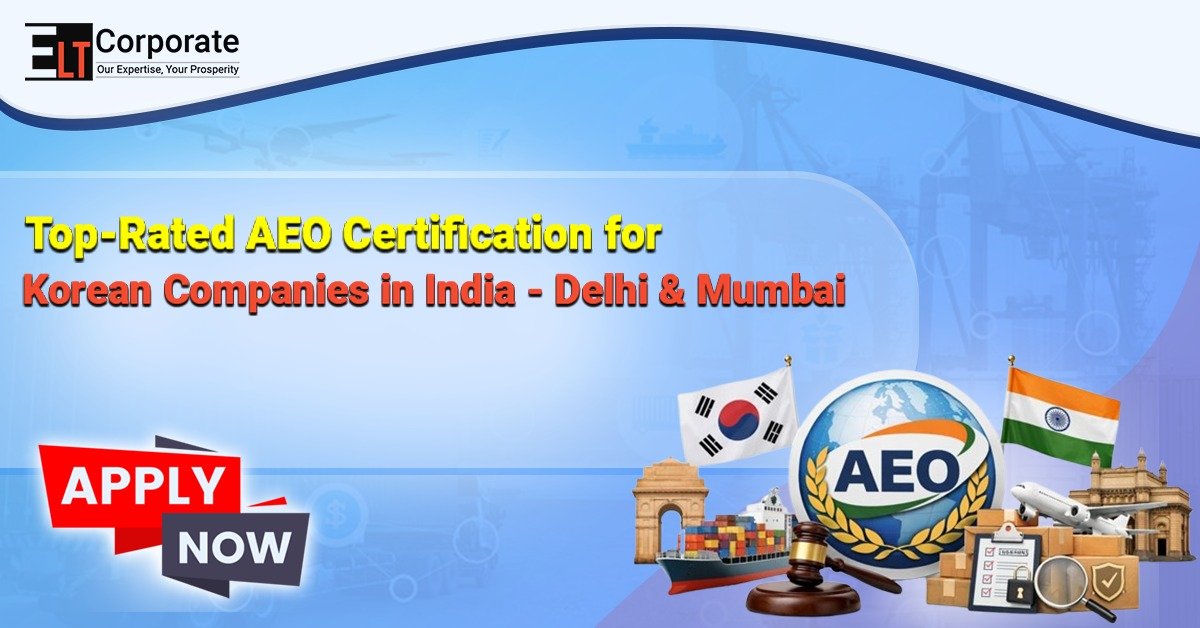
With the growing trade between South Korea and India, Korean companies in India are now more focused than ever on reducing customs delays, gaining supply chain visibility, and securing faster clearance on cargo. For Korean manufacturers, exporters, and logistics-based companies, securing top-tier AEO certification in Delhi and Mumbai, India, has become more of a strategic imperative than an option for compliance.
Delhi and Mumbai are India’s central customs and logistics hubs. They handle a significant portion of the Korean trade, which includes imports and exports in electronics, auto parts, chemicals, machinery, and industrial tools. With top-rated AEO Certification, Korean companies operating in India receive priority facilitation that Indian AEO-certified companies receive.
This document elaborates on top-rated AEO certification for Korean companies in Delhi and Mumbai. It evaluates the various options for AEO certification, elucidates the entire process, and assists Korean companies in selecting AEO certification services in an unambiguous manner.
What are AEO Certifications and their significance to Korean Industry?
AEO Certification in India is administered by the Central Board of Indirect Taxes & Customs (CBIC) under the World Customs Organization (WCO) SAFE Framework. Korean companies operating in India can apply for AEO status if they meet compliance and security requirements.
For Korean companies operating in India, AEO certification is advantageous, as it decreases the level of intervention by customs, lowers the frequency of inspections, and increases the overall predictability of cross-border transactions. With AEO certification in India, Korean companies receive operational benefits in all major port, airport, and inland container depot facilities in Mumbai and Delhi.
The Importance of Delhi and Mumbai for Korean Businesses in India
Delhi and Mumbai are of utmost importance with respect to Korean trade operations in India.
Delhi is pivotal in the air cargo and inland container traffic distribution, and is, therefore, critical for the movement of electronics, value-added components, and time-sensitive cargo. Mumbai is the epicenter of bulk imports, especially industrial commodities and the top assembly of the manufacturing value chain, with Nhava Sheva (JNPT) and other large sea port facilities.
With top-rated AEO Certification, Korean companies operating in India receive priority facilitation at both Delhi and Mumbai customs locations, regardless of shipment origin or destination.
Which Korean Companies Are Eligible for AEO Certification?
Korean companies can apply for AEO certification if they are:
- Importers or exporters registered in India
- Manufacturers with cross-border supply chains
- They apply under AEO-T1/T2/T3
- Subsidiaries or joint ventures of Korean parent companies
Both medium-sized enterprises and large multinational Korean corporations are eligible, provided they meet compliance and financial criteria.
AEO Certification Types: Comparison for Korean Companies
Choosing the right AEO tier is critical. Below is a clear comparison to help Korean companies decide:
| AEO Tier | Best Suited For | Key Benefits |
| AEO-T1 | New or mid-sized Korean companies | Faster clearance, reduced document checks |
| AEO-T2 | Established exporters/importers | Fewer inspections, priority treatment |
| AEO-T3 | Large manufacturers & MNCs | Maximum facilitation, minimal intervention |
Applying for the wrong tier is a common mistake that can delay approval or reduce benefits.
Step-by-Step Process for AEO Certification for Korean Companies in India
Step 1: Compliance and Risk Assessment
The first step involves reviewing customs compliance history, GST records, financial statements, and internal control systems. Korean companies often underestimate this stage, but it determines eligibility.
Step 2: Gap Analysis and Rectification
Any gaps in documentation, security procedures, or record-keeping are identified and corrected before filing the application. This step significantly improves approval chances.
Step 3: Online Application Filing
The application is submitted through the Indian Customs AEO portal along with supporting documents related to legal status, finances, and supply chain security.
Step 4: Customs Verification and Site Audit
Indian Customs may conduct a physical or virtual audit of offices, warehouses, or factories in Delhi, Mumbai, or other locations to verify compliance claims.
Step 5: Grant of AEO Certification
Once customs authorities are satisfied, the AEO certificate is issued. Validity depends on the tier, usually ranging from three to five years.
Cost of AEO Certification for Korean Companies
There is no government application fee for AEO certification. Costs arise mainly from professional support, documentation preparation, internal audits, and compliance improvements. For Korean companies, working with experienced consultants helps avoid costly rejections or repeated audits.
Common Mistakes Korean Companies Make in AEO Applications
Many applications are delayed or rejected due to incorrect AEO tier selection, incomplete documentation, lack of supply chain security evidence, or poor audit preparation. These mistakes can be avoided with proper planning and expert guidance.
Why Choose ELT Corporate for AEO Certification?
ELT Corporate specialises in top-rated AEO certification for Korean companies in India Delhi Mumbai with a strong understanding of cross-border trade, multinational compliance structures, and customs expectations.
ELT Corporate offers complete support, including eligibility assessment, gap analysis, documentation preparation, audit coordination, and post-certification compliance. Their structured approach ensures faster approvals and long-term regulatory stability for Korean businesses operating in India.
Conclusion
For Korean companies trading with India, AEO certification is no longer just a compliance badge—it is a competitive advantage. With growing scrutiny at Indian borders and increasing trade volumes, top-rated AEO certification for Korean companies in India Delhi Mumbai enables smoother operations, reduced delays, and stronger trust with customs authorities. Choosing the right certification strategy and expert support can make the difference between repeated audits and seamless trade facilitation.
Is AEO certification mandatory for Korean companies in India?
No, but it offers significant customs and operational benefits.
Is AEO certification valid across all Indian ports?
Yes, it is valid nationwide.
How long does AEO certification take?
Typically 3–6 months, depending on readiness and audit outcomes.
Can Korean subsidiaries apply independently?
Yes, if they are legally registered in India.