How To Apply For AEO Certificate For Agriculture and Food Processing Exporters: Step-by-Step Guide
India is the world’s second-largest producer of rice, wheat, and other cereals. It is among the largest exporters of basmati rice, spices, processed foods, fruits, vegetables, meat products, and dairy. And yet, many agriculture and food processing exporters — including established APEDA-registered businesses — are competing in global markets without one of the most powerful customs facilitation tools available to them: AEO certification.
For agri and food exporters specifically, the stakes of customs delays are higher than almost any other sector. Perishable cargo sitting at ports due to inspection holds. Missed cold chain windows. Shipments that arrive late for seasonal buyers. Rejection of consignments due to documentation failures.
AEO certification directly addresses every one of these pain points — and for APEDA-registered exporters and food processing units, the path to certification is more accessible than most businesses realise.
This guide walks you through the complete process — eligibility, sector-specific considerations, required documents, and the step-by-step application — tailored specifically for agriculture and food processing exporters in India.
Why AEO Certification Matters Specifically for Agri and Food Exporters
AEO certification matters for every exporter — but for agri and food processing businesses, the operational benefits are particularly acute:
1. Perishables Cannot Wait at Ports
Fresh fruits, vegetables, dairy products, meat, and seafood have narrow clearance windows. Every hour in customs examination is a direct quality risk — and potentially a financial loss. AEO-certified companies get priority clearance — fewer document inspections, less cargo inspection, and quicker release of cargo. Your goods advance above others, particularly in peak port congestion or system overload. For perishable exporters, this is not a convenience — it is a supply chain safeguard.
2. Phytosanitary and Food Safety Inspections Are Already Mandatory
Agri exporters already undergo FSSAI, APEDA, and phytosanitary inspections before export. Layering additional routine customs inspection on top of this creates compounding delays. AEO status reduces the routine customs inspection burden significantly — so your shipments move on the strength of your existing APEDA and food safety certifications, not in spite of them.
3. MRA Markets Are Key Agri Export Destinations
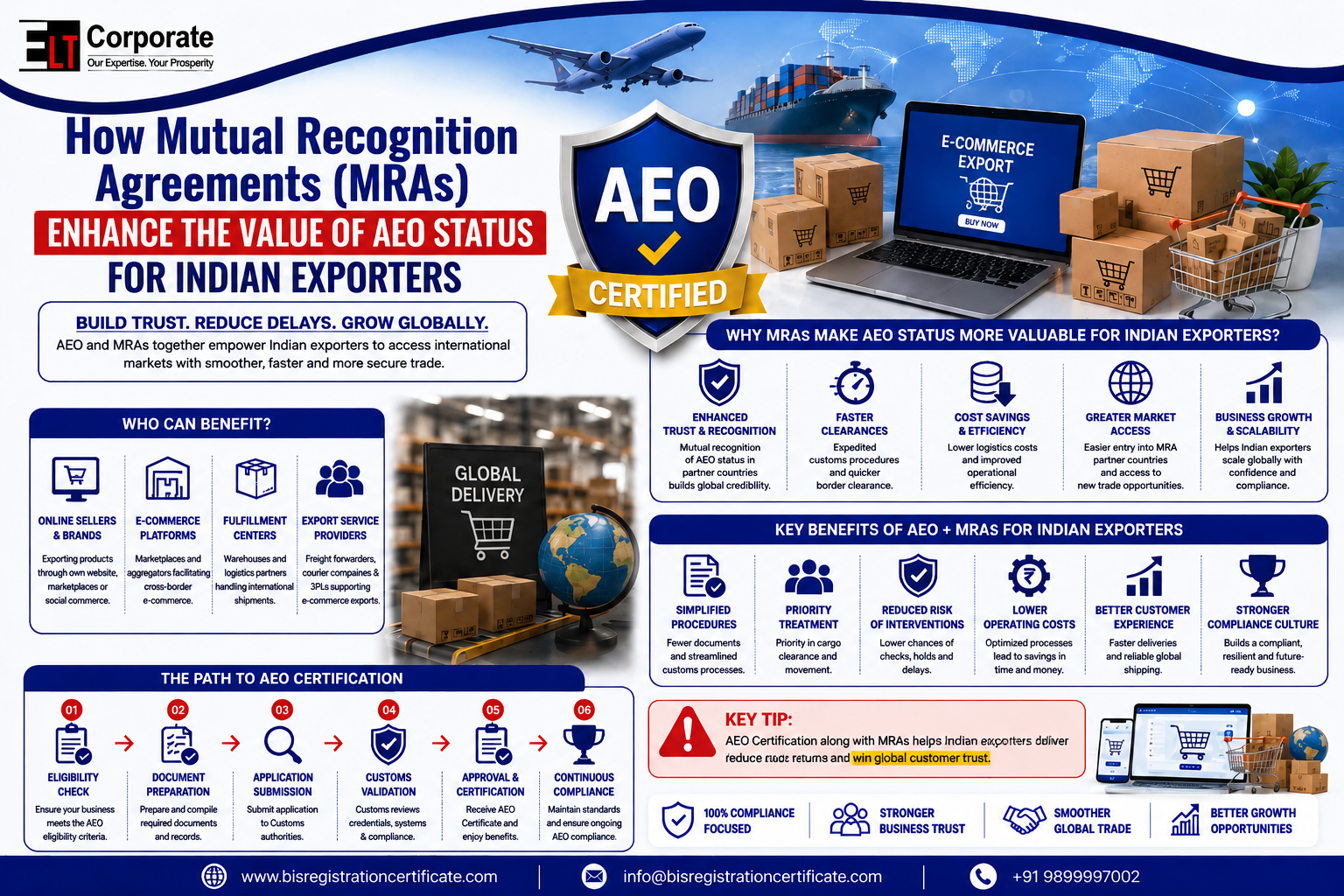
India’s Mutual Recognition Arrangements cover South Korea, Hong Kong, and Singapore (signed May 2025) — all significant markets for Indian processed foods, organic products, spices, and beverages. If you are AEO certified in India, your business would be entitled to quicker clearance and improved treatment in partner nations as well — making your supply chain more dependable across borders.
4. Bank Guarantee Relief for Capital-Constrained Exporters
Many agri and food processing exporters — particularly MSMEs — operate on thin margins with working capital pressure. AEO certification significantly reduces bank guarantee requirements. For MSME AEO-T1 holders, bank guarantees drop to just 25% of the non-AEO requirement — freeing capital that can be redirected to procurement, processing, or cold chain infrastructure.
5. Duty Drawback Priority — Critical for Agri Exporters
Duty drawback on exported agricultural products is a significant component of margin for many food exporters. AEO-certified entities receive priority duty drawback processing — meaning faster access to refunds that directly improve cash flow between shipment cycles.
Who Is This Guide For?
This guide is specifically relevant for:
- Fresh produce exporters — fruits, vegetables, floriculture
- Processed food exporters — packaged foods, confectionery, bakery, beverages, spices
- Organic product exporters — NPOP-certified organic produce and processed organics
- Cereal and grain exporters — basmati rice, non-basmati rice, wheat, millets
- Animal products exporters — meat, poultry, dairy, seafood
- Agri-commodity traders — groundnuts, cashews, spices, sugar products
- Food processing units — manufacturing and exporting processed agri products
If your business holds APEDA RCMC registration and ships regularly, you are likely already eligible for AEO-T1 — and possibly T2.
AEO Eligibility for Agriculture and Food Processing Exporters
Before applying, confirm your eligibility against CBIC’s criteria:
| Eligibility Criterion | Standard Requirement | MSME Relaxation |
| Customs clearance documents (per year) | Minimum 25 Shipping Bills / Bills of Entry | Minimum 10 (at least 5 per half-year) |
| Years of business operations | Minimum 3 financial years | Minimum 2 financial years |
| GST registration | Valid, all returns filed | Same |
| IEC (Import Export Code) | Active and current | Same |
| Financial health | Positive net worth and net current assets | Same |
| Compliance record | No significant SCNs in last 3 years | Same |
| AEO-T1 processing time | 30 working days | 15 working days |
Good news for agri exporters: Most established agri and food processing exporters who are APEDA-registered already exceed the customs document volume threshold. Seasonal exporters with concentrated shipment periods should verify their half-year document count — at least 5 Shipping Bills per half-year is required for MSME applicants.
Sector-Specific Considerations Before You Apply
Agriculture and food processing exporters have unique regulatory touchpoints that interact with AEO certification. Address these before applying:
APEDA RCMC Registration
APEDA is a statutory body established in 1986 under the Ministry of Commerce and Industry, Government of India, to promote the export and development of agricultural and processed food products. The RCMC certificate — officially known as the Registration-Cum-Membership Certificate — is a compulsory legal authorization issued by APEDA for any person or business exporting scheduled agricultural or processed food products listed under the APEDA Act.
Your APEDA RCMC must be active and current before applying for AEO. The RCMC number and export data on APEDA’s system will be consistent with your ICEGATE Shipping Bill record — which CBIC cross-references during AEO review.
FSSAI License for Food Processing Exporters
Food processing units exporting packaged or processed food products must hold a valid FSSAI Central License. Ensure your FSSAI license covers all products you export and is current. A lapsed or mismatched FSSAI license creates a compliance gap that will surface during CBIC’s review of your regulatory compliance record.
Phytosanitary Certificates and Plant Quarantine Compliance
Fresh produce exporters operate under Plant Quarantine (Regulation of Import into India) Order, 2003 and must comply with the destination country’s phytosanitary requirements. Your compliance record with the Directorate of Plant Protection, Quarantine and Storage (DPPQ&S) is relevant to your overall regulatory compliance profile for AEO purposes.
Organic Exporters: NPOP Certification
If you export organic products, your National Programme for Organic Production (NPOP) certification — managed through APEDA — is a valuable supporting credential for AEO. It demonstrates systematic compliance with documented quality and process standards — exactly the kind of institutional discipline AEO assesses.
EIC Registration for Animal Products
Exporters of meat, poultry, dairy, and seafood must be registered with the Export Inspection Council (EIC) and hold relevant EIC certificates. Ensure these are current and that your EIC compliance record is clean before applying.
Which AEO Tier Should Agri and Food Exporters Apply For?
| Your Profile | Recommended Tier | Why |
| MSME agri exporter, 10–25 Shipping Bills/year, 2+ years operations | AEO-T1 (MSME Package) | Fastest path — 15 working day decision, simplified annexures, maximum bank guarantee reduction for MSME |
| Established food processing exporter, 25+ Shipping Bills/year, 3+ years | AEO-T1 → T2 | Start T1, upgrade to T2 for deferred duty, DPD/DPE, and MRA benefits |
| Large agri conglomerate, significant import-export volumes, site infrastructure | AEO-T2 directly | If eligibility is clear, T2 delivers significantly higher benefits including deferred duty and physical security verification |
| Cold chain logistics / warehouse operator serving agri exporters | AEO-LO | Logistics Operator certification — for warehouses, freight forwarders, and customs brokers |
Documents Required: Agriculture and Food Processing Exporters
The document requirements for agri and food exporters follow the standard AEO framework, with some sector-specific additions:
Standard Documents (All Tiers)
- Certificate of Incorporation / Partnership Deed / Proprietorship proof
- Valid IEC certificate (current)
- GST Registration Certificate (all returns filed)
- PAN Card of the entity
- Last 2–3 years audited financial statements
- Details of business premises — address, ownership/lease proof
- Details of customs clearance history — Shipping Bills from ICEGATE
- DSC (Digital Signature Certificate) of authorised signatory
Sector-Specific Documents for Agri and Food Exporters
- APEDA RCMC — Registration-Cum-Membership Certificate (current)
- FSSAI Central License — for food processing exporters (if applicable)
- EIC Registration Certificate — for meat, poultry, dairy, seafood exporters
- NPOP Certification — for organic product exporters
- Warehouse / cold storage details — ownership/lease, capacity, temperature control documentation
- Quality certifications — ISO 22000, HACCP, BRC, GlobalGAP (wherever held — not mandatory but significantly strengthen your compliance profile)
Additional Documents for AEO-T2
- Solvency certificate from bank
- Site layout / facility floor plan (including cold storage, packaging area, cargo loading)
- Import/export process map — from procurement/harvest to customs clearance
- Security SOPs — access control, visitor management, cargo handling, vehicle entry/exit
- Annexure B — Security Questionnaire (mandatory for T2)
Step-by-Step: How to Apply for AEO Certificate
1. Confirm Eligibility & Check Compliance Record
Verify your Shipping Bill count on ICEGATE for the last financial year. Pull your complete compliance record — GST returns, any Show Cause Notices, APEDA compliance, FSSAI status. Identify and resolve any gaps before proceeding. An SCN involving fraud or misclassification in the last 3 years is a disqualifying factor that must be addressed with legal counsel.
2. Select Your AEO Tier
Use the tier selection table above to identify the right starting tier for your business profile. Most agri and food processing exporters start with AEO-T1 (MSME package if eligible) and upgrade to T2 after 1–2 years. Confirm your DSC of the authorised signatory is valid — this is required for portal submission.
3. Prepare Your Document Dossier
Compile all standard and sector-specific documents listed above. For T2 applicants, prepare your site layout (include cold storage and cargo areas), process map, and security SOPs. Ensure all documents are current — financial statements signed by CA, APEDA RCMC and FSSAI license valid, solvency certificate not older than 6 months. Inaccurate or outdated documents can result in delays or rejection — double-check Annexures, financial statements, site plans, and declarations before submission.
4. Complete the Annexures
For AEO-T1 (Standard): Complete Annexure A — the main application form with business operations, compliance status, and trade history details.
For AEO-T1 (MSME Package): Complete MSME Annexure 1 and MSME Annexure 2 — simplified forms with reduced documentary requirements.
For AEO-T2: Complete Annexures A through E, plus the mandatory Annexure B (Security Questionnaire). Answer every security question with specific, factual responses — reference your SOPs and facility layout for each answer.
5. Register & Submit on AEO Portal
Register on www.aeoindia.gov.in. Select your AEO tier, fill entity details (name, IEC, PAN), upload DSC, complete the application form, and upload all supporting documents. Submit the complete application electronically via the official CBIC AEO portal. Note your acknowledgement number after submission.
6. CBIC Review & Deficiency Response
The application is reviewed. If incomplete, you are notified within 30 days to rectify deficiencies. Monitor your portal dashboard daily. Respond to any deficiency notice completely and promptly — partial responses lead to repeat query cycles, each adding 4–8 weeks. For agri exporters, ensure your APEDA and FSSAI compliance records are immediately accessible for any clarification CBIC requests.
7. Site Inspection (AEO-T2 Applicants)
For AEO-T2/LO, customs officials conduct a mandatory physical on-site audit within 90 days to validate security protocols. For agri and food processing facilities, inspectors will assess your cold storage security, cargo handling procedures, access control to processing and storage areas, visitor management, and documentation systems. Prepare your facility and brief key staff before the inspection notice arrives.
8. Receive AEO Certificate & Activate Benefits
Once approved, your AEO certificate is available on your portal dashboard. Immediately activate your benefits — Direct Port Entry, Direct Port Delivery, reduced bank guarantee, and deferred duty payment each require separate notification to relevant customs authorities. Do not assume they activate automatically. For AEO-T1 issued after 01.04.2019, file your annual self-declaration between October 1 and December 31 each year to maintain uninterrupted status.
Realistic Timelines for Agri and Food Processing Exporters
| Application Type | CBIC Decision Timeline | Total Realistic Timeline |
| AEO-T1 (MSME Package) | 15 working days | 4–6 weeks (prep + submission + decision) |
| AEO-T1 (Standard) | 30 working days | 6–10 weeks |
| AEO-T2 | 60–90 working days + site inspection | 4–6 months (complete dossier) |
Common Mistakes Agri and Food Exporters Make
| Mistake | Consequence |
| APEDA RCMC expired at time of application | Compliance gap identified in CBIC review — query raised |
| FSSAI license not covering all exported products | Regulatory mismatch — CBIC query on compliance |
| Shipping Bill count below threshold for seasonal exporters | Ineligible — must wait for next full financial year of activity |
| Cold storage security not documented for T2 site inspection | Inspection failure — re-inspection required |
| Benefits not activated after certification | AEO certificate held but DPE/DPD/deferred duty not operational |
| Annual self-declaration missed (T1) | Status suspended — full reapplication may be required |
2025 Updates Relevant to Agri and Food Exporters
- On-Arrival Movement Regulations (2025): CBIC has notified new Customs regulations allowing AEO-T2 and T3 importers to store and clear goods on arrival at their own premises — significantly cutting warehouse dwell time and demurrage costs. For food processing units that import raw materials, this is a major operational benefit.
- Singapore MRA (May 2025): India signed a Mutual Recognition Arrangement with Singapore in May 2025 — a key market for Indian processed foods, spices, and organic products. AEO-T2 and T3 certified agri exporters now benefit from expedited treatment on arrival in Singapore.
- Gems & Jewellery AEO Extension: CBIC has extended AEO status to the gems and jewellery sector — a signal that sector-specific AEO extensions are actively being considered. Agri exporters with APEDA mandates should watch for any sector-specific facilitation announcements.
- APEDA Advisory — EU Emergency Controls (April 2026): APEDA has flagged temporary increases in official controls for certain Indian agricultural products entering the European Union. AEO-certified exporters with strong compliance records are better positioned to navigate enhanced destination-country controls.
The Bottom Line
India’s agriculture and food processing sector exports billions of dollars of produce every year — competing with suppliers from dozens of countries in quality, price, and reliability. Customs delays, inspection holds, and documentation failures are not just operational inconveniences. They are competitive disadvantages that can cost you buyers, contracts, and market share.
AEO certification is the most structured, government-backed tool available to eliminate these disadvantages. For APEDA-registered exporters who are already compliant, the path to AEO-T1 is shorter than most businesses realise — particularly under the MSME package.
Start the process now. Your next season’s shipments should move as a trusted trader — not as an unverified one.
Need Help Applying for AEO Certification?
We provide end-to-end AEO certification support for agriculture and food processing exporters — from eligibility assessment to certificate in hand:
- Eligibility and document gap assessment
- APEDA, FSSAI, and EIC compliance review for AEO purposes
- Complete Annexure preparation (T1, T2, MSME package)
- Site inspection preparation for food processing and cold chain facilities
- Portal submission and CBIC query handling
- Post-certification benefit activation support