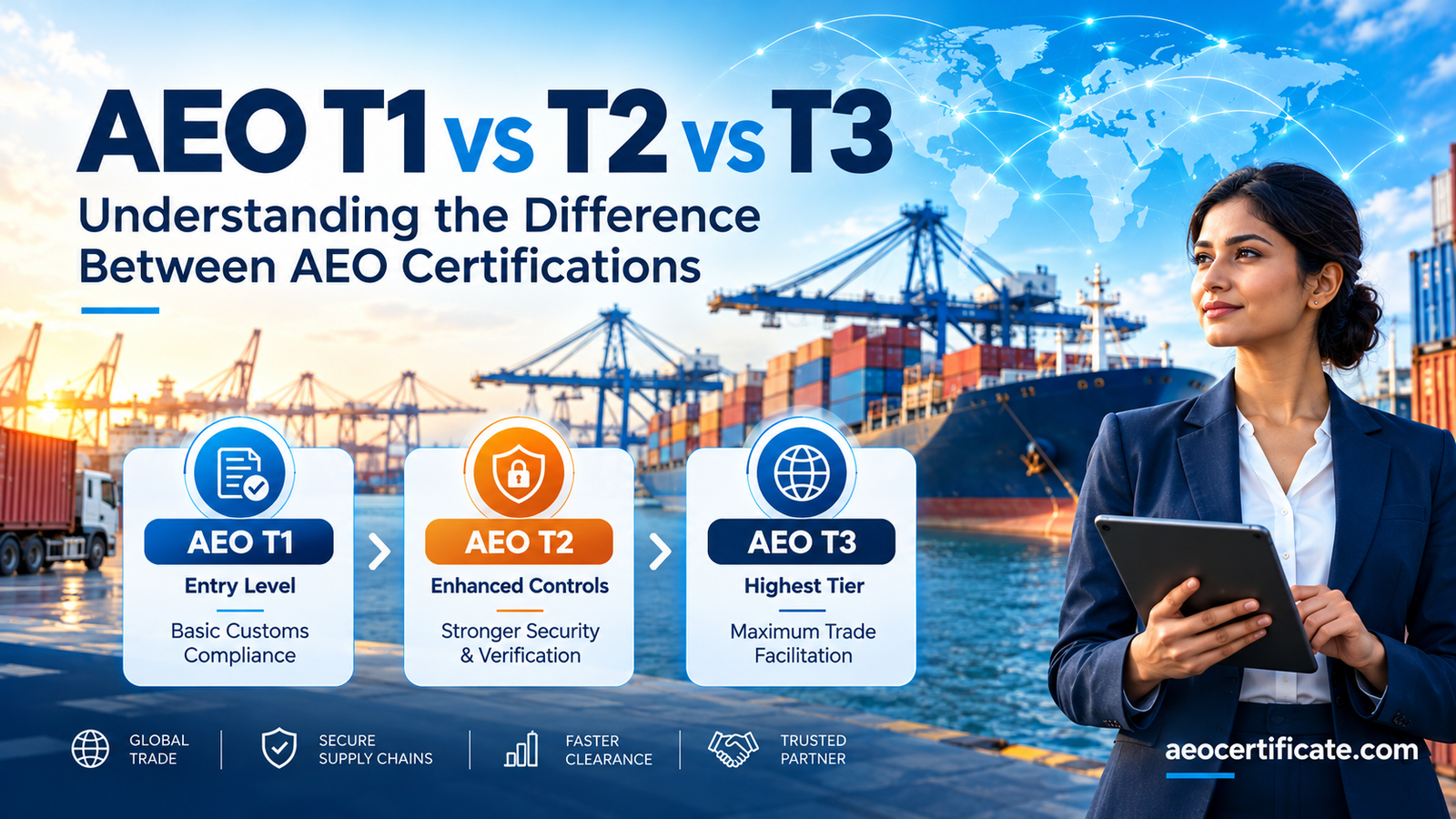
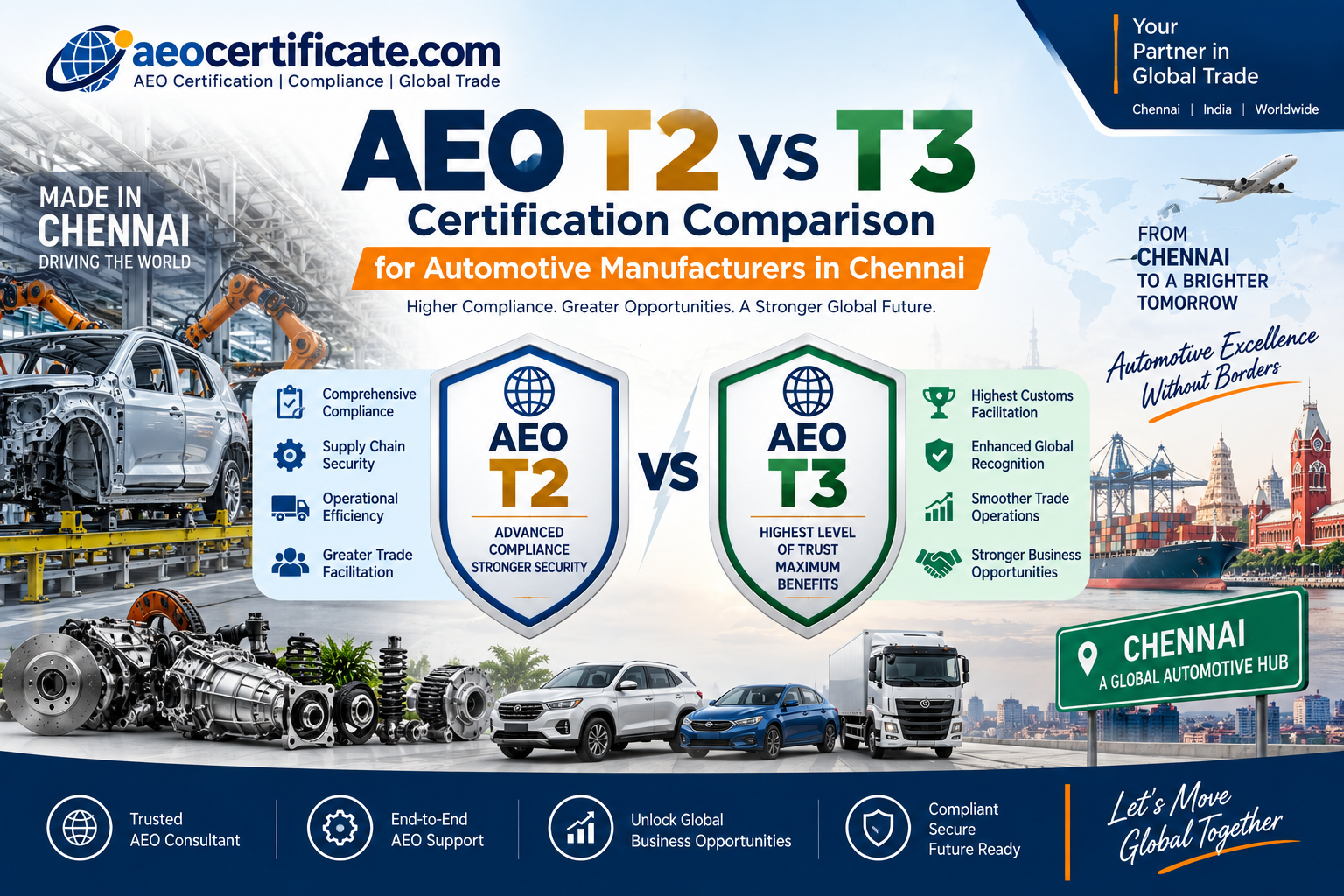
Chennai is one of India’s leading automotive manufacturing and export hubs, with a strong ecosystem of vehicle manufacturers, auto-component suppliers, engineering companies, logistics providers, and international supply-chain partners. Automotive manufacturers operating at scale frequently import components, machinery, electronic systems, tooling, and raw materials while exporting vehicles and components to global markets.
For such businesses, the AEO T2 vs T3 Certification Comparison is important when deciding whether to maintain AEO T2 status or progress toward the highest AEO tier available to eligible importers and exporters.
India’s Authorised Economic Operator (AEO) program is administered by Indian Customs under CBIC. It recognizes eligible and compliant international trade participants and provides customs facilitation according to their certification tier.
This guide explains the differences between AEO T2 and T3, eligibility, benefits, documentation, compliance requirements, and considerations specifically relevant to automotive manufacturers in Chennai.
AEO T2 vs T3 Certification Comparison—What Are AEO T2 and T3?
The AEO T2 vs T3 Certification Comparison begins with understanding the position of these two tiers within India’s AEO program.
AEO T2 is an advanced certification for eligible importers and exporters that meet prescribed customs-compliance requirements and demonstrate appropriate supply-chain security.
AEO T3 represents the highest AEO tier for qualifying importers and exporters. It is intended for eligible existing AEO T2 holders that satisfy the prescribed conditions for progression.
Therefore, AEO T3 should not be viewed simply as an alternative to T2. For an automotive manufacturer, T2 is generally the foundation from which eventual T3 eligibility can arise.
AEO T2 vs T3 Certification Comparison – Why It Matters for Chennai Automotive Manufacturers
The AEO T2 vs T3 Certification Comparison is particularly relevant to Chennai’s automotive sector because vehicle manufacturing depends on complex international supply chains.
Automotive companies may regularly handle:
- Imported auto components
- Electronic modules
- Sensors and semiconductors
- Machinery and equipment
- Tooling and dies
- Raw materials
- Spare parts
- Completely Knocked Down (CKD) components
A delay involving an important imported component can potentially affect manufacturing schedules. A mature AEO framework can therefore support customs predictability and stronger supply chain governance.
AEO T2 vs T3 Certification Comparison – AEO T3 Eligibility
Eligibility is one of the most important distinctions in the AEO T2 vs T3 Certification Comparison.
A business cannot simply choose T3 because it is a large manufacturer or has substantial import/export turnover.
AEO T3 is available to qualifying existing T2 holders subject to the conditions prescribed under the AEO program.
An automotive manufacturer considering progression should therefore review:
- Existing AEO T2 status
- Period of T2 certification
- Customs compliance after obtaining T2
- Applicable transaction requirements
- Significant Customs proceedings or violations
- Changes in business operations
- Changes in locations
- Security incidents
- Corrective actions
- Continued implementation of AEO controls
Eligibility should be confirmed before beginning the upgrade exercise.
AEO T2 vs T3 Certification Comparison – Customs Benefits
The AEO T2 vs T3 Certification Comparison should also consider the level of customs facilitation available.
Both T2 and T3 are advanced trusted-trader statuses, but T3 represents the highest tier and receives the highest applicable level of facilitation under the program.
Depending on prevailing customs provisions, AEO benefits can include:
- Priority customs facilitation
- Reduced examination/intervention based on applicable risk parameters
- Improved clearance predictability
- Preferential treatment in specified Customs processes
- Other tier-specific facilitation measures
Manufacturers should evaluate benefits based on their actual shipment profile rather than viewing certification purely as a status symbol.
AEO T2 vs T3 Certification Comparison – Supply-Chain Security Requirements
Supply chain security is central to the AEO T2 vs T3 Certification Comparison.
Automotive manufacturers can have enormous facilities involving production plants, warehouses, yards, loading bays, vendor parks, and logistics areas.
Relevant controls may include:
Physical Security
Appropriate perimeter controls, entry points, restricted areas, and surveillance.
Cargo Security
Controls designed to maintain the integrity of imported and exported cargo.
Employee Security
Identification, access permissions, joining/separation controls, and security awareness.
Business-Partner Security
Appropriate evaluation of suppliers, transporters, customs brokers, freight forwarders, and other relevant partners.
IT Security
Controls protecting customs, logistics, commercial, and supply chain information.
T3 applicants should be able to demonstrate that these controls remain mature and consistently implemented.
AEO T2 vs T3 Certification Comparison – Importance of Customs Compliance History
Customs history can significantly influence the AEO T2 vs T3 Certification Comparison.
Automotive manufacturers should periodically review:
- HS classification
- Customs valuation
- Related-party imports
- Country-of-origin claims
- Exemption notifications
- Duty payments
- Import licenses where applicable
- Export documentation
- Customs notices
- Adjudication matters
- Penalties
- Record retention
Any material issue should be assessed and appropriately addressed before pursuing a higher AEO tier.
AEO T2 vs T3 Certification Comparison – Multi-Plant Automotive Operations
Large automotive groups may operate several manufacturing and warehouse locations. This makes multi-location compliance an important part of the AEO T2 vs T3 Certification Comparison.
Relevant facilities may include:
- Vehicle manufacturing plants
- Engine or component plants
- Warehouses
- Vendor parks
- Spare-parts centers
- Export yards
- Corporate offices
- Distribution centers
A common challenge is maintaining consistent procedures across all relevant facilities.
A multi-location gap assessment can identify differences in security, documentation, employee awareness, and implementation.
AEO T2 vs T3 Certification Comparison – Vendor and Supplier Management
Automotive manufacturing relies heavily on extensive supplier networks, making business-partner controls particularly important in the AEO T2 vs T3 Certification Comparison.
Relevant partners may include:
- Tier-1 suppliers
- Tier-2 suppliers
- Overseas component suppliers
- Transporters
- Customs brokers
- Freight forwarders
- Warehouse operators
- Contract manufacturers
- Security agencies
- Logistics providers
Manufacturers should maintain appropriate systems for selecting, evaluating, and periodically reviewing relevant business partners.
AEO T2 vs T3 Certification Comparison – IT and Cybersecurity Controls
Automotive supply chains increasingly depend on digital platforms, ERP systems, warehouse-management systems, customs portals, and electronic shipment records.
Therefore, IT security is important in the AEO T2 vs T3 Certification Comparison.
Companies should consider controls such as
- Role-based access
- Strong authentication
- Password management
- Data backups
- Firewall protection
- Endpoint security
- Access logs
- Employee exit controls
Access to customs and supply chain information should be restricted according to business responsibilities.
AEO T2 vs T3 Certification Comparison – Internal Audit Requirements
An effective internal audit program strengthens the AEO T2 vs T3 Certification Comparison readiness of an automotive manufacturer.
Periodic assessments should determine whether:
- Customs SOPs are followed.
- Security systems remain operational.
- Employee training is current.
- Vendor assessments are completed.
- Visitor controls are maintained.
- Customs records are retrievable.
- IT access is appropriately controlled.
- Incidents are properly documented.
- Corrective actions have been closed.
This becomes especially important when demonstrating sustained compliance for progression toward T3.
AEO T2 vs T3 Certification Comparison – T2 to T3 Upgrade Process
For eligible manufacturers, the AEO T2 vs T3 Certification Comparison can be translated into a practical upgrade roadmap.
Step 1 – Confirm T3 Eligibility: Review current T2 status against applicable T3 conditions.
Step 2 – Conduct Customs Health Check: Examine compliance since T2 certification.
Step 3 – Perform Gap Assessment: Review operational and security controls.
Step 4 – Review Multiple Locations: Ensure consistent implementation across relevant plants and warehouses.
Step 5 – Update Documentation: Revise outdated SOPs, policies, and records.
Step 6 – Close Compliance Gaps: Implement necessary corrective actions.
Step 7 – Organize Evidence: Compile internal audits, training records, security evidence, and customs documentation.
Step 8 – Prepare Application: Complete the applicable T3 application process.
Step 9 – Respond to Customs: Address any queries or observations.
Step 10 – Maintain Compliance: Continue monitoring AEO controls after certification.
AEO T2 vs T3 Certification Comparison – Government Fees and Cost
Cost is another consideration in the AEO T2 vs T3 Certification Comparison.
Government Application Fee
Indian Customs does not charge an application fee merely for filing an AEO application.
However, businesses may incur professional or implementation expenses for:
- AEO consultancy
- Customs compliance review
- Multi-location gap assessments
- SOP preparation
- Internal audits
- Employee training
- Security improvements
- IT controls
- CCTV/access-control improvements
- Assessment preparation
For a large automotive manufacturer, implementation costs depend heavily on the maturity of existing systems.
AEO T2 vs T3 Certification Comparison—Which Is Better for Automotive Manufacturers?
The answer to the AEO T2 vs T3 Certification Comparison depends on the manufacturer’s current status.
AEO T2 may be appropriate when:
- The company is eligible for advanced AEO certification.
- It has mature customs compliance.
- Strong supply-chain security systems exist.
- It is not yet eligible for T3.
AEO T3 may be appropriate when:
- The company already holds qualifying T2 status.
- T3 eligibility conditions are satisfied.
- Customs compliance has been consistently maintained.
- Security systems are mature.
- The organization seeks the highest applicable AEO tier.
Therefore, T3 is better viewed as a progression from mature T2 compliance rather than a competing alternative.
AEO T2 vs T3 Certification Comparison – Importance for Automobile Exporters
The AEO T2 vs T3 Certification Comparison becomes particularly important for automotive manufacturers exporting finished vehicles, engines, components, and spare parts to multiple international markets.
High-volume automobile exports require coordination between manufacturing plants, export yards, transporters, customs brokers, freight forwarders, shipping lines, ports, and overseas customers.
A mature AEO framework can help manufacturers establish better control over:
- Export documentation
- Cargo movement
- Customs procedures
- Logistics partners
- Vehicle dispatch
- Container management
- Record retention
- Supply-chain security
For companies exporting regularly from Chennai and nearby industrial clusters, predictable customs processes can be operationally valuable.
AEO T2 vs T3 Certification Comparison – Importance for Auto Component Manufacturers
The AEO T2 vs T3 Certification Comparison is equally relevant for auto-component manufacturers supplying products to overseas OEMs.
Such businesses may manufacture and export:
- Engine components
- Brake systems
- Transmission components
- Electrical components
- Electronic modules
- Steering systems
- Suspension components
- Automotive lighting
- Sensors
- EV components
- Battery-related components
Component manufacturers with substantial import/export activity can use AEO as part of their broader Customs compliance strategy.
AEO T2 vs T3 Certification Comparison – Importance for Electric Vehicle Manufacturers
As electric vehicle manufacturing expands, the AEO T2 vs T3 Certification Comparison can also become relevant for EV manufacturers operating complex international supply chains.
EV manufacturers may import specialized components such as
- Battery cells
- Battery-management systems
- Electric motors
- Controllers
- Power electronics
- Sensors
- Charging components
- Semiconductor devices
- Electronic control units
Strong customs compliance and supply chain controls can help such companies manage high-value and time-sensitive international shipments more systematically.
AEO T2 vs T3 Certification Comparison—Just-in-Time Manufacturing and Customs Clearance
Automotive manufacturing frequently relies on tightly controlled inventory and production schedules. Therefore, the AEO T2 vs T3 Certification Comparison should also be considered from a just-in-time supply chain perspective.
Where production depends on imported components, customs delays can potentially affect:
Component Arrival → Customs Clearance → Warehouse Receipt → Production Line → Vehicle Assembly → Finished Vehicle Dispatch
Greater predictability in customs processes can therefore contribute to more efficient supply chain planning.
AEO should not be viewed as guaranteeing zero delays, but applicable facilitation can be valuable for businesses handling frequent customs transactions.
AEO T2 vs T3 Certification Comparison – Customs Classification Controls
Correct tariff classification should form part of an automotive company’s AEO T2 vs T3 Certification Comparison readiness review.
Automotive manufacturers may import thousands of different components.
Companies should maintain appropriate procedures for:
- Product identification
- Technical specification review
- HS classification
- Classification approval
- Supporting documentation
- Periodic classification review
- Change management when products are modified
Where classification is technically complex, the Customs/EXIM team should coordinate with engineering or product teams.
AEO T2 vs T3 Certification Comparison – Customs Valuation and Related Party Imports
Customs valuation is another important area within the AEO T2 vs T3 Certification Comparison, particularly for multinational automotive manufacturers.
Many automotive companies procure components, machinery, tooling, or technology from related overseas group companies.
Relevant areas may include:
- Related-party transactions
- Transfer pricing arrangements
- Royalties
- License fees
- Engineering charges
- Tooling
- Assists
Manufacturers should ensure that Customs valuation positions are appropriately documented and supported.
AEO T2 vs T3 Certification Comparison – Country of Origin Management
Country-of-origin controls can also influence the AEO T2 vs T3 Certification Comparison readiness of an automotive manufacturer.
Automotive supply chains often source components from multiple countries.
Businesses claiming preferential customs treatment should maintain appropriate documentation, including applicable:
- Certificates of Origin
- Supplier declarations
- Product information
- Origin-supporting records
- Preferential trade documentation
A structured internal verification process can help reduce origin-related compliance risks.
AEO T2 vs T3 Certification Comparison – Customs Broker Management
Customs brokers play an important operational role, but the AEO T2 vs T3 Certification Comparison should assess whether the manufacturer maintains adequate internal oversight.
Automotive companies should have processes for:
- Customs broker appointment
- Sharing accurate product data
- Providing classification instructions
- Reviewing Bills of Entry
- Reviewing Shipping Bills
- Monitoring customs errors
- Maintaining customs records
A company should not rely entirely on its customs broker for internal customs compliance.
AEO T2 vs T3 Certification Comparison – Cargo and Container Security
Cargo integrity is particularly important in the AEO T2 vs T3 Certification Comparison.
Manufacturers should consider procedures covering:
- Container inspection
- Cargo loading
- Cargo segregation
- Seal controls
- Seal-number recording
- Vehicle entry and exit
- Dispatch authorization
- Handover to transporters
Relevant evidence should be retained to demonstrate that procedures are actually followed.
AEO T2 vs T3 Certification Comparison – Employee Security and Training
Employees are critical to the success of an AEO T2 vs T3 Certification Comparison compliance program.
Automotive manufacturers should ensure appropriate controls for personnel involved in:
- EXIM
- Customs
- Logistics
- Warehousing
- Procurement
- Security
- Finance
- IT
- HR
- Supply chain
Training can cover Customs compliance, security awareness, cargo integrity, access controls, incident reporting, and individual responsibilities.
Training records should be maintained.
AEO T2 vs T3 Certification Comparison – Visitor and Contractor Management
Large automotive plants receive substantial numbers of vendors, contractors, drivers, service engineers, and visitors.
Therefore, visitor management is an important operational consideration in the AEO T2 vs T3 Certification Comparison.
Controls can include:
- Visitor identification
- Entry authorization
- Visitor passes
- Restricted-area controls
- Escort requirements
- Contractor identification
- Entry and exit records
- Return of temporary passes
- Escalation of suspicious activity
These controls should be consistently implemented across relevant facilities.
AEO T2 vs T3 Certification Comparison – Physical Security of Automotive Plants
Physical security is fundamental to advanced AEO compliance.
As part of the AEO T2 vs T3 Certification Comparison, manufacturers should evaluate:
- Perimeter security
- Gates
- Security personnel
- CCTV coverage
- Lighting
- Restricted areas
- Loading bays
- Warehouses
- Export yards
Identified security gaps should be documented and corrected systematically.
AEO T2 vs T3 Certification Comparison – Internal CAPA System
A strong corrective and preventive action system can support the AEO T2 vs T3 Certification Comparison readiness of a manufacturer.
A practical CAPA workflow can be:
Observation → Root Cause → Corrective Action → Responsible Department → Target Date → Evidence → Effectiveness Check → Closure
For example, if an internal audit identifies missing visitor records, the company should determine the cause, implement corrective measures, train responsible personnel, and verify that the new system is working.
AEO T2 vs T3 Certification Comparison – Role of Internal AEO Committee
Large automotive manufacturers can consider establishing an internal committee to support ongoing AEO T2 vs T3 Certification Comparison compliance.
The committee may include representatives from:
- EXIM
- Customs
- Logistics
- Supply chain
- Finance
- Legal
The committee can periodically review Customs issues, security incidents, training, corrective actions, and changes affecting AEO status.
AEO T2 vs T3 Certification Comparison – Management Review
Senior management oversight can strengthen the AEO T2 vs T3 Certification Comparison framework.
Periodic management reviews can cover:
- Customs compliance performance
- AEO audit findings
- Security incidents
- Vendor issues
- Employee training
- IT security incidents
- Corrective actions
- Changes in business operations
- New plants or warehouses
- Regulatory developments
Management involvement helps ensure that AEO remains an organization-wide compliance program rather than an EXIM department project.
AEO T2 vs T3 Certification Comparison – Cost of Upgrading from T2 to T3
Cost considerations form another part of the AEO T2 vs T3 Certification Comparison.
The AEO application itself should be distinguished from professional and implementation expenses.
Potential costs can arise from:
- Professional advisory services
- Customs compliance audit
- Multi-plant assessment
- Documentation updates
- SOP revision
- Employee training
- Security improvements
- IT security upgrades
A manufacturer with a mature T2 framework may require fewer corrective measures than one whose existing AEO systems have not been actively maintained.
AEO T2 vs T3 Certification Comparison—When Should a Manufacturer Upgrade to T3?
The AEO T2 vs T3 Certification Comparison should ultimately answer whether an upgrade makes strategic sense.
A manufacturer should consider T3 when:
- It already holds qualifying T2 status.
- It meets the applicable T3 eligibility conditions.
- Customs compliance has remained strong.
- Its AEO controls are actively maintained.
- Internal audits are conducted.
- Corrective actions are properly closed.
A business should not pursue T3 merely for marketing purposes if its compliance framework is not ready.
AEO T2 vs T3 Certification Comparison – Documentation Requirements
Documentation plays an important role in the AEO T2 vs T3 Certification Comparison.
Automotive manufacturers should maintain appropriate records concerning:
- Existing AEO certification
- IEC and GST details
- Corporate information
- Import/export transactions
- Customs compliance history
- Financial solvency
- Organizational structure
- Customs SOPs
- Warehouse procedures
- Cargo-security controls
- Employee procedures
- Visitor controls
- Business-partner assessments
For progression to T3, evidence demonstrating continued compliance after T2 certification becomes particularly important.
AEO T2 vs T3 Certification Comparison – Common Mistakes to Avoid
Businesses conducting an AEO T2 vs T3 certification comparison should avoid:
- Assuming large turnover automatically qualifies a company for T3
- Applying without confirming eligibility
- Ignoring customs compliance history
- Using outdated SOPs
- Maintaining inconsistent controls across plants
- Weak vendor assessments
- Missing employee training records
- Poor incident documentation
- Inadequate internal audits
- Treating AEO as merely a paperwork exercise
The strongest applications are supported by both documentation and evidence of implementation.
AEO T2 vs T3 Certification Comparison—How ELT Corporate Can Assist
ELT Corporate can assist automotive manufacturers undertaking an AEO T2 vs T3 Certification Comparison and deciding on the appropriate certification strategy.
Support can include:
- AEO eligibility assessment
- T2/T3 suitability review
- T3 eligibility assessment
- Customs compliance health check
- Multi-location gap analysis
- Supply-chain security review
- SOP preparation and revision
- Documentation review
- Corrective-action support
- Post-certification compliance guidance
For automotive manufacturers, the objective should be to integrate AEO into the broader customs, logistics, security, and supply chain governance system.
Conclusion
The AEO T2 vs T3 Certification Comparison is particularly important for automotive manufacturers in Chennai because large-scale vehicle and component manufacturing depends on efficient international supply chains.
AEO T2 provides an advanced trusted-trader framework combining customs compliance with supply-chain security. AEO T3 represents the highest tier for qualifying businesses that have demonstrated sustained maturity under T2 and satisfy the applicable eligibility requirements.
For automotive manufacturers, the decision should therefore not simply be “T2 or T3?” Instead, the correct question is whether the organization currently satisfies T2 requirements and, if already certified at T2, whether it is eligible and operationally ready to progress to T3.
Frequently Asked Questions
Q.1 What is the main difference between AEO T2 and T3?
T2 is an advanced AEO tier, while T3 is the highest tier available to qualifying importers/exporters meeting the prescribed conditions.
Q.2 Can an automotive manufacturer directly apply for T3?
T3 is intended for qualifying existing T2 holders; eligibility should be confirmed against current requirements.
Q.3 Does company turnover alone determine T3 eligibility?
No. Business size or turnover alone does not automatically qualify an applicant.
Q.4 Is AEO certification compulsory for automotive manufacturers?
No. The AEO program is voluntary.
Q.5 Is there a government application fee?
No government application fee is charged merely for filing an AEO application.
Q.6 Can multi-location automotive manufacturers obtain AEO status?
Yes, subject to applicable eligibility and compliance requirements. Relevant locations and controls should be appropriately assessed.