International trade involves multiple customs procedures, documentation requirements, security checks, and compliance obligations. For businesses regularly engaged in imports and exports, delays in customs clearance can significantly affect supply chains, inventory planning, and overall operating costs.
The Authorised Economic Operator (AEO) Programme of Indian Customs is designed to recognise businesses that demonstrate reliable compliance and secure international supply chain practices. In return, eligible AEO-certified businesses receive various Customs facilitation benefits.
For importers and exporters, the Indian AEO Programme has three certification levels: AEO T1, AEO T2, and AEO T3. The level of facilitation and compliance requirements generally increases as a business moves from AEO T1 vs T2 vs. T3, which represents the highest tier available to eligible importers and exporters.
Understanding AEO T1 vs T2 vs T3 is therefore important before deciding which certification is most appropriate for a business.
What is AEO Certification?
AEO stands for Authorised Economic Operator. It is a trusted-trader program administered by Indian Customs under the Central Board of Indirect Taxes and Customs (CBIC).
The program recognizes businesses involved in the international supply chain that maintain appropriate customs compliance, record management, financial solvency, internal controls, and, where applicable, supply chain security standards.
The objective is to create a partnership between Customs AEO T1, T2, and T3 authorities and compliant businesses so that legitimate international trade can move more efficiently while maintaining security.
AEO certification is voluntary. Businesses can decide whether to apply based on their international trade activities and the benefits they expect from the program.
Structure of the Indian AEO Programme
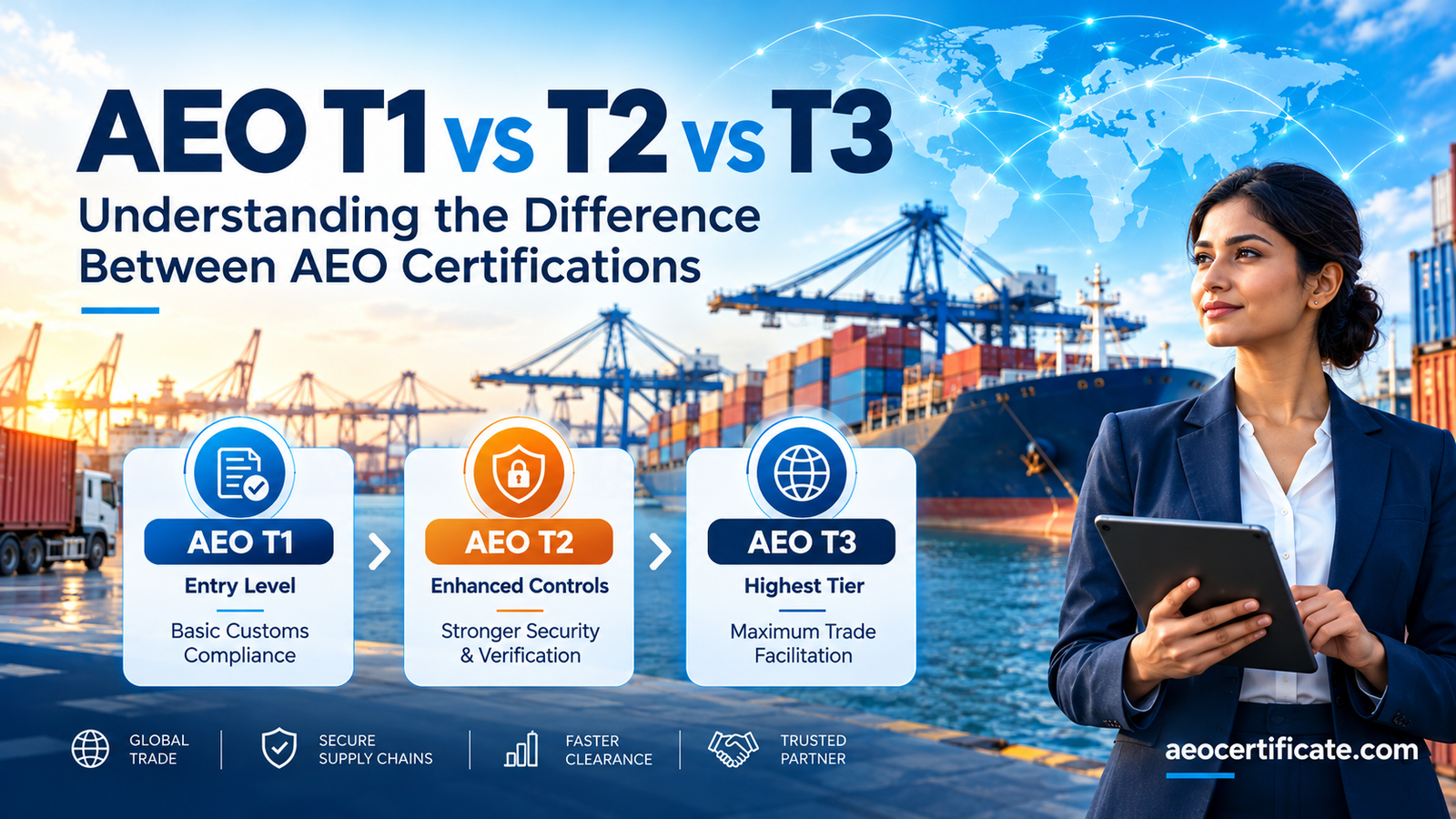
For importers and exporters, there are three AEO tiers:
- AEO T1 – Entry-level certification
- AEO T2 – Enhanced certification
- AEO T3 – Highest level of certification
A separate category known as AEO-LO applies to eligible logistics operators and other supply chain participants such as customs brokers, custodians or terminal operators, logistics service providers, and warehouse operators.
The main difference in AEO T1, T2, and T3 relates to the level of verification, security requirements, customs facilitation, and additional benefits available to the certificate holder.
What is AEO T1 Certification?
AEO T1 is the entry-level AEO certification available to eligible importers and exporters.
It is suitable for businesses that want to enter the AEO program and demonstrate a satisfactory record of customs compliance, appropriate commercial record management, and financial solvency.
For AEO T1, T2, and T3, the applicant is primarily assessed based on the information and documents submitted to establish compliance with the prescribed requirements. Unlike T2, the process does not ordinarily depend on the same level of physical verification of security systems at the applicant’s premises.
Major Benefits of AEO T1
AEO T1 certificate holders may receive benefits such as:
– Faster customs clearance and higher facilitation
– Direct Port Delivery (DPD) for eligible imports
– Direct Port Entry (DPE) for eligible exports
– Reduced routine Customs intervention
– Authorized personnel identity cards
– Separate space at customs terminals wherever operationally feasible
– Reduction in applicable bank guarantee requirements, subject to prescribed conditions
– Risk-based post-clearance audit
– 24×7 customs clearance at eligible seaports and airports without merchant overtime charges
– Time-bound handling of certain investigations and adjudication proceedings
The AEO India portal presently describes AEO T1, T2, and T3 as the entry tier for qualifying importers and exporters.
Who Should Consider AEO T1?
AEO T1 vs T2 vs T3 may be suitable for businesses that:
– Regularly import or export goods
– Are applying for AEO certification for the first time
– Have a satisfactory customs compliance history
– Maintain proper commercial and customs records
– Want to receive Customs facilitation benefits without initially moving to the more extensive T2 security verification process
What is AEO T2 Certification?
AEO T2 is the next level of certification and involves more extensive compliance and security requirements than T1.
For AEO T1 vs T2 vs T3, information and claims relating to prescribed eligibility, compliance, record management, financial solvency, and safety and security requirements are subject to physical verification by the AEO Programme Team at the concerned premises.
This makes T2 particularly relevant for businesses that AEO T1 vs T2 vs T3 have established structured internal controls and mature supply chain security systems.
Major Benefits of AEO T2
T2 provides enhanced AEO T1 vs T2 vs T3 facilitation compared with T1. Current AEO guidance lists benefits including:
– Higher customs facilitation for imports and exports
– Direct Port Delivery and Direct Port Entry
– Further reduction in bank guarantee requirements, subject to conditions
– Risk-based post-clearance audit with reduced routine transactional intervention
– Priority and time-bound handling of certain special valuation branch proceedings
– Facility for MRP stickering at the AEO’s premises under applicable procedure
– Dedicated Client Relationship Manager
Who Should Consider AEO T2?
AEO T1 vs T2 vs T3 may be suitable for importers and exporters that:
– Have significant international trade operations
– Maintain documented compliance and security procedures
– Have well-controlled cargo handling and business processes
– Can demonstrate physical and procedural supply-chain security
– Want greater customs facilitation than that available under T1
– Are ultimately planning to qualify for AEO T3
Major Benefits of AEO T2
T2 provides enhanced facilitation AEO T1 vs T2 vs T3 compared with T1. Current AEO guidance lists benefits including:
– Higher customs facilitation for imports and exports
– Direct Port Delivery and Direct Port Entry
– Further reduction in bank guarantee requirements, subject to conditions
– Risk-based post-clearance audit with reduced routine transactional intervention
– Priority and time-bound handling of certain special valuation branch proceedings
– Facility for MRP stickering at the AEO’s premises under applicable procedure
– Dedicated Client Relationship Manager
Who Should Consider AEO T2?
AEO T1 vs T2 vs T3 may be suitable for importers and exporters that:
– Have significant international trade operations
– Maintain documented compliance and security procedures
– Have well-controlled cargo handling and business processes
– Can demonstrate physical and procedural supply-chain security
– Want greater customs facilitation than that available under T1
– Are ultimately planning to qualify for AEO T3
What is AEO T3 Certification?
AEO T3 is the highest certification level available to importers and exporters under the Indian AEO Programme.
Unlike T1 and T2, T3 is generally an upgradation route for an existing AEO T2 certificate holder.
An applicant can qualify for T3 if it has continuously held AEO T2 status for at least two years preceding the application
Alternatively, an AEO T2 holder may qualify through the prescribed business-partner route where its relevant international supply chain partners hold AEO T2, AEO-LO, or equivalent AEO certification granted by a foreign customs administration, as prescribed under the AEO framework.
Major Benefits of AEO T3
T3 provides the highest level of Customs facilitation. Important benefits of AEO T1 vs T2 vs T3 currently highlighted by the AEO portal include:
– Highest level of facilitation for imports and exports
– Minimal container scanning, except where selected based on specific intelligence
– Priority for containers selected for scanning
– Complete waiver of bank guarantee requirements in prescribed cases, except specified exceptions
– Risk-based intervention by participating AEO T1 vs T2 vs T3 government agencies
– Examination or inspection at the AEO’s premises where permitted
– Faster processing of complete refund or rebate claims
– Priority assessment and examination of Bills of Entry and Shipping Bills
– Deferred payment of Customs duty for eligible importers
AEO T1 vs T2 vs T3 – Key Differences
| Particular | AEO T1 | AEO T2 | AEO T3 |
| Certification Level | Entry Level | Enhanced Level | Highest Level |
| Available To | Importers & Exporters | Importers & Exporters | Eligible AEO T2 Importers & Exporters |
| Physical Verification | Generally documentation-based assessment | Physical verification of prescribed requirements | Depends on the eligibility route and whether significant changes require verification. |
| Safety & Security Requirements | Comparatively limited | Detailed security requirements | Highest maturity expected |
The validity of AEO T1 vs T2 vs T3 is three years, and T3 is five years under the amended AEO framework.
AEO T1 vs T2 vs T3: Which Certification Should You Choose?
The appropriate tier depends on your current compliance maturity, business operations, and long-term trade strategy.
Choose AEO T1 if:
You are an eligible importer or exporter entering the AEO program for the first time and want basic customs facilitation without immediately AEO T1 vs T2 vs T3 undergoing the more extensive security verification applicable to T2.
Choose AEO T2 if:
Your organisation has established AEO T1 vs T2 vs T3 compliance systems, documented security procedures, internal controls, and adequate evidence to successfully undergo physical verification.
Choose AEO T3 if:
You are already an AEO T2 holder and satisfy the specific eligibility requirements for upgrading to the highest certification level.
It is therefore important not to view AEO T1 vs T2 vs T3 simply as three independent options. T3 is specifically linked to T2 status and the prescribed upgradation conditions.
Basic AEO Application Process
Although documentation varies depending on the tier, the general application journey includes:
- Eligibility Assessment – Determine whether the business meets the applicable AEO eligibility requirements.
- Document Preparation — Compile corporate, customs, compliance, financial, process, and security-related records as applicable.
- Online Application – Submit the appropriate application through the AEO portal.
- Desk Review – Authorities examine the application and may seek clarification or additional documents.
- Physical Verification — Applicable particularly to T2 and other cases requiring premises verification.
- Decision and Certification – AEO status is granted once the authorities are satisfied that the prescribed requirements have been fulfilled.
For T1, the AEO portal currently indicates issuance within 30 days after complete information and documents AEO T1 vs T2 vs T3 are provided. T2 involves scrutiny and a physical verification process, while eligible continuous T2 holders applying for T3 may receive certification within the prescribed expedited timeline, subject to significant changes requiring further verification.
Benefits of Obtaining AEO Certification
Regardless of tier, AEO certification can provide significant operational advantages for businesses involved in regular international trade.
These may include:
- Faster customs clearance
- Reduced cargo dwell time
- Greater predictability in import and export operations
- Reduced customs interventions based on risk
- Facilitation under applicable Mutual Recognition Arrangements
For businesses dealing with frequent imports and exports, these benefits can contribute to lower logistics costs and more efficient supply-chain planning.
Documentation Required for AEO T1, T2 and T3 Certification
The documentation required for AEO certification depends on the tier being applied for and the AEO T1 vs T2 vs T3 nature of the applicant’s business. In general, the applicant must demonstrate legal identity:
- Certificate of Incorporation or registration certificate
- PAN of the business
- GST registration certificate
- Import Export Code (IEC)
- Partnership deed, LLP agreement, or Memorandum and Articles of Association, as applicable
- Registered office and operational premises details
These documents help Customs verify that the applicant is a legally established business engaged in genuine commercial activities.
How Can ELT Corporate Help with AEO Certification?
Applying for AEO certification requires more than simply completing an online form. Businesses need to assess eligibility, prepare appropriate documents, structure compliance information, and ensure that internal processes can withstand Customs scrutiny.
ELT Corporate Private Limited can assist importers and exporters with the AEO certification process, including:
- Preliminary AEO eligibility assessment
- Selection of the appropriate AEO tier
- Documentation gap analysis
- Preparation and review of required documentation
- Assistance with process maps and compliance records
- Guidance for safety and security requirements
Whether a business is applying for AEO T1, moving toward AEO T2, or planning an upgrade to AEO T3, proper preparation can reduce deficiencies and help make the certification process more organized.
Conclusion
Understanding AEO T1 vs T2 vs T3 is essential for importers and exporters planning to benefit from India’s trusted-trader program.
AEO T1 provides an accessible entry point for compliant businesses. AEO T2 introduces stronger security requirements and enhanced Customs benefits, while AEO T1 vs T2 vs T3 represents the highest level of recognition and facilitation for qualifying T2 certificate holders.
The best AEO tier depends on the organization’s compliance history, volume and nature of international trade, internal controls, supply chain security, and long-term business objectives.
Businesses should therefore assess their AEO T1 vs T2 vs T3 readiness carefully before applying and ensure that the information, records, procedures, and security controls submitted to Customs accurately reflect their actual operations.
Need assistance with AEO T1, T2, or T3 certification?
ELT Corporate can assist your organisation in assessing eligibility, preparing the required documentation, filing the AEO application, responding to queries, preparing for physical verification, and upgrading existing AEO certification.
Frequently Asked Questions
Q1. What is the main difference between AEO T1, T2, and T3?
The primary difference is the level of compliance verification and customs facilitation. T1 is the entry tier; AEO T1 vs T2 vs T3 requires stronger security controls and physical verification, while T3 is the highest tier available to qualifying AEO T2 holders.
Q2. Can a first-time applicant directly apply for AEO T3?
No. AEO T3 is available to eligible AEO T2 certificate holders who satisfy the prescribed T3 conditions.
Q3. Can a company directly apply for AEO T2 without obtaining T1 first?
Yes. Eligible importers and exporters may apply for AEO T1 or AEO T2 based on the applicable requirements and their compliance readiness.
Q4. Is AEO certification mandatory for importers and exporters?
No. The AEO Program is voluntary. Businesses may apply based on their operational requirements and the benefits they wish to obtain.
Q5. Which AEO certification provides the maximum benefits?
AEO T3 offers the highest level of Customs facilitation for eligible importers and exporters.