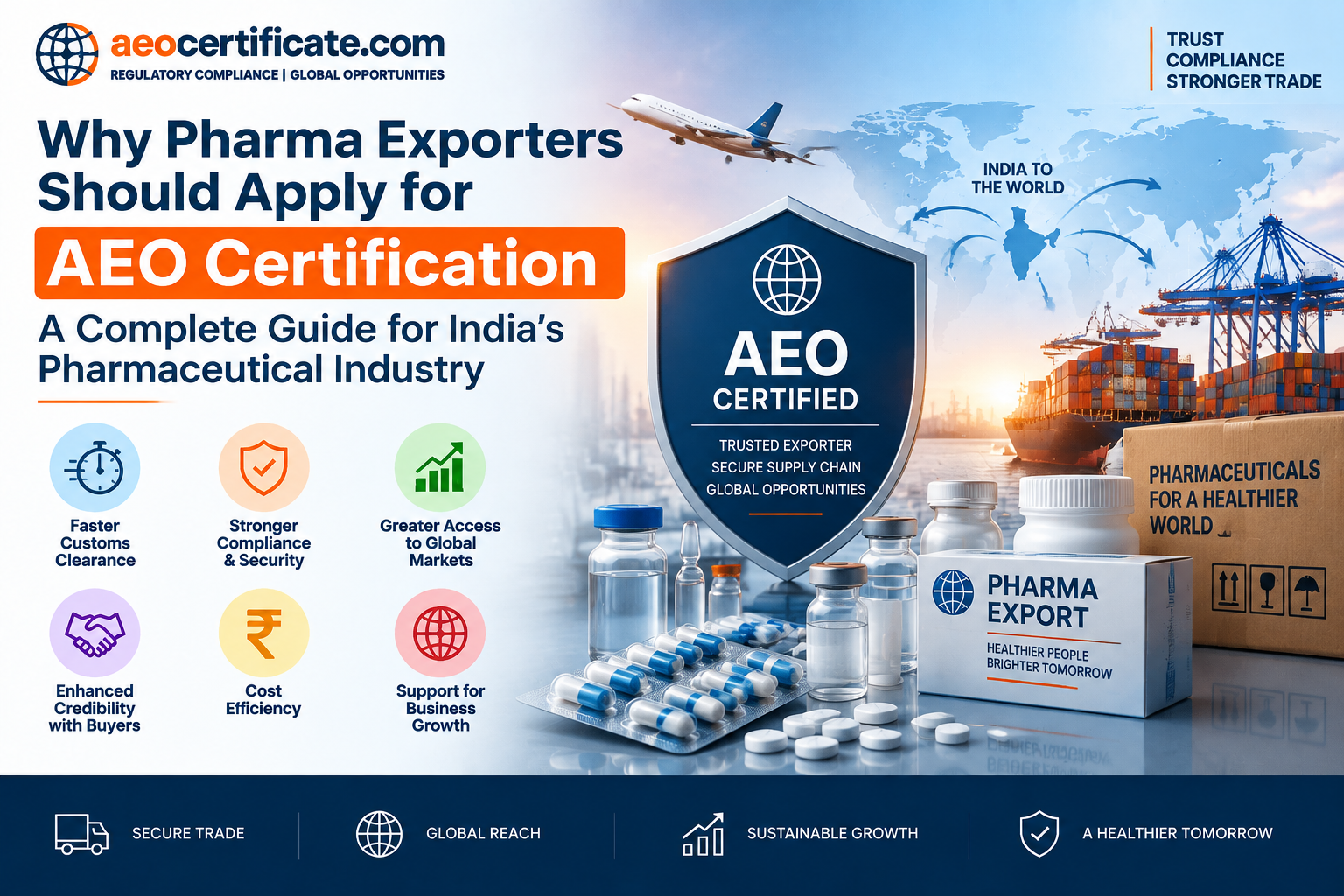
India is one of the largest pharmaceutical suppliers in the world, exporting medicines, active pharmaceutical ingredients (APIs), formulations, and healthcare products to multiple international markets. With increasing global demand, pharmaceutical exporters must maintain efficient supply chains, strong compliance systems, and reliable customs procedures.
In this competitive environment, AEO Certification for Pharma Exporters has become an important step for pharmaceutical companies looking to improve their international trade operations and establish themselves as trusted global suppliers.
The Authorised Economic Operator (AEO) programme recognises businesses that maintain high standards of customs compliance, documentation control, and supply chain security. For pharmaceutical exporters, AEO certification can support smoother customs processes, improved credibility, and better control over export operations.
This complete guide explains the importance, benefits, eligibility, documentation requirements, and application process of AEO Certification for Pharma Exporters in India.
What is AEO Certification?
AEO (Authorised Economic Operator) certification is a trade facilitation program introduced by customs authorities to recognize businesses that demonstrate strong compliance practices and secure supply chain management.
An AEO-certified company is considered a trusted partner because it maintains:
- Proper customs compliance systems
- Accurate documentation procedures
- Risk management practices
- Secure supply chain controls
The certification is applicable to various stakeholders involved in international trade, including manufacturers, exporters, importers, logistics companies, and pharmaceutical businesses.
For pharmaceutical exporters, AEO Certification for Pharma Exporters provides an opportunity to strengthen their global trade framework and improve operational efficiency.
Why AEO Certification is Important for Pharma Exporters
The pharmaceutical industry operates under strict regulatory requirements due to the sensitive nature of healthcare products. Pharma exporters need to ensure:
- Timely delivery of medicines
- Proper documentation
- Secure handling of products
- Compliance with international trade requirements
Export delays, documentation errors, or supply chain disruptions can affect business operations and customer relationships.
AEO Certification for Pharma Exporters helps pharmaceutical companies develop structured processes that support secure and efficient international trade.
Key Benefits of AEO Certification for Pharma Exporters
1. Faster Customs Clearance
One of the major benefits of AEO Certification for pharma exporters is improved customs facilitation.
Pharmaceutical exports often involve time-sensitive shipments where delays can impact product availability in international markets.
AEO certification helps companies establish reliable compliance systems, which can support:
- Faster processing of shipments
- Reduced operational delays
- Improved export efficiency
- Better supply chain coordination
2. Enhanced Credibility in Global Markets
International buyers and healthcare organizations prefer working with reliable suppliers who maintain strong compliance practices.
AEO certification demonstrates that a pharmaceutical exporter follows:
- Secure trade practices
- Proper documentation systems
- Compliance-focused operations
For pharma companies entering new international markets, AEO Certification for Pharma Exporters can strengthen business credibility among overseas customers and partners.
3. Improved Supply Chain Security
Pharmaceutical products require careful handling throughout the supply chain.
AEO certification encourages exporters to implement security measures related to:
- Product movement
- Warehouse management
- Transportation controls
- Access management
- Information security
These practices help pharmaceutical exporters maintain product integrity and reduce supply chain risks.
4. Better Management of Export Operations
Pharmaceutical exporters manage multiple activities, including:
- Manufacturing coordination
- Packaging
- Documentation
- Logistics management
- Customs procedures
Preparing for AEO Certification for Pharma Exporters helps businesses review and improve their internal processes.
Companies can develop:
- Standard Operating Procedures (SOPs)
- Document control systems
- Compliance monitoring systems
- Employee responsibility frameworks
5. Competitive Advantage for Pharmaceutical Companies
The pharmaceutical export market is highly competitive.
AEO certification helps companies differentiate themselves by demonstrating:
- Strong compliance culture
- Secure supply chain practices
- Professional business processes
For pharmaceutical manufacturers and exporters, AEO status can support stronger relationships with international buyers and supply chain partners.
6. Reduced Compliance Risks
Pharmaceutical exporters must manage various documentation and regulatory requirements.
AEO certification encourages businesses to maintain:
- Accurate records
- Proper approvals
- Internal checks
- Compliance reviews
This helps reduce risks related to:
- Documentation mistakes
- Shipment issues
- Customs-related concerns
7. Support for International Expansion
Many Indian pharmaceutical companies are expanding into markets such as
- United States
- European Union
- Africa
- Middle East
- Southeast Asia
Global expansion requires reliable supply chain systems.
AEO Certification for Pharma Exporters helps businesses create a compliance framework that supports international growth and improves trust with overseas partners.
Who Should Apply for AEO Certification in the Pharmaceutical Industry?
AEO Certification for Pharma Exporters can benefit different types of pharmaceutical businesses, including:
1. Pharmaceutical Manufacturers
Companies manufacturing medicines and exporting finished formulations can apply to strengthen their trade compliance systems.
2. API Manufacturers and Exporters
Active Pharmaceutical Ingredient (API) exporters can benefit from improved supply chain security and operational controls.
3. Contract Manufacturing Companies
Pharma companies involved in third-party manufacturing and international supply chains can use AEO certification to demonstrate reliability.
4. Pharmaceutical Trading Companies
Companies involved in pharmaceutical exports can improve their credibility through recognized compliance practices.
Eligibility Requirements for AEO Certification for Pharma Exporters
Before applying for AEO certification, pharmaceutical exporters should ensure they maintain:
1. Business Registration
Required details may include:
- Company registration documents
- PAN details
- GST registration
- Import Export Code (IEC)
2. Customs Compliance History
Companies should maintain:
- Export records
- Shipping documents
- Customs declarations
- Duty-related records
3. Secure Supply Chain Practices
Businesses should have procedures related to:
- Warehouse security
- Cargo handling
- Transportation management
- Employee access control
4. Documented Procedures
Pharmaceutical exporters should maintain SOPs for:
- Export processes
- Documentation handling
- Quality and security controls
- Risk management
AEO Certification Process for Pharma Exporters
Step 1: Evaluate Business Readiness
The company should review its current compliance and security practices.
Step 2: Prepare Documentation
Collect required documents, SOPs, and compliance records.
Step 3: Submit AEO Application
Submit the application along with required supporting documents.
Step 4: Customs Assessment
Customs authorities review the application and may conduct verification.
Step 5: Grant of AEO Certification
After successful evaluation, eligible businesses receive AEO certification.
How Pharma Exporters Can Prepare for AEO Certification
1. Create Strong SOPs
Pharma companies should document procedures related to:
- Export handling
- Shipment management
- Security controls
- Documentation practices
2. Train Employees
Employees involved in exports should understand:
- Customs procedures
- Documentation requirements
- Security responsibilities
3. Maintain Proper Records
Companies should maintain evidence of:
- Export transactions
- Internal reviews
- Training activities
- Security checks
4. Conduct Internal Reviews
Regular compliance reviews help identify gaps before the AEO assessment.
Common Challenges Pharma Exporters Face During AEO Application
1. Lack of Proper Documentation
Many companies follow processes but do not maintain written records.
2. Weak Security Procedures
Companies may need improvements in:
- Warehouse controls
- Access management
- Data security
3. Inconsistent Internal Processes
Different departments following different procedures can create compliance gaps.
Future Importance of AEO Certification for the Pharmaceutical Industry
The pharmaceutical export sector is expected to become more globally connected, with increasing focus on secure and transparent supply chains.
In the coming years, companies with strong compliance systems will have better opportunities to work with international partners.
AEO Certification for Pharma Exporters can help pharmaceutical businesses prepare for future trade requirements by improving compliance, security, and operational efficiency.
1. Role of AEO Certification in Pharmaceutical Global Supply Chain
The pharmaceutical supply chain involves multiple stakeholders, including manufacturers, suppliers, logistics providers, distributors, and international buyers. Any disruption in the supply chain can impact medicine availability and business operations.
AEO Certification for Pharma Exporters helps pharmaceutical companies establish secure and reliable supply chain practices by focusing on:
- Secure movement of pharmaceutical products
- Better documentation control
- Risk identification and management
- Improved coordination with logistics partners
For pharma exporters, a secure supply chain increases confidence among international customers and business partners.
2. How AEO Certification Supports Pharmaceutical Export Compliance
Pharmaceutical exports require strict control over documentation and processes.
AEO certification encourages companies to maintain:
- Accurate export documentation
- Proper customs declarations
- Internal compliance procedures
- Record management systems
With AEO Certification for Pharma Exporters, businesses can create a structured approach towards managing international trade compliance.
3. Importance of Supply Chain Security for Pharmaceutical Products
Pharmaceutical products require special attention due to their sensitive nature.
Supply chain security under AEO certification focuses on:
Product Protection
Ensuring medicines and healthcare products are protected during storage and transportation.
Access Control
Restricting unauthorized access to warehouses and operational areas.
Transportation Security
Maintaining proper procedures during movement of pharmaceutical shipments.
Data Security
Protecting important business and shipment-related information.
4. AEO Certification Benefits for API Manufacturers and Exporters
Active Pharmaceutical Ingredient (API) manufacturers play an important role in the global pharmaceutical supply chain.
AEO Certification for Pharma Exporters can help API businesses by:
- Improving international buyer confidence
- Strengthening export processes
- Supporting reliable supply chain management
- Demonstrating compliance commitment
For API exporters working with global pharmaceutical companies, AEO certification can improve business credibility.
5. Impact of AEO Certification on Pharmaceutical Export Operations
Pharma exporters manage several critical activities, including
- Product documentation
- Shipment planning
- Customs procedures
- Logistics coordination
AEO certification helps businesses improve these operations through:
- Defined responsibilities
- Standardized procedures
- Better record management
- Internal monitoring systems
6. AEO Certification and International Pharmaceutical Markets
Indian pharmaceutical companies export products to various global markets.
International buyers often evaluate suppliers based on:
- Quality systems
- Regulatory compliance
- Supply chain reliability
- Business transparency
AEO Certification for Pharma Exporters can support companies in demonstrating their commitment towards reliable international trade practices.
Difference Between AEO Certification and GMP Certification in Pharma
Many pharmaceutical companies confuse AEO certification with GMP compliance.
| AEO Certification | GMP Certification |
| Focuses on customs compliance and supply chain security | Focuses on manufacturing quality standards |
| Related to international trade operations | Related to pharmaceutical production |
| Evaluates business processes and security controls | Evaluates manufacturing practices |
Both certifications serve different purposes and can support overall business compliance.
How AEO Certification Helps Pharma SMEs Expand Globally
Small and medium pharmaceutical companies often face challenges while entering international markets.
AEO Certification for Pharma Exporters helps SMEs by providing:
- Better business credibility
- Stronger compliance systems
- Improved customer confidence
- Professional trade practices
This can support SMEs in building stronger international partnerships.
Internal Controls Required for Pharma AEO Certification
Pharmaceutical exporters should establish proper internal controls related to:
Documentation Control
- Export records
- Shipment documents
- Customer records
Employee Responsibility
- Defined roles
- Training procedures
- Compliance awareness
Process Monitoring
- Regular reviews
- Internal checks
- Corrective actions
Strong internal controls improve readiness for AEO assessment.
AEO Certification Checklist for Pharmaceutical Exporters
Before applying, pharma exporters should check:
✅ Valid company registrations
✅ Updated IEC and GST details
✅ Proper export records maintained
✅ Customs compliance history available
✅ SOPs prepared
✅ Security policies implemented
✅ Employee training conducted
✅ Warehouse and logistics controls established
✅ Internal compliance review completed
Documents Required for AEO Certification for Pharma Exporters
The documentation generally includes:
Company Documents
- Certificate of Incorporation
- PAN Card
- GST Registration Certificate
- Import Export Code
- Company profile
- Organizational structure
Export and Customs Documents
- Shipping Bills
- Export records
- Customs declarations
- Transaction records
- Compliance records
Operational Documents
- Export process flow
- Warehouse details
- Logistics procedures
- SOPs
- Quality management procedures
Security Documents
- Security policy
- Access control procedures
- CCTV details
- Employee verification records
- IT security procedures
How AEO Certification Creates Trust Among Global Buyers
Global pharmaceutical buyers prefer suppliers who can ensure:
- Reliable supply
- Secure handling
- Transparent processes
- Regulatory commitment
AEO certification provides evidence that the exporter follows structured compliance practices.
This trust factor can help pharmaceutical companies build long-term international relationships.
Future of AEO Certification in India’s Pharmaceutical Export Sector
India’s pharmaceutical industry continues to expand globally. As international trade becomes more compliance-driven, pharmaceutical companies need stronger systems to manage exports.
In the future, AEO Certification for Pharma Exporters can become an important advantage for businesses focusing on:
- Global expansion
- Secure supply chains
- International partnerships
- Efficient customs management
Conclusion
AEO Certification for Pharma Exporters provides pharmaceutical companies with an opportunity to strengthen customs compliance, improve supply chain security, and build trust in international markets.
With proper documentation, SOPs, and compliance systems, pharma exporters can enhance operational efficiency and prepare for global trade growth.
For India’s pharmaceutical industry, AEO certification can support businesses in creating a secure, transparent, and reliable export framework while improving credibility among global partners.
Frequently Asked Questions
Q1. What is AEO Certification for Pharma Exporters?
AEO Certification for Pharma Exporters recognizes pharmaceutical businesses that maintain strong customs compliance and secure supply chain practices.
Q2. Why should pharma exporters apply for AEO certification?
It helps improve compliance, enhance credibility, and support smoother international trade operations.
Q3. Can API manufacturers apply for AEO certification?
Yes, eligible API manufacturers and exporters can apply for AEO certification.
Q4. Is AEO certification mandatory for pharma exporters?
No, it is voluntary but provides various trade facilitation and business benefits.
Q5. What documents are required for pharma AEO certification?
Companies generally need business documents, export records, SOPs, compliance documents, and security-related records.