Obtaining AEO (Authorized Economic Operator) certification requires more than submitting an application. Organizations must demonstrate strong customs compliance, effective internal controls, secure supply chain practices, and proper documentation systems.
Many businesses struggle with AEO preparation because they do not know CBIC where to begin, which documents to prepare, or how to organize their internal processes.
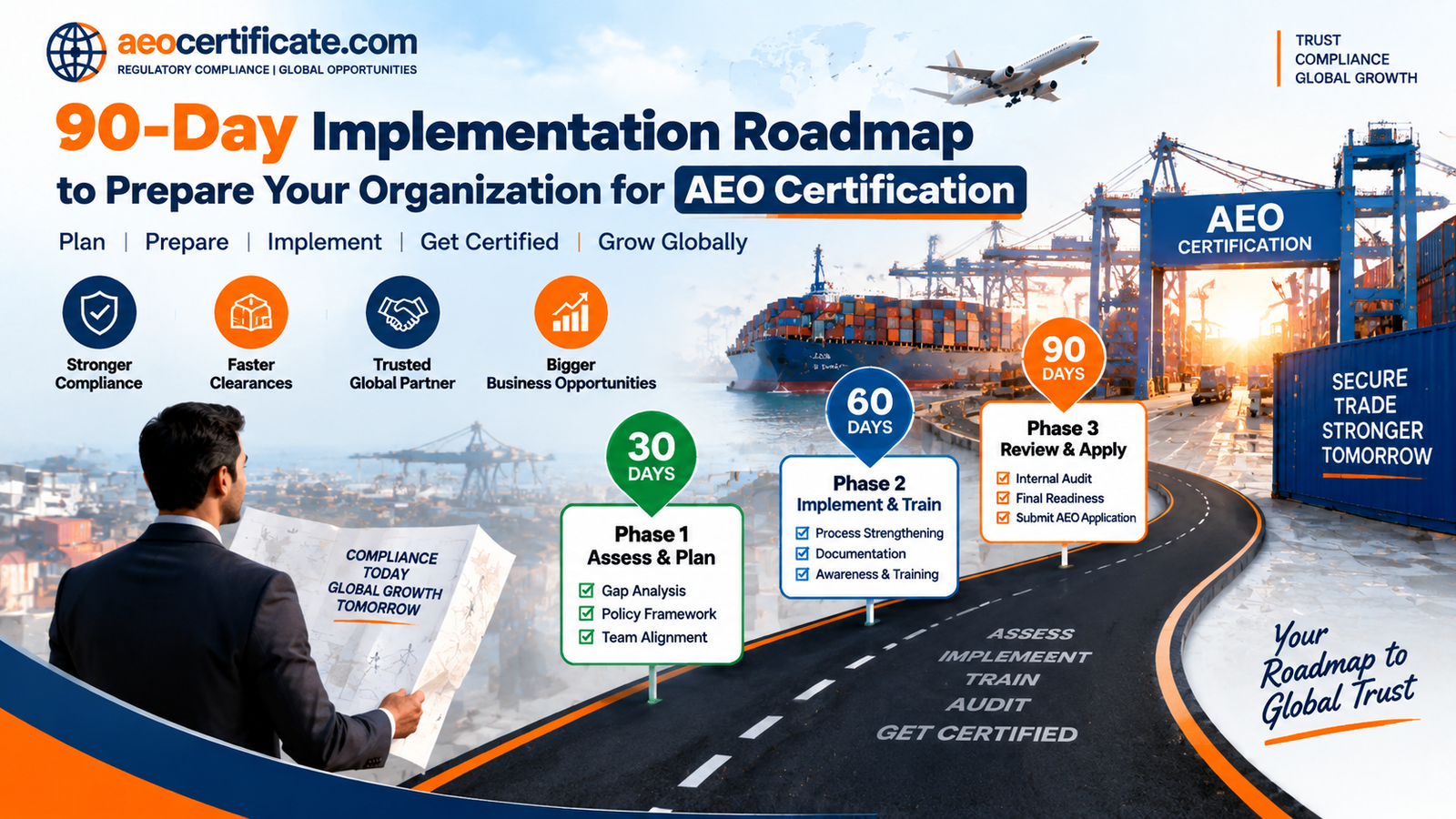
A structured 90-day implementation roadmap for AEO certification helps organizations systematically prepare for AEO requirements by dividing the preparation process into different phases, including compliance assessment, documentation development, SOP creation, employee training, and final readiness review.
This roadmap allows businesses to identify gaps, improve their systems, and develop a strong foundation before submitting their AEO application.
What is AEO Certification?
AEO (Authorized Economic Operator) certification is a customs compliance recognition provided to businesses that demonstrate a 90-Day Implementation Roadmap for AEO Certification, strong compliance practices and secure supply chain management.
The AEO program is based on the World Customs Organization (WCO) SAFE Framework of Standards, which promotes secure and efficient international trade.
An AEO-certified organization demonstrates:
- Customs compliance practices
- Proper documentation control
- Internal risk management systems
- Secure supply chain procedures
- Transparent business operations
The 90-Day Implementation Roadmap for AEO Certification helps organizations prepare these systems in a structured and time-bound manner.
Why Organizations Need a 90-Day Implementation Roadmap for AEO Certification
Many businesses delay AEO preparation because they consider it a complex compliance process.
A planned roadmap helps organizations:
- Understand AEO requirements
- Identify compliance gaps
- Organize required documents
- Develop SOPs
- Train employees
- Improve supply chain security
The 90-Day Implementation Roadmap for AEO Certification provides a practical approach for businesses that want to become AEO-ready within a defined timeline.
Phase 1 (Day 1–30): Compliance Assessment and Gap Identification
The first 30 days focus on understanding the current CBIC compliance position of the organization.
Conduct AEO Readiness Assessment
The organization should review its existing systems and compare them with AEO requirements.
The assessment should cover:
- Customs compliance history
- Export and import procedures
- Documentation systems
- Financial records
- Internal controls
- Supply chain security
A gap assessment helps identify the 90-day implementation roadmap for AEO certification areas that require improvement before filing the AEO application.
Review Existing Documentation Systems
Documentation plays a critical role in AEO certification.
During the first phase of the 90-Day Implementation Roadmap for AEO Certification, organizations should review:
- Import/export records
- Shipping documents
- Customs declarations
- Invoices
- Purchase records
- Logistics documents
The objective is to ensure that business records are accurate, complete, and easily accessible.
Identify Responsible Teams and Employees
The 90-day implementation roadmap for AEO Certification requires coordination between multiple departments.
Organizations should identify responsible persons from:
- Export department
- Logistics team
- Purchase department
- Finance department
- Compliance team
- Management
Assigning responsibilities ensures proper implementation of AEO requirements.
Phase 2 (Day 31–60): Documentation Development and Process Improvement
The second phase focuses on creating structured systems for CBIC and improving internal processes.
Develop Standard Operating Procedures (SOPs)
AEO certification requires businesses to maintain documented procedures.
During this phase of the 90-Day Implementation Roadmap for AEO Certification, organizations should prepare SOPs for:
Export and Import Operations
Define procedures for:
- Order processing
- Documentation preparation
- Shipment handling
- Customs filing
Document Control Procedures
Establish processes for:
- Document creation
- Review and approval
- Storage and retrieval
- Record retention
Supplier and Business Partner Management
Organizations should define procedures for:
- Supplier verification
- Vendor evaluation
- Business partner monitoring
Compliance Monitoring
Develop systems for:
- Internal reviews
- Compliance checks
- Corrective actions
Strengthen Internal Control Systems
Internal controls help organizations monitor and manage compliance risks.
Businesses should establish:
- Approval procedures
- Responsibility allocation
- Document verification systems
- Monitoring mechanisms
Strong internal controls demonstrate operational reliability during AEO assessment.
Improve Supply Chain Security
Supply chain security is an important part of AEO compliance.
Organizations should review:
Warehouse Security
Including:
- Access control
- Storage procedures
- Security monitoring
Cargo Security
Including:
- Cargo handling procedures
- Shipment protection
- Transportation controls
Employee Security Awareness
Including:
- Training programs
- Security responsibilities
- Awareness sessions
Phase 3 (Day 61–90): Training, Review, and Final AEO Preparation
The final phase focuses on testing readiness and preparing for application submission.
Employee Training and Awareness
Employees involved in international trade on the 90-day implementation roadmap for AEO certification activities should understand their compliance responsibilities.
Training should cover:
- Customs procedures
- Documentation requirements
- Internal SOPs
- Security practices
- Risk management procedures
Employee awareness is important because the 90-Day Implementation Roadmap for AEO Certification depends on the involvement of different departments.
Conduct an Internal Audit and Review
Before applying for AEO certification, organizations should conduct an internal review.
The review should verify:
- Availability of required documents
- Implementation of SOPs
- Employee awareness
- Security procedures
- Compliance records
The 90-Day Implementation Roadmap for AEO Certification should include a final readiness assessment before application submission.
Prepare Final AEO Application Documents
The organization should compile all required documents, including:
Company Documents
- Certificate of Incorporation
- PAN Card
- GST Registration
- Import Export Code (IEC)
- Organization details
Customs Documents
- Import/export transaction records
- Shipping Bills
- Bill of Entry records
- Customs compliance details
Financial Documents
- Audited financial statements
- Financial records
- Tax documents
Compliance Documents
- SOPs
- Security procedures
- Training records
- Internal control documents
Benefits of Following a 90-Day Implementation Roadmap for AEO Certification
A structured roadmap helps businesses create organized compliance systems.
Improved Documentation Control
Organizations develop proper methods for maintaining and managing trade records.
Stronger Supply Chain Security
Businesses improve security practices related to suppliers, warehouses, and logistics operations.
Better Employee Awareness
Training ensures employees understand their roles in maintaining compliance.
Higher Application Readiness
A planned approach reduces the 90-day implementation roadmap for AEO certification and last-minute challenges during the AEO application process.
Common Mistakes Organizations Should Avoid During AEO Preparation
Organizations should first understand their 90-Day Implementation Roadmap for AEO Certification current compliance position.
Preparing Documents Without Process Improvement
AEO certification requires practical implementation, not only document preparation.
Ignoring Employee Training
Employees must understand procedures and compliance responsibilities.
Lack of Regular Monitoring
Businesses should continue reviewing their compliance systems even after certification.
How Businesses Can Maintain AEO Compliance After Certification
AEO certification is not only a one-time activity. Organizations should continue maintaining compliance through:
- Regular internal audits
- SOP updates
- Employee training
- Security reviews
- Documentation monitoring
Continuous improvement helps organizations maintain their trusted trader status.
Understanding Organizational Readiness Before Starting
Before beginning the AEO certification process, organizations should evaluate whether they are ready for the compliance requirements.
AEO readiness depends on:
- Existing customs compliance practices
- Availability of proper records
- Internal process documentation
- Employee awareness
- Supply chain security measures
A proper readiness evaluation helps organizations understand their 90-Day Implementation Roadmap for AEO Certification current position and create an effective implementation strategy.
Creating an AEO Compliance Team
Successful AEO preparation requires coordination between different departments.
Organizations should create a dedicated AEO compliance team involving:
- Management representatives
- Customs compliance team
- Logistics department
- Finance team
- Purchase department
- Warehouse team
The team should define responsibilities, monitor progress, and ensure timely completion of AEO preparation activities.
Developing an AEO Compliance Calendar
A compliance calendar helps organizations track important activities during the preparation process.
The calendar may include:
- Document preparation deadlines
- SOP development timelines
- Employee training schedules
- Internal audit dates
- Review meetings
A structured compliance calendar ensures that every activity under the 90-Day Implementation Roadmap for AEO Certification is completed systematically.
Reviewing Customs Compliance History
Organizations should review their previous customs activities before applying.
The review should include:
- Import and export transactions
- Customs declarations
- Past notices or queries
- Duty payment records
- Compliance issues
This helps identify potential risks and prepare a 90-day implementation roadmap for AEO Certification corrective measures before application submission.
Preparing Risk Management Procedures
Risk management is an important part of AEO compliance.
Organizations should identify risks related to:
- Customs documentation
- Supply chain operations
- Supplier management
- Shipment handling
- Data security
Businesses should develop procedures for identifying, controlling, and reducing these risks.
Establishing Document Control Systems
AEO certification requires businesses to maintain accurate and accessible records.
Organizations should create systems for:
- Document approval
- Version control
- Record storage
- Document retrieval
- Data protection
A strong document control system supports better CBIC compliance management.
Improving Supplier and Vendor Controls
Supply chain partners directly impact an organization’s compliance performance.
Organizations should establish procedures for:
- Supplier verification
- Vendor selection
- Partner evaluation
- Compliance monitoring
Strong supplier controls help businesses maintain a 90-Day Implementation Roadmap for AEO certification and secure and reliable supply chains.
Strengthening Warehouse Security
Warehouse operations are an important part of supply chain security.
Organizations should review:
- Entry and exit controls
- Visitor management
- Inventory protection
- Storage procedures
- Security monitoring
Improving warehouse security supports AEO compliance requirements.
Preparing Employee Awareness Programs
Employees play an important role in the 90-Day Implementation Roadmap for AEO Certification in maintaining compliance.
Organizations should conduct awareness programs covering:
- AEO requirements
- Customs compliance
- Security procedures
- Documentation practices
- Reporting responsibilities
Employee involvement helps ensure successful implementation of AEO systems.
Conducting Internal Compliance Audits
Internal audits help organizations verify whether implemented procedures are working effectively.
The audit should review:
- SOP implementation
- Documentation accuracy
- Employee compliance
- Security controls
- Record maintenance
Audit findings should be documented, and corrective 90-Day Implementation Roadmap for AEO certification actions should be implemented.
Developing Corrective Action Plans
During preparation, organizations may identify gaps in their existing systems.
A corrective action plan should include:
- Identified issue
- Root cause
- Corrective action
- Responsible person
- Completion timeline
This helps organizations systematically close compliance gaps.
Preparing for Customs Verification
Organizations should prepare for possible verification by ensuring:
- Documents are organized
- SOPs are implemented
- Employees understand procedures
- Security systems are functional
- Records are available
Proper preparation helps businesses confidently 90-Day Implementation Roadmap for AEO Certification demonstrate their compliance systems.
Role of Top Management Support
Management involvement is essential for successful AEO implementation.
Leadership should:
- Allocate resources
- Monitor progress
- Approve policies
- Encourage compliance culture
Strong management support improves the effectiveness of AEO preparation.
Technology and Digital Compliance Management
Technology can simplify AEO compliance management.
Organizations can use:
- ERP systems
- Digital document management systems
- Compliance tracking tools
- Inventory management software
- Data backup systems
Digital systems improve the accuracy and accessibility of compliance records.
Creating a Long-Term Compliance Culture
AEO certification should not be treated as a one-time activity.
Organizations should continue:
- Regular training
- Internal reviews
- SOP updates
- Compliance monitoring
- Risk assessments
A strong compliance culture helps maintain AEO standards after certification.
Final 10-Day Readiness Checklist
Before submitting the application, organizations should verify:
✔ All required documents are prepared
✔ SOPs are approved and implemented
✔ Employees are trained
✔ Compliance gaps are closed
✔ Security procedures are active
✔ Internal audit is completed
✔ Records are properly maintained
Common Reasons for Application Delays
Organizations may face delays due to:
- Incomplete documentation
- Lack of internal coordination
- Missing compliance records
- Poor SOP implementation
- Unclear employee responsibilities
Proper planning helps avoid these challenges.
Benefits of Early Preparation
Starting AEO preparation early helps organizations:
- Avoid last-minute documentation issues
- Improve internal processes
- Reduce compliance risks
- Create better operational discipline
- Improve application readiness
Moving From Compliance to Business Growth
AEO preparation creates benefits 90-Day Implementation Roadmap for AEO Certification beyond certification.
Organizations can achieve:
- Better operational control
- Improved customer confidence
- Stronger supply chain management
- Better international business opportunities
AEO readiness becomes a foundation for sustainable business growth.
Preparing Different Departments for AEO Requirements
AEO compliance involves multiple departments working together.
Each department should understand its role:
Logistics Department
Responsible for shipment handling, transportation controls, and logistics records.
Finance Department
Responsible for financial records and transaction-related documentation.
Purchase Department
Responsible for supplier evaluation and vendor records.
Export Department
Responsible for customs documentation and export procedures.
Proper coordination between departments improves the effectiveness of AEO implementation.
Importance of Customs Compliance History Before Application
Customs compliance history plays 90-Day Implementation Roadmap for AEO certification and AEO readiness.
Organizations should review:
- Previous import/export transactions
- Customs declarations
- Duty payment records
- Previous notices or queries
- Compliance issues
A review of past activities helps businesses identify risks and take corrective actions before applying for certification.
Documents Required for AEO Certification Preparation
Organizations following the 90-Day Implementation Roadmap for AEO Certification need to prepare documents related to company details, customs compliance, financial records, internal procedures, and supply chain security.
Company and Business Documents
- Certificate of Incorporation / Registration Certificate
- PAN Card of the company
- GST Registration Certificate
- Import Export Code (IEC)
- Company profile and business details
- Organization structure and management details
- Details of offices, warehouses, and manufacturing locations
Proper documentation preparation helps organizations demonstrate their readiness and successfully implement the 90-Day Implementation Roadmap for AEO Certification.
Conclusion
The 90-Day Implementation Roadmap for AEO Certification provides organizations with a structured approach to prepare for AEO compliance requirements.
AEO certification is not only about preparing documents but also about developing strong internal systems, improving customs compliance, strengthening supply chain security, and creating a compliance-focused culture.
By following a planned 90-day approach, organizations can:
- Identify compliance gaps
- Develop effective SOPs
- Improve documentation systems
- Train employees
- Strengthen internal controls
- Prepare for successful assessment
A well-planned implementation strategy helps businesses become AEO-ready and creates long-term benefits through better operational control, improved credibility, and stronger participation in global trade.
Organizations that treat AEO preparation as a continuous improvement process can build a stronger foundation for sustainable business growth.
Frequently Asked Questions
Q.1 What is the 90-Day Implementation Roadmap for AEO Certification?
The 90-Day Implementation Roadmap for AEO Certification is a structured plan that helps organizations prepare compliance systems, documentation, SOPs, and security procedures required for AEO certification.
Q.2 Can an organization prepare for AEO certification in 90 days?
Yes, with proper planning, resource allocation, and implementation of required compliance systems, organizations can prepare effectively within a defined timeline.
Q.3 What are the main phases of AEO preparation?
The main phases include compliance assessment, documentation preparation, SOP development, employee training, internal review, and final application readiness.
Q.4 Why are SOPs important for AEO certification?
SOPs help organizations demonstrate that their operations are controlled, consistent, and properly documented.
Q.5 What documents are required for AEO certification?
Documents generally include company records, customs documents, financial records, SOPs, security procedures, and employee training records.