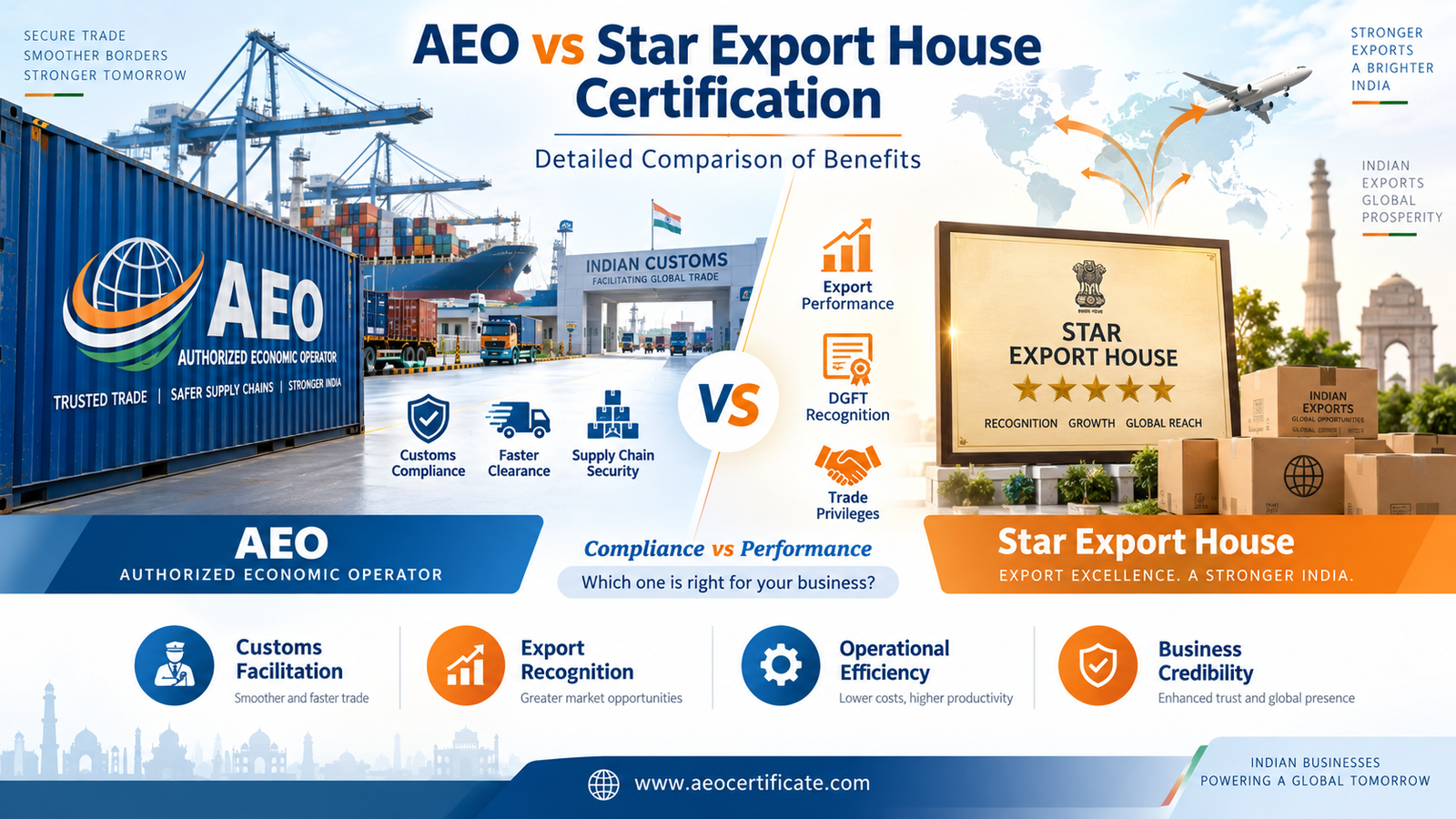
International trade plays a crucial role in India’s economic growth. To encourage exports, improve customs efficiency, and recognize reliable businesses, the Indian government offers various certification programs. Two important programs are Authorized Economic Operator AEO vs Star Export House Certification
Understanding AEO and Star Export House Certification is essential for exporters seeking to improve their operational efficiency, reduce regulatory complications, and strengthen their international market presence.
Although both certifications offer valuable advantages, their objectives, eligibility requirements, issuing authorities, and benefits differ significantly.
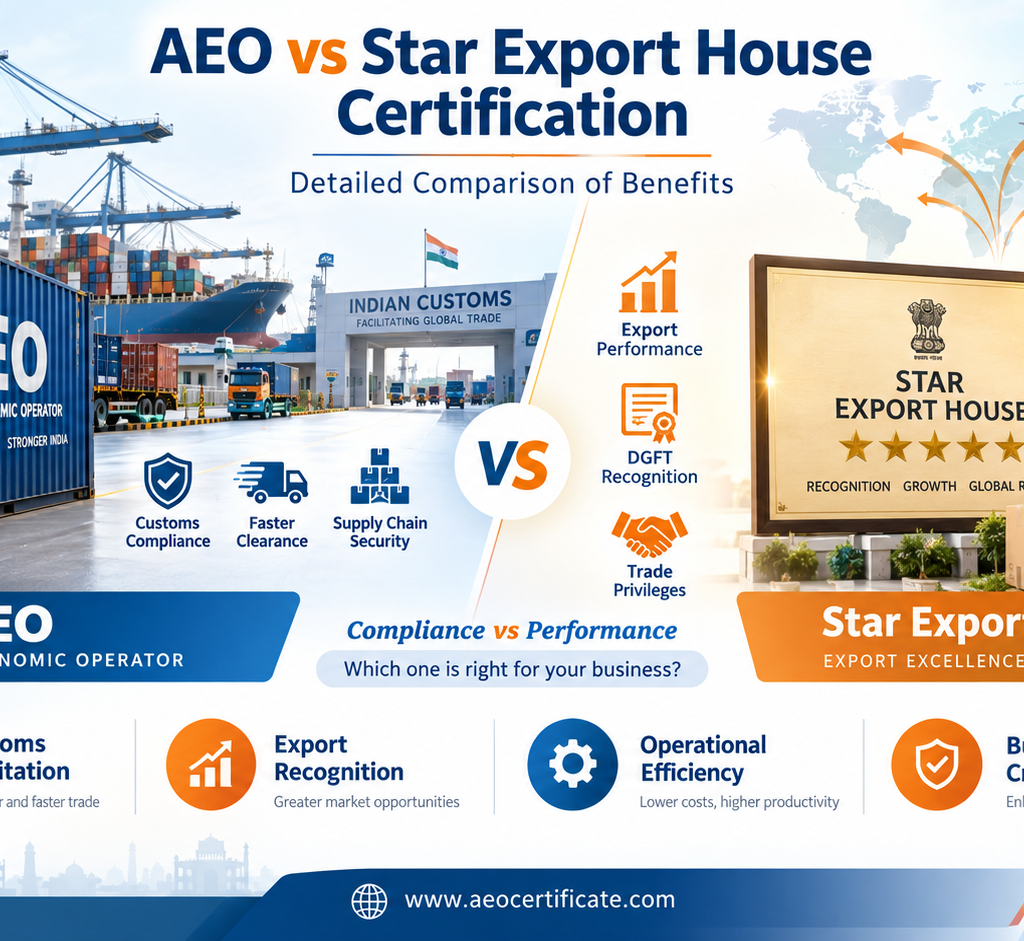
AEO Certification primarily focuses on customs compliance, supply chain security, and trade facilitation. In contrast, Star Export House Certification, formally known as Status Holder recognition, acknowledges exporters based on their export performance.
This article provides a detailed comparison of AEO vs Star Export House Certification, covering eligibility, benefits, registration procedures, and their importance for Indian exporters.
What Is AEO Certification? Understanding AEO vs Star Export House Certification
Authorized Economic Operator (AEO) Certification is a voluntary program administered by the Central Board of Indirect Taxes and Customs (CBIC).
It recognizes businesses that demonstrate compliance with customs regulations, financial solvency, secure supply chain practices, and effective internal controls.
The AEO program aims to facilitate legitimate international trade while strengthening supply chain security.
Types of AEO Certification
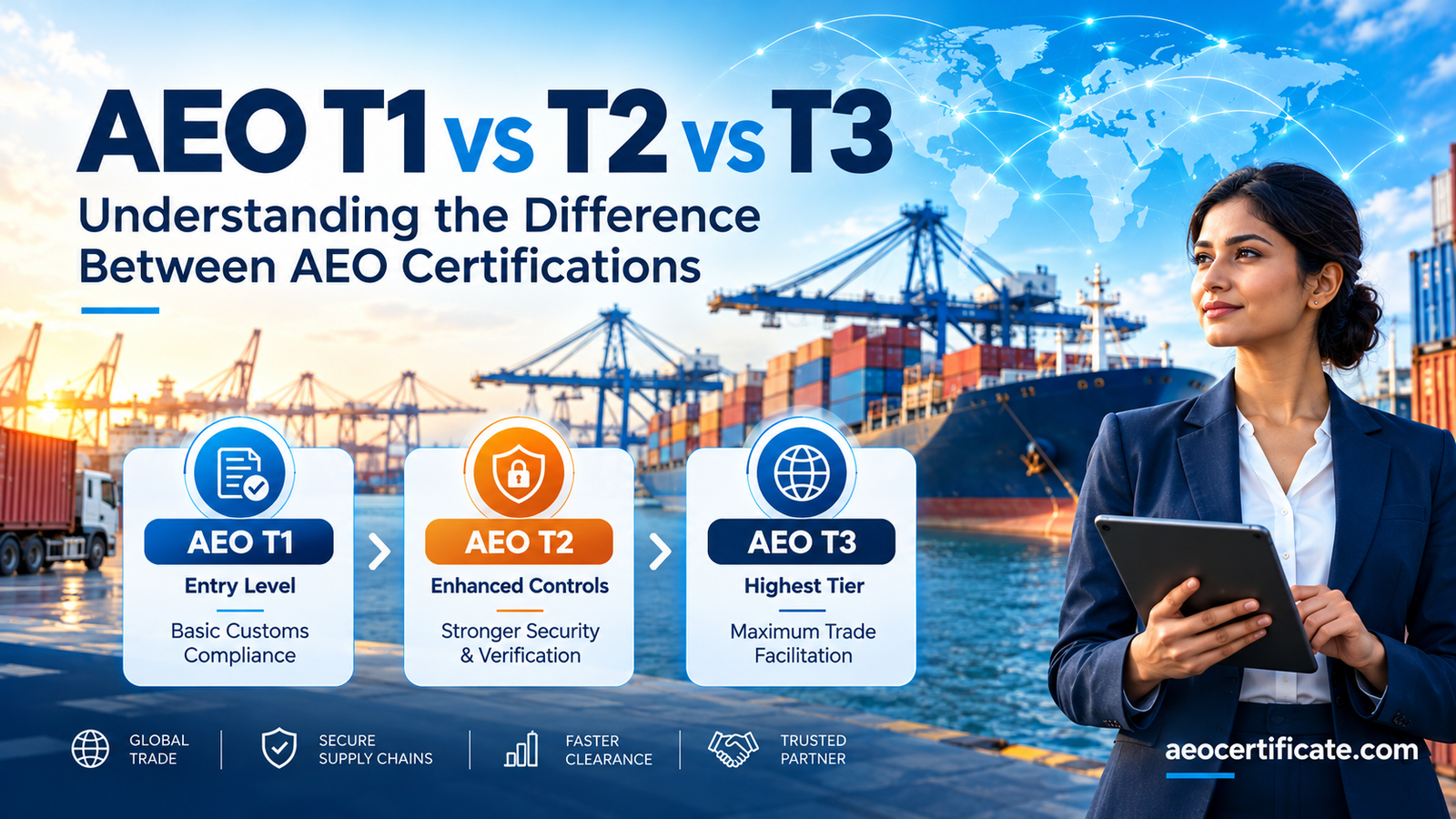
- AEO T1: Entry-level certification for eligible importers and exporters.
- AEO T2: Advanced certification with enhanced customs facilitation benefits.
- AEO T3: Highest certification level for eligible, established AEO T2 businesses.
- AEO-LO: Certification category for eligible logistics operators and other international supply chain participants.
In the comparison of AEO vs Star Export House Certification, AEO primarily emphasizes regulatory compliance and customs-related operational efficiency.
What Is Star Export House Certification? AEO vs Star Export House Certification Explained
Star Export House Certification is a recognition granted under India’s Foreign Trade Policy by the Directorate General of Foreign Trade (DGFT).
It recognizes exporters based on their export performance during the prescribed assessment period.
Status holder recognition is divided into five categories:
| Status Holder Category | Export Performance Threshold |
| One Star Export House | US$3 million |
| Two Star Export House | US$15 million |
| Three Star Export House | US$50 million |
| Four Star Export House | US$200 million |
| Five Star Export House | US$800 million |
Eligibility Criteria for AEO Certification
Eligibility depends upon the AEO and Star Export House Certification category being applied for.
Businesses participating in the international supply chain and undertaking customs-related activities in India may be eligible.
Typical eligible applicants include:
- Manufacturer exporters
- Merchant exporters
- Importers
- Import-export companies
- Customs brokers
- Custodians
- Warehouse operators
- Freight forwarders
- Logistics operators
- Other eligible supply-chain participants
The applicant must generally demonstrate appropriate:
- Customs and regulatory compliance
- Record-keeping systems
- Financial solvency
- Internal controls
- Standard operating procedures
- Safety and security controls, wherever applicable
Eligibility for AEO T1 and AEO T2
The official AEO and Star Export House Certification identifies conditions including customs-related work, participation in the international supply chain, prescribed business history, and minimum customs-document handling criteria.
Certain relaxed requirements apply to qualifying MSMEs.
The applicant must also have an acceptable compliance record and adequate systems for managing Customs-related transactions and records.
AEO vs Star Export House Certification: Difference in Eligibility
The easiest way to understand the difference is
Compliance-driven certification
The authority evaluates how well the applicant manages:
- Customs compliance
- Financial stability
- Records
- Internal systems
- Security procedures
- International supply-chain risks
Star Export House Certification
DGFT primarily evaluates:
- Export performance
- Relevant export realization
- IEC-linked export history
- Eligibility under prescribed status holder thresholds
Therefore:
AEO = Compliance + Security + Customs Facilitation
Star Export House = Export Performance + Government Recognition
Eligibility for AEO T3
AEO T3 is not normally the starting category for a new applicant.
A business generally reaches T3 after establishing itself as a mature AEO T2 operator.
The official AEO guidance provides eligibility pathways, including:
- Holding AEO T2 for two years, or
- Being an AEO T2 holder whose applicable business partners hold qualifying AEO T2, AEO-LO, or equivalent foreign AEO and Star Export House Certification.
Therefore, AEO T3 is intended for businesses with mature and consistently demonstrated customs-compliance and supply-chain security systems.
Special Double Weightage for One Star Export House
FTP 2023 also provides double weightage for determining eligibility for One Star Export House recognition for specified categories.
These include qualifying:
- Micro and Small Enterprises
- Manufacturing units having ISO/BIS certification
- Units located in specified northeastern states and specified union territories
- Eligible exports of fruits and vegetables falling under specified ITC(HS) chapters
Double weightage applies only for determining AEO and Star Export House Certification status and is subject to the conditions prescribed under the Foreign Trade Policy.
Eligibility Criteria for Star Export House Certification
To obtain Status Holder recognition, the applicant must generally:
- Hold a valid Importer Exporter Code (IEC).
- Be an exporter of eligible goods, services, or technology.
- Achieve the prescribed export-performance threshold.
- Have export performance during the applicable assessment period.
- Maintain proper export records.
- Comply with applicable DGFT and Foreign Trade Policy requirements.
Under FTP 2023, export AEO and Star Export House Certification performance is generally calculated based on FOB export earnings in freely convertible foreign currency or qualifying Indian rupee receipts in accordance with the policy.
Major Benefits of AEO Certification
AEO Certification can provide significant operational advantages to eligible international trade businesses.
1. Faster Customs Clearance
AEO entities receive higher levels of facilitation, helping reduce cargo-release time and routine customs intervention.
2. Reduced Examination
AEO entities can receive reduced routine examination or inspection based on the applicable risk-management framework.
3. Direct Port Delivery and Direct Port Entry
Eligible AEO entities may benefit from:
- Direct Port Delivery (DPD) for imports
- Direct Port Entry (DPE) for exports
subject to applicable conditions.
4. Reduced Bank Guarantee Requirements
AEO tiers provide progressively enhanced bank guarantee benefits.
For example, the official AEO and Star Export House Certification identifies reduced bank guarantee requirements at T1 and further reductions at T2, subject to applicable conditions.
AEO T3 receives the highest level of facilitation, including significant bank guarantee benefits.
5. Priority Treatment
AEO businesses are treated as trusted trade partners and may receive priority handling under applicable Customs processes.
6. Reduced Cargo Dwell Time
Fewer compliance interventions can help reduce:
- Port delays
- Storage costs
- Demurrage exposure
- Supply-chain uncertainty
7. Improved Supply-Chain Predictability
Businesses can plan shipments more efficiently when Customs procedures are faster and more predictable.
8. Dedicated Customs Support
The AEO framework includes mechanisms for improved coordination between certified entities and Customs authorities.
9. Mutual Recognition Benefits
AEO certification may provide international benefits in jurisdictions covered by applicable Mutual Recognition Arrangements/Agreements (MRAs).
10. Improved Corporate Credibility
AEO certification demonstrates that a business maintains structured compliance and supply-chain security systems.
Benefits of AEO T3 Certification
AEO and Star Export House Certification offers the highest level of facilitation available to importers and exporters under the AEO tiers.
Key benefits can include:
- Highest level of customs facilitation
- Reduced customs intervention
- Priority processing
- Faster cargo clearance
- Enhanced Bank Guarantee benefits
- Priority container scanning
- Improved customs predictability
- Stronger trusted-trader positioning
- Benefits under applicable international AEO mutual-recognition arrangements
The AEO portal currently highlights maximum facilitation, a 100% bank guarantee waiver in the applicable framework, and top priority in container scanning as major T3 benefits.
Major Benefits of Star Export House Certification
Status holder recognition also provides important benefits to qualifying exporters.
Under FTP 2023, privileges available to status holders include several procedural and trade-facilitation benefits.
1. Government Recognition of Export Performance
Status holder certification establishes the exporter as a recognized contributor to India’s international trade.
2. Self-Declaration Benefits
Authorizations and customs clearances for imports and exports may be granted on a self-declaration basis subject to applicable provisions.
3. Priority Fixation of Input-Output Norms
Input-output norms may receive priority processing by the Norms Committee in applicable cases.
4. Bank Guarantee Exemption
Status holders are eligible for exemption from furnishing bank AEO and Star Export House Certification guarantees under specified FTP schemes unless otherwise prescribed.
5. Export Warehouse Benefits
Two-star and above export houses may establish export warehouses subject to Department of Revenue guidelines.
6. Preferential Treatment
Status Holders are entitled to preferential treatment and priority handling of their consignments by concerned agencies.
7. Origin Self-Certification Benefits
Eligible manufacturer status holders in specified categories may receive self-certification benefits relating to origin under applicable preferential trade arrangements.
8. Export Promotion Samples
Status holders can freely export exportable goods on a free-of-cost basis for export promotion within applicable limits and subject to prescribed conditions.
AEO vs Star Export House: Which Provides Better Customs Benefits?
If the main objective of a company is to obtain:
- Faster clearance
- Reduced examination
- Improved cargo-release time
- Direct Port Delivery
- Direct Port Entry
- Reduced customs intervention
- Improved customs coordination
Then AEO Certification is generally more directly focused on these objectives.
This is because AEO is fundamentally a Customs trusted-trader program.
Star Export House recognition provides important trade privileges, but its primary purpose is recognition of export performance rather than comprehensive supply-chain security and customs-risk management.
Which Certification Provides Better Export Recognition?
For recognition specifically based on export performance, Star Export House Certification is more directly relevant.
An exporter achieving significant international sales can progress through:
One Star → Two Star → Three Star → Four Star → Five Star
This provides formal recognition of the company’s export performance under India’s Foreign Trade Policy.
Can a Company Have Both AEO and Star Export House Certification?
Yes.
AEO Certification and Star Export House Certification serve different regulatory objectives.
An eligible company may therefore potentially hold both certifications simultaneously, provided it independently satisfies the requirements of each program.
For example, a large manufacturer exporter may obtain:
- AEO T2/T3 for customs facilitation and supply chain security; and
- Two-star/three-star export house status based on qualifying export performance.
Obtaining both can create a stronger overall trade-compliance and export-recognition profile.
Benefits of Holding Both AEO and Star Export House Status
Holding both certifications may provide a combination of:
- Faster customs processes
- Reduced compliance intervention
- Export-performance recognition
- Preferential regulatory treatment
- Better supply-chain predictability
- Enhanced corporate credibility
- International trusted-trader recognition through AEO mechanisms
- Improved operational efficiency
- Better positioning with global customers and supply-chain partners
For established exporters, the certifications can therefore complement rather than replace each other.
Documents Required for AEO Certification
Exact documentation varies depending on whether the applicant applies for AEO T1, T2, T3 or AEO-LO.
Typical information may include:
- IEC Certificate
- GST registration details
- PAN and entity details
- Details of directors/partners/proprietors
- Customs transaction details
- Import/export history
- Financial statements
- Solvency Certificate
- Customs compliance information
T2, T3, and AEO-LO applications generally require more detailed evidence relating to security and internal controls than T1 applications.
Validity of AEO Certification
Under the applicable AEO framework, the validity prescribed is generally:
- AEO T1 – 3 years
- AEO T2 – 3 years
- AEO T3 – 5 years
- AEO-LO – 5 years
Subject to continued compliance and applicable renewal/continuation requirements.
AEO entities must continue complying with ongoing obligations even after certification.
Validity of Star Export House Certification
Under the current FTP 2023 framework, a Status Certificate is valid for five years from the date on which the application for recognition was filed.
If an exporter subsequently achieves a higher performance threshold, it may apply for an upgrade in its Status Holder category after surrendering the previous certificate in accordance with the applicable procedure.
Documents Required for Star Export House Certification
Typical documents/information may include:
- IEC details
- PAN details
- Company/entity details
- Export-performance records
- Shipping Bill details
- Foreign exchange realization details
- e-BRC details, as applicable
- Export turnover details
- CA certification where required
AEO Certification Registration Process – Step by Step
The application for Status Holder recognition is submitted online to the jurisdictional Regional Authority in ANF 1B, along with the prescribed documents.
Step 1: Determine the Appropriate AEO Category
The applicant should first determine whether it is eligible for:
- AEO T1
- AEO T2
- AEO T3
- AEO-LO
Step 2: Conduct AEO Readiness Assessment
Review:
- Customs compliance
- Financial solvency
- Import/export records
- Internal systems
- Security processes
- SOPs
- Business-partner controls
Step 3: Register on the AEO Portal
Applications are filed through the official Indian AEO Portal.
Applicants should ensure that their:
- IEC details
- Entity details
- Registered email
- Registered mobile number
are accurate and updated.
The portal requires applicant details to correspond with official IEC information.
Step 4: Prepare Application and Supporting Documents
Prepare the required AEO and Star Export House Certification application forms, declarations, annexures, and documentary evidence applicable to the selected AEO tier.
Step 5: Submit Online Application
Complete the application and upload the required supporting documents through the AEO Portal.
Step 6: Desk Review
The AEO authorities review the application for:
- Completeness
- Eligibility
- Compliance
- Documentation
Queries or clarification requests may be issued where required.
Step 7: Verification
For T2, T3, and other applicable categories, the authorities may conduct physical verification of the relevant premises, systems, and security arrangements.
Step 8: Corrective Action, if Required
Any deficiencies observed during verification may need to be resolved by the applicant.
Step 9: Final Review
The concerned AEO authorities assess the verification report and compliance status.
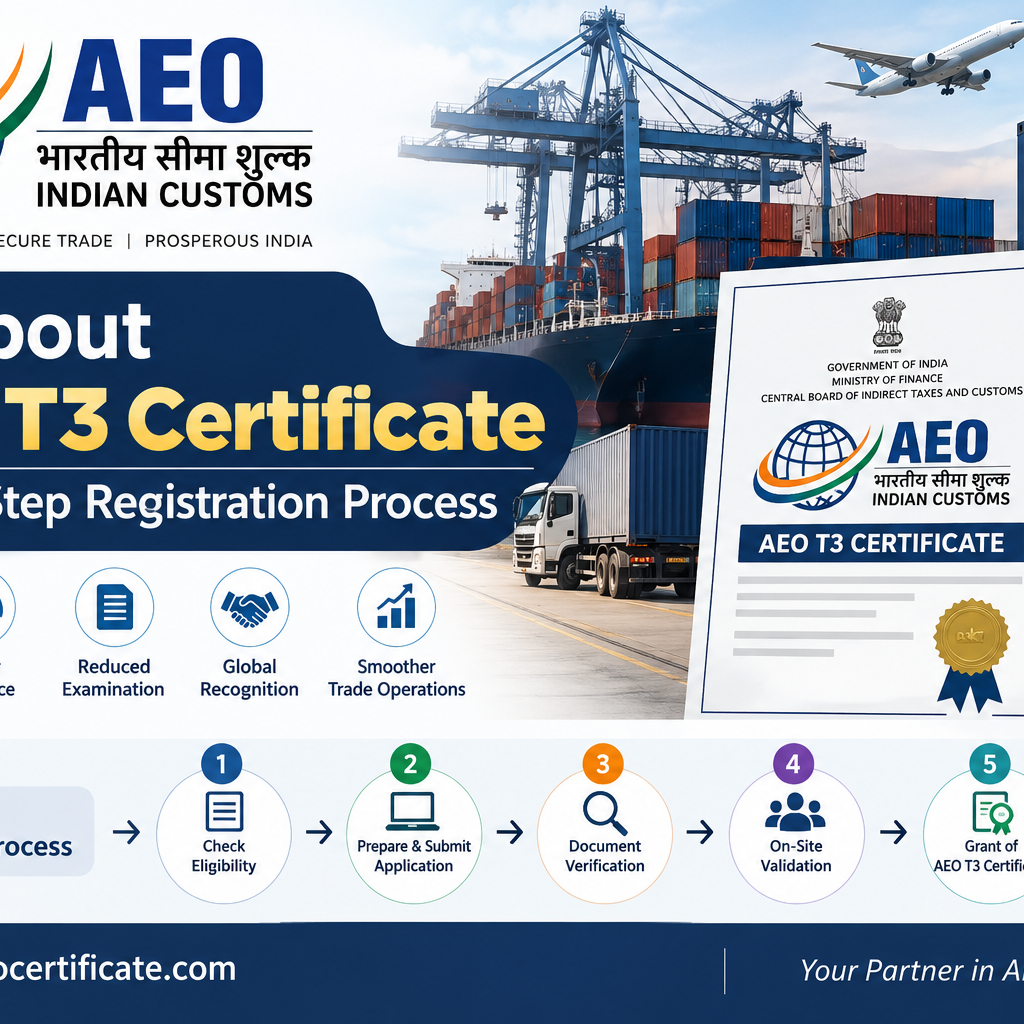
Step 10: Grant of AEO Certificate
Upon satisfactory completion of the process, the applicable AEO status is granted.
The official AEO portal broadly summarizes the journey as Prepare → Submit → Desk Review → Verification → Decision.
Star Export House Registration Process—Step by Step
On successful verification, DGFT grants the relevant Status Holder Certificate.
Step 1: Check IEC Status
Ensure that the applicant holds an active and updated Importer Exporter Code.
Step 2: Calculate Export Performance
Calculate eligible export performance for the relevant assessment period.
Step 3: Determine Applicable Star Category
Compare export performance against:
- USD 3 million – One Star
- USD 15 million – Two Star
- USD 50 million – Three Star
- USD 200 million – Four Star
- USD 800 million – Five Star
Step 4: Check Double Weightage Eligibility
When applying for One Star recognition, determine whether the applicant qualifies for applicable double weightage.
Step 5: Prepare Supporting Documents
Compile export performance and other prescribed documentation.
Step 6: File Online Application
Submit the Status Holder application online in ANF 1B to the jurisdictional DGFT Regional Authority.
Step 7: DGFT Verification
DGFT reviews the applicant’s export performance and submitted information.
Step 8: Clarification, if Required
Queries or deficiency letters may be issued where discrepancies or incomplete information are identified.
Compliance After Obtaining AEO Certification
AEO Certification is not merely a one-time approval.
Certified businesses should continue maintaining:
- Customs compliance
- Accurate records
- Financial solvency
- Security procedures
- Internal controls
- Updated SOPs
- Changes in key business information
- Supply-chain-security standards
Failure to maintain applicable conditions can affect continuation of AEO status.
Compliance After Obtaining Star Export House Status
Status holders must maintain AEO and Star Export House Certification proper records relating to the exports and imports on which their recognition is based.
Under the current Handbook of Procedures, status holders must maintain true and proper accounts and make them available to the relevant authority for inspection when required.
The certificate can also be refused, suspended, or cancelled in situations involving prescribed violations, misrepresentation, or non-compliance.
AEO vs Star Export House Certification for MSMEs
For MSMEs engaged in international trade, AEO and Star Export House Certification can be particularly useful where the company wants to:
- Improve customs clearance
- Reduce shipment delays
- Strengthen compliance systems
- Reduce regulatory intervention
- Improve logistics predictability
The AEO framework provides certain relaxed eligibility provisions and additional facilitation for qualifying MSMEs.
Meanwhile, qualifying micro and small enterprises may receive double weightage when determining eligibility for One Star Export House status under specified FTP conditions.
Therefore, eligible MSME exporters should evaluate both certifications.
AEO vs Star Export House for Manufacturer Exporters
Manufacturer exporters can benefit AEO and Star Export House Certification substantially from obtaining both certifications.
AEO Can Help With:
- Customs clearance
- Imported raw materials
- Export shipments
- Port handling
- Supply-chain controls
- International customer confidence
Star Export House Can Help With:
- Formal recognition of export performance
- FTP-related privileges
- Preferential treatment
- Export promotion
- Higher status holder recognition as exports grow
Manufacturer exporters in sectors such as
- Medical devices
- Pharmaceuticals
- Engineering products
- Electronics
- Chemicals
- Automotive components
- Textiles
- Machinery
- Consumer goods
may benefit from evaluating both certifications.
AEO vs Star Export House for Merchant Exporters
Merchant exporters can also consider both certifications.
A merchant exporter meeting AEO and Star Export House Certification may benefit from improved customs facilitation, while qualifying export performance may make the business eligible for Star Export House recognition.
The suitability depends on:
- Export volume
- Customs transaction frequency
- Compliance maturity
- Supply-chain structure
- Export-performance history
AEO vs Star Export House for Medical Device Exporters
Medical device exporters often operate within tightly controlled international supply chains and may require frequent interaction with:
- Customs
- Freight forwarders
- Airports
- Ports
- International distributors
- Regulatory authorities
Obtaining AEO Certification can support more efficient customs operations, while Status Holder recognition can strengthen the exporter’s formal export credentials.
For established medical device manufacturers with growing international sales, holding both certifications can support a more mature international trade framework.
Conclusion
Both AEO Certification and Star Export House Certification can play an important role in strengthening an Indian company’s international trade operations.
AEO Certification is primarily designed to reward compliant and secure businesses through better customs facilitation, reduced intervention, improved cargo clearance, and trusted-trader recognition.
AEO and Star Export House Certification, or Status Holder recognition, is primarily designed to recognize exporters that achieve prescribed levels of export performance.
For businesses involved heavily in international trade, the ideal strategy may be to evaluate eligibility for both AEO and Star Export House Certification.
An exporter with strong customs compliance and high export performance can benefit from combining the operational advantages of AEO with the export recognition and privileges available to status holders.
Frequently Asked Questions
Q1. What is the main difference between AEO and Star Export House Certification?
AEO Certification focuses primarily on customs compliance, supply chain security, and trade facilitation, whereas AEO and Star Export House Certification recognizes exporters based primarily on their export performance.
Q2. Is AEO Certification mandatory?
No. AEO is a voluntary trusted-trader certification.
Q3. Is Star Export House Certification mandatory?
No. Status Holder recognition is also not mandatory for every exporter.
Q4. Can a company obtain both AEO and Star Export House Certification?
Yes. Subject to meeting the respective requirements, a business can hold both certifications.
Q5. Which certification helps in faster customs clearance?
AEO Certification is specifically structured around customs facilitation and therefore provides more direct customs-related benefits.
Q6. What is the highest AEO category?
For eligible importers/exporters, AEO T3 provides the highest level of facilitation under the tiered AEO framework.