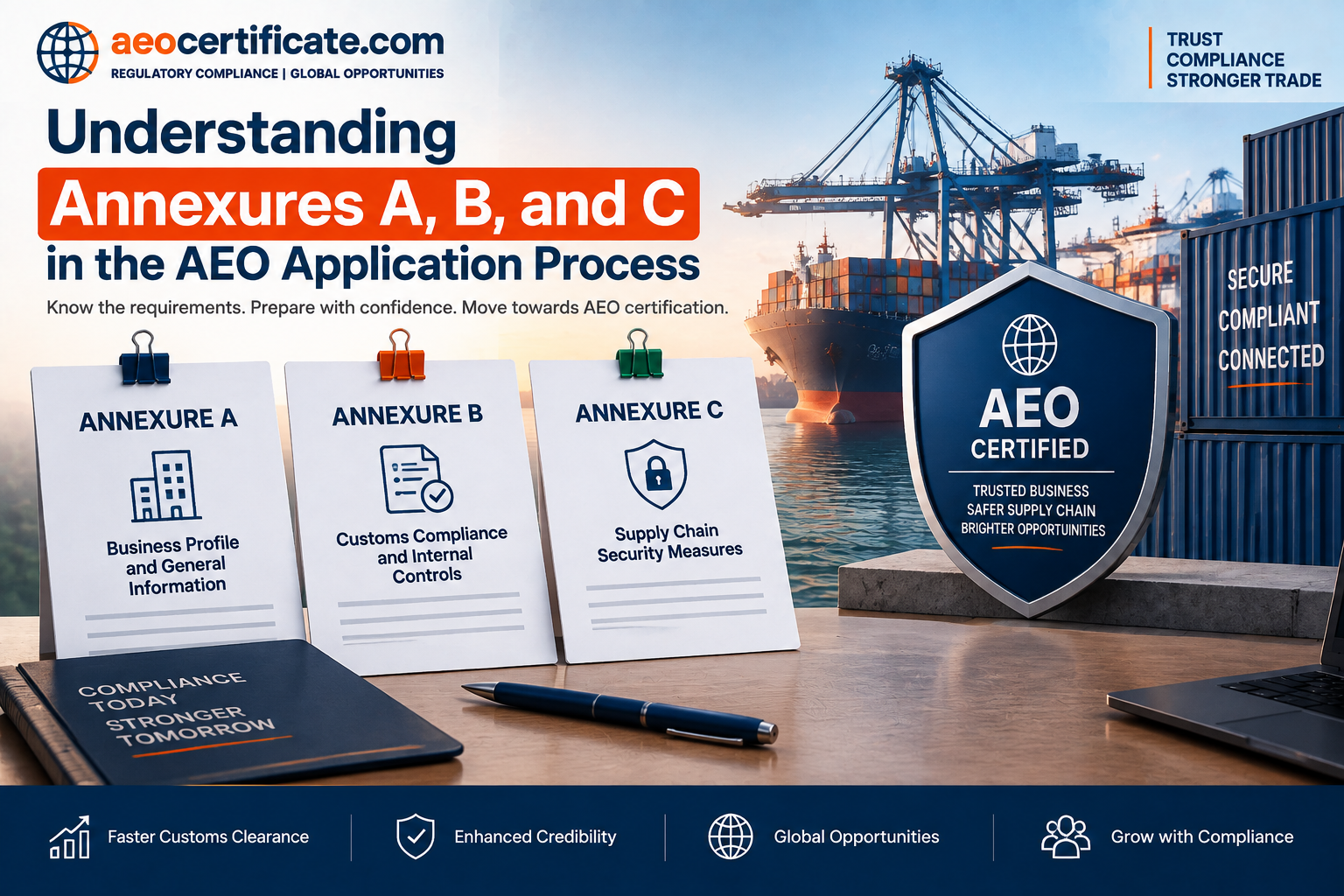
The Authorized Economic Operator (AEO) Certification is an important recognition provided to businesses that demonstrate strong customs compliance, secure supply chain practices, and effective internal control systems. The AEO application process requires organizations to provide detailed information about their business operations, compliance procedures, security measures, and risk management practices.
One of the most important parts of this process is preparing the AEO Application Annexures. These annexures help customs authorities evaluate the eligibility, compliance standards, and operational controls of an applicant.
Proper understanding and preparation of AEO application annexures are essential because incomplete information, missing documents, or incorrect details can delay the application process. Businesses should carefully review each annexure and provide accurate information supported by relevant records.
What Are AEO Application Annexures?
AEO Application Annexures are supporting documents and information formats submitted along with the AEO application. They provide detailed information about the applicant’s business structure, customs compliance history, security procedures, and operational processes.
The annexures help customs authorities assess whether the applicant meets the requirements of the AEO program.
The information provided through these annexures generally covers:
- Company profile
- Business activities
- Import-export operations
- Customs compliance history
- Internal control systems
- Supply chain security measures
- Employee and facility details
A properly prepared set of AEO application annexures demonstrates the organization’s readiness and commitment towards maintaining compliance standards.
Importance of AEO Application Annexures in the Certification Process
The AEO application process is not limited to submitting basic company documents. Customs authorities need detailed information about how an organization manages its trade operations and security controls.
The AEO Application Annexures help authorities understand:
- How the company manages customs transactions
- Whether proper documentation systems exist
- How risks are identified and controlled
- Whether supply chain security measures are implemented
- Whether employees are trained for compliance activities
Accurate annexures improve transparency and help businesses. AEO application annexures present a strong compliance profile during the assessment process.
Understanding Annexure A in the AEO Application Process
Annexure A is generally related to AEO application annexures to the basic details and profile information of the applicant. It provides an overview of the organization applying for AEO certification.
This section helps customs authorities understand the company’s background, business activities, and operational structure.
Information Covered Under Annexure A:
Annexure A may include details related to:
- Name and address of the organization
- Legal constitution of the business
- Import Export Code (IEC)
- GST registration details
- Nature of business activities
- Manufacturing, trading, or service operations
- Details of authorized persons
- Locations involved in trade activities
The applicant should ensure that all information provided in Annexure A matches official company records.
Any mismatch in AEO application annexures between application details and statutory documents may create unnecessary queries during the assessment process.
Understanding Annexure B in the AEO Application Process
Annexure B focuses more on customs compliance, operational procedures, and internal control systems followed by the organization.
This part of the AEO Application Annexures provides information about how the company manages its import-export activities and ensures compliance with customs requirements.
Key Areas Covered Under Annexure B:
Customs Compliance History
The company may need to provide information related to:
- Previous customs transactions
- Compliance records
- Customs disputes or notices
- Regulatory history
Internal Procedures
Businesses’ AEO application annexures should explain their processes related to:
- Import documentation
- Export documentation
- Record maintenance
- Classification procedures
- Verification systems
Risk Management Practices
Companies should demonstrate how they identify and control risks related to:
- Documentation errors
- Incorrect declarations
- Supply chain issues
- Compliance failures
A detailed and accurate Annexure B AEO application annexure helps demonstrate that the organization has effective compliance management systems.
Understanding Annexure C in the AEO Application Process
Annexure C generally focuses on AEO application annexures, security-related information, and supply chain controls implemented by the applicant.
Security is one of the key aspects evaluated under the AEO framework because trusted traders are expected to maintain secure business operations.
Areas Covered Under Annexure C:
Physical Security
Organizations may need to provide details about:
- Premises security
- Access control systems
- Visitor management
- CCTV monitoring
- Warehouse security
Cargo Security
Companies should explain procedures related to:
- Shipment protection
- Cargo handling
- Transportation security
- Tampering prevention
Employee Security
Details may include:
- Employee verification procedures
- Training programs
- Security awareness
Information Security
Companies should explain controls related to:
- Data protection
- System access management
- Confidential information handling
Proper preparation of Annexure C demonstrates that the company has effective security measures throughout its supply chain.
Common Mistakes While Preparing AEO Application Annexures
Many businesses face delays because of incomplete or inaccurate information while preparing their application.
Common mistakes include:
- Providing inconsistent company information
- Missing supporting documents
- Not updating SOPs
- Incomplete security details
- Lack of employee training records
- Incorrect customs compliance information
Companies should carefully review all sections of the AEO Application Annexures before submission.
Best Practices for Preparing AEO Application Annexures
Businesses can improve their application quality by following a structured approach.
Recommended practices include:
- Review AEO requirements before preparing annexures
- Collect documents in advance
- Assign responsibility to a dedicated team
- Verify information accuracy
- Maintain updated SOPs
- Conduct internal reviews before submission
- Keep supporting evidence ready
A well-prepared application demonstrates organizational readiness and improves the efficiency of the assessment process.
Role of Internal Departments in Preparing AEO Application Annexures
AEO certification involves multiple departments, and their coordination is important for accurate annexure preparation.
Different teams contribute information such as
- Compliance team: Customs records and procedures
- Logistics team: Shipment and transportation details
- Warehouse team: Security and facility information
- HR team: Employee training records
- IT team: Information security controls
- Management team: Overall approval and monitoring
Proper coordination ensures that all sections of the AEO Application Annexures are completed accurately.
Step-by-Step Process of Preparing AEO Application Annexures
Preparing AEO application annexures requires a systematic approach because every section must be supported with accurate information and relevant documents.
The preparation process starts with understanding the AEO requirements applicable to the organization. Companies should first collect all necessary information related to their business profile, customs activities, security procedures, and internal controls.
The next step involves assigning responsibilities to different departments. The compliance team, logistics team, warehouse team, AEO application annexures, HR department, and management should coordinate to provide accurate details for different sections of the annexures.
After collecting information, companies should review the details, verify supporting documents, and ensure consistency between the annexures and official records. A final internal review should be conducted before submitting the application.
A structured preparation process helps organizations complete their AEO Application Annexures accurately and reduces the chances of delays during assessment.
Role of Self-Assessment in AEO Application Annexures
Self-assessment is an important step before submitting the AEO application. It allows companies to evaluate their existing systems and identify areas requiring improvement.
Through self-assessment, organizations can review:
- Customs compliance procedures
- Documentation systems
- Security measures
- Employee training
- Risk management practices
A proper self-assessment helps businesses identify gaps before submitting their AEO Application Annexures and improves overall application readiness.
Common Documentation Gaps in AEO Application Annexures
Many organizations face challenges because their operational practices are not properly documented.
Common documentation gaps include:
- Missing Standard Operating Procedures (SOPs)
- Incomplete security policies
- Lack of employee training records
- Improper record maintenance
- Outdated company information
- Missing audit reports
Before submitting AEO Application Annexures, companies should conduct a documentation review to ensure all required evidence is available.
Importance of SOPs in AEO Application Annexures
Standard operating procedures are an important part of demonstrating compliance capability.
Companies should maintain SOPs related to:
- Import and export procedures
- Customs documentation verification
- Shipment handling
- Warehouse operations
- Security management
- Risk control procedures
Well-defined SOPs demonstrate that the organization has controlled processes and help strengthen the AEO Application Annexures.
AEO Verification Visit Preparation Checklist
Create a practical checklist:
✅ Documents arranged
✅ SOPs available
✅ Security systems active
✅ Employees trained
✅ Records maintained
✅ Facilities ready for inspection
Role of Supply Chain Security in AEO Application Annexures
Explain:
Security assessment covers:
- Supplier security
- Transportation security
- Warehouse security
- Cargo protection
- Access control
Importance of Employee Awareness During AEO Assessment
Explain why employees should know:
- Company AEO objectives
- Their responsibilities
- Security procedures
- Documentation process
- Emergency handling
AEO Application Annexures: Pre-Submission Final Checklist
Final checklist section:
Before submission, verify:
- All annexures completed
- Information matches statutory documents
- Supporting documents attached
- SOPs updated
- Security policies available
- Internal approvals completed
How Consultants Help in Preparing AEO Application Annexures
Explain consultant support:
- Gap assessment
- Document preparation
- SOP drafting
- Annexure review
- Compliance improvement
- Audit preparation
Importance of Accuracy in AEO Application Annexures
Explain:
Incorrect information may lead to:
- Queries
- Delays
- Additional verification
- Rework
Accurate annexures improve application quality.
Timeline for Preparing AEO Application Annexures
Explain approximate preparation stages:
- Weeks 1–2: Data collection
- Weeks 3–4: Documentation preparation
- Weeks 5–6: SOP development
- Weeks 7–8: Internal review
- Weeks 9: Final submission preparation
How AEO Application Annexures Improve Business Compliance
Explain long-term benefits:
- Better internal controls
- Improved documentation
- Stronger security systems
- Process standardization
- Risk reduction
Difference Between AEO Application Preparation and AEO Compliance Maintenance
Add a comparison table:
| Application Preparation | Compliance Maintenance |
| Preparing documents | Updating records |
| Gap analysis | Continuous monitoring |
| SOP creation | SOP review |
| Initial assessment | Regular audits |
Common Mistakes While Preparing AEO Application Annexures
Explain mistakes businesses should avoid:
- Incorrect company information
- Missing supporting documents
- Inconsistent data
- Incomplete security details
- Lack of SOPs
- Poor record maintenance
- Unsupported claims
How to Organize Documents Before AEO Application Submission
Explain document management strategy.
Include:
- Creating document folders
- Department-wise document collection
- Document indexing
- Version control
- Approval process
- Final verification checklist
Role of SOPs and Policies in AEO Application Approval
Explain important SOPs required:
- Import procedure SOP
- Export procedure SOP
- Customs documentation SOP
- Security SOP
- Warehouse SOP
- Risk management SOP
- Incident reporting SOP
AEO Application Annexures for Manufacturers
Explain manufacturer-specific requirements.
Cover:
- Manufacturing process details
- Raw material imports
- Production records
- Warehouse controls
- Finished goods movement
- Quality systems
Documentation Required for AEO Application Annexures
While preparing AEO application annexures, applicants should maintain proper supporting documents to demonstrate their compliance, security controls, and operational procedures. The exact documents may vary depending on the applicant category and business nature, but generally include:
Company Profile Documents (Related to Annexure A)
- Certificate of Incorporation / Registration Certificate
- PAN Card and GST Registration Certificate
- Import Export Code (IEC)
- Company organizational structure
- Details of directors/partners/proprietors
- Details of branches, warehouses, and manufacturing facilities
- Details of import-export activities
- Previous customs compliance records
AEO Application Annexures for Importers and Traders
Explain importer/trader requirements.
Cover:
- Supplier management
- Import documentation
- Customs broker coordination
- Inventory management
- Logistics controls
Difference between Annexures A, B, and C
| Annexure | Main Focus | Purpose |
| Annexure A | Company Profile | Understanding the applicant’s background and business details |
| Annexure B | Customs Compliance | Evaluating internal compliance systems |
| Annexure C | Supply Chain Security | Assessing security practices and risk controls |
Conclusion
The AEO application annexures are an essential part of the Authorised Economic Operator certification process. Annexure A focuses on understanding the applicant’s business profile, Annexure B evaluates customs compliance systems, and Annexure C assesses supply chain security practices.
Proper preparation of these annexures, along with supporting documentation and evidence of compliance, helps businesses demonstrate their reliability and commitment towards secure international trade practices.
Companies should ensure that the information provided in their AEO application annexures accurately reflects their actual processes, as Customs authorities may verify the submitted details during assessment.
Frequently Asked Questions
Q1. What are AEO application annexures?
AEO application annexures are supporting documents that provide details about a company’s profile, customs compliance, and supply chain security practices.
Q2. What is the purpose of Annexure A?
Annexure A provides basic information about the applicant company, business activities, and import-export details.
Q3. What does Annexure B cover?
Annexure B focuses on customs compliance procedures, documentation controls, and internal processes.
Q4. What is included in Annexure C?
Annexure C covers supply chain security measures such as premises security, cargo protection, and IT controls.
Q5. Why are AEO application annexures important?
They help Customs evaluate the applicant’s compliance level and eligibility for AEO certification.
Q6. Can incorrect annexure details affect AEO approval?
Yes, incomplete or inaccurate information may lead to queries or delays during assessment.