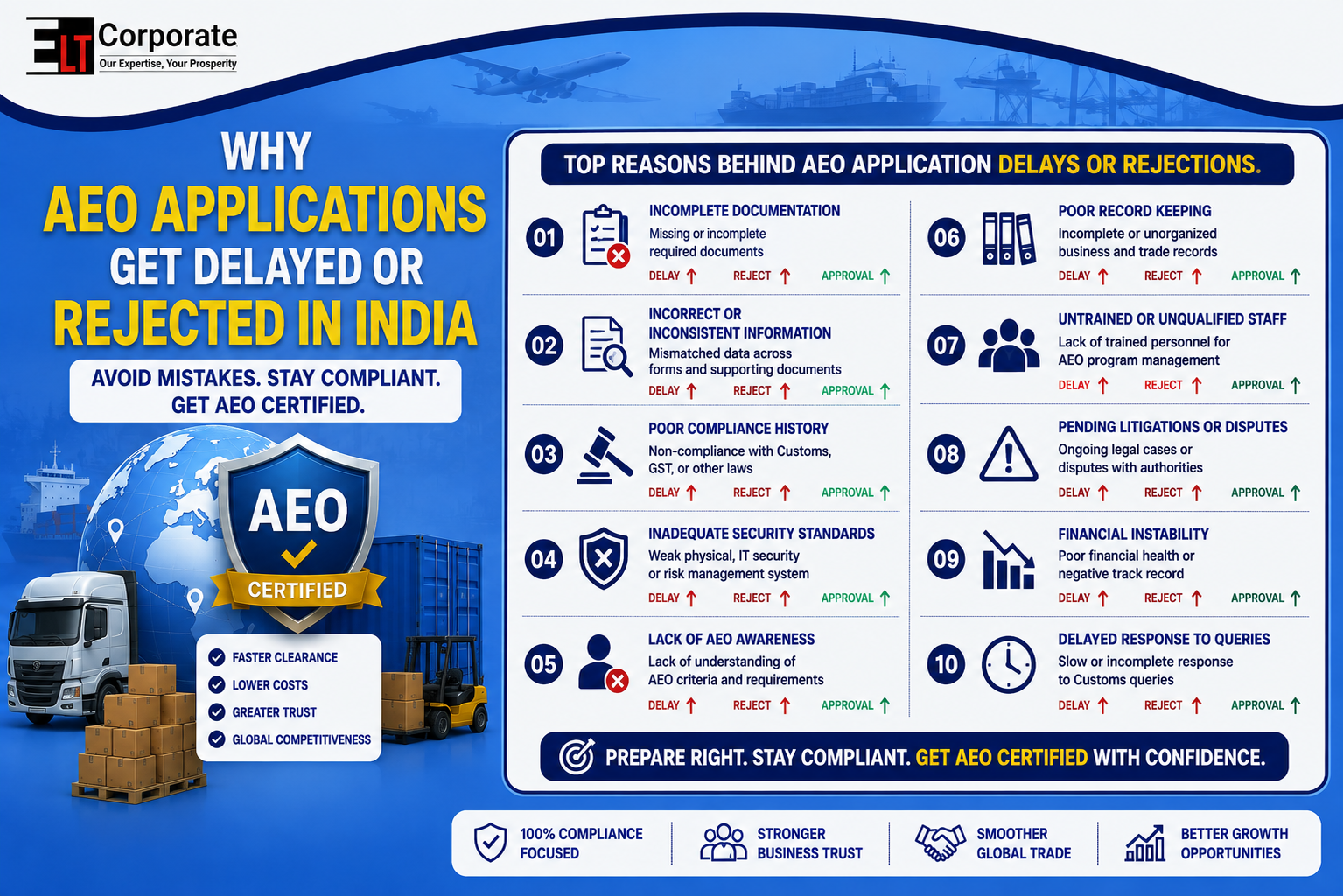
Getting an authorized economic operator (AEO) application delayed in India can bring benefits to businesses that work with international trade. AEO status helps Customs recognize businesses that are trusted and compliant. This status can offer levels of help with trade processes depending on the AEO category. Applying for AEO certification is not just about filling out a form online. The person applying must meet the conditions and show they are compliant. They also need to provide complete information. If documents are missing, details are wrong, there are compliance issues, or the internal systems are not strong, the application can be delayed. In some cases, it can even be turned down.
In the AEO system, an application might be rejected if the person applying is not eligible for AEO status. It can also be rejected if there is a problem in the application that cannot be fixed. This article talks about the reasons why AEO applications are delayed or rejected in India. It also shows how businesses can avoid these problems.
Incomplete AEO Application
One of the common reasons for delay is an incomplete application. A company may submit the application. Forget to provide certain documents, details, declarations, or supporting information. For example:
- Some fields in the application may be left blank.
- Supporting documents may not be attached.
- Information regarding business operations may be incomplete.
- Customs-related details may not match supporting records.
- Required declarations may not be properly completed.
When customs authorities need information, they may raise a query or ask the applicant to submit further documents. This increases the processing time.
How to avoid it
Before submitting AEO applications for delays, businesses should prepare a checklist and review every section carefully. All supporting documents should be checked before submission.
Common Reasons for AEO Application Delays
An issue people have is that the information they put in the application is not correct or it does not match. The details you write in the AEO application need to be the same as what’s in your company’s official papers. You can find mistakes in things like
- Company name
- Registered office address
- GST details
- IEC details
- PAN details
- Customs records
- Director or partner information
- Import-export details
If the AEO application and the other documents you provide have a small difference, you might need to explain it. So businesses should make sure all the information is correct and up to date before they send in the AEO application.
How to Avoid AEO Application Delays
If there are issues, keep clear records that explain:
- Nature of the problem
- Current situation
- Steps that were taken to fix it
- New rules that were put in place
- Strong records show that the company cares about following the rules.
The company needs to have documentation to prove that they are taking compliance seriously. Good documentation is essential for the company to demonstrate that compliance is a priority.
Documents That Can Cause AEO Application Delays
Proper record-keeping is important for AEO applications. A company should be able to maintain and retrieve records relating to its international trade activities. These may include:
- Import documents.
- Export documents
- Shipping documents
- Customs declarations
- Purchase records
- Sales records
- Inventory information
- Vendor records
- Logistics records
- Financial records
Poorly maintained records can create problems during the review of AEO applications. If documents are scattered across different departments or cannot be produced when required, verification may take longer.
Solution
Companies should maintain an organized system for keeping customs and trade-related records. Digital record management can also make documents easier to retrieve during AEO applications.
AEO Application Delays Due to Compliance Issues
When a company is going through the AEO application process, financial stability and good financial records are very important. The AEO assessment is a deal, and financial information plays a huge role in it. If the company does not have its information in order, problems can come up. This happens when the company gives inconsistent financial information to the people doing the AEO applications. For example, the following things can cause problems:
- Financial statements are not available when they are needed.
- The information in the statements does not match the information in other records.
- The tax-related information is not complete.
- The financial documents are all over the place and not organised properly.
- Some required documents that need to be submitted with the application are missing.
So companies should make sure they have their audited statements and other important financial information ready and in order before they start the application for the AEO applications. The AEO assessment requires a lot of information, and companies need to be prepared. Financial information is key to an AEO assessment, so companies should take it very seriously and make sure everything is done correctly.
Lack of Internal Resources AEO Application Delays
AEO applications are not about handing over papers. Officials might also want to know how the company manages its import, export, customs, logistics, and security activities. Businesses need to have internal rules. These could include:
- Import procedures
- Export procedures
- Document checking
- Customs compliance
- Employee responsibilities
- Vendor management
- Cargo handling
- Security controls
- Record keeping
- Incident reporting
If workers do these tasks in a way without written rules, the company might struggle to show that it has good internal control.
Check AEO Eligibility
A business should first confirm whether it meets the basic eligibility requirements. According to the official AEO India eligibility information, relevant criteria include participation in the international supply chain, undertaking Customs-related work, and handling the required level of Customs documents. The official portal also mentions three financial years of business activity, with scope for waiver in deserving cases.
Therefore, businesses should not start preparing AEO applications without conducting an eligibility assessment. Before submitting an AEO, a business should first check whether it meets the basic eligibility requirements. The applicant should be involved in international trade or Customs-related activities and should have proper business, compliance, and transaction records. Checking eligibility in advance helps avoid unnecessary delays, document queries, or rejection of AEO applications. It also helps the company choose the correct AEO category and prepare the required documents properly.
Timely Reply to AEO Queries
Delay in replying to queries is one of the reasons why AEO applications may take longer to process. During the review of an AEO application, customs authorities may ask the applicant to provide documents, to clarify certain information, to correct errors or to submit supporting records. If the company does not respond on time, the application may remain pending until the required information is received and reviewed.
In some cases, businesses take extra time because the required documents are not properly organized or because different departments are involved in collecting the information. For example, AEO applications. Customs may ask for records of import-export details, compliance documents, or explanations related to previous transactions. If these records are not easily available, the applicant may take days or weeks to prepare a response. Answer with complete, correct, and properly supported information.
Choose the Right AEO Category
India’s AEO Programme has kinds of categories like
| AEO Category | Generally applicable to | Level |
| AEO T1 | Importers and Exporters | Entry Level |
| AEO T2 | Importers and exporters meeting higher requirements | Higher Level |
| AEO T3 | Businesses qualifying for the highest tier | Highest Level |
| AEO-LO | Eligible logistics operators | Logistics Category |
Business Changes That AEO-Certified Companies
A company can have changes after applying for AEO applications or while dealing with its compliance system. These can be changes in company name, address, ownership, type of business, accounting or computer systems, people in charge, or locations in the supply chain. These big changes can impact AEO applications. Need to be dealt with properly.
The current official AEO guidance says that big changes affecting AEO status need to be reported as soon as possible and within the set rules. When a company that is AEO-certified makes changes, it can affect the records they have. They also need to update who is allowed to sign things for the company, what the company does, and how it gets things from one place to another.
If an AEO application company keeps all this information up to date, it will help avoid problems with following the rules. It will also help avoid getting questions, delays, or issues when the AEO-certified company needs to verify or renew something in the future.
AEO Certification Services by ELT Corporate
ELT Corporate provides support for:
Businesses that are unsure about documentation, eligibility, SOP preparation, compliance review, or application filing can seek professional assistance.
AEO T1 Certification – Support for eligible importers and exporters applying for the first level of AEO recognition.
AEO T2 Certification – Assistance with documentation, compliance preparation, and requirements associated with the higher AEO level.
AEO T3 Certification – Support for eligible businesses seeking the highest tier available to importers and exporters.
AEO-LO Certification – Assistance for eligible logistics operators participating in the international supply chain.
You can explore the complete AEO Certification Services offered by ELT Corporate for assistance with the certification process. ELT Corporate’s services page states that it provides support for AEO-T1, AEO-T2, AEO-T3, and AEO-LO certification.
Common Reasons for Delay or Rejection
| Common Problem | Possible Result | How to Prevent It |
| Missing documents | Query or delay | Use a complete checklist. |
| Incorrect information | Clarification required | Cross-check company records. |
| Customs compliance issues | Detailed review | Review compliance history. |
| Poor financial records | Additional documents required | Organise financial data. |
| Missing SOPs | Weak compliance demonstration | Prepare practical SOPs. |
| Poor security documentation | Additional verification | Document security systems |
| Wrong AEO category | Application complications | Check category first. |
| Eligibility not checked | Application may not proceed smoothly. | Conduct eligibility assessment. |
Conclusion
When people apply for AEO applications, they often get rejected. This happens when the applicant cannot show that they are eligible, that they comply with rules, that they have records that they are financially reliable, that they have written procedures, or that they have the right safety and security measures in place. If AEO applications are not supported, if the applicant takes a long time to respond, or if they do not prepare well for verification, it can make the whole process very hard.
If the application is well organized, if it has records to back it up, and if the company has actually put the procedures into practice, then it is easier for the Customs people to check the company, and this can help avoid delays that could have been prevented. Businesses should really focus on getting ready before they apply for AEO certification.
Frequently Asked Questions
Q1. What business changes should an AEO-certified company report?
Changes in company name, address, ownership, directors, GST, IEC, warehouse, or business activity may need to be updated.
Q2. Why is it important to report business changes?
It helps keep AEO records accurate and avoids compliance issues or unnecessary queries.
Q3. Should a change in company address be reported?
Yes, important address changes should be updated with the relevant authority wherever required.
Q4. Is a change in directors important for AEO compliance?
Yes, changes in key management or authorized persons may need to be communicated.
Q5. What happens if business changes are not reported?
It may lead to queries, delays, verification issues, or problems with AEO status.
Q6. Should changes in GST or IEC details be updated?
Yes, significant changes in statutory or registration details should be properly updated.