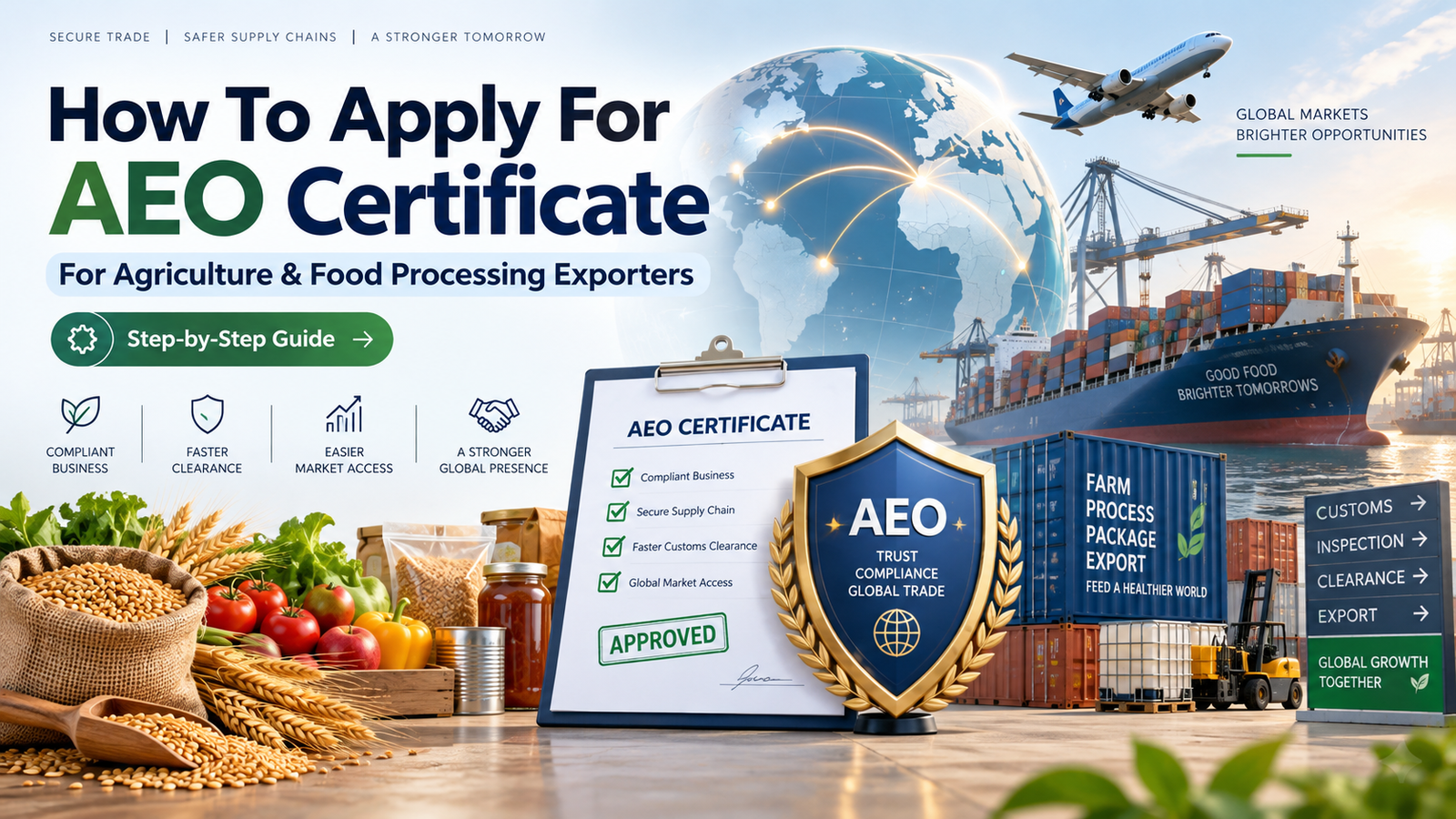
Agriculture and food processing exports play an important role in India’s international trade. Exporters dealing in processed foods, agricultural commodities, spices, fruits, vegetables, cereals, beverages, dairy products, and other food items often face challenges such as customs clearance delays, documentation requirements, and supply chain management.
Obtaining an AEO Certificate for Agriculture and Food Processing Exporters can help eligible exporters establish themselves as trusted and compliant participants in the international supply chain.
The Authorised Economic Operator (AEO) Programme is a trade facilitation programme administered by Indian Customs under the Central Board of Indirect Taxes and Customs (CBIC). It recognizes eligible entities that demonstrate strong customs compliance, proper record management, and, depending on the AEO tier, adequate supply chain security measures.
This guide explains how to apply for the AEO Certificate for Agriculture and Food Processing Exporters, its eligibility requirements, application procedure, documents, benefits, and important compliance points.
What Is an AEO Certificate for Agriculture and Food Processing Exporters?
An AEO Certificate for Agriculture and Food Processing Exporters is an AEO status obtained by an eligible agriculture or food-processing business involved in international trade.
AEO stands for Authorised Economic Operator. Under the Indian AEO Programme, compliant importers, exporters, manufacturers, traders, and eligible logistics operators may receive different levels of AEO accreditation.
For importers and exporters, the principal AEO tiers are:
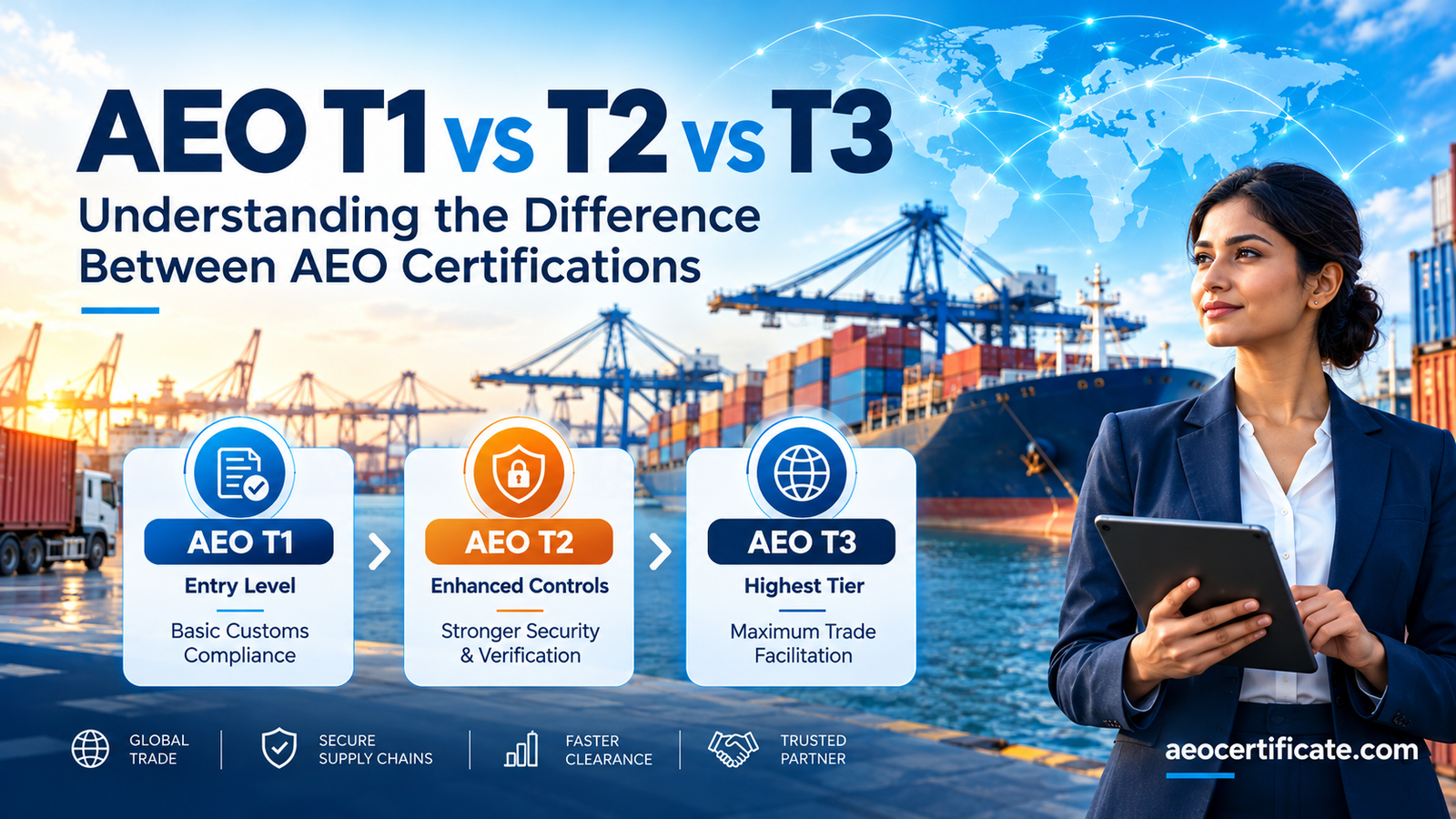
AEO-T1 – Entry-level accreditation for eligible importers and exporters.
AEO-T2 – Higher accreditation involving stronger and verifiable compliance and security controls.
AEO-T3—The highest level available to eligible existing AEO-T2 holders meeting prescribed conditions.
The official AEO portal describes T1 as the entry tier, T2 as providing a higher level of facilitation with verification requirements, and T3 as the highest facilitation level for qualifying existing T2 entities.
Why AEO Certificate for Agriculture and Food Processing Exporters Is Important
The international movement of agricultural and food products can be highly time-sensitive. Certain commodities may have limited shelf life, temperature requirements, or strict delivery schedules.
An AEO Certificate for Agriculture and Food Processing Exporters can therefore be useful for businesses seeking more predictable customs procedures and a recognized compliance status.
The AEO Program is designed to facilitate legitimate trade through benefits such as priority treatment, reduced routine interventions, and more predictable customs processes, subject to the applicable AEO tier and customs risk-management requirements.
For exporters, this can support better planning of international shipments and supply-chain operations.
Benefits of AEO Certificate for Agriculture and Food Processing Exporters
Obtaining an AEO Certificate for Agriculture and Food Processing Exporters can provide several trade-facilitation advantages, depending on the AEO tier granted.
1. Faster Customs Facilitation
AEO-certified businesses can receive priority facilitation and more predictable customs processing, subject to applicable customs procedures and risk assessment.
2. Reduced Routine Interventions
AEO status may result in reduced routine examinations or customs interventions based on risk-management principles.
3. Improved Supply-Chain Efficiency
For agricultural and food-processing exporters, faster and more predictable clearance can help in managing shipment schedules, particularly for time-sensitive goods.
4. Enhanced Business Reputation
An AEO Certificate for Agriculture and Food Processing Exporters indicates that the exporter has demonstrated the compliance standards applicable to its AEO tier.
5. Better International Trade Credibility
AEO is based on the internationally recognised trusted-trader concept and can strengthen an organization’s credibility within the international supply chain.
6. Mutual Recognition Benefits
Higher AEO tiers may qualify for benefits arising from Mutual Recognition Arrangements, wherever applicable under India’s AEO framework.
7. Greater Predictability
More predictable customs procedures can support better planning of production, logistics, inventory, and delivery schedules.
Who Can Apply for an AEO Certificate for Agriculture and Food Processing Exporters?
An AEO Certificate for Agriculture and Food Processing Exporters may be applied for by eligible businesses involved in customs-related international supply chain activities in India.
This can include:
- Agricultural commodity exporters
- Food-processing manufacturers
- Processed-food exporters
- Spice exporters
- Rice and cereal exporters
- Fruit and vegetable exporters
- Packaged-food exporters
- Beverage exporters
- Marine and processed-food businesses
- Manufacturers engaged in exports
- Merchant exporters
- Importer-exporters
According to the official AEO portal, manufacturers and traders carrying out import or export activities may apply for AEO-T1 or AEO-T2, subject to prescribed eligibility conditions. AEO-T3 is available to qualifying AEO-T2 holders.
Eligibility for AEO Certificate for Agriculture and Food Processing Exporters
Before applying for an AEO Certificate for Agriculture and Food Processing Exporters, the applicant should assess its compliance systems and supporting records.
Important eligibility areas generally include:
Customs and Legal Compliance
The applicant should demonstrate an appropriate compliance track record under applicable Customs and other relevant laws.
Proper Record Management
The company should maintain reliable and auditable records for its import-export operations.
These may include:
- Purchase records
- Sales records
- Inventory records
- Shipping documents
- Transport records
- Export documentation
- Warehouse records
- Accounting records
- Documented Business Procedures
Standard operating procedures should be available and should reflect the processes actually followed by the business.
Financial Solvency
The applicant must meet the applicable financial-solvency requirements under the AEO framework.
Security Controls for Higher Tiers
For AEO-T2 and AEO-T3, detailed safety and supply-chain security requirements apply. The official AEO guidance specifically distinguishes these from T1, where applicants are primarily assessed on eligibility, compliance, record management, and financial solvency requirements applicable to that tier.
Step-by-Step Process to Apply for AEO Certificate for Agriculture and Food Processing Exporters
The application for an AEO Certificate for Agriculture and Food Processing Exporters is made through the official Indian AEO portal.
Step 1: Determine the Correct AEO Certificate
The first step is selecting the appropriate AEO tier.
For a first-time agriculture or food-processing exporter, AEO-T1 may generally be the starting point where the applicant meets the applicable eligibility requirements.
Companies with more mature security, compliance, and internal-control systems may evaluate eligibility for AEO-T2.
AEO-T3 is not normally the starting level for a new applicant; it is available to eligible existing AEO-T2 holders in accordance with prescribed conditions.
Step 2: Review Eligibility
Before filing the application, review the following:
- Customs compliance history
- Import and export activities
- Internal control systems
- Record-keeping procedures
- Financial standing
- Supply-chain processes
- Security arrangements, where applicable
- Business-partner controls
- Warehouse and factory procedures
Any gaps identified during this review should preferably be corrected before submission.
Step 3: Prepare Documents
Documents vary according to the AEO tier and nature of the applicant.
- A typical documentation set may include:
- Import Export Code (IEC)
- Company/entity details
- GST-related information, as applicable
- Export and import activity details
- Product details
- HSN codes
- Countries of export/import
Details of shipping bills and Bills of Entry, as applicable
- Organizational information
- Process-flow documentation
- Record-keeping documents
- Financial information
- Compliance-related declarations
- Standard Operating Procedures
- Security-related documents for applicable tiers
Step 4: Prepare Process Map
A process map is an important part of the application.
For an AEO Certificate for Agriculture and Food Processing Exporters, the process map should clearly explain how goods move through the organization and supply chain.
Depending on the business, it can cover:
Procurement → Raw Material Receipt → Manufacturing/Processing → Quality Check → Packing → Storage → Export Order → Documentation → Transportation → Customs Clearance → Port/Airport → Export
Relevant business partners, such as transporters, customs brokers, freight forwarders, warehouses, and other service providers, should be appropriately reflected wherever they form part of the process.
The official T1 application guidance requires the process map to demonstrate the flow of goods and the roles of the applicant and relevant business partners in the import-export supply chain.
Step 5: Register for the AEO Certificate
The applicant must register through the official Indian AEO portal.
During registration, the entity should ensure that the company name and other information correspond with its official records.
The current portal specifically instructs applicants to use entity details matching the IEC Certificate. It also requires IEC-related documentation during registration.
Step 6: Complete Application
After registration, log in to the AEO portal and select the appropriate certification category.
Provide the required information regarding:
- Entity
- IEC
- Business operations
- Export activities
- Products
- HSN codes
All information should match the company’s supporting records.
Documents Required for AEO Certificate for Agriculture and Food Processing Exporters
The precise documents depend on the applicant and AEO tier, but exporters AEO Certificate for Agriculture and Food Processing Exporters should generally keep the following categories of information ready:
| Document / Information | Purpose |
| IEC Certificate | Identification of importer/exporter |
| Entity Details | Verification of applicant |
| GST Details | Tax/business information, where applicable |
| Export Product List | Details of exported goods |
| HSN Codes | Classification of goods |
| Export Country Details | International trade profile |
| Shipping Bill Details | Evidence of export activity |
| Process Flow Chart | Understanding movement of goods |
| Purchase and Sales Records | Audit trail |
Applicants should always follow the latest checklist displayed on the official AEO portal for their particular tier.
Special Considerations for AEO Certificates for Agriculture and Food Processing Exporters
Agriculture and food-processing businesses may need to pay particular attention to the traceability and documentation of their supply chain.
Their process documentation may cover:
- Source of raw materials
- Receipt of agricultural products
- Manufacturing or food processing
- Quality-control procedures
- Packaging
- Batch identification
- Finished-goods storage
- Warehouse movement
- Export documentation
- Transportation
- Customs clearance
- Shipment
Where applicable, exporters should also maintain relevant sector-specific licences, registrations, and certifications required for their products. However, these regulatory approvals are separate from the AEO certification itself unless specifically requested as supporting information during the assessment.
AEO Certificate for Agriculture and Food Processing Exporters Application Timeline
The processing period depends on the AEO category, completeness of the application, clarifications, and verification requirements.
According to the current AEO portal:
AEO-T1: The certificate is targeted within 30 days after complete information/documents are available.
Eligible MSME AEO-T1 – applications are targeted for processing within 15 working days after submission of complete documents.
Eligible MSME AEO-T2 – applications have an indicated processing period of around 3 months after complete documentation.
T2 involves additional scrutiny and verification stages.
Eligible T3 – cases may have a prescribed 30-day processing framework in the circumstances specified by the program.
These timelines are indicative and can vary depending on application quality and verification requirements.
How ELT Corporate Can Help With AEO Certificate for Agriculture and Food Processing Exporters
Applying for an AEO Certificate for Agriculture and Food Processing Exporters requires proper documentation, internal compliance assessment, and a careful presentation of the applicant’s international supply chain processes.
ELT Corporate Private Limited can assist businesses with:
- AEO eligibility assessment
- Selection of an appropriate AEO category
- AEO documentation checklist
- Application preparation
- Process-flow mapping
- SOP preparation and review
Professional assistance can help exporters identify documentation gaps before filing and organize their application in line with the applicable AEO requirements.
Conclusion
An AEO Certificate for Agriculture and Food Processing Exporters can be valuable for businesses looking to strengthen customs compliance, improve supply-chain efficiency and receive the trade-facilitation benefits available to trusted operators.
Agriculture and food-processing exporters should first determine the appropriate AEO tier, review their compliance records, prepare the required documentation and SOPs, develop a clear process map, and submit the application through the official AEO portal.
A properly prepared application with consistent supporting documents and evidence of actual compliance systems can reduce the risk of deficiencies and unnecessary delays.
For businesses seeking professional support, ELT Corporate Private Limited can assist with eligibility assessment, documentation, application filing, SOPs, process mapping, query handling, and end-to-end support for obtaining an AEO Certificate for Agriculture and Food Processing Exporters.
Frequently Asked Questions
Q.1 What is an AEO Certificate for Agriculture and Food Processing Exporters?
It is a customs certification that recognises eligible exporters as trusted and compliant international trade operators.
Q.2 Is AEO certification mandatory for food exporters?
No, AEO certification is voluntary.
Q.3 Who can apply for an AEO Certificate?
Eligible importers, exporters, manufacturers and traders involved in international trade can apply.
Q.4 Which AEO tier is suitable for new exporters?
AEO-T1 is generally the entry-level certification for eligible importers and exporters.
Q.5 Is there any government fee for the AEO application?
Currently, Indian Customs does not charge a government application fee for AEO certification.
Q.6 What documents are required for AEO certification?
Common documents include IEC details, export records, HSN details, process maps, financial information, SOPs, and compliance records.