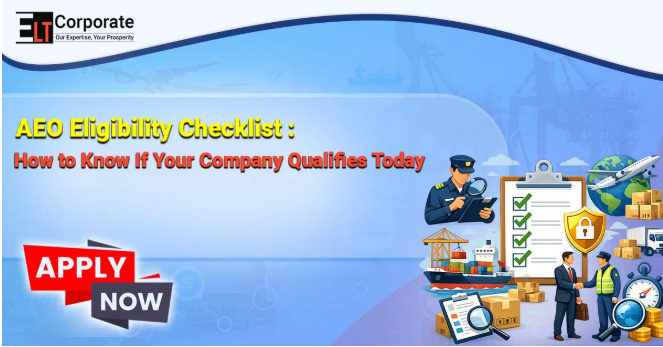
Are you planning to apply for AEO certification but unsure whether your company qualifies?
Before investing time and resources in the application process, it is important to understand whether your business meets the minimum eligibility criteria prescribed under Indian customs guidelines. This guide provides a clear, structured AEO eligibility checklist to help you assess your readiness and identify potential gaps.
What Is AEO Eligibility?
AEO eligibility refers to the minimum compliance, financial, and security criteria that a business must meet before applying for Authorised Economic Operator (AEO) certification under Indian Customs (CBIC).
Meeting eligibility criteria does not automatically guarantee approval. Final grant of AEO status depends on verification, site validation (where applicable), and risk assessment by customs authorities.
Quick AEO Self-Assessment Checklist (India)
Your company is generally considered eligible to apply if:
- You have a consistent customs transaction history for the past 2–3 financial years
- You maintain a clean customs compliance record
- You have no serious customs violations or fraud cases
- Your financial statements show financial stability and positive net worth
- You have documented security procedures in place
- Your premises and cargo handling processes are secured
- You maintain proper record-keeping systems
If you are unsure about two or more of these points, a structured readiness assessment is recommended before applying.
Why AEO Certification Matters
AEO certification establishes your company as a trusted trade partner with customs authorities. It enhances operational predictability, strengthens compliance credibility, and improves supply chain efficiency.
Key advantages may include the following:
- Faster customs clearance (subject to risk parameters)
- Reduced routine interventions
- Priority processing during congestion
- Facilitation benefits depend on the tier
- Improved reputation with global trade partners
- Benefits under Mutual Recognition Agreements (MRAs)
AEO is not mandatory, but it significantly improves trade facilitation for businesses involved in regular imports or exports.
Understanding the 4 AEO Certification Tiers in India
The AEO program in India operates under four categories:
AEO-T1 (Entry Level—Importers/Exporters)
- Primarily documentation-based review
- Basic security procedures required
- Generally suitable for first-time applicants
AEO-T2 (Intermediate Level)
- Mandatory on-site verification
- Demonstration of implemented security measures
- Higher facilitation compared to T1
AEO-T3 (Advanced Level)
- Highest level for importers/exporters
- Comprehensive compliance review
- Strong internal risk management systems are required
AEO-LO (Logistics Operator)
- Applicable to customs brokers, freight forwarders, warehouse operators, and transporters
- Focus on logistics and operational security controls
Core AEO Eligibility Requirements
The following baseline requirements generally apply across tiers.
1. Legal and Operational Requirements
- Registered and legally operating business in India
- Valid IEC, PAN, and GST registration
- Customs transaction history over the preceding financial years
- Prescribed minimum customs documents (as per applicable circulars)
In deserving cases, certain tenure-related requirements may be reviewed by customs authorities.
2. Financial Eligibility Checklist
Customs authorities assess financial stability to ensure reliability.
Your company should demonstrate:
- Positive net worth
- Satisfactory liquidity position
- No ongoing insolvency or bankruptcy proceedings
- Clean and properly audited financial statements
- No major adverse audit remarks
Financial solvency is an essential eligibility pillar.
3. Customs Compliance Requirements
Your company should have:
- No serious customs law violations in recent years
- No history of fraud or deliberate non-compliance
- Proper internal systems to monitor customs filings
- Timely duty payments and regulatory adherence
Minor procedural lapses, if resolved properly, may not automatically disqualify the applicant.
4. Security & Supply Chain Requirements
Security compliance is central to the AEO qualification.
Your business should maintain the following:
- Documented security procedures
- Controlled access to premises
- CCTV or monitoring mechanisms
- Cargo integrity controls
- IT security safeguards
- Employee screening procedures
- Regular security awareness training
Higher tiers require deeper validation of implementation, not just documentation.
Tier-Specific Comparison
| Factor | AEO-T1 | AEO-T2 | AEO-T3 | AEO-LO |
| Site Verification | Generally no. | Yes | Yes | Yes |
| Compliance Depth | Basic documented systems | Implemented & validated | Advanced integrated systems | Logistics-specific controls |
| Risk Management | Basic | Formalized | Integrated framework | Operational risk focus |
| Facilitation Level | Entry level | Higher | Maximum | Sector-specific |
Common Reasons Companies May Not Qualify
Applications often face issues due to:
- Weak documentation systems
- Poor security implementation
- Negative financial indicators
- Pending serious customs disputes
- Lack of internal compliance controls
- Incomplete application submissions
Many rejections occur due to preparation gaps rather than ineligibility.
What Happens If You Do Not Apply for AEO?
AEO certification is voluntary. However, businesses without AEO status may continue to experience:
- Standard customs processing timelines
- Higher likelihood of routine interventions
- No facilitation-based processing
- Full bank guarantee requirements (where applicable)
- Limited recognition under MRAs
For high-volume traders, AEO often improves predictability and operational efficiency.
Validity of AEO Certification in India
Certification validity depends on the tier:
- AEO-T1 – Valid for 3 years
- AEO-T2 – Valid for 3 years
- AEO-T3 – Valid for 5 years
- AEO-LO – Valid for 5 years
Renewal must be applied for before expiry, subject to continued compliance.
Estimated Cost Considerations
There is generally no government application fee. However, indirect costs may include:
| Category | Estimated Range (INR) |
| Internal preparation efforts | Variable (man-hours) |
| Consultant support | Depends on scope |
| Security upgrades | If required |
| Training programs | As applicable |
| Ongoing compliance management | Recurring |
How ELT Corporate Pvt. Ltd. Can Support
ELT Corporate Pvt. Ltd. assists businesses through the following:
- AEO eligibility assessment
- Structured gap analysis
- Documentation preparation
- Security compliance advisory
- Application filing guidance
- Pre-verification preparation
- Renewal support
A structured readiness review significantly reduces the risk of rejection or delays.
Conclusion
AEO eligibility assessment is the first and most important step before filing an application. If your company maintains strong financial stability, a clean compliance history, and documented security systems, you are likely well-positioned to apply.
However, eligibility alone does not guarantee approval. Customs verification and risk evaluation ultimately determine certification grants. Careful preparation, structured documentation, and compliance alignment are key to a successful application.
FAQs
What is the purpose of an AEO eligibility checklist?
It helps businesses determine whether they meet the baseline financial, compliance, and security criteria required before applying for AEO certification.
Does meeting eligibility guarantee approval?
No. Approval depends on customs verification, documentation review, and site validation, where applicable.
Can MSMEs apply for AEO certification?
Yes. Businesses of all sizes can apply, provided they meet eligibility and compliance requirements.
How long does an AEO certification remain valid?
T1 and T2 are valid for 3 years. T3 and LO are valid for 5 years, subject to renewal.
Is there an official government application fee?
Typically, no official application fee is charged. Costs arise from preparation, compliance alignment, and security enhancements.