One of the most common questions ELT Corporate receives from importers, exporters, and logistics businesses across India is simple: “Do we actually qualify for AEO certification?”
The honest answer is that more businesses qualify than they realize—and many that think they qualify have hidden disqualifiers they have overlooked. Knowing exactly where you stand before you apply saves you time, avoids wasted fees, and lets you fix any gaps before submitting.
This guide gives you a complete, practical AEO eligibility checklist—structured by Tier (T1, T2, T3, and LO)—with specific attention to the MSME relaxations introduced by CBIC. Work through each section, mark your status honestly, and you will know by the end whether you can apply today—and if not, exactly what needs to change.
Who Can Apply for AEO Certification in India?
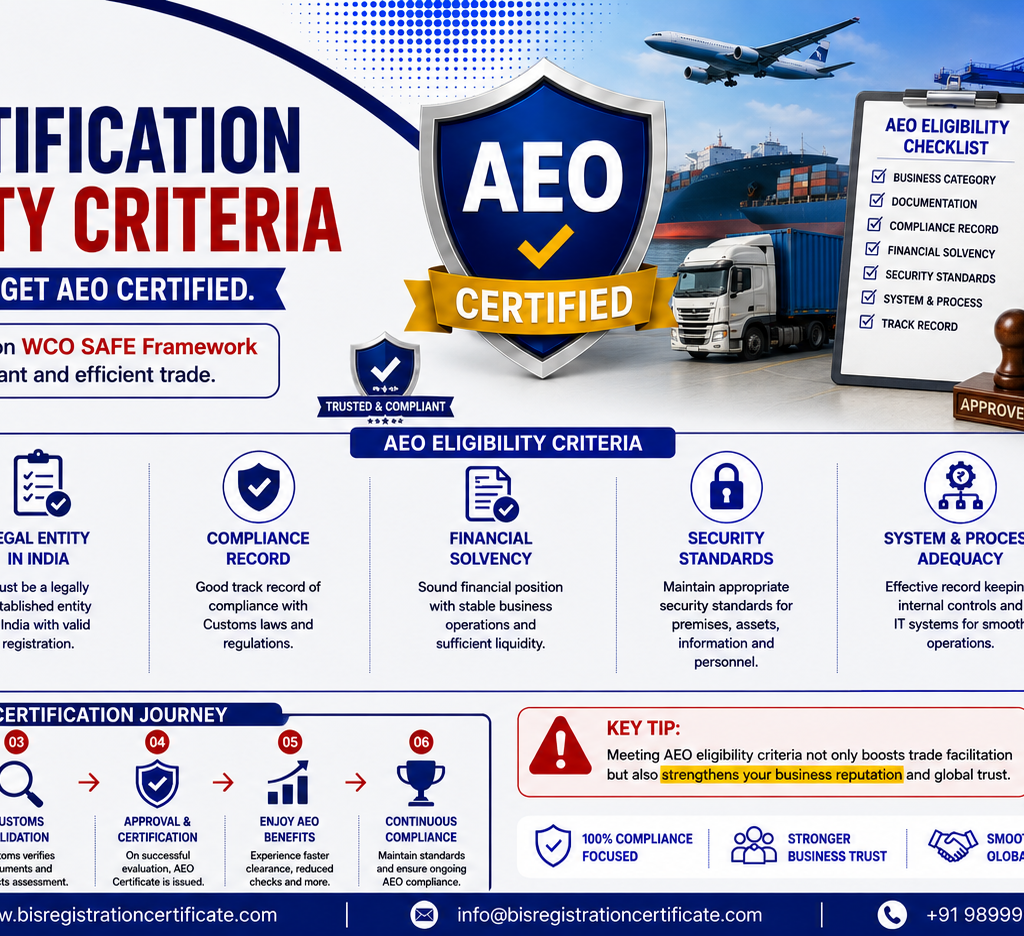
Before going into the detailed checklist, understand the broad scope of eligibility. AEO certification is not limited to large importers or exporters. Anyone involved in the international supply chain and undertaking customs-related activity in India can apply.
Eligible entities include:
- Importers — companies that bring goods into India from abroad
- Exporters — companies that send goods from India to international markets
- Manufacturer-exporters — production units that manufacture and export goods
- Trading houses — companies that trade in imported or exported goods
- Customs brokers and freight forwarders (apply for AEO-LO)
- Warehouse operators and terminal operators (apply for AEO-LO)
- Carriers and logistics service providers (apply for AEO-LO)
The certification is issued entity-wise — not group-wise. If your business group has multiple companies that import or export independently, each company must apply separately under its own PAN and IEC.
AEO certification was extended to the Gems and Jewellery sector in 2025—reflecting CBIC’s continued expansion of the program to new industries. If your sector was previously uncertain about eligibility, check with a consultant—the program now covers virtually all import-export sectors.
Part 1 — Universal Eligibility Checklist (All Tiers)
These criteria apply to ALL AEO tiers — T1, T2, T3, and LO. Every applicant must meet all of these requirements before applying for any tier.
| Category A — Legal Establishment & Registrations |
|
|
Established in India Your business entity must be legally established in India. Foreign companies without an Indian legal presence cannot apply directly. |
|
|
Valid PAN Card The Permanent Account Number should be in the name of the business entity, not in the name of the proprietor individually. Company PAN required. |
|
|
Valid IEC (Importer Exporter Code) Active IEC issued by DGFT. A suspended, cancelled, or expired IEC disqualifies the application immediately. |
|
|
Valid GST Registration Active GST registration. GST must not be suspended or cancelled at the time of application. |
|
|
Certificate of Incorporation or Business Registration For companies: Certificate of Incorporation from MCA. For partnership firms: Partnership Deed. For proprietorships: Business registration document. |
| Category B — Business Activity & Trade Volume |
|
|
Active in Customs-Related Activities Your business must actively engage in import, export, or related supply chain activities. Dormant entities or shell companies do not qualify. |
|
|
Minimum 3 Financial Years of Business Operations Your entity must have been conducting business for at least 3 financial years preceding the application date. [MSME exception: see Part 2] |
|
|
Minimum 25 Customs Documents in the Last Financial Year You must have filed at least 25 bills of entry (imports) or shipping bills (exports)—or a combination—in the previous financial year. [MSME exception: 10 documents — see Part 2] |
|
|
Minimum 5 Documents in Each Half-Year (MSME route) For MSME-registered applicants using the 10-document threshold, at least 5 documents must have been filed in each half of the financial year — not all 10 in one half. |
| Category C — Compliance & Legal Clean Record |
|
|
No Show-Cause Notice for Fraud or Forgery (Last 3 Years) No pending or recently adjudicated show-cause notice involving forgery, fraud, or fabrication of documents in the last three financial years. Such an event is generally treated as a disqualifier under AEO guidelines. |
|
|
No Smuggling or Clandestine Goods Removal Notice (Last 3 Years) No show-cause notice for outright smuggling or clandestine removal of excisable goods in the last three financial years. |
|
|
No Unpaid/Undeposited Service Tax (Last 3 Years) No show-cause notice for collecting service tax or GST from clients but not depositing it with the government. This is a serious compliance violation. |
|
|
No Significant Customs or GST Offences (Ongoing) No active adjudication proceedings for major customs or GST violations. Minor technical defaults that have been regularized are generally acceptable. |
| Category D — Financial Health |
|
|
Positive Net Worth in the Previous Financial Year Your audited balance sheet must show positive net worth (total assets minus total liabilities). Negative net worth is a disqualifier — it raises financial solvency concerns. |
|
|
Positive Net Current Assets in the Previous Financial Year Current assets must exceed current liabilities in your most recent audited accounts. |
|
|
Audited Financial Statements Available (3 Years) Three years of audited financial statements must be ready for submission. Unaudited accounts are not accepted for AEO applications. |
| Category E — Security & Internal Controls |
|
|
Documented Security Measures for Supply Chain Your business must have documented security protocols covering physical premises, cargo handling, access controls, and IT systems. For T1, basic documentation suffices. For T2/T3, comprehensive SOPs are required. |
|
|
No History of Security Breaches or Cargo Tampering No incidents of cargo tampering, warehouse security breaches, or supply chain fraud in your operational history that would raise red flags with CBIC. |
|
|
IT Systems for Record-Keeping and Customs Compliance Your business should maintain digital records of import/export transactions, duty payments, and customs filings. CBIC may verify these during T2/T3 audits. |
Part 2—MSME Liberalised AEO Package: Special Eligibility Rules
If your business holds a valid MSME certificate from the Ministry of MSME (Udyam Registration), you qualify for CBIC’s Liberalized MSME AEO Package, which significantly relaxes several eligibility criteria:
| Eligibility Criteria | Standard Rule | MSME Relaxed Rule |
| Minimum Business Age | 3 Financial Years | 2 Financial Years |
| Minimum Customs Documents/Year | 25 documents | 10 documents (5 per half-year) |
| Processing Timeline (T1) | Standard review | CBIC aims to process MSME applications within 15 days in cases where documentation is complete. |
| Bank Guarantee Requirement | Standard reduction | Further reduction or full waiver |
| Documentation Burden | Full Annexures A-E | Simplified MSME Annexures 1 & 2 |
| Renewal Self-Declaration | Standard process | Simplified process |
| Ongoing MSME Status Required | N/A | Must maintain active MSME registration during AEO validity |
Important: If you use the MSME relaxation to get AEO certified, you must maintain your active Udyam MSME registration throughout the validity of your AEO certificate. Lapsing your MSME registration could impact your AEO benefits.
Part 3 — Tier-Specific Additional Requirements
Beyond the universal requirements above, each AEO tier has additional criteria. Once you have confirmed Part 1 eligibility, check which tier’s additional requirements you can meet.
AEO T1 — Entry Level
AEO T1 has no additional requirements beyond Part 1. The application is entirely document-based — CBIC reviews your submission without conducting a physical site visit. This makes T1 the fastest and most accessible starting point.
- Application: Fully online via CBIC AEO portal (aeoindia.gov.in)
- Verification: Document review only — 2 Annexures (simplified from earlier 7)
- Site visit: NOT required for T1
- Timeline: 15 days for MSMEs; 2–3 months for standard applicants with complete submission
- Certificate validity: 2 years
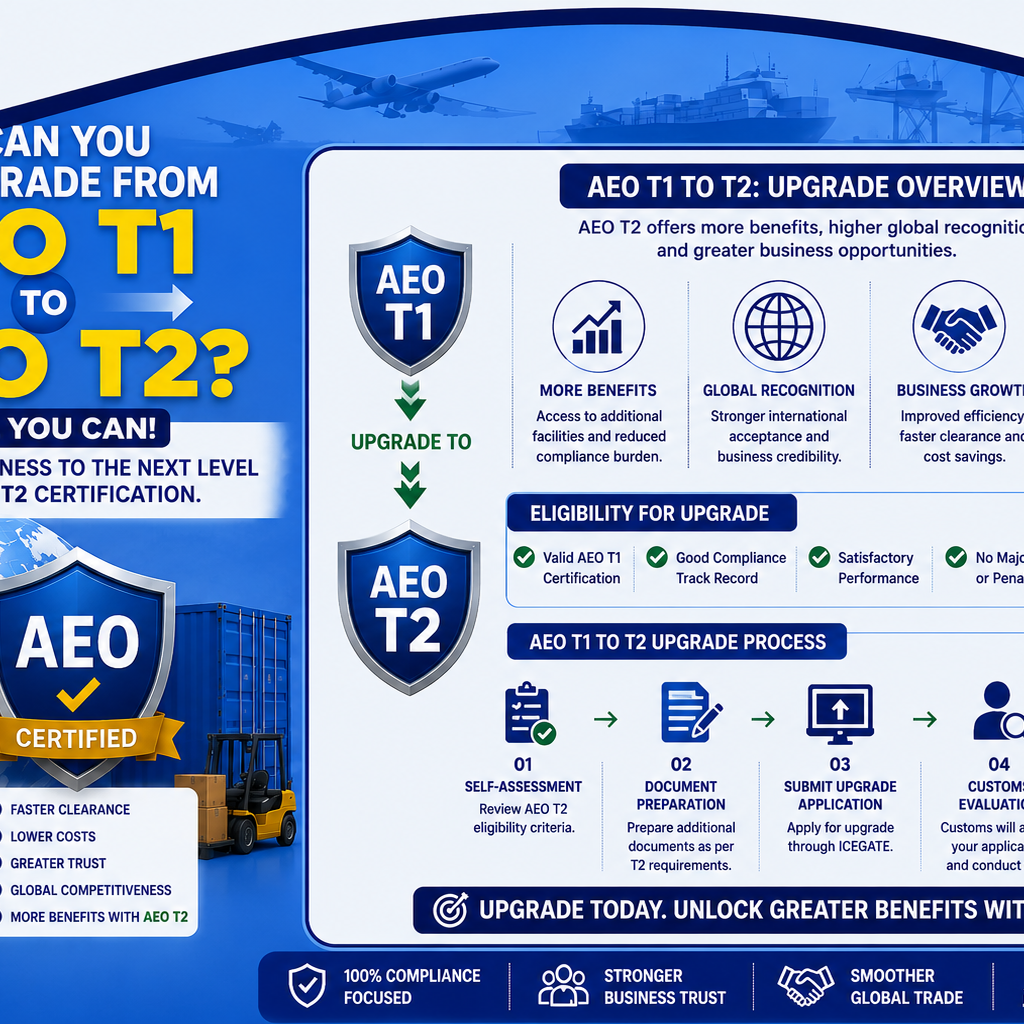
AEO T2 — Intermediate Level
AEO T2 requires everything in Part 1 plus the following:
- Comprehensive Standard Operating Procedures (SOPs) — covering security, warehouse management, IT systems, employee vetting, and cargo handling
- Physical on-site audit by CBIC officers—customs officials visit your office, warehouse, or facility and review actual operations, not just documents
- IT infrastructure documentation — evidence of your digital record-keeping systems, data security measures, and customs-related IT compliance
- Detailed supply chain mapping—CBIC wants to understand exactly how goods move through your supply chain from origin to destination
- Strong internal compliance function — evidence that your team actively monitors and maintains customs compliance, not just ad-hoc filings
- You can apply directly for T2 without holding T1 first—there is no mandatory progression requirement
AEO T3 — Advanced Level
AEO T3 is available only to businesses that have held AEO T2 status for a minimum of 2 continuous years with consistent compliance. Additional requirements:
- Minimum 2 consecutive years of active AEO T2 status with no significant violations or lapses
- Enhanced security measures and documented supply chain security programme
- Proven track record of compliance — CBIC reviews your performance as a T2 holder before granting T3
- Certificate validity: 5 years
AEO LO — Logistics Operators
AEO LO is specifically for logistics service providers — customs brokers, freight forwarders, warehouse operators, carriers, terminal operators, and custodians. Requirements include:
- Active CHA (Customs House Agent) license for customs brokers, or relevant operational license for other logistics entities
- Documented security protocols for goods in your custody
- Physical site audit of your facilities — warehouses, handling areas, IT systems
- Track record of compliant handling of third-party cargo
Part 4 — Automatic Disqualifiers: Check These Before Applying
These are the conditions that will result in automatic rejection of your AEO application. Verify each one carefully before investing time in your application:
|
|
Active show-cause notice for fraud, forgery or smuggling If CBIC or any enforcement agency has issued a show-cause notice for these specific violations in the last 3 years, your application will be rejected. You must wait until the matter is adjudicated and resolved. |
|
|
Suspended or cancelled IEC An inactive IEC is an immediate disqualifier. Ensure your IEC is active and current before applying. |
|
|
Suspended or cancelled GST registration If your GST registration is suspended—even temporarily due to nonfiling— you cannot apply until it is restored. |
|
|
Negative net worth in the previous audited accounts If your last audited balance sheet shows negative net worth, CBIC will not grant AEO status. Address financial health before applying. |
|
|
Entity incorporated but not yet trading (less than 2 years for MSME, 3 years for others) A newly incorporated entity with no actual customs activity cannot apply. Time in business is a firm requirement — though waivable in deserving cases. |
|
|
Fewer than the minimum required customs documents If you have filed fewer than 25 documents (or 10 for MSMEs) in the last financial year, you do not yet meet the activity threshold. Build your customs document count before applying. |
|
|
Ongoing adjudication for major customs duty evasion If a significant case of customs duty evasion is currently under adjudication against your entity, the application will be held or rejected. |
A waiver is possible for the 3-year business age requirement in deserving cases — for example, a startup with a strong compliance record and active trade volumes. An experienced AEO consultant can advise whether your situation qualifies for a waiver request and how to present it effectively to CBIC.
Part 5 — Your AEO Readiness Score: How to Assess Yourself
After going through the checklist above, use this scoring guide to assess your current position:
|
|
You are likely ready to apply for AEO T1 today. Engage a consultant to review your documentation completeness and submit your application. Aim for T1 now and plan the T2 upgrade in 12–18 months. |
|
|
You are close but not quite ready. Identify which gaps you have—the most common are the 3-year age requirement, insufficient customs documents, or incomplete SOPs. These can typically be addressed within 3–6 months. |
|
|
You need a compliance readiness plan before applying. Do not waste time and effort on incomplete applications — get a free eligibility assessment from ELT Corporate and build a 6–12 month roadmap to qualification. |
|
|
You qualify for the Liberalised MSME Package, which reduces your barriers significantly. Minimum 10 documents, 2-year business age, simplified documentation, and 15-day processing. Apply for T1 as soon as your document count reaches 10. |
Part 6 — What to Do Once You Know Your Eligibility Status
If You Qualify for T1 Today
Start your application immediately. The CBIC AEO portal at aeoindia.gov.in accepts online T1 applications. For MSME applicants, CBIC aims to process MSME applications within 15 days, subject to complete documentation. decision on complete applications. Working with an experienced consultant ensures your application is complete, consistent, and formatted correctly from submission—avoiding the most common cause of delay: deficiency notices due to incomplete documentation.
If You Qualify for T2 Directly
You do not need to go through T1 first. If your compliance record is strong, your SOPs are documented, and you are ready for a physical audit, apply for T2 directly. The deferred duty payment and bank guarantee exemption benefits justify the additional effort—and you get a 3-year certificate instead of 2 years.
If You Have Gaps to Address
The most common gaps that prevent immediate application are the following:
- Document count below threshold—Continue importing/exporting and reapply once your document count reaches 25 (or 10 for MSMEs) in a financial year
- Business age below 3 years — Consider a waiver request if your compliance record is strong. An experienced consultant can advise on eligibility.
- Pending show-cause notice — Resolve the matter and wait for adjudication before applying. Do not apply with an active notice—it will be rejected.
- Negative net worth — Strengthen your balance sheet before applying. AEO is a trust-based program—financial health is a genuine eligibility criterion.
- Missing SOPs or security documentation — This is typically fixable within 4–8 weeks with consultant support. Document your existing practices.
For Newly Established Businesses
If your business is less than 2 years old (or 3 years for non-MSMEs), focus on building a clean customs compliance record from day one. File all bills of entry and shipping bills promptly, maintain clean financial accounts, and document your security procedures. Apply for AEO T1 as soon as you meet the minimum age and document thresholds—the sooner you get T1, the sooner your RMS trust score builds toward T2 eligibility.
Frequently Asked Questions on AEO Eligibility
I have 18 customs documents this year, but I am not MSME registered. Do I qualify?
No — the standard minimum threshold is 25 documents per financial year. You would need to either wait until you reach 25 documents or obtain MSME (Udyam) registration if your business meets the MSME criteria, which would reduce your threshold to 10 documents.
My company is 2 years old and MSME-registered. Can I apply?
Yes—CBIC’s MSME relaxation reduces the minimum business age requirement from 3 years to 2 years for MSME-registered entities. As long as you meet the 10-document threshold and the compliance criteria, you can apply for AEO T1.
We had a minor customs penalty 4 years ago. Does that disqualify us?
Generally, no. The specific show-cause notice disqualifiers cover fraud, forgery, smuggling, and undeposited service tax and look back only 3 years. A minor technical penalty from 4 years ago that has been paid and regularized typically does not disqualify an application. However, you should disclose it to your consultant so it can be addressed appropriately in the application.
Can we apply as a partnership firm, or does it need to be a company?
AEO certification is available to all legally established business entities in India — including sole proprietorships, partnership firms, LLPs, private limited companies, and public limited companies. The entity type does not affect eligibility, as long as the business meets the other criteria.
We import goods but do not export anything. Can we still apply?
Absolutely. AEO eligibility applies to importers, exporters, or businesses that do both. Your document count threshold of 25 (or 10 for MSMEs) can be met entirely through Bills of Entry (import documents) — you do not need any Shipping Bills (export documents) to qualify.
How much does AEO certification cost?
CBIC’s application fees are nominal — the primary cost is professional consultant fees for preparing and managing your application. For T1, typical consultant fees range from Rs. 25,000 to 60,000 depending on business complexity. For T2, Rs. 60,000 to 1.5 lakhs. These are one-time costs per application cycle and are typically recovered within the first 1–3 months of active AEO status through demurrage savings, DPD benefits, and reduced handling charges.
The Bottom Line
AEO certification is one of the most valuable—and most underutilized—tools available to Indian importers, exporters, and logistics businesses. Thousands of active businesses qualify today but have not yet applied, simply because they have not taken the time to check their eligibility.
Use this checklist as your starting point. Work through each category, assess your position honestly, and identify any gaps. If you qualify, apply now — every month without AEO status is a month of higher costs, slower clearances, and unnecessary compliance friction.
If you have gaps, use them as a roadmap. Most eligibility gaps can be addressed within 3 to 12 months with the right guidance. Businesses that begin working toward AEO eligibility today will enjoy the benefits long before their competitors, who continue to wait.
Thousands of businesses in India hold AEO certification. The gap between AEO and non-AEO businesses in clearance speed, costs, and global credibility grows wider every year. The right time to apply was yesterday. The next best time is today.
| Get Your Free AEO Eligibility Assessment — Know In 24 Hours
Share your basic business details — IEC, annual customs document count, MSME status, and compliance history. Our AEO specialists will confirm your eligibility, identify any gaps, and tell you exactly which tier to target — at zero cost. |