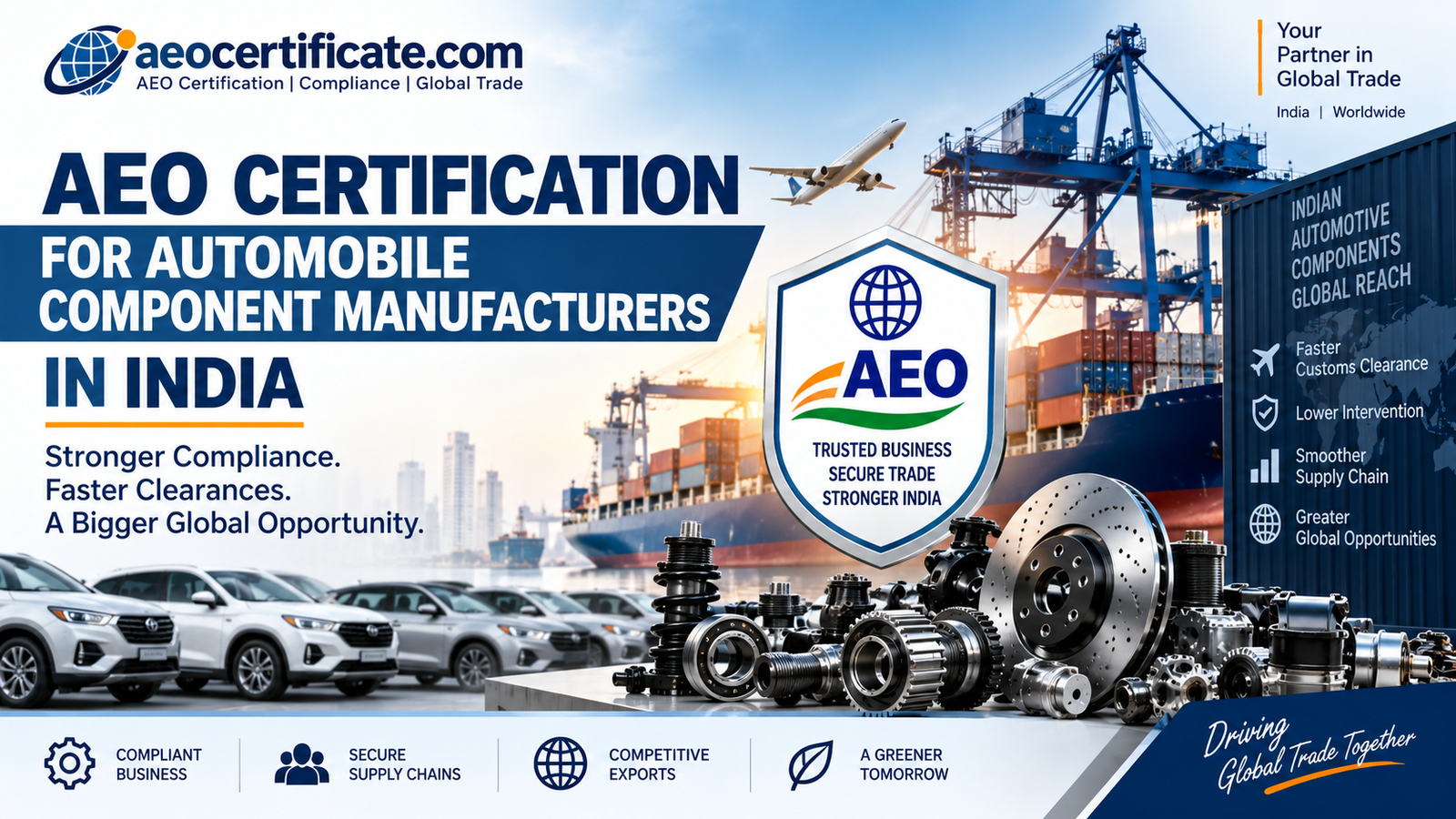
India’s automobile component industry is deeply integrated with global supply chains. Manufacturers routinely import specialized raw materials, electronic components, machinery, tooling, sensors, and other inputs while exporting automotive parts to OEMs and aftermarket customers worldwide. With this scale of cross-border trade, customs efficiency and compliance can directly influence production schedules, inventory costs, and customer commitments.
AEO Certification for automobile component manufacturers can provide eligible businesses with trusted-trader recognition under India’s Authorised Economic Operator (AEO) Programme. Administered by Indian Customs under CBIC, the program is intended to facilitate compliant international trade while strengthening supply chain security.
For automobile component manufacturers with regular imports and exports, AEO certification can become an important part of the company’s customs compliance and international supply chain strategy.
AEO Certification for Automobile—What Is AEO Certification?
AEO Certification for automobile component manufacturers is based on the Authorised Economic Operator program, a voluntary customs compliance initiative for eligible participants in the international supply chain.
An AEO-certified business demonstrates compliance with prescribed requirements relating to areas such as
- Customs compliance
- Commercial record management
- Financial solvency
- Internal controls
- Supply-chain security, depending on the tier
AEO status can provide various Customs facilitation benefits according to the applicable certification category.
The program should therefore be understood as a trusted-trader framework rather than merely another business registration.
AEO Certification for Automobile—Why Component Manufacturers Should Consider AEO
AEO Certification for automobile manufacturers can be particularly relevant because automotive production frequently depends on highly coordinated international supply chains.
Automobile component manufacturers may import:
- Electronic components
- Sensors
- Semiconductors
- Steel and alloys
- Aluminum
- Plastics and polymers
- Machinery
- Tooling and dies
- Testing equipment
- Specialized chemicals
At the same time, they may export components to vehicle manufacturers in Europe, the United States, Japan, South Korea, Southeast Asia, and other markets.
Greater predictability in customs processes can therefore contribute to more efficient supply chain planning.
AEO Certification for Automobile—Types of AEO Certification
Choosing the appropriate tier is an important part of AEO Certification for automobile manufacturers.
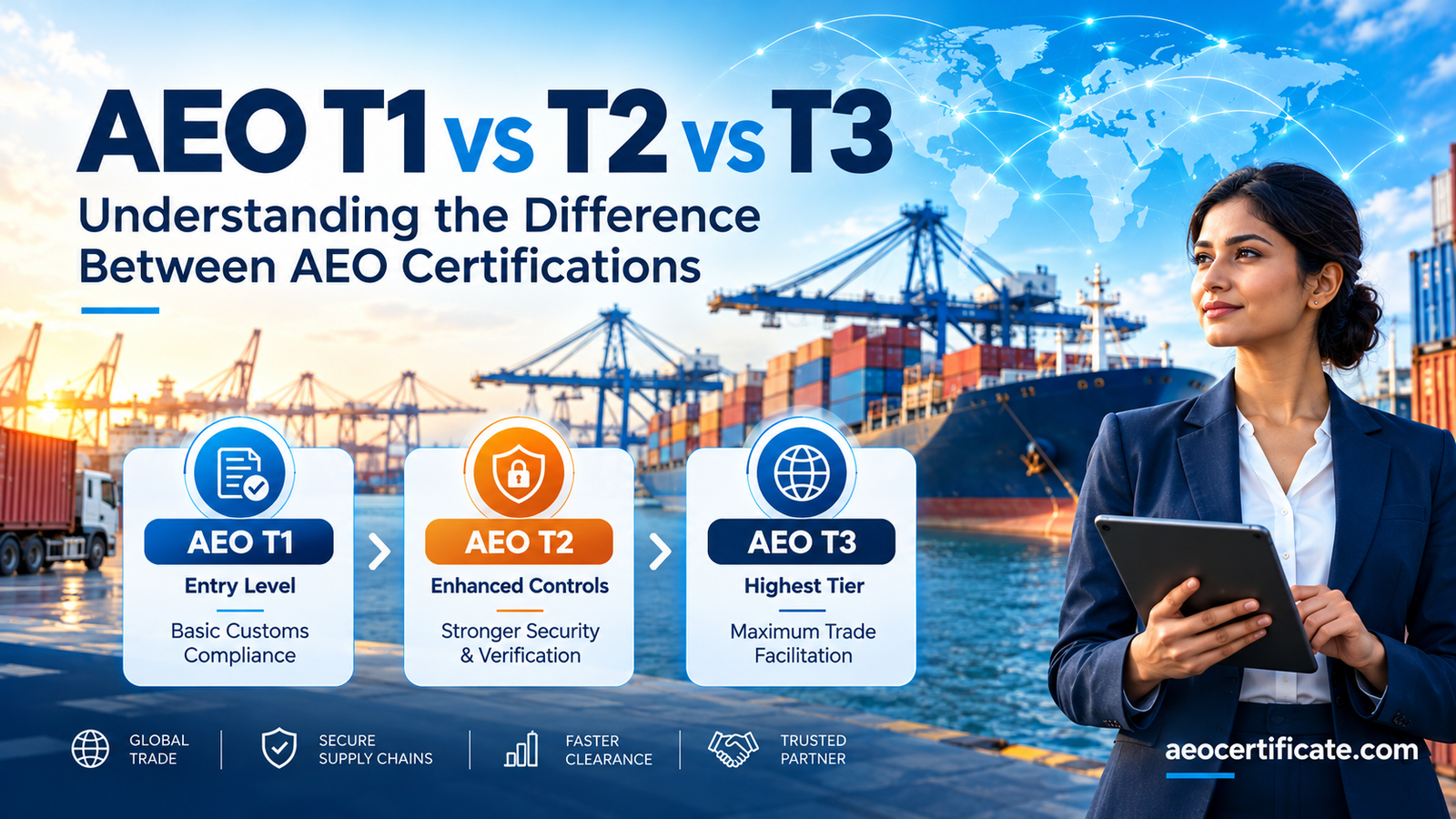
AEO-T1
AEO-T1 is an entry-level tier for eligible importers and exporters.
The assessment focuses on prescribed compliance requirements, including customs compliance, record management, and financial solvency.
It can be suitable for eligible manufacturers starting their AEO journey.
AEO-T2
AEO-T2 is an advanced certification that involves a stronger supply-chain security framework.
In addition to customs compliance, relevant controls can include:
- Premises security
- Cargo security
- Employee security
- Business-partner security
- Access controls
- IT security
- Incident management
Verification forms an important part of the T2 framework.
AEO-T3
AEO-T3 is the highest tier for qualifying importers and exporters.
It is intended for eligible existing T2 holders satisfying the applicable conditions for progression to T3.
AEO Certification for Automobiles—Major Benefits for Component Manufacturers
The potential advantages of AEO Certification for automobile component manufacturers go beyond simply obtaining a certificate.
Depending on the applicable tier and customs provisions, benefits can include:
Customs Facilitation
AEO-certified businesses can receive facilitation in Customs processes according to their applicable tier.
Reduced Intervention
AEO entities may receive reduced examination or inspection based on applicable risk-management parameters.
Greater Clearance Predictability
More predictable customs procedures can help manufacturers coordinate inbound materials and outbound finished goods.
Stronger Internal Compliance
AEO implementation encourages companies to establish defined responsibilities, procedures, and controls for international trade.
Improved Supply Chain Security
Advanced AEO tiers encourage stronger physical, employee, cargo, business-partner, and IT security systems.
AEO Certification for Automobiles—Importance for Just-in-Time Manufacturing
Just-in-time and closely managed inventory systems make AEO Certification for automobile manufacturers particularly relevant.
A typical automotive supply chain may operate as follows:
Overseas Supplier → International Shipment → Indian Customs → Warehouse → Production Line → OEM → Export/Distribution
A delay at one stage can potentially affect the subsequent production schedule.
AEO does not guarantee that every shipment will be cleared without delay. However, applicable Customs facilitation and a stronger internal compliance framework can help improve operational predictability.
AEO Certification for Automobile – Eligibility Requirements
Before applying for AEO Certification for Automobile, manufacturers should assess their eligibility under the applicable AEO requirements.
Important areas can include:
- Customs compliance history
- Import/export activity
- Financial solvency
- Commercial record management
- Internal customs controls
- Legal compliance
- Supply-chain security for applicable advanced tiers
A company should conduct an eligibility assessment before investing substantial resources in application preparation.
AEO Certification for Automobile – Documents Required
Documentation for AEO Certification for Automobile depends on the selected tier and the manufacturer’s operations.
Relevant information may include:
- IEC details
- GST registration
- PAN
- Company incorporation documents
- Organization chart
- Business profile
- Import/export transaction records
- Customs compliance history
- Financial information
- Customs-related SOPs
- Warehouse procedures
- Cargo-handling procedures
For advanced certification, evidence demonstrating actual implementation becomes particularly important.
AEO Certification for Automobile – Customs Classification Compliance
Automobile component manufacturers can handle hundreds or even thousands of individual parts, making tariff classification an important consideration for AEO Certification for Automobile.
A manufacturer should maintain an internal process such as:
Product Identification → Technical Review → HS Classification → Internal Approval → Documentation → Periodic Review
Technical teams may need to coordinate with Customs or EXIM personnel where classification depends on the product’s design, function, material, or application.
Classification decisions should be appropriately documented.
AEO Certification for Automobile – Customs Valuation Compliance
Customs valuation is another important area for AEO Certification for automobile manufacturers.
Automotive businesses frequently procure components, machinery, tooling, or technology from overseas group companies.
Relevant valuation considerations may include:
- Related-party transactions
- Royalties
- Licence fees
- Tooling charges
- Assists
- Engineering costs
- Technical-service arrangements
- Transfer-pricing arrangements
- Other additions relevant to customs value
Where applicable, Special Valuation Branch-related matters should also be appropriately reviewed.
AEO Certification for Automobile – Country of Origin Controls
Country-of-origin compliance can also form part of the customs governance supporting AEO Certification for automobiles.
Automobile manufacturers may source components from multiple countries and claim preferential tariff treatment where applicable.
Businesses should maintain suitable controls relating to:
- Certificates of Origin
- Supplier declarations
- Product information
- Origin criteria
- Supporting manufacturing information
- Preferential trade documentation
- Record retention
Companies should avoid treating a supplier’s certificate as the only internal control without appropriate verification.
AEO Certification for Automobile – Supply-Chain Security Requirements
Supply-chain security becomes especially important for AEO-T2 and therefore forms a major part of AEO Certification for automobile manufacturers seeking advanced certification.
Relevant controls may include:
Premises Security
Factories, warehouses, and cargo-handling areas should have appropriate physical and access controls.
Cargo Security
Procedures should protect imported and exported cargo against unauthorized access, substitution, or tampering.
Employee Security
Access rights and responsibilities should be appropriately controlled.
Business-Partner Security
Relevant suppliers, transporters, customs brokers, and logistics providers should be appropriately evaluated.
IT Security
Customs, logistics, and commercial information should be protected against unauthorized access or alteration.
AEO Certification for Automobile – Vendor and Logistics Partner Management
Automotive supply chains involve large networks of suppliers and service providers, making partner management important for AEO Certification for Automobile.
Relevant parties may include:
- Overseas component suppliers
- Tier-1 suppliers
- Tier-2 suppliers
- Transporters
- Customs brokers
- Freight forwarders
- Warehouse operators
- Shipping lines
- Airlines
- Contract manufacturers
- Security agencies
A company should maintain appropriate procedures for selection, evaluation, and periodic review of relevant partners.
AEO Certification for Automobile—Multi-Plant Manufacturers
Large component manufacturers may operate several plants and warehouses. This makes multi-location controls important for AEO Certification for Automobile.
For example, a manufacturer may operate:
- Corporate office in Delhi NCR
- Plant in Gurugram or Manesar
- Plant in Pune
- Facility in Chennai
- Warehouse in Gujarat
- Export logistics locations near ports
Relevant AEO procedures should be consistently implemented across applicable locations.
A multi-location gap assessment can identify differences in security controls, SOPs, employee training, and record management.
AEO Certification for Automobile – Employee Training
Employees play an important role in maintaining AEO Certification for automobile compliance.
Training may be required for teams working in:
- Customs and EXIM
- Logistics
- Supply chain
- Procurement
- Finance
- Warehousing
- Security
- Human resources
- IT
- Legal and compliance
Employees should understand their responsibilities rather than merely being given copies of SOPs.
Training records should also be maintained.
AEO Certification for Automobile – IT and Cybersecurity
Modern automobile manufacturing depends heavily on digital systems, making IT controls important for AEO Certification for Automobile.
Companies should consider:
- Role-based access
- Strong authentication
- Password controls
- Data backup
- Firewall protection
- Endpoint security
- System logs
- Administrator controls
- Employee exit procedures
- Business continuity
- Disaster recovery
- Cyber-incident management
Customs and supply-chain data should only be accessible to appropriately authorized personnel.
AEO Certification for Automobile – Internal Audit and CAPA
Periodic internal reviews can help maintain AEO Certification for automobile standards.
Internal audits can assess:
- Customs compliance
- SOP implementation
- Cargo security
- Warehouse controls
- Employee training
- Business-partner assessment
- IT security
- Incident records
- Documentation
- Security-system effectiveness
Where deficiencies are identified, companies can use a structured corrective-action process:
Observation → Root Cause → Corrective Action → Responsible Person → Deadline → Evidence → Effectiveness Review → Closure
This can help demonstrate an active compliance-management system.
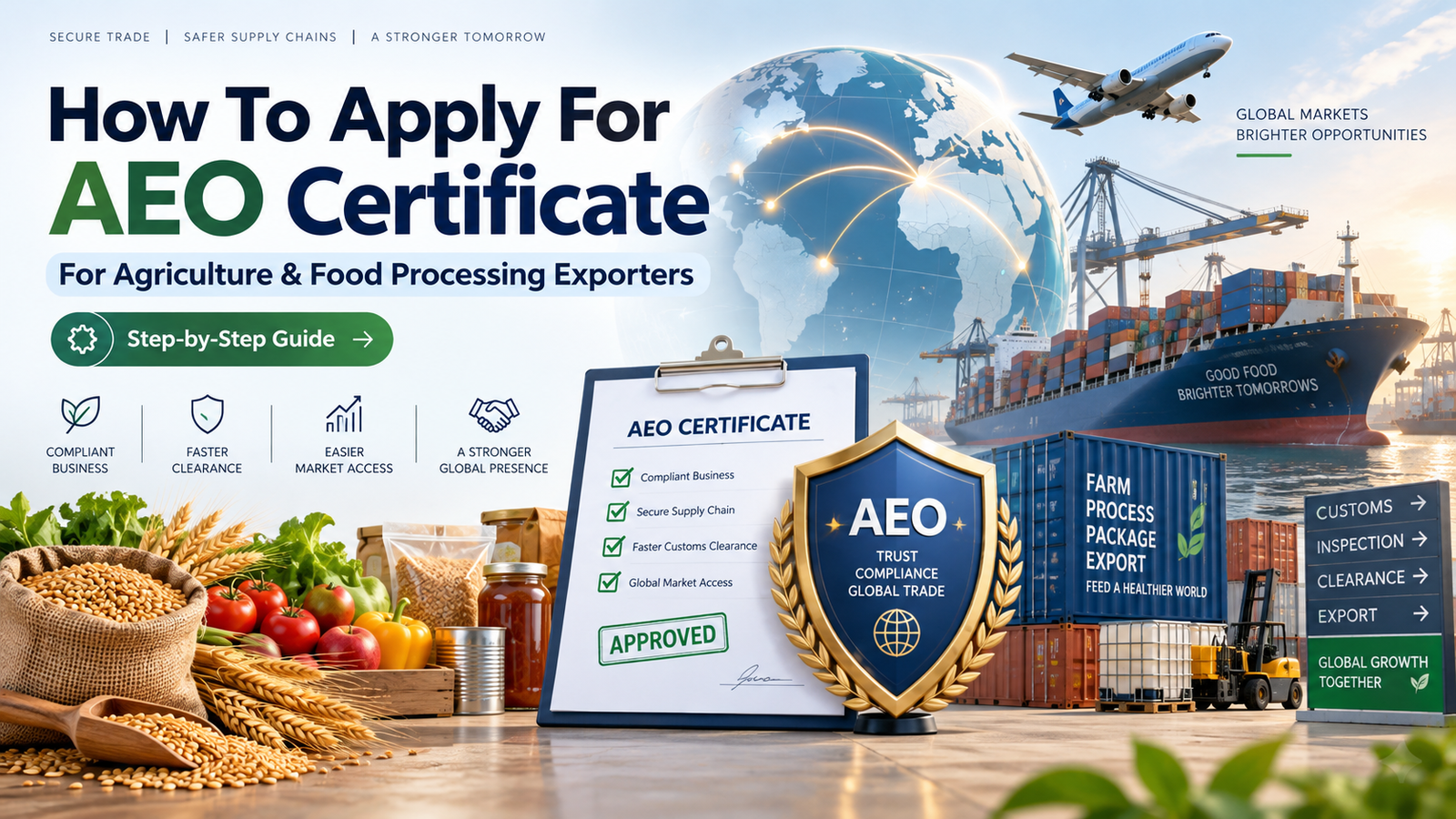
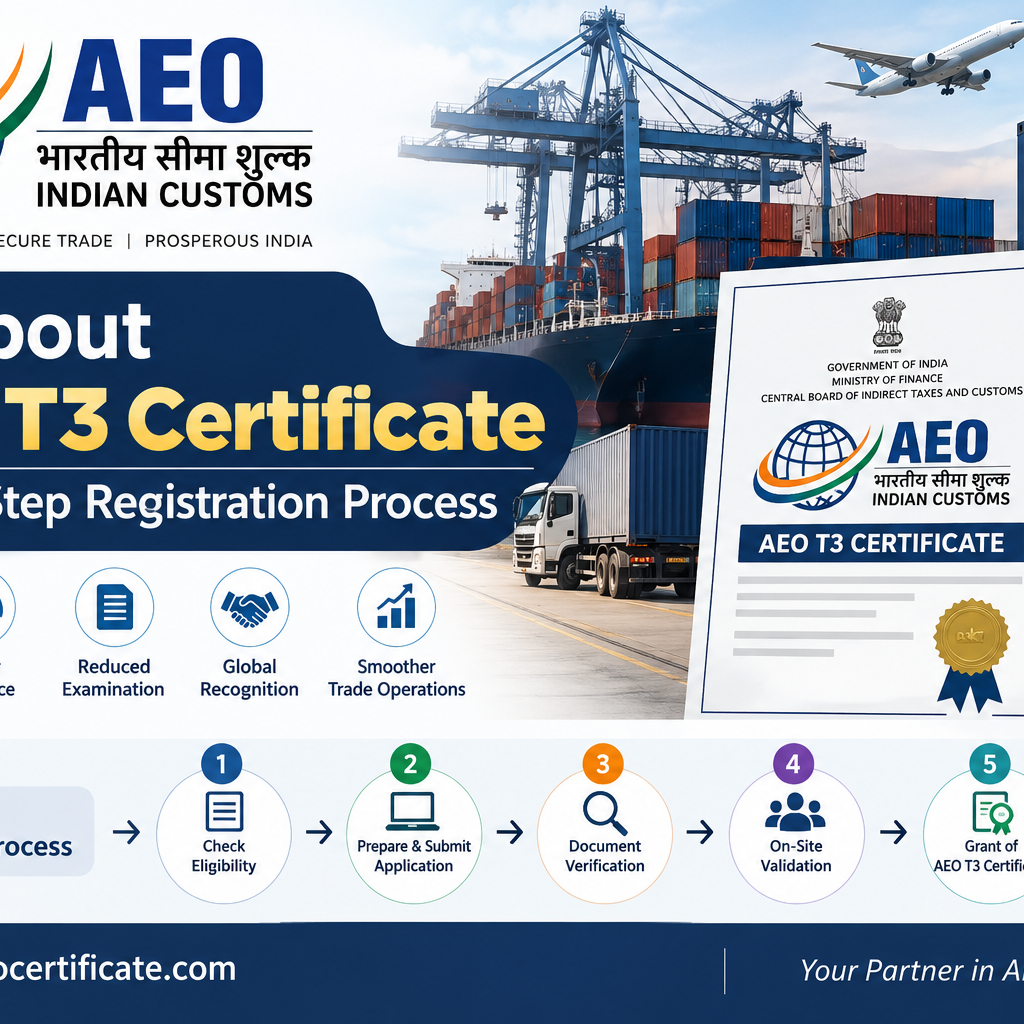
AEO Certification for Automobile – Application Process
A systematic approach to AEO certification for automobiles can involve:
Step 1 – Eligibility Assessment: Confirm whether the company meets applicable AEO requirements.
Step 2 – Tier Selection: Determine whether T1 or T2 is appropriate.
Step 3 – Customs Health Check: Review Customs compliance history.
Step 4 – Gap Analysis: Identify documentation, security, and operational deficiencies.
Step 5 – Corrective Actions: Close identified gaps.
Step 6 – Documentation: Prepare and organize required SOPs and supporting evidence.
Step 7 – Application Filing: Submit the appropriate AEO application.
Step 8 – Customs Scrutiny: Respond to observations or additional information requirements.
Step 9 – Verification: Prepare for verification where applicable.
Step 10 – Certification and Maintenance: Maintain ongoing compliance after certification.
AEO Certification for Automobile – Cost and Government Fees
Cost is an important consideration for AEO Certification for automobile manufacturers.
Government AEO Application Fee: NIL
Indian Customs does not charge an application fee merely for filing an AEO application.
However, businesses may incur costs for:
- Professional consultancy
- Customs compliance audit
- Gap assessment
- SOP preparation
- Employee training
- Security improvements
- CCTV/access-control upgrades
- IT security improvements
- Internal audits
- Verification preparation
The total implementation cost depends on the manufacturer’s existing level of compliance and infrastructure.
AEO Certification for Automobile—Common Mistakes to Avoid
Businesses pursuing AEO Certification for automobiles should avoid:
- Selecting the wrong AEO tier
- Incomplete applications
- Ignoring historical customs issues
- Incorrect or inconsistent business information
- Generic SOPs
- Poor implementation evidence
- Weak vendor assessments
- Missing employee training
- Inconsistent controls across plants
- Inadequate security documentation
- Delayed responses to Customs queries
A detailed pre-application assessment can reduce many of these risks.
AEO Certification for Automobile—How ELT Corporate Can Assist
ELT Corporate can assist manufacturers throughout AEO Certification for automobile projects.
Support can include:
- Eligibility assessment
- AEO T1/T2/T3 assessment
- Customs compliance review
- Multi-location gap analysis
- Supply-chain security assessment
- SOP preparation
- Documentation review
- Application preparation
- Filing assistance
- Customs query handling
- Verification readiness
- Corrective-action support
- Post-certification compliance guidance
The objective is to develop a sustainable customs compliance framework rather than merely complete an application.
Conclusion
AEO certification for automobile component manufacturers can be an important strategic tool for businesses involved in frequent international trade.
Automotive manufacturing depends on tightly coordinated global supply chains. Delays involving imported components or exported finished goods can affect production schedules, inventory management, and customer commitments. AEO certification can provide applicable Customs facilitation while encouraging businesses to strengthen their internal compliance and supply-chain security systems.
For automobile component manufacturers, the most effective approach is to combine eligibility assessment, customs compliance review, gap analysis, supply chain security, vendor management, employee training, internal audits, and proper documentation.
Rather than viewing AEO as merely another certificate, manufacturers can use the framework to build a more secure, compliant and predictable international supply chain.
Frequently Asked Questions
Q.1 Is AEO mandatory for automobile component manufacturers?
No. The AEO programme is voluntary.
Q.2 Which AEO tier is suitable for a first-time applicant?
Eligible businesses generally evaluate T1 or T2 depending on their compliance maturity and applicable requirements.
Q.3 Can an automobile component manufacturer apply directly for T3?
T3 is intended for qualifying existing T2 holders satisfying the prescribed requirements.
Q.4 Is there a government application fee?
No government application fee is charged merely for filing an AEO application.
Q.5 Does AEO-T2 involve verification?
Yes. Verification of applicable security and compliance controls forms an important part of the T2 process.
Q.6 Can large multi-plant manufacturers obtain AEO certification?
Yes, subject to eligibility and applicable requirements. Relevant locations and controls should be properly assessed.