Hyderabad has developed into an important industrial hub for chemicals, pharmaceuticals, speciality chemicals, bulk drugs, intermediates, and allied manufacturing sectors. Companies operating in these industries frequently import raw materials and machinery while exporting finished products to international markets. Efficient customs clearance and strong supply chain compliance can therefore play an important role in their international operations.
AEO Certification for Chemical Exporters can help eligible businesses participate in India’s Authorised Economic Operator (AEO) program, administered by Indian Customs under CBIC. The program recognizes compliant participants in the international supply chain and provides facilitation benefits according to the applicable AEO tier.
Choosing the right consultant is particularly important for chemical exporters because their operations can involve complex Customs documentation, classification, storage, transportation, safety controls, and international supply chains.
Here are five categories/providers chemical exporters in Hyderabad may consider when seeking AEO consulting support in 2026.
AEO Certification for Chemical Exporters – Why Hyderabad Chemical Companies Should Consider AEO
Before comparing consultants, it is important to understand why AEO Certification for Chemical Exporters can be valuable.
Chemical exporters may regularly deal with:
- Imported raw materials
- Chemical intermediates
- Specialized machinery
- Packaging materials
- Bulk export consignments
- Customs brokers
- Freight forwarders
- Warehouses
- Ports and ICDs
- International customers
For businesses undertaking frequent import and export transactions, customs delays can affect production schedules, inventory levels, delivery commitments, and logistics costs.
AEO certification can provide applicable Customs facilitation while encouraging companies to maintain structured internal compliance and supply-chain security systems.
AEO Certification for Chemical Exporters – 1. ELT Corporate
For companies seeking comprehensive AEO Certification for chemical exporters, ELT Corporate can be considered for end-to-end regulatory and AEO compliance assistance.
ELT Corporate provides regulatory and compliance consulting services and can assist businesses with different stages of the AEO process.
Services for Chemical Exporters
Support can include:
- AEO eligibility assessment
- Identification of the appropriate AEO tier
- Customs compliance gap analysis
- Review of existing documentation
- SOP preparation and review
- Supply-chain security assessment
- Application preparation
- AEO filing assistance
- Customs query-response support
- Verification readiness
- Corrective-action assistance
- Post-certification compliance guidance
For chemical manufacturers with complex international operations, the ability to combine documentation with a practical compliance review can be particularly useful.
AEO Certification for Chemical Exporters – 2. Big Four and Large Professional Advisory Firms
Large professional advisory firms can also be considered for AEO Certification for chemical exporters, particularly by multinational chemical manufacturers or organizations with complex customs and tax structures.
Such firms may be useful where the AEO project needs to be integrated with broader areas such as
- Customs advisory
- Indirect taxation
- Transfer pricing
- Global trade management
- Customs valuation
- Related-party imports
- Supply-chain restructuring
- Enterprise risk management
Their services can be particularly relevant to large organizations requiring multi-country or multi-location compliance coordination.
However, businesses should confirm that the proposed team has direct experience with Indian AEO applications rather than only general customs or tax advisory experience.
AEO Certification for Chemical Exporters – 3. Specialized Customs and Foreign Trade Consultants
Another option for AEO Certification for chemical exporters is a specialist customs or foreign-trade consulting firm.
Such consultants generally focus on areas including:
- Customs law
- Import/export procedures
- Foreign Trade Policy
- Customs classification
- Valuation
- Export documentation
- Duty exemptions
- Customs audits
- AEO applications
For chemical exporters, industry familiarity can be particularly valuable because the business may handle numerous products, raw materials, tariff classifications, and regulatory requirements.
Before appointment, exporters should assess whether the consultant provides full AEO implementation support or only application-filing assistance.
AEO Certification for Chemical Exporters – 4. Supply Chain Security and Compliance Consultants
AEO T2 applicants require stronger supply-chain security systems. Therefore, companies pursuing advanced AEO Certification for Chemical Exporters may also require consultants with experience in operational and security controls.
Such consultants can help evaluate:
- Premises security
- Warehouse controls
- Access management
- CCTV systems
- Visitor management
- Employee security
- Cargo security
- Vehicle controls
- Business-partner security
- IT security
- Incident reporting
- Emergency procedures
Chemical exporters considering AEO T2 should ensure that their consultant understands that the process extends beyond Customs paperwork.
The actual implementation of security controls is an important part of advanced AEO readiness.
AEO Certification for Chemical Exporters – 5. Integrated Regulatory and Export Compliance Consultants
Chemical exporters often operate within multiple regulatory frameworks simultaneously.
An integrated consultant for AEO Certification for Chemical Exporters may therefore be useful where the organization wants broader support involving Customs, product regulations, environmental compliance, packaging, or other trade-related requirements.
Such an approach can help organizations create a centralized compliance system instead of maintaining completely separate documentation across different departments.
This model can be particularly useful for mid-sized chemical manufacturers expanding exports and building formal compliance departments.
AEO Certification for Chemical Exporters – T1 vs T2
Choosing the correct certification tier is an important stage of AEO Certification for Chemical Exporters.
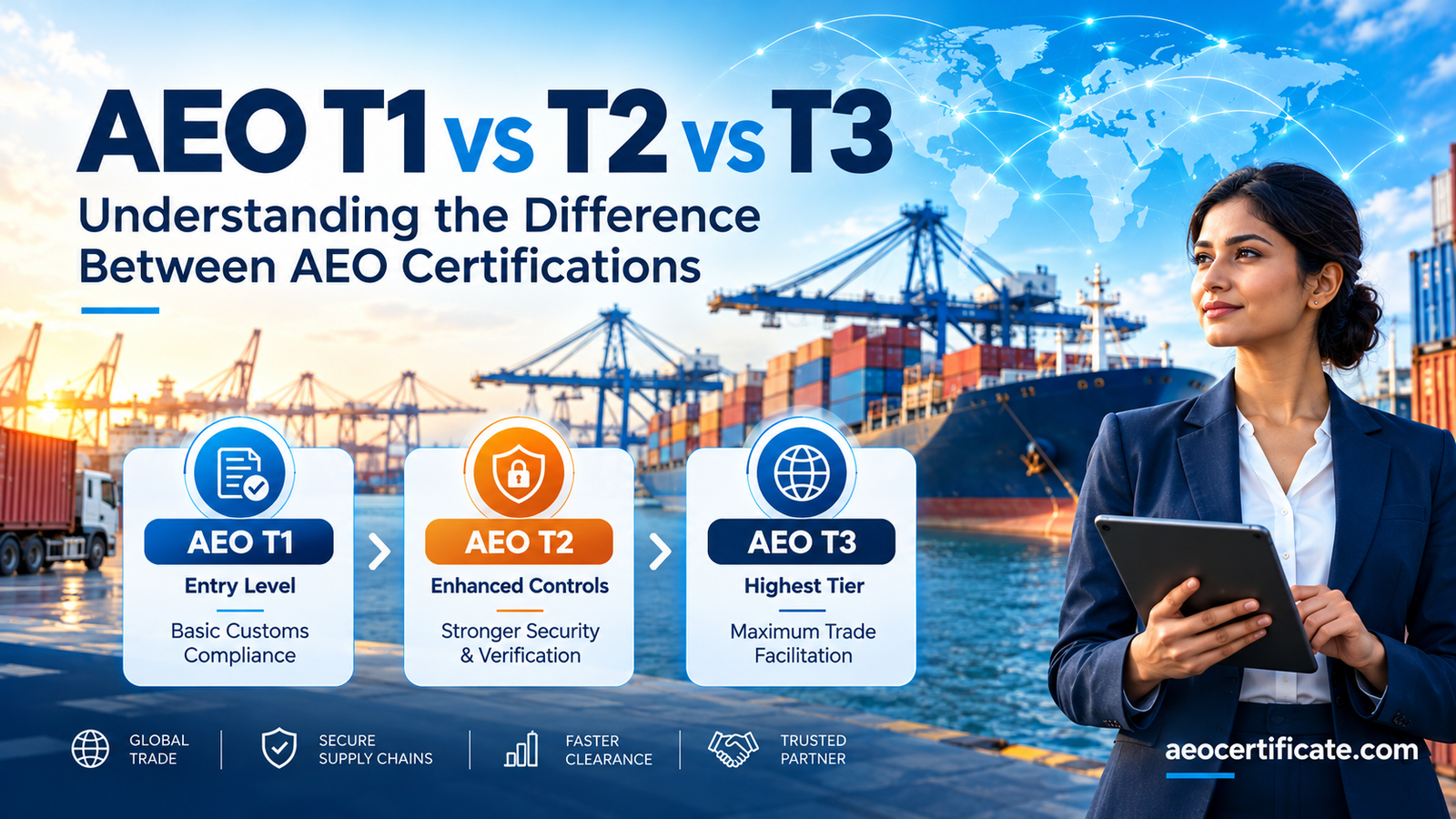
AEO T1
T1 is the entry-level certification available to eligible importers and exporters.
It primarily evaluates applicable requirements concerning:
- Customs compliance
- Legal compliance
- Financial solvency
- Record management
- Internal processes
T1 may be suitable for eligible exporters beginning their AEO journey.
AEO T2
T2 involves more extensive requirements, particularly regarding supply-chain security.
It can involve assessment of:
- Premises security
- Cargo security
- Employee controls
- Business partners
- IT systems
- Access controls
- Incident management
- Security procedures
Physical verification forms an important part of the T2 assessment process.
AEO Certification for Chemical Exporters – Customs Compliance Review
Before filing for AEO Certification for Chemical Exporters, companies should consider conducting a customs compliance health check.
The review can examine:
- HS classification
- Customs valuation
- Country of origin
- Duty payments
- Exemption notifications
- Import documentation
- Export documentation
- Related-party transactions
- Customs notices
- Penalties and disputes
- Record retention
- Customs broker management
Historical issues should be assessed carefully before the AEO application is submitted.
AEO Certification for Chemical Exporters – Chemical Warehouse and Cargo Security
Security can be especially important for AEO Certification for Chemical Exporters, particularly for T2 applicants.
Chemical businesses may maintain dedicated storage areas for raw materials, intermediates, and finished goods.
Relevant AEO controls can include:
- Restricted access
- Employee identification
- Visitor controls
- CCTV surveillance
- Cargo integrity
- Vehicle controls
- Loading and unloading procedures
- Seal controls where applicable
- Incident reporting
- Emergency escalation
These AEO requirements should be coordinated with, but not confused with, other applicable chemical-safety requirements.
AEO Certification for Chemical Exporters – Business Partner Due Diligence
International chemical supply chains involve numerous third parties.
As part of AEO Certification for Chemical Exporters, organizations may need appropriate controls over relevant business partners such as
- Overseas suppliers
- Transporters
- Customs brokers
- Freight forwarders
- Shipping lines
- Warehouse operators
- Contract manufacturers
- Security agencies
A structured vendor and business-partner assessment process can strengthen the organization’s overall supply-chain security.
AEO Certification for Chemical Exporters – Government Fees and Consultancy Cost
One important point regarding AEO Certification for Chemical Exporters is that Indian Customs does not charge an application fee merely for filing an AEO application.
Government Application Fee: NIL
However, companies may incur expenses for:
- Professional consultancy
- Compliance gap assessment
- SOP development
- Documentation
- Security improvements
- Employee training
- IT improvements
- CCTV/access-control upgrades
- Travel and verification preparation
Therefore, businesses should not confuse consultancy or implementation expenses with a government AEO application fee.
AEO Certification for Chemical Exporters – How to Select the Best Consultant
When selecting a consultant for AEO Certification for Chemical Exporters, price should not be the only criterion.
Evaluate whether the consultant can provide:
AEO Experience: Has the team handled AEO applications and assessments?
Customs Knowledge: Does it understand classification, valuation, compliance history, and customs procedures?
Documentation Capability: Can the consultant prepare practical SOPs rather than generic templates?
T2 Readiness: Can it assess physical and supply-chain security?
Query Support: Will the consultant assist if Customs raises observations?
On-Site Assistance: Can it conduct facility gap assessments where required?
Post-Certification Support: Can it help maintain AEO compliance after approval?
A detailed scope of work should be obtained before appointing a consultant.
AEO Certification for Chemical Exporters – Red Flags When Choosing a Consultant
Businesses seeking AEO Certification for chemical exporters should be cautious if a consultant:
- Guarantees certification without assessment.
- Claims that AEO is merely an online registration.
- Does not review Customs compliance history.
- Uses generic SOPs for every client.
- Does not distinguish between T1 and T2.
- Cannot explain supply-chain security requirements.
- Does not provide query-response assistance.
- Quotes government application charges where none apply without explaining what the charge represents.
- Does not assess implementation at the operational level.
AEO is a compliance-based program, and approval ultimately depends on satisfaction of the applicable requirements.
AEO Certification for Chemical Exporters – Importance for Speciality Chemical Manufacturers
AEO Certification for Chemical Exporters can be particularly relevant for specialty chemical manufacturers dealing with high-value products, multiple raw materials, overseas suppliers, and international customers.
Such businesses may handle frequent imports of intermediates, additives, catalysts, specialized equipment, and packaging materials while simultaneously exporting finished chemical products.
A structured AEO framework can help strengthen:
- Customs documentation controls
- Import and export record management
- Vendor due diligence
- Cargo-security procedures
- Warehouse controls
- Employee responsibilities
- Logistics-partner management
- Internal compliance monitoring
For specialty chemical manufacturers, AEO can therefore become part of the broader international trade compliance framework.
AEO Certification for Chemical Exporters – Importance of Correct HS Classification
Correct tariff classification is an important customs compliance consideration for AEO Certification for chemical exporters.
Chemical companies may deal with hundreds of raw materials, intermediates, formulations, and finished products. Classification errors can potentially result in incorrect duty treatment, customs disputes, or compliance concerns.
Businesses should maintain an appropriate internal process covering:
Product Identification → Technical Information → Classification Review → Applicable Tariff Heading → Documentation → Periodic Review
Technical teams and Customs/EXIM personnel should coordinate where the nature or composition of a chemical product affects its classification.
AEO Certification for Chemical Exporters – Customs Valuation Compliance
Customs valuation is another important consideration when preparing for AEO Certification for chemical exporters.
Companies should review whether imported goods are valued correctly, particularly where transactions involve:
- Related overseas suppliers
- Royalties
- Licence fees
- Technical assistance
- Tooling costs
- Assists
- Transfer-pricing arrangements
- Inter-company transactions
- Freight and insurance components
Large chemical groups purchasing raw materials from related overseas entities may also have Special Valuation Branch (SVB)-related considerations where applicable.
A Customs compliance review before filing an AEO application can help identify material valuation issues requiring attention.
AEO Certification for Chemical Exporters – Importance of Country of Origin Compliance
Businesses pursuing AEO Certification for chemical exporters should maintain adequate controls relating to the country of origin.
This becomes especially relevant when a company imports raw materials under preferential trade arrangements or exports products where customers require origin documentation.
Internal controls may cover:
- Supplier declarations
- Certificates of origin
- Product origin records
- Preferential tariff claims
- Supporting manufacturing information
- Record retention
- Verification of applicable origin criteria
Country-of-origin documentation should be properly maintained and readily retrievable.
AEO Certification for Chemical Exporters – Import and Export Documentation Controls
Documentation forms the backbone of AEO Certification for Chemical Exporters.
Chemical exporters should establish a system to review and retain relevant trade documentation, which may include:
- Commercial invoices
- Packing lists
- Bills of Entry
- Shipping Bills
- Bills of Lading
- Airway Bills
- Certificates of Origin
- Purchase Orders
- Export Orders
- Freight documentation
- Customs correspondence
- Applicable licenses/authorizations
- Product-related supporting documents
A centralized documentation system can help reduce errors and improve retrieval during internal or external reviews.
AEO Certification for Chemical Exporters – Dangerous Goods and AEO Compliance
Certain chemical products may also be subject to dangerous-goods or hazardous-material transportation requirements.
While AEO Certification for Chemical Exporters is a trusted-trader program for customs and does not replace such requirements, companies should ensure that their wider logistics controls are properly coordinated.
Depending on the products and mode of transportation, relevant operational areas may include:
- Product identification
- Classification for transport purposes
- Appropriate packaging
- Marking and labelling
- Documentation
- Handling procedures
- Storage controls
- Employee training
- Emergency response
- Transporter selection
Businesses should separately identify all product-specific and transportation regulations applicable to their chemicals.
AEO Certification for Chemical Exporters – Factory and Warehouse Readiness
For advanced AEO Certification for Chemical Exporters, particularly AEO T2, factory and warehouse readiness can become an important area of assessment.
Businesses should examine controls relating to:
- Perimeter security
- Gates and access points
- CCTV coverage
- Visitor management
- Employee identification
- Restricted areas
- Cargo storage
- Loading and unloading
- Vehicle movements
- Seal controls where applicable
- Dispatch procedures
- Incident reporting
The actual controls should correspond with the company’s risk profile and operations.
AEO Certification for Chemical Exporters – CCTV and Access Control Readiness
Physical security forms an important part of advanced AEO certification for chemical exporters.
Chemical exporters should assess whether critical areas are appropriately monitored and controlled.
Potential areas for review include:
- Main entry/exit gates
- Warehouse entry points
- Loading areas
- Dispatch zones
- Finished-goods storage
- High-risk storage locations
- Server or IT rooms
- Restricted operational areas
Companies should also maintain appropriate procedures for access authorization, visitor entry, contractor access, and employee separation.
AEO Certification for Chemical Exporters – Employee Background and Security Controls
Employees directly influence the effectiveness of AEO Certification for Chemical Exporters.
Companies should establish appropriate HR and security controls for personnel involved in customs, logistics, warehousing, security, and international trade operations.
Relevant procedures can cover:
- Employee identification
- Joining formalities
- Role allocation
- Access permissions
- Confidentiality requirements
- Security awareness
- Compliance training
- Employee separation
- Revocation of system access
- Return of company assets
Evidence of implementation should also be maintained.
AEO Certification for Chemical Exporters – IT and Cybersecurity Requirements
Modern chemical exporters depend on ERP systems, customs portals, warehouse software, email, electronic documentation, and other digital platforms.
Therefore, AEO Certification for Chemical Exporters should also consider information-security controls.
Businesses can assess:
- User access rights
- Password policies
- Multi-factor authentication where appropriate
- Data backup
- Firewall and endpoint protection
- System logs
- Restricted administrator access
- Employee exit controls
- Disaster recovery
- Business continuity
- Cyber-incident procedures
Sensitive customs and commercial information should be protected against unauthorized access or alteration.
AEO Certification for Chemical Exporters – Role of Customs Brokers and Freight Forwarders
Customs brokers and freight forwarders often play an important role in AEO Certification for Chemical Exporters because they handle critical parts of the international shipment process.
However, appointing a customs broker does not eliminate the exporter’s responsibility for its own compliance.
Chemical exporters should establish procedures for:
- Appointment of customs brokers
- Sharing accurate product information
- Reviewing customs declarations
- Communicating classification instructions
- Checking shipment documents
- Monitoring errors
- Escalating discrepancies
- Periodically reviewing service providers
Companies should avoid becoming completely dependent on external service providers for their internal customs knowledge.
AEO Certification for Chemical Exporters – Internal AEO Audit Programme
An internal audit mechanism can significantly strengthen AEO Certification for Chemical Exporters.
Instead of reviewing compliance only when certification or renewal approaches, companies can conduct periodic assessments covering:
- Customs documentation
- SOP implementation
- Warehouse controls
- Cargo security
- Employee training
- Business-partner assessments
- CCTV and access controls
- IT security
- Incident records
- Corrective actions
Audit findings should be documented and assigned to responsible personnel for closure.
AEO Certification for Chemical Exporters – Corrective and Preventive Action System
An effective AEO Certification for Chemical Exporters framework should include a mechanism for addressing identified deficiencies.
A simple CAPA process can follow:
Observation → Root Cause → Corrective Action → Responsible Person → Target Date → Evidence → Verification → Closure
For example, if an internal audit identifies that visitor records are incomplete, the company should not merely correct one register. It should identify why the process failed and implement measures to prevent recurrence.
This demonstrates a mature compliance culture.
AEO Certification for Chemical Exporters – Multi-Location Chemical Manufacturers
Large chemical companies may operate multiple factories, warehouses, corporate offices, and logistics locations.
For these organizations, AEO Certification for Chemical Exporters should include a multi-location compliance review.
One location may maintain strong security controls, while another may have:
- Incomplete visitor records
- Different SOPs
- Weak access restrictions
- Insufficient CCTV coverage
- Poor training documentation
- Inconsistent cargo procedures
Standardizing relevant controls across applicable locations can significantly strengthen AEO readiness.
AEO Certification for Chemical Exporters – Management Commitment and Governance
Senior management involvement is important for successful AEO Certification for chemical exporters.
Management should ensure that AEO responsibilities are distributed across relevant departments rather than assigned only to the EXIM team.
AEO implementation may require involvement from:
- EXIM
- Customs
- Logistics
- Supply chain
- Procurement
- Finance
- Legal and compliance
- Human resources
- Information technology
- Security
- Warehouse
- Quality
- Senior management
Periodic management review can help ensure that gaps are identified and closed promptly.
AEO Certification for Chemical Exporters – Preparing Employees for AEO T2 Verification
For companies pursuing AEO T2, AEO Certification for Chemical Exporters requires preparation at both documentary and operational levels.
Relevant employees should understand:
- Their individual responsibilities
- Applicable SOPs
- Visitor procedures
- Cargo-security requirements
- Incident-reporting mechanisms
- Restricted-area controls
- Emergency procedures
- Information-security responsibilities
A company should avoid a situation where its written policy says one thing, but employees follow a completely different process.
A pre-verification readiness assessment can identify such gaps.
AEO Certification for Chemical Exporters – Step-by-Step Process
A structured approach to AEO Certification for chemical exporters can include:
- Eligibility Assessment – Determine whether the company satisfies the applicable requirements.
- Tier Selection – Decide whether T1 or T2 is appropriate.
- Customs Compliance Review – Assess historical compliance.
- Gap Analysis – Compare current systems against AEO requirements.
- SOP Preparation – Prepare or update required procedures.
- Evidence Compilation – Organize supporting records.
- Application Filing – Submit the applicable application.
- Customs Scrutiny – Respond to queries and observations.
- Verification— Prepare for physical verification where applicable.
- Certification & Maintenance – Maintain ongoing compliance after approval.
AEO Certification for Chemical Exporters – Documents Required
A properly prepared AEO Certification for Chemical Exporters application may require information and supporting documentation concerning:
- IEC
- GST registration
- PAN
- Company constitution
- Organizational structure
- Import/export transactions
- Customs compliance history
- Financial information
- Business premises
- Accounting and record systems
- Customs SOPs
The precise documentation depends on the applicable AEO category and the company’s operations.
AEO Certification for Chemical Exporters—Why ELT Corporate Can Be Considered in Hyderabad
For exporters seeking AEO Certification for chemical exporters, ELT Corporate can assist businesses in Hyderabad even when the certification project involves multiple departments and facilities.
Support can include:
- Eligibility assessment
- T1/T2 selection
- Customs compliance review
- Gap assessment
- SOP preparation
- Documentation
- Application filing
- Security assessment
- Query handling
- Verification preparation
- Corrective actions
- Ongoing AEO compliance
For chemical manufacturers, the focus should be on establishing an AEO framework that is practical, documented, and capable of being demonstrated during assessment.
Conclusion
Selecting among the Top 5 AEO Certification Consultants for Chemical Exporters in Hyderabad 2026 should involve more than comparing consultancy prices.
Chemical exporters should evaluate the consultant’s AEO knowledge, customs expertise, documentation capabilities, security assessment experience, query support, and understanding of manufacturing operations.
AEO Certification for Chemical Exporters can be particularly valuable for businesses with frequent imports and exports, complex supply chains, multiple logistics partners, and substantial customs interaction.
Whether the company chooses ELT Corporate, a large advisory organization, a Customs specialist, a supply-chain security consultant, or an integrated compliance firm, the objective should remain the same: build a sustainable Customs compliance and supply-chain security framework rather than merely obtain a certificate.
Frequently Asked Questions
Q1. What is AEO Certification for Chemical Exporters?
AEO Certification for Chemical Exporters is participation in India’s Authorised Economic Operator programme for eligible exporters.
Q2. Can chemical exporters in Hyderabad apply for AEO certification?
Yes. Eligible chemical exporters in Hyderabad can apply for the appropriate AEO tier subject to the prescribed requirements.
Q3. Which AEO certification is best for chemical exporters—T1 or T2?
AEO T1 is generally the entry-level option, while T2 involves more extensive supply-chain security requirements.
Q4. What is the government fee for AEO Certification for chemical exporters?
There is no government application fee merely for filing an AEO application with Indian Customs.
Q5. What documents are required for AEO Certification for Chemical Exporters?
Documents may include IEC, GST, and company details; customs transaction records; financial information; compliance history; SOPs; and security-related records depending on the applicable tier.
Q6. Does AEO T2 require physical verification?
Yes. AEO T2 involves verification of relevant compliance and supply-chain security arrangements.