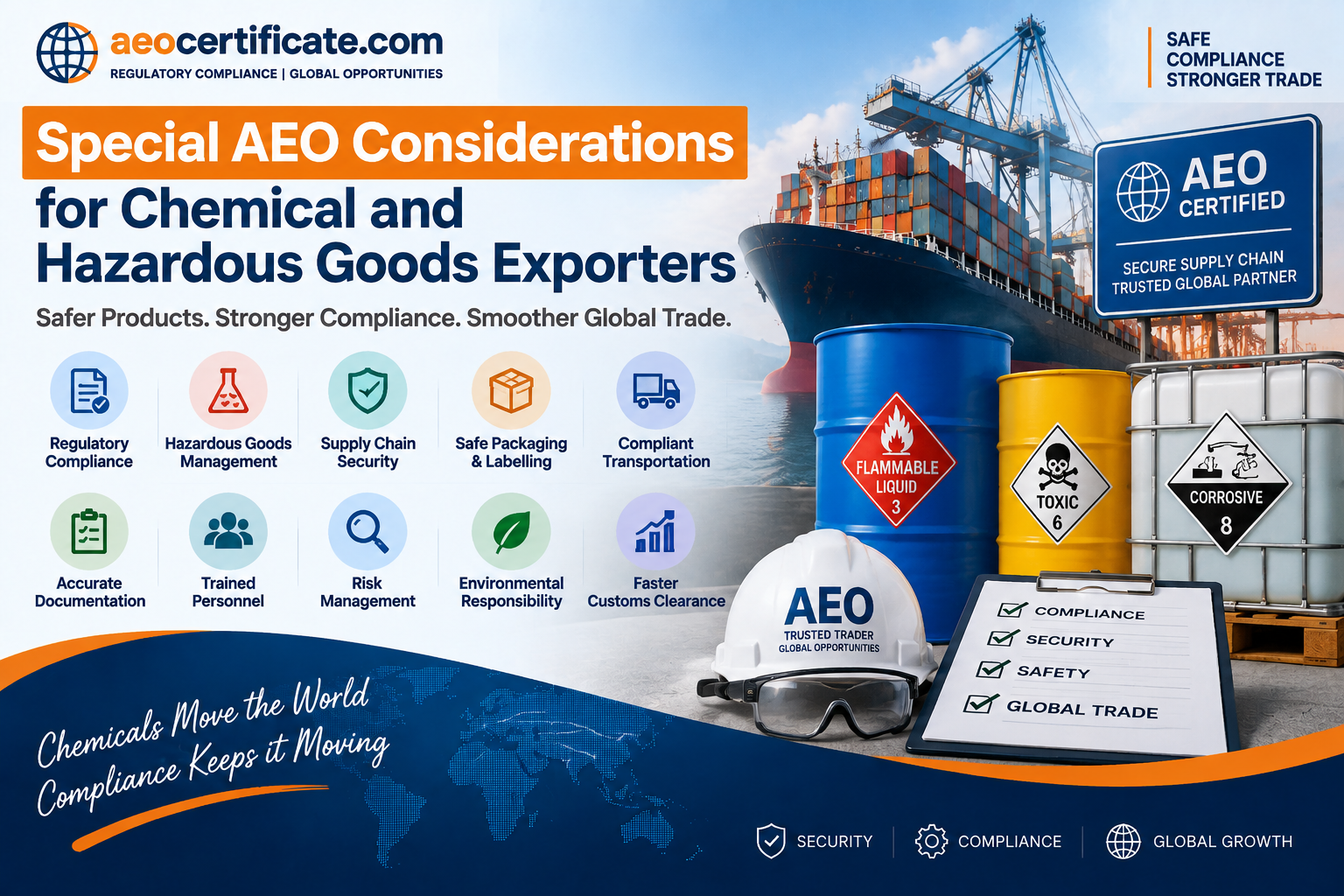
The chemical and hazardous goods industry is one of the most sensitive sectors in international trade due to the nature of products involved, strict safety requirements, and complex regulatory obligations. Exporters dealing with chemicals must ensure that their supply chain remains secure, compliant, and transparent while meeting customs and international trade requirements.
In this environment, AEO Certification for Chemical Exporters plays an important role by helping businesses establish strong customs compliance systems, improve supply chain security, and develop efficient export processes. The Authorized Economic Operator (AEO) program recognizes businesses that maintain proper internal controls, secure logistics operations, and effective compliance management systems.
For chemical and hazardous goods exporters, AEO certification requires special attention because these products involve higher risks related to storage, transportation, handling, documentation, and environmental safety. Companies must demonstrate that they have appropriate systems in place to manage these risks effectively.
AEO Certification for Chemical Exporters is not only a customs recognition but also a framework that supports better risk management, operational efficiency, and global business credibility.
Understanding AEO Certification for Chemical Exporters
Chemical exporters deal with a wide range of products, including industrial chemicals, specialty chemicals, solvents, pharmaceutical ingredients, and AEO Certification for Chemical Exporters for other hazardous substances. Due to their sensitive nature, these products require additional controls throughout the supply chain.
Unlike general goods, chemical shipments require proper classification, safety documentation, secure transportation, and specialized handling procedures. Any mistake in documentation, packaging, or transportation can lead to shipment delays, regulatory issues, or safety risks.
Through AEO Certification for Chemical Exporters, companies can demonstrate that they follow structured compliance procedures and maintain a secure supply chain from manufacturing to final export.
AEO certification encourages chemical companies to establish better systems for customs documentation, employee training, warehouse security, transportation management, and internal monitoring.
Importance of AEO Certification for Chemical Exporters
The chemical industry operates under strict regulatory requirements because hazardous goods can impact safety, security, and the environment. Customs authorities and international buyers prefer dealing with companies that have reliable compliance systems.
AEO Certification for Chemical Exporters helps businesses create confidence among customs authorities, logistics partners, and global customers by showing that the organization follows internationally recognized supply chain security practices.
AEO-certified chemical exporters can improve their operational efficiency by reducing documentation errors, improving shipment planning, strengthening internal controls, and maintaining better communication between manufacturers, AEO Certification for Chemical Exporters, customs brokers, and logistics providers.
The certification also supports companies in developing a proactive approach toward compliance instead of managing issues after they occur.
Key Benefits:
| Area | Benefit of AEO Certification |
| Customs Clearance | Better customs facilitation and predictable processing |
| Compliance | Improved documentation and record management |
| Supply Chain | Enhanced security controls |
| Risk Management | Better identification and prevention of risks |
| Business Reputation | Increased trust among global customers |
Special Considerations for Chemical and Hazardous Goods Exporters
1. Proper Classification of Hazardous Goods
One of the most important aspects of AEO Certification for Chemical Exporters is accurate product classification.
Chemical products must be correctly identified according to:
- HS Codes
- Hazard classification
- UN numbers
- Chemical categories
- Applicable regulatory requirements
Incorrect classification can result in:
- Customs delays
- Shipment rejection
- Penalties
- Compliance issues
Chemical exporters should maintain a proper classification system supported by technical documents.
2. Strong Documentation Management System
Documentation accuracy is a critical requirement for chemical exporters.
- Trade value declaration
- Shipment details
- Chemical safety information
- Product quality verification
- Regulatory compliance
- Export movement records
Important documents include AEO-certified chemical companies should maintain proper document control procedures to ensure accuracy and availability during customs verification.
3. Hazardous Material Storage and Handling Controls
Chemical exporters must maintain secure storage facilities.
Important considerations include:
- Proper segregation of chemicals
- Temperature control systems
- Fire safety measures
- Restricted access areas
- Emergency response procedures
For AEO Certification for Chemical Exporters, companies should demonstrate that their facilities have appropriate security and safety measures.
4. Supply Chain Security Management
AEO certification focuses heavily on supply chain security.
Chemical exporters should evaluate security controls related to:
- Manufacturing facilities
- Warehouses
- Transport providers
- Logistics partners
- Customs brokers
Security measures may include:
- Access control systems
- CCTV monitoring
- Visitor management
- Employee verification
- Shipment tracking
5. Employee Training and Awareness
Employees involved in chemical exports should understand:
- Hazard identification
- Documentation requirements
- Safety procedures
- Customs compliance
- Emergency response
Training records should be maintained as evidence of compliance.
AEO-certified companies should conduct regular training programs for:
- Warehouse staff
- Export documentation teams
- Logistics personnel
- Security teams
Comparison: Normal Chemical Exporter vs. AEO-Certified Chemical Exporter
| Parameter | Normal Chemical Exporter | AEO-Certified Chemical Exporter |
| Compliance System | Basic compliance | Structured compliance framework |
| Documentation | Transaction-based | Controlled documentation system |
| Security Controls | Limited | Enhanced supply chain security |
| Risk Management | Reactive approach | Preventive approach |
| Customs Relationship | Standard process | Trusted trader relationship |
How AEO Certification Improves Chemical Export Operations
AEO Certification for Chemical Exporters provides a structured approach to improve international trade operations.
It helps companies achieve:
Better Shipment Planning
Improved documentation and compliance systems reduce uncertainty.
Reduced Operational Risks
Risk identification systems help prevent compliance failures.
Improved Customer Confidence
International buyers prefer suppliers with strong compliance practices.
Better Supply Chain Control
Companies gain improved visibility over manufacturing, storage, and transportation activities.
Challenges Faced by Chemical Exporters While Obtaining AEO Certification
1. Complex Documentation Requirements
Chemical companies need extensive records related to products, safety, and compliance.
2. Multiple Regulatory Requirements
Companies must coordinate between:
- Customs regulations
- Safety regulations
- Environmental requirements
- Transportation requirements
3. Maintaining Continuous Compliance
AEO certification requires ongoing monitoring and improvement.
Best Practices for Chemical Exporters Applying for AEO Certification
Companies should:
- Create documented SOPs
- Conduct regular internal audits
- Train employees regularly
- Maintain updated chemical records
- Monitor logistics partners
- Review security procedures periodically
Hazardous Goods Storage and Handling Requirements
Storage and handling of hazardous chemicals: AEO Certification for Chemical Exporters requires strict safety and security measures. Chemical exporters must ensure that their warehouses follow appropriate safety practices and maintain controlled access.
Proper segregation of chemicals, safety equipment availability, fire protection systems, emergency response procedures, and restricted access controls are important elements of a secure chemical supply chain.
During the AEO assessment process, companies should be able to demonstrate that their storage facilities have appropriate security arrangements and operational controls.
AEO Certification for Chemical Exporters requires businesses to show that hazardous materials are managed responsibly throughout their supply chain.
Challenges in Maintaining AEO Compliance for Chemical Companies
Chemical companies’ AEO certification for chemical exporters may face challenges such as
- Maintaining updated documentation
- Managing multiple regulatory requirements
- Training employees regularly
- Monitoring logistics partners
- Updating security procedures
Continuous review and improvement are necessary to maintain effective AEO compliance.
Best Practices for AEO Compliance in the Chemical Industry
Chemical AEO Certification for Chemical Exporters: Exporters should:
- Develop clear SOPs
- Conduct regular internal audits
- Maintain updated SDS/MSDS records
- Train employees periodically
- Monitor supply chain partners
- Review risk management procedures
- Maintain accurate customs records
Transportation Compliance for Hazardous Chemical Shipments
Transportation is one of the most important areas for chemical exporters because hazardous goods require specialized handling during movement.
Companies should obtain AEO Certification for chemical exporters to ensure that transportation partners understand hazardous goods requirements and follow appropriate safety procedures.
Proper packaging, labeling, documentation, vehicle suitability, and trained personnel are essential for safe transportation.
Chemical exporters with AEO Certification for Chemical Exporters should also maintain records related to transportation partners, shipment tracking, and emergency handling procedures.
A secure transportation system supports better compliance and strengthens the overall AEO application process.
Supply Chain Security Management for Chemical Exporters
Supply chain security is a major focus area of AEO certification. Chemical exporters must ensure that every stage of their supply chain is properly controlled.
This includes manufacturing facilities, warehouses, transportation providers, customs brokers, and other business partners.
Companies should implement AEO Certification for chemical exporters security measures such as access control systems, visitor monitoring, employee verification procedures, shipment tracking systems, and security policies.
By implementing these controls, companies can reduce risks related to unauthorized access, shipment manipulation, and compliance failures.
Employee Training and Awareness
Employees with AEO Certification for Chemical Exporters involved in chemical exports must understand their responsibilities related to safety, documentation, and customs compliance.
Regular training programs help employees understand hazardous material handling procedures, export documentation requirements, security practices, and emergency response methods.
Companies applying for AEO Certification for Chemical Exporters should maintain proper training records as evidence of employee awareness and competency.
A well-trained workforce reduces operational risks and improves overall compliance performance.
AEO Certification Requirements for Chemical Exporters
Explain:
- Eligibility criteria for chemical companies
- Basic AEO requirements
- Customs compliance history
- Security standards
- Internal control systems
- Record maintenance requirements
Step-by-Step AEO Certification Process for Chemical Exporters
Cover:
- Application preparation
- Document compilation
- Self-assessment
- Customs verification
- Risk assessment
- Approval process
- Post-certification responsibilities
Risk Management and Internal Controls
Risk assessment is an important component of AEO certification. Chemical exporters should identify possible risks within their export operations and establish preventive measures.
Risks may include incorrect documentation, unauthorized access, transportation failures, regulatory non-compliance, or improper handling of hazardous materials.
A strong internal AEO Certification for Chemical Exporters control system helps companies identify problems early and implement corrective actions.
Regular internal reviews and audits help ensure that compliance systems remain effective over time.
How AEO Certification Improves Chemical Export Operations
AEO Certification for Chemical Exporters helps businesses improve their overall export operations by creating a structured compliance environment.
Companies can achieve better shipment planning, improved documentation accuracy, reduced operational risks, and stronger supply chain visibility.
AEO certification also improves business credibility because international customers and partners prefer working with companies that maintain secure and reliable supply chains.
The certification supports long-term business AEO Certification for chemical exporters’ growth by improving operational discipline and creating confidence among global stakeholders.
Checklist: Are You Ready for AEO Certification as a Chemical Exporter?
Create a checklist:
✅ Proper documentation system
✅ SDS/MSDS available
✅ Secure warehouse
✅ Trained employees
✅ Approved transport partners
✅ Internal audit system
✅ Risk management process
Challenges Faced by Chemical Exporters During AEO Certification
Chemical exporters may face challenges while preparing for AEO certification due to complex documentation requirements, multiple regulatory obligations, and the need for continuous compliance monitoring.
Maintaining updated records, implementing security procedures, training employees, and coordinating with multiple supply chain partners require proper planning.
Companies that establish AEO Certification for chemical exporters, have clear procedures, and regularly review their compliance systems can successfully manage these challenges.
Documentation Required for AEO Certification for Chemical Exporters
Chemical exporters should prepare comprehensive documentation before applying for AEO certification.
Company Documents
- Company registration documents
- Import Export Code (IEC)
- GST registration
- Organization details
- Business profile
Customs Compliance Records
- Export declarations
- Shipping bills
- Customs communication records
- Previous compliance history
Security Documents
- Security policy
- Access control procedures
- Visitor management procedure
- CCTV records
Chemical-Specific Documents
- Safety Data Sheets (SDS/MSDS)
- Product specifications
- Hazard classification details
- Storage procedures
- Transportation procedures
Employee Documents
- Training records
- Employee verification records
- Responsibility matrix
Best Practices for AEO Certification for Chemical Exporters
Chemical exporters’ AEO certification for chemical exporters should focus on developing strong standard operating procedures, maintaining accurate records, conducting regular internal audits, and continuously improving their security systems.
Companies should also evaluate their logistics partners, update employee training programs, and monitor changes in customs and regulatory requirements.
A continuous improvement approach helps businesses maintain AEO certification and maximize the benefits of certification.
Conclusion
Chemical and hazardous goods exporters operate in a highly regulated environment where safety, compliance, and supply chain security are extremely important. AEO certification provides a structured approach for companies to improve customs compliance, strengthen operational controls, and build trust with international stakeholders.
AEO Certification for Chemical Exporters helps businesses move beyond basic customs compliance by creating a secure, transparent, and efficient export management system.
By focusing on proper documentation, hazardous goods handling, employee training, transportation security, and risk management, chemical exporters can achieve better operational performance and maintain a reliable global supply chain.
Frequently Asked Questions
Q1. What is AEO Certification for Chemical Exporters?
AEO Certification for Chemical Exporters recognizes companies with secure supply chains and strong customs compliance systems.
Q2. Why is AEO Certification important for chemical exporters?
It helps improve compliance, supply chain security, and export efficiency.
Q3. What documents are required for chemical exporters under AEO?
Important documents include SDS/MSDS, export records, security procedures, and compliance documents.
Q4. Does AEO Certification help in hazardous goods exports?
Yes, it supports better risk management, documentation control, and customs facilitation.
Q5. What are key AEO compliance areas for chemical companies?
Key areas include documentation, storage security, transportation control, and employee training.
Q6. How can chemical exporters prepare for AEO Certification?
Companies should implement SOPs, maintain records, conduct audits, and strengthen supply chain security.