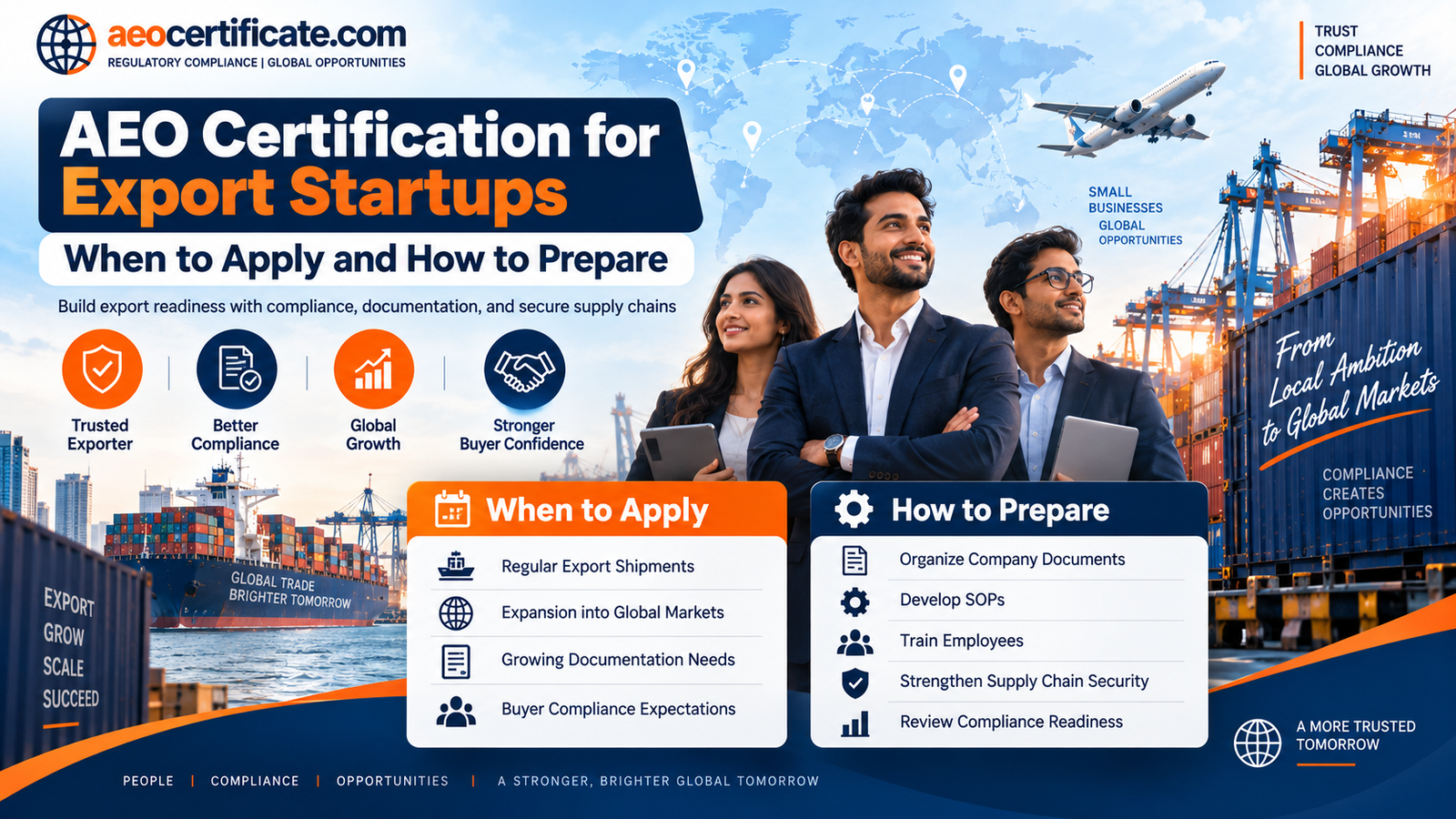
Starting an export business is an exciting opportunity, but entering international markets requires more than just finding overseas buyers. Export startups must build trust, maintain compliance, manage documentation, and ensure smooth customs operations.
AEO Certification for Export Startups is becoming an important compliance milestone for businesses that want to establish credibility in global trade. AEO (Authorized Economic Operator) certification recognizes businesses that demonstrate strong customs compliance, secure supply chain practices, and reliable operational systems.
For export startups, obtaining AEO certification at the right stage can help create a strong foundation for international expansion by improving compliance processes and strengthening relationships with customers, logistics partners, and customs authorities.
What is AEO Certification?
AEO Certification for Export Startups is a customs compliance certification provided to businesses that meet specific eligibility and security requirements under the Authorized Economic Operator program.
An AEO-certified business demonstrates:
- Strong customs compliance practices
- Proper documentation management
- Secure supply chain processes
- Risk management procedures
- Transparent business operations
In India, the AEO program is implemented by Indian Customs under CBIC to provide facilitation benefits to eligible businesses involved in international trade.
Why Should Export Startups Consider AEO Certification?
Many new exporters focus only on obtaining customers and completing shipments. However, long-term success in international markets depends on developing reliable compliance systems.
AEO Certification for Export Startups helps businesses create a structured approach towards:
Building International Buyer Confidence
Foreign buyers prefer working with suppliers who follow professional compliance practices. AEO certification demonstrates that the exporter follows organized procedures and maintains reliable operations.
Improving Customs Compliance
Export startups often face challenges related to:
- Documentation errors
- Incorrect declarations
- Lack of internal procedures
- Limited customs knowledge
AEO preparation encourages businesses to establish proper systems to manage these challenges.
Strengthening Supply Chain Management
International trade involves multiple stakeholders, including:
- Suppliers
- Manufacturers
- Transporters
- Warehouses
- Logistics partners
AEO certification encourages startups to develop secure and controlled supply chain processes.
When Should an Export Startup Apply for AEO Certification?
The timing of applying for AEO Certification for Export Startups depends on the business stage, export volume, compliance readiness, and future growth plans.
When the Startup Has Regular Export Activities
Export startups that have started regular international shipments should consider AEO certification.
Businesses involved in:
- Regular export shipments
- International customer contracts
- Global supply chains
- Overseas partnerships
can benefit from developing stronger compliance systems.
When the Startup Plans International Expansion
If an export startup plans to enter new international markets, AEO certification can support its growth strategy.
Large international buyers often evaluate suppliers based on:
- Compliance standards
- Operational reliability
- Supply chain security
Obtaining AEO certification early can help startups prepare for global business requirements.
When Customs Operations Become More Complex
As export businesses grow, customs activities become more complicated.
Startups should consider AEO certification when they experience:
- Increased shipment frequency
- Multiple export destinations
- Complex documentation requirements
- Higher logistics dependency
AEO systems help businesses manage these processes in a structured manner.
Is AEO Certification Suitable for New Export Startups?
Many startups believe AEO certification is only suitable for large exporters. However, eligible small and medium businesses can also apply if they meet the required conditions.
AEO Certification for Export Startups can be beneficial for businesses that want to:
- Build professional compliance systems
- Improve international credibility
- Develop long-term export strategies
- Participate in global supply chains
However, startups should first evaluate their readiness before applying.
Why AEO Certification is Important for Export Startups
New export businesses often face difficulty convincing foreign buyers about their reliability.
International customers generally evaluate exporters based on:
- Product quality
- Delivery reliability
- Compliance standards
- Business transparency
- Operational capability
AEO Certification for Export Startups helps businesses demonstrate that they follow professional export practices and maintain structured compliance systems.
This can help startups:
- Build confidence among foreign buyers
- Improve business reputation
- Participate in global supply chains
- Develop long-term partnerships
Moving From Informal Operations to Professional Systems
Many startups begin their AEO Certification for Export Startups journey with small teams. Initially, business activities may depend heavily on individual knowledge and experience.
However, as exports increase, businesses need organized systems.
Without proper processes, startups may face:
- Documentation mistakes
- Shipment delays
- Communication gaps
- Compliance issues
- Difficulty managing higher export volumes
AEO Certification for Export Startups encourages businesses to establish professional systems such as
- Document control procedures
- Export SOPs
- Employee responsibilities
- Internal review mechanisms
- Compliance monitoring systems
Eligibility Considerations for AEO Certification for Export Startups
Before applying for AEO Certification for Export Startups, businesses should evaluate important factors such as
Business Registration
The startup should have proper legal registration and required business documents.
Common documents include:
- Certificate of Incorporation
- PAN Card
- GST Registration
- Import Export Code (IEC)
Export Compliance History
Businesses should maintain proper records related to:
- Export transactions
- Shipping Bills
- Customs declarations
- Duty-related matters
Financial Stability
Export startups should maintain proper financial records demonstrating business stability.
Relevant documents may include:
- Audited financial statements
- Income tax records
- Financial reports
Internal Compliance Systems
Startups should develop procedures for:
- Export documentation
- Shipment handling
- Record maintenance
- Compliance monitoring
How to Prepare for AEO Certification as an Export Startup
Preparation is the most important stage before submitting an AEO application.
Conduct a Compliance Gap Assessment
Before applying, startups should review their existing systems.
The assessment should cover:
- Customs compliance
- Documentation practices
- Supply chain security
- Employee responsibilities
- Risk management procedures
A gap analysis helps identify areas requiring improvement.
Develop Standard Operating Procedures (SOPs)
AEO certification requires businesses to maintain structured procedures.
Export startups should prepare SOPs for:
- Export order processing
- Document verification
- Shipment management
- Vendor management
- Security controls
Well-defined SOPs demonstrate operational maturity.
Improve Documentation Management
Proper documentation is a key requirement for successful AEO preparation.
Startups should maintain records of:
- Export invoices
- Packing lists
- Shipping Bills
- Purchase documents
- Logistics records
- Customer details
Accurate documentation reduces compliance risks.
Train Employees on Compliance Requirements
Employees involved in export activities should understand:
- Customs procedures
- Documentation requirements
- Security practices
- Internal compliance policies
Regular training helps create a compliance-focused work culture.
Benefits of AEO Certification for Export Startups
AEO Certification for Export Startups helps businesses demonstrate reliability to:
- International buyers
- Logistics partners
- Global supply chain companies
Better Export Management
AEO preparation improves:
- Documentation control
- Process management
- Compliance monitoring
Improved Supply Chain Confidence
Strong security procedures help startups build dependable supply chain operations.
Competitive Advantage in International Markets
Export startups with structured compliance systems. AEO Certification for Export Startups can differentiate them from competitors and create stronger business relationships.
Common Mistakes Export Startups Should Avoid During AEO Preparation
The AEO Certification for Export Startups is based on the World Customs Organization (WCO) SAFE Framework of Standards, which promotes secure and efficient international trade.
Applying Without Compliance Readiness
Startups should first evaluate their systems before submitting an application.
Poor Documentation Management
Incomplete records can create challenges during assessment.
Lack of SOPs
Businesses should maintain documented procedures for export operations.
Ignoring Supply Chain Security
AEO certification focuses not only on customs compliance but also on secure trade practices.
Step-by-Step Process for AEO Certification for Export Startups
The general process includes:
Step 1: Eligibility Assessment
Review whether the startup meets AEO requirements.
Step 2: Compliance Gap Analysis
Identify gaps in documentation, procedures, and security systems.
Step 3: Documentation Preparation
Prepare company records, customs documents, SOPs, and security procedures.
Step 4: Application Submission
Submit the AEO Certification for Export Startups through the applicable customs process.
Step 5: Assessment and Verification
Customs authorities review the company’s compliance systems and operational practices.
Step 6: Grant of AEO Status
Eligible businesses receive AEO certification after successful assessment.
AEO Certification for Export Startups:
Many export startups focus primarily on increasing sales, finding international buyers, and expanding shipment volumes. However, sustainable export AEO Certification for export startup growth requires strong compliance systems along with business expansion.
AEO Certification for Export Startups helps businesses understand that export success is not only about shipping more products but also about maintaining:
- Accurate documentation
- Regulatory compliance
- Secure supply chain operations
- Internal process control
This section can explain how startups should develop compliance systems parallel to their export growth strategy.
Importance of Building Compliance Culture from the Beginning
Large exporters usually have AEO Certification for Export Startups dedicated compliance teams, but startups often manage export activities through small teams.
Building a compliance culture early helps startups avoid future operational challenges.
Discuss:
- Assigning compliance responsibilities
- Maintaining export records
- Following documented procedures
- Conducting regular internal reviews
- Training employees
Explain how AEO Certification for Export Startups encourages businesses to move from informal processes to structured operations.
How AEO Preparation Improves Business Process Management
AEO preparation requires startups to review their internal operations.
During preparation, businesses often improve:
- Order processing systems
- Documentation workflow
- Approval procedures
- Communication between departments
- Record maintenance
AEO Certification for Export Startups is not only a certification exercise but also an opportunity to improve overall business efficiency.
Role of Internal Audits Before Application
Before applying for AEO certification, startups should review their compliance status through internal audits.
Internal audits help identify:
- Documentation gaps
- Process weaknesses
- Missing records
- Compliance risks
Discuss how regular audits help businesses maintain continuous readiness for AEO assessment.
Importance of Export Risk Management
International trade involves multiple risks, including:
- Documentation errors
- Shipment delays
- Regulatory changes
- Supply chain disruptions
AEO certification encourages exporters to establish risk management systems.
Discuss:
- Identifying export risks
- Creating preventive measures
- Monitoring compliance issues
- Maintaining corrective action procedures
How to Maintain AEO Compliance After Approval
Obtaining AEO certification is not the final step. Businesses must continue maintaining compliance standards.
Discuss post-certification practices:
- Regular compliance monitoring
- Updating SOPs
- Employee training
- Maintaining proper records
- Reviewing security procedures
Continuous improvement is important after obtaining AEO status.
Importance of Supplier and Vendor Management
Export startups depend on multiple suppliers and service providers.
AEO Certification for Export Startups encourages businesses to evaluate their supply chain partners.
Discuss:
- Supplier verification
- Vendor documentation
- Partner reliability checks
- Communication procedures
Proper supplier management supports secure international trade operations.
Importance of Warehouse and Cargo Security
Supply chain security is an important part of AEO compliance.
Export startups should evaluate:
- Warehouse access controls
- Storage procedures
- Cargo handling practices
- Security monitoring systems
Secure cargo management helps reduce risks during AEO Certification for Export Startups’ international transportation.
Impact on Export Documentation Accuracy
Documentation mistakes are one of the common challenges faced by exporters.
Discuss common errors:
- Incorrect invoice details
- Wrong product descriptions
- Missing supporting documents
- Incorrect shipping information
AEO preparation helps startups establish document verification systems.
How AEO Certification Supports Long-Term Export Growth
AEO Certification for Export Startups is not only a customs approval but also a business improvement framework.
It helps startups develop:
- Better operational discipline
- Strong compliance culture
- Secure supply chains
- International credibility
Businesses that establish these systems early can manage future growth more effectively.
Documents Required for AEO Certification for Export Startups
Export startups generally need AEO Certification for export startups to prepare documents related to company details, customs compliance, financial position, and security procedures.
Important documents may include:
Company Documents
- Certificate of Incorporation
- PAN Card
- GST Certificate
- IEC Certificate
- Company profile
Customs Documents
- Export transaction details
- Shipping Bills
- Customs records
- Compliance history
Financial Documents
- Audited financial statements
- Income tax returns
- Financial records
Security and Compliance Documents
- SOPs
- Internal control procedures
- Supply chain security policies
- Employee training records
Final Checklist Before Applying for AEO Certification
Before submitting an application, export startups should check:
✔ Company documents are updated
✔ IEC and GST details are available
✔ Export records are maintained
✔ SOPs are prepared
✔ Employees are trained
✔ Security procedures are implemented
✔ Compliance gaps are reviewed
✔ Financial records are organized
Conclusion
AEO Certification for Export Startups provides an opportunity for new exporters to establish themselves as trusted participants in international trade.
For startups, AEO certification is not only about customs facilitation but also about creating professional business systems, improving compliance standards, and preparing for global expansion.
The right time to apply depends on business readiness, export activity, documentation practices, and growth plans.
By developing proper SOPs, maintaining accurate records, training employees, and strengthening supply chain security, export startups can successfully prepare for AEO certification and build a strong foundation for international success.
Frequently Asked Questions
Q.1 What is AEO Certification for Export Startups?
AEO Certification for Export Startups is a customs compliance certification that recognizes exporters with strong compliance and supply chain security practices.
Q.2 When should startups apply for AEO certification?
Startups should consider applying after establishing regular export operations and maintaining proper compliance systems.
Q.3 Is AEO certification mandatory for exporters?
No, AEO certification is voluntary but helps exporters improve credibility and compliance.
Q.4 Can small exporters apply for AEO certification?
Yes, eligible small and medium exporters can apply for AEO certification.
Q.5 What are the main benefits of AEO certification?
It helps improve compliance management, documentation systems, business credibility, and supply chain security.
Q.6 How can startups prepare for AEO certification?
Startups can prepare by conducting gap assessments, developing SOPs, maintaining records, training employees, and improving security procedures.