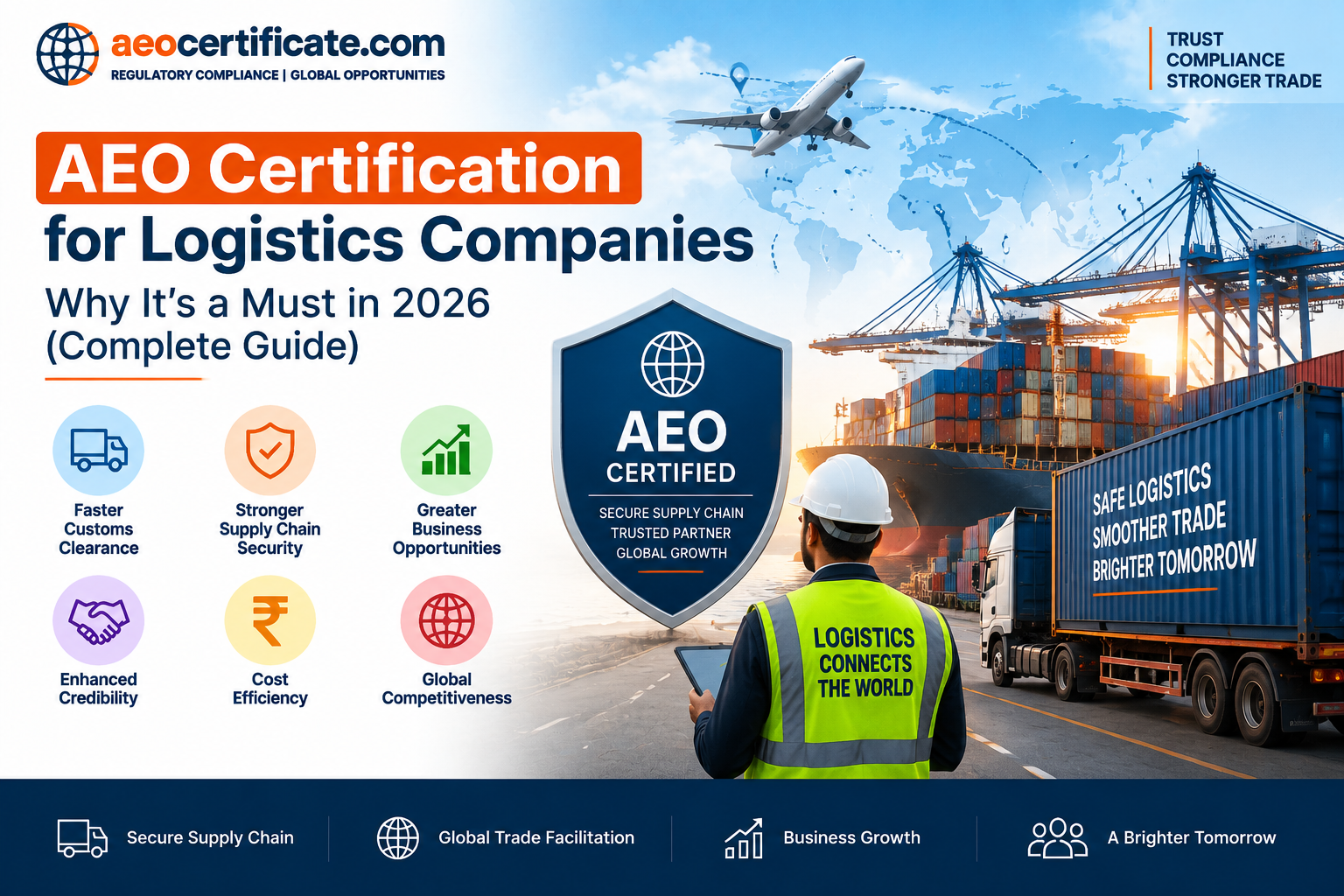
The logistics industry plays a critical role in international trade by connecting manufacturers, exporters, importers, and global supply chains. With increasing global trade activities, logistics companies are expected to maintain higher standards of compliance, security, and operational transparency.
In this changing trade environment, AEO Certification for Logistics Companies has become an important recognition for businesses involved in transportation, warehousing, freight forwarding, and supply chain management.
AEO (Authorised Economic Operator) certification helps logistics companies demonstrate their commitment towards customs compliance, supply chain security, and reliable trade practices. In 2026, as businesses focus more on secure and efficient supply chains, obtaining AEO status can provide logistics providers with a competitive advantage.
This complete guide explains the importance, benefits, eligibility, documentation, and process of AEO Certification for Logistics Companies in India.
What is AEO Certification?
AEO (Authorised Economic Operator) certification is a trade facilitation program introduced by customs authorities to recognize businesses that maintain strong compliance standards and secure supply chain practices.
An AEO-certified organization is considered a trusted partner in international trade because it follows:
- Customs compliance procedures
- Documented operational processes
- Risk management systems
- Supply chain security measures
The program applies to various stakeholders involved in global trade, including:
- Logistics companies
- Freight forwarders
- Customs brokers
- Transport operators
- Warehouse operators
- Importers and exporters
Why AEO Certification for Logistics Companies is Important in 2026
The logistics sector is becoming increasingly complex due to:
- Growth in international trade
- Higher customer expectations
- Increased supply chain risks
- Need for faster shipment movement
- Greater focus on compliance
Customers today prefer logistics partners who can provide secure, transparent, and reliable services.
AEO Certification for Logistics Companies helps logistics providers demonstrate that they follow internationally accepted compliance and security practices.
For logistics businesses handling global shipments, AEO certification can become an important step towards building trust and improving operational efficiency.
Benefits of AEO Certification for Logistics Companies
1. Improved Customs Facilitation
One of the major benefits of AEO Certification for logistics companies is improved customs facilitation.
AEO-certified companies may receive trade facilitation benefits that help improve customs procedures and shipment movement.
This can help logistics companies:
- Reduce operational delays
- Improve shipment turnaround time
- Support faster movement of goods
- Provide better service to customers
2. Enhanced Credibility Among Clients
Logistics companies operate in a highly competitive market where trust is essential.
AEO certification demonstrates that the company follows:
- Compliance procedures
- Security controls
- Proper documentation systems
This can improve confidence among:
- Exporters
- Importers
- Multinational companies
- International supply chain partners
For logistics providers, AEO status can become a valuable business credential.
3. Stronger Supply Chain Security
Modern logistics requires secure handling of goods from origin to destination.
AEO Certification for Logistics Companies focuses strongly on supply chain security measures, including:
- Cargo protection
- Warehouse security
- Transportation controls
- Access management
- Data security
These practices help logistics companies minimize risks and improve operational reliability.
4. Competitive Advantage in the Logistics Industry
Many businesses select logistics partners based on compliance capabilities and reliability.
AEO-certified logistics companies can differentiate themselves by demonstrating:
- Professional systems
- Secure operations
- Regulatory commitment
This can help logistics providers strengthen their position while competing for international contracts.
5. Better Relationship with Customs Authorities
AEO certification establishes a partnership approach between customs authorities and businesses.
For logistics companies, maintaining AEO status shows commitment towards:
- Transparent operations
- Accurate documentation
- Compliance management
This can support smoother interactions with customs authorities.
6. Improved Internal Management Systems
Preparing for AEO Certification for Logistics Companies requires businesses to evaluate and improve their existing processes.
Companies may develop better systems for:
- Shipment documentation
- Record maintenance
- Employee responsibilities
- Security management
- Risk assessment
These improvements help create more organized business operations.
7. Increased Customer Trust
Global businesses prefer working with logistics providers who can ensure safe and compliant movement of goods.
AEO certification helps logistics companies communicate their reliability and commitment towards secure trade practices.
This can support:
- Long-term customer relationships
- International partnerships
- Business expansion opportunities
Who Can Apply for AEO Certification in the Logistics Sector?
AEO Certification for Logistics Companies can be applicable to various logistics-related businesses, including:
1. Freight Forwarders
Companies managing international transportation arrangements can benefit from AEO recognition.
2. Customs Brokers
Customs brokers involved in clearance activities can strengthen their compliance systems through AEO certification.
3. Transport Operators
Transport companies handling domestic and international cargo movement can apply if they meet the requirements.
4. Warehouse Operators
Companies providing storage and distribution services can demonstrate their security controls through AEO certification.
5. Third-Party Logistics Providers (3PL)
3PL companies managing complete supply chain solutions can use AEO certification to improve customer confidence.
Eligibility Requirements for AEO Certification for Logistics Companies
Before applying, logistics companies should ensure they meet the required conditions.
Generally, businesses should maintain:
1. Proper Business Registration
- Valid company registration
- GST registration
- PAN details
- Import Export Code (where applicable)
2. Customs Compliance History
Companies should maintain:
- Proper customs records
- Accurate documentation
- Compliance with customs regulations
3. Security Practices
Businesses should implement:
- Access control systems
- Warehouse security procedures
- Employee verification processes
- Data protection measures
4. Documented Procedures
Companies should maintain written SOPs related to:
- Shipment handling
- Security management
- Documentation control
- Risk management
AEO Certification Process for Logistics Companies
Step 1: Evaluate Eligibility
The company should review its compliance status and operational practices.
Step 2: Prepare Documentation
Collect required documents, SOPs, and security records.
Step 3: Submit AEO Application
Complete the application forms and submit supporting documents.
Step 4: Customs Assessment
Customs authorities review the application and may conduct verification.
Step 5: Grant of AEO Status
After successful assessment, eligible businesses receive AEO certification.
How Logistics Companies Can Prepare for AEO Certification
1. Develop Proper SOPs
Create written procedures for:
- Cargo handling
- Documentation
- Security controls
- Employee responsibilities
2. Train Employees
Employees should understand:
- Compliance requirements
- Security procedures
- Documentation practices
3. Maintain Records
Proper records should be maintained for:
- Shipments
- Audits
- Training
- Security checks
4. Conduct Internal Reviews
Regular reviews help identify gaps before the official assessment.
Common Challenges During AEO Certification
1. Lack of Documentation
Many logistics companies follow good practices but do not maintain proper written records.
2. Weak Security Procedures
Companies may need to improve:
- Access controls
- Warehouse security
- Data protection systems
3. Inconsistent Processes
Different departments following different procedures can create compliance gaps.
Why AEO Certification is a Must for Logistics Companies in 2026
The future of logistics depends on secure, transparent, and technology-driven supply chains.
AEO Certification for Logistics Companies provides a framework for businesses to improve compliance, strengthen security, and build trust with global partners.
For logistics providers planning growth in 2026, AEO certification can support:
- Better operational control
- Improved customer confidence
- Stronger market reputation
- Global business opportunities
Importance of Compliance in the Logistics Industry
The logistics industry operates across multiple stakeholders, including manufacturers, exporters, importers, customs authorities, transporters, and warehouse operators. Due to this interconnected system, even a small compliance issue can impact the complete supply chain.
AEO Certification for Logistics Companies helps businesses develop structured compliance practices by focusing on:
- Accurate documentation
- Secure cargo movement
- Proper record maintenance
- Risk management
- Transparent operations
For logistics companies handling international shipments, compliance is not only a regulatory requirement but also a factor that influences customer trust and business growth.
How AEO Certification Improves Logistics Operations
AEO certification encourages logistics companies to review and improve their daily operations.
1. Better Documentation Management
Logistics companies handle a large number of documents, including:
- Shipping documents
- Transportation records
- Customs paperwork
- Delivery records
- Customer documentation
AEO compliance encourages businesses to maintain proper document control systems, reducing errors and improving efficiency.
2. Improved Risk Management
Risk management is an important part of international trade.
Through AEO Certification for Logistics Companies, businesses develop systems to identify and manage risks related to:
- Cargo security
- Unauthorized access
- Documentation errors
- Supply chain disruptions
A proper risk management approach helps companies maintain smooth operations.
Role of Technology in AEO Compliance for Logistics Companies
Technology has become an essential part of modern logistics operations.
Logistics companies can use technology solutions for:
Shipment Tracking
Real-time tracking helps improve visibility and control over cargo movement.
Digital Documentation
Electronic document management helps maintain accurate records and reduces paperwork.
Access Management
Digital security systems help control access to warehouses and operational areas.
Data Protection
IT security systems help protect sensitive business and customer information.
The use of technology supports businesses in meeting the requirements of AEO Certification for Logistics Companies.
AEO Certification and International Supply Chain Standards
Global supply chains require businesses to follow reliable security and compliance practices.
AEO certification aligns logistics companies with the concept of trusted trade partnerships.
It helps companies demonstrate:
- Secure supply chain management
- Compliance commitment
- Operational reliability
- Professional business practices
This makes AEO certification valuable for logistics companies working with international clients.
How AEO Certification Helps 3PL Companies
Third-party logistics (3PL) providers manage multiple activities such as
- Transportation
- Warehousing
- Distribution
- Inventory management
For 3PL companies, AEO Certification for Logistics Companies can help strengthen their market position.
Benefits include:
- Increased customer confidence
- Better compliance systems
- Improved supply chain management
- Enhanced business reputation
Many global companies prefer logistics partners who maintain strong compliance frameworks.
Benefits of AEO Certification for Freight Forwarders
Freight forwarders coordinate international shipments and manage multiple trade-related activities.
AEO certification can help freight forwarders by:
- Improving credibility with exporters and importers
- Demonstrating secure handling practices
- Strengthening relationships with business partners
- Supporting efficient shipment management
For freight forwarding businesses, AEO status can become a valuable competitive advantage.
Security Measures Required Under AEO Certification
Security is one of the key areas evaluated during the AEO assessment.
Logistics companies should focus on:
Physical Security
- CCTV surveillance
- Controlled entry points
- Restricted access areas
- Security monitoring
Cargo Security
- Proper cargo handling procedures
- Shipment verification systems
- Protection against unauthorized access
Employee Security
- Employee verification
- Defined responsibilities
- Security awareness training
Information Security
- Data protection systems
- User access control
- Backup procedures
AEO Certification Preparation Checklist for Logistics Companies
Before applying for AEO Certification for Logistics Companies, businesses should review the following:
✅ Company registration documents are updated
✅ Customs records are properly maintained.
✅ Logistics SOPs are prepared
✅ Security policies are implemented
✅ Employee training records are available
✅ Warehouse security measures are documented
✅ Transportation procedures are defined
✅ Internal compliance checks are conducted
How AEO Certification Supports Long-Term Business Growth
AEO certification is not only about obtaining approval; it encourages businesses to create a culture of compliance.
Long-term advantages include:
- Better operational control
- Improved customer relationships
- Stronger business reputation
- Easier expansion into international markets
For logistics companies planning future growth, compliance-based operations can provide a strong foundation.
Importance of Compliance in the Logistics Industry
The logistics industry operates across multiple stakeholders, including manufacturers, exporters, importers, customs authorities, transporters, and warehouse operators. Due to this interconnected system, even a small compliance issue can impact the complete supply chain.
AEO Certification for Logistics Companies helps businesses develop structured compliance practices by focusing on:
- Accurate documentation
- Secure cargo movement
- Proper record maintenance
- Risk management
- Transparent operations
For logistics companies handling international shipments, compliance is not only a regulatory requirement but also a factor that influences customer trust and business growth.
How AEO Certification Improves Logistics Operations
AEO certification encourages logistics companies to review and improve their daily operations.
1. Better Documentation Management
Logistics companies handle a large number of documents, including:
- Shipping documents
- Transportation records
- Customs paperwork
- Delivery records
- Customer documentation
AEO compliance encourages businesses to maintain proper document control systems, reducing errors and improving efficiency.
2. Improved Risk Management
Risk management is an important part of international trade.
Through AEO Certification for Logistics Companies, businesses develop systems to identify and manage risks related to:
- Cargo security
- Unauthorized access
- Documentation errors
- Supply chain disruptions
A proper risk management approach helps companies maintain smooth operations.
Role of Technology in AEO Compliance for Logistics Companies
Technology has become an essential part of modern logistics operations.
Logistics companies can use technology solutions for:
Shipment Tracking
Real-time tracking helps improve visibility and control over cargo movement.
Digital Documentation
Electronic document AEO Certification for logistics company management helps maintain accurate records and reduces paperwork.
Access Management
Digital security systems help control access to warehouses and operational areas.
Data Protection
IT security systems help protect sensitive business and customer information.
The use of technology supports businesses in meeting the requirements of AEO Certification for Logistics Companies.
AEO Certification and International Supply Chain Standards
Global supply chains require businesses to follow reliable security and compliance practices.
AEO Certification for Logistics Companies aligns logistics companies with the concept of trusted trade partnerships.
It helps companies demonstrate:
- Secure supply chain management
- Compliance commitment
- Operational reliability
- Professional business practices
This makes AEO certification valuable for logistics companies working with international clients.
How AEO Certification Helps 3PL Companies
Third-party logistics (3PL) providers manage multiple activities such as:
- Transportation
- Warehousing
- Distribution
- Inventory management
For 3PL companies, AEO Certification for Logistics Companies can help strengthen their market position.
Benefits include:
- Increased customer confidence
- Better compliance systems
- Improved supply chain management
- Enhanced business reputation
Many global companies prefer logistics partners who maintain strong compliance frameworks.
Benefits of AEO Certification for Freight Forwarders
Freight forwarders coordinate international shipments and manage multiple trade-related activities.
AEO certification can help freight forwarders by:
- Improving credibility with exporters and importers
- Demonstrating secure handling practices
- Strengthening relationships with business partners
- Supporting efficient shipment management
For freight forwarding businesses, AEO Certification for Logistics Companies can become a valuable competitive advantage.
Security Measures Required Under AEO Certification
Security is one of the key areas evaluated during the AEO assessment.
Logistics companies should focus on:
Physical Security
- CCTV surveillance
- Controlled entry points
- Restricted access areas
- Security monitoring
Cargo Security
- Proper cargo handling procedures
- Shipment verification systems
- Protection against unauthorized access
Employee Security
- Employee verification
- Defined responsibilities
- Security awareness training
Information Security
- Data protection systems
- User access control
- Backup procedures
AEO Certification Preparation Checklist for Logistics Companies
Before applying for AEO Certification for Logistics Companies, businesses should review the following:
✅ Company registration documents are updated
✅ Customs records are properly maintained
✅ Logistics SOPs are prepared
✅ Security policies are implemented
✅ Employee training records are available
✅ Warehouse security measures are documented
✅ Transportation procedures are defined
✅ Internal compliance checks are conducted
Documents Required for AEO Certification for Logistics Companies
The documentation AEO Certification for Logistics Companies requirements generally include:
Company Documents
- Certificate of Incorporation
- PAN Card
- GST Registration Certificate
- IEC Certificate (if applicable)
- Company profile
- Organizational structure
Operational Documents
- Logistics process flow
- Shipment handling procedures
- Warehouse details
- Transportation procedures
- Customer management process
How AEO Certification Supports Long-Term Business Growth
AEO certification is not only about obtaining approval; it encourages businesses to create a culture of compliance.
Long-term advantages include:
- Better operational control
- Improved customer relationships
- Stronger business reputation
- Easier expansion into international markets
For logistics companies planning future growth, compliance-based operations can provide a strong foundation.
Conclusion
AEO Certification for Logistics Companies is becoming increasingly important in the modern international trade environment. It helps logistics providers demonstrate compliance, strengthen supply chain security, and establish themselves as trusted trade partners.
By implementing proper documentation systems, security procedures, and compliance practices, logistics companies can successfully achieve AEO certification and prepare themselves for future growth in global markets.
For logistics businesses looking to expand their services and build long-term credibility, AEO certification can be a valuable strategic step in 2026.
Frequently Asked Questions
Q1. Is AEO certification beneficial for freight forwarding companies?
Yes, freight forwarders can improve credibility and demonstrate secure trade practices through AEO certification.
Q2. Does AEO certification help logistics companies attract international clients?
Yes, AEO status can improve confidence among international customers and supply chain partners.
Q3. What is the main focus of AEO certification for logistics companies?
The main focus is customs compliance, supply chain security, and risk management.
Q4. Can warehouse operators apply for AEO certification?
Yes, eligible warehouse operators involved in international supply chains can apply.
Q5. How can logistics companies prepare for AEO certification?
Companies should develop SOPs, maintain records, implement security measures, and review compliance practices.