
India is one of the world’s growing export markets, with thousands of businesses supplying products to international buyers. Not every exporter of AEO Certification for merchant exporters in India manufactures the products they sell. Many businesses operate as merchant exporters, purchasing finished goods from manufacturers, suppliers, or traders and exporting them to overseas customers.
Although merchant exporters play an important role in international trade, they must manage several responsibilities, including customs documentation, supplier coordination, shipping arrangements, export compliance, and international transportation.
To support secure and efficient international trade, the Central Board of Indirect Taxes and Customs (CBIC) introduced the Authorized Economic Operator (AEO) Programme in India.
AEO Certification for Merchant Exporters in India provides an opportunity for eligible exporting businesses to become recognised participants in the international supply chain.
An AEO certificate recognises businesses that demonstrate appropriate customs compliance, proper record management, and reliable supply chain practices.
Whether you operate an export trading company, merchant export business, or export house, understanding AEO certification can help you improve your export operations and access applicable customs facilitation benefits.
In this complete guide, we will explain the eligibility criteria, benefits, documents, certification categories, and application process for merchant exporters in India.
What Is AEO Certification for Merchant Exporters in India?
AEO stands for Authorized Economic Operator. It is a voluntary certification program administered by Indian Customs under CBIC.
The program identifies businesses involved in the international supply chain that demonstrate a strong compliance record and appropriate security practices.
For merchant exporters, AEO Certification for Merchant Exporters in India is particularly relevant because their business activities involve purchasing products from Indian manufacturers or suppliers and exporting them to international customers.
For example, a merchant exporter purchasing textile products from an Indian manufacturer and exporting them to the United States, Europe, or the Middle East may qualify for AEO certification in Europe if the prescribed eligibility conditions are satisfied.
The program aims to:
- Improve international supply chain security.
- Encourage customs compliance.
- Reduce unnecessary customs delays.
- Support faster and more predictable cargo clearance.
- Improve cooperation between businesses and customs authorities.
- Promote ease of doing business in international trade.
Important: A merchant exporter does not need to own a manufacturing facility to explore AEO certification. Eligibility depends on its role in the international supply chain and compliance with the applicable conditions.
Who Is a Merchant Exporter?
A merchant exporter is an AEO Certification for Merchant Exporters in India, a business or individual entity that purchases goods from manufacturers, suppliers, or other businesses and exports those products to overseas buyers.
Unlike manufacturer exporters, merchant exporters generally do not manufacture the products themselves.
Their primary responsibilities include:
- Identifying international buyers.
- Purchasing products from Indian manufacturers.
- Negotiating prices with suppliers.
- Managing export orders.
- Arranging transportation and logistics.
- Preparing export documentation.
- Coordinating customs clearance.
- Delivering products to international customers.
For example, a merchant exporter may purchase pharmaceutical products, garments, engineering goods, agricultural products, or automobile components from Indian manufacturers and export them to foreign markets.
Since merchant exporters participate directly in international trade and customs-related activities, they can explore AEO certification under the applicable importer-exporter categories.
AEO Certification Eligibility Criteria for Merchant Exporters in India
Understanding the eligibility conditions is the first step before applying for an AEO certificate.
Merchant exporters must satisfy the prescribed requirements under the Indian AEO Program.
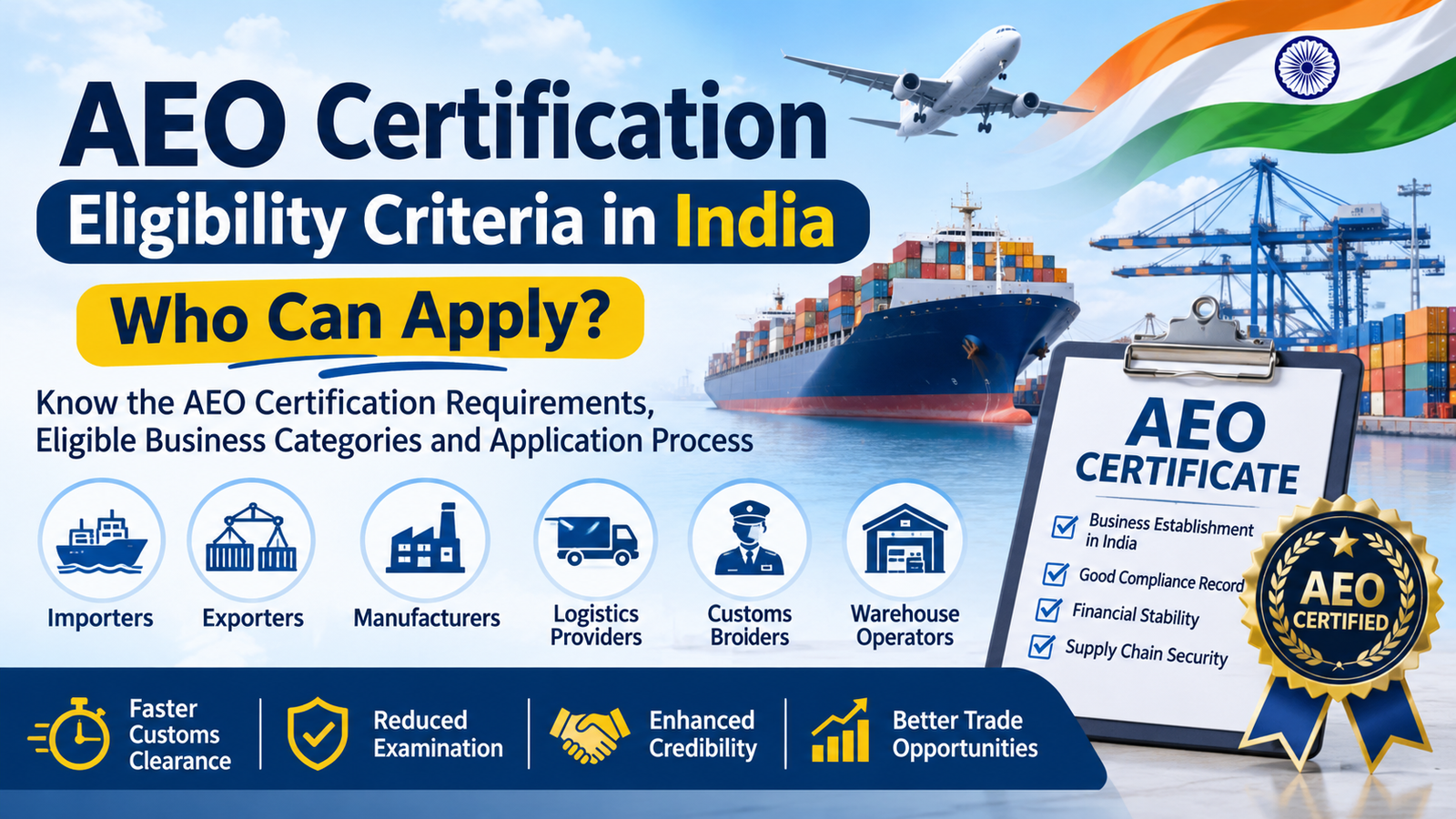
A. Business Establishment in India
The applicant must be an entity established in India.
The business should maintain AEO Certification for Merchant Exporters in India valid registration and identification documents, such as
- Certificate of Incorporation, where applicable.
- PAN Card.
- GST Registration Certificate.
- Importer Exporter Code (IEC).
- Business address and registration details.
B. Involvement in International Supply Chain Activities
The merchant exporter must undertake customs-related activities in India.
For example, exporting products through customs procedures and maintaining relevant shipping bills can demonstrate involvement in international trade.
C. Business Experience
Generally, the applicant should have at least three financial years of business activity preceding the application.
Eligible MSME applicants receive a relaxation to two financial years, subject to applicable conditions.
D. Customs Documentation
Applicants must maintain appropriate customs transaction records.
The AEO Certification for Merchant Exporters in India framework includes transaction-document requirements. The official applicant guidance identifies a general threshold of 25 customs documents in the preceding financial year, with a relaxation to 10 for eligible MSME applicants under the relevant criteria.
The applicable current checklist should be checked before filing.
E. Financial Solvency
The merchant exporter should demonstrate financial stability and the ability to meet its financial obligations.
Relevant records may include audited financial statements, balance sheets, and other supporting financial information.
F. Compliance History
The applicant should maintain an appropriate record of compliance with applicable customs and other relevant laws.
G. Proper Record Management
The business should maintain accurate and auditable records of export orders, invoices, supplier transactions, shipping bills, transportation, and other relevant commercial activities.
H. Security and Internal Controls
Applicants under AEO Certification for Merchant Exporters in India and other applicable higher categories must demonstrate the required safety and security controls.
These may include documented operating procedures, access control, employee identification, and appropriate cargo security arrangements.
Can Merchant Exporters Apply for AEO-T1, AEO-T2, and AEO-T3?
Yes. Eligible merchant exporters can explore AEO certification under the importer-exporter categories.
Understanding the different certification levels helps businesses select the appropriate category.
AEO-T1 Certification
AEO-T1 is the AEO Certification for Merchant Exporters in India, an entry-level certification for eligible importers and exporters.
It is suitable for merchant exporters looking to establish their customs compliance credentials and access applicable facilitation benefits.
AEO-T2 Certification
AEO-T2 is intended for eligible importers and exporters that satisfy additional compliance and safety and security requirements.
Merchant exporters with established internal procedures and documented security arrangements can consider this category.
AEO-T3 Certification
AEO-T3 is the higher certification category for eligible AEO Certification for Merchant Exporters in India holders that meet the prescribed additional requirements.
It provides enhanced customs facilitation benefits.
AEO-LO Certification
AEO-LO is designed for eligible logistics operators and other qualifying supply chain participants.
A merchant exporter should not apply for AEO-LO simply because it arranges transportation or uses a third-party warehouse. Its actual role must meet the applicable logistics-operator criteria.
Benefits of AEO Certification for Merchant Exporters in India
Obtaining an AEO Certification for Merchant Exporters in India can provide several advantages to eligible merchant exporters.
1. Faster Customs Clearance
Customs clearance is an important part of the export process.
Eligible AEO entities may receive facilitation measures that help reduce cargo release time and improve shipment planning.
2. Reduced Cargo Examination
Depending on the AEO Certification for Merchant Exporters in India category and applicable procedures, AEO entities may benefit from reduced levels of routine cargo examination.
This can support more predictable export operations.
3. Priority Customs Treatment
AEO certification can provide priority treatment under applicable customs facilitation measures.
This can be useful for businesses handling regular export shipments.
4. Better International Trade Credibility
An AEO certificate demonstrates that the business has been recognised under the Indian Customs AEO Program.
It can strengthen the company’s credibility among overseas buyers, suppliers, and international business partners.
5. Mutual Recognition Benefits
India has entered into AEO Mutual Recognition Arrangements (MRAs) with participating countries.
Eligible AEO businesses may receive facilitation benefits in partner countries under the relevant arrangements.
6. Improved Supply Chain Management
AEO compliance encourages businesses to maintain AEO Certification for merchant exporters in India,, with proper documentation, supplier records, security procedures, and internal controls.
These practices can improve overall export management.
7. Better Business Opportunities
For merchant exporters working with international customers, maintaining recognised customs compliance standards can support stronger business relationships and supply chain confidence.
Documents Required for AEO Certification for Merchant Exporters
Documentation plays a significant role in the AEO Certification for Merchant Exporters in India process.
Merchant exporters should prepare their business, financial, customs, and operational records before submitting an application.
Commonly relevant documents include:
| Document | Purpose |
| Certificate of Incorporation | Business establishment proof |
| PAN Card | Business identification |
| GST Registration Certificate | Tax registration |
| IEC Certificate | Import-export identification |
| Audited Financial Statements | Financial solvency |
| Income Tax Returns | Tax compliance |
| Shipping Bills | Export transaction evidence |
The exact checklist depends on the selected AEO category and the applicant’s business structure.
Applicants should follow the latest official AEO portal checklist.
How Merchant Exporters Can Prepare for AEO Certification
Before submitting an application, merchant exporters seeking AEO Certification for Merchant Exporters in India should review their internal business operations.
The following activities can help improve application readiness.
A. Organize Export Documentation
Maintain accurate shipping bills, commercial invoices, purchase orders, packing lists, and transportation documents.
B. Maintain Supplier Records
Since merchant exporters purchase goods from manufacturers and suppliers, maintaining proper supplier records is important.
Keep relevant supplier details, purchase records, and transaction information organized.
C. Establish Standard Operating Procedures
Prepare documented procedures for export order management, procurement, documentation, transportation, and customs compliance.
D. Improve Record Management
Ensure that export transactions can be AEO Certification for Merchant Exporters in India traced through relevant commercial and customs records.
E. Review Business Partner Security
Evaluate relevant suppliers, transporters, freight forwarders, and other business partners involved in the international supply chain.
F. Conduct an Internal Compliance Review
Review your customs records, financial information, operating procedures, and applicable security arrangements before submitting the application.
Step-by-Step Process to Apply for an AEO Certificate in India
Merchant exporters can follow these general steps to apply for AEO certification.
Step 1: Check Eligibility
Evaluate whether your business is established in India, undertakes customs-related activities, and meets the prescribed eligibility requirements.
Step 2: Select the Appropriate AEO Category
Choose the appropriate category, such as AEO-T1 or AEO-T2, according to your business activities and compliance readiness.
Step 3: Prepare Required Documents
Collect business registration details, AEO Certification for Merchant Exporters in India details, financial statements, shipping bills, export records, and other applicable documents.
Step 4: Review Internal Compliance
Check your customs documentation, supplier records, financial information, and standard operating procedures.
Step 5: Submit the Application
Register and submit the applicable application through the official Indian AEO portal.
Common Challenges Faced by Merchant Exporters During AEO Applications
Merchant exporters often coordinate with AEO Certification for Merchant Exporters in India with several suppliers, manufacturers, transporters, and international customers.
This can create documentation and compliance challenges.
Some common issues include:
- Incomplete Shipping Bill records.
- Inconsistent business registration information.
- Poor supplier documentation.
- Missing purchase and sales invoices.
- Inadequate record management procedures.
- Missing evidence supporting documented operating procedures.
- Delayed responses to Customs clarification requests.
Merchant exporters should ensure that their actual business practices are properly documented and supported by relevant records.
Why Choose Professional AEO Certification Consultants in India?
Applying for an AEO Certification for Merchant Exporters in India requires a proper understanding of customs regulations, eligibility conditions, documentation, and compliance requirements.
For merchant exporters, preparing the application while managing regular export operations can be challenging.
Professional AEO certification consultants can assist with:
- Understanding AEO eligibility requirements.
- Selecting the appropriate certification category.
- Preparing application documentation.
- Reviewing customs transaction records.
- Organizing internal compliance procedures.
- Identifying documentation gaps.
- Preparing for verification and assessment.
- Understanding post-certification compliance responsibilities.
ELT Corporate provides AEO certification consultancy and regulatory compliance assistance for eligible businesses in India.
Whether you operate a merchant export company, export trading business, or international trading organization, professional guidance can help you understand the AEO application requirements.
Visit https://aeocertificate.com/ to explore AEO certification consultancy services.
Conclusion
AEO Certification for Merchant Exporters in India provides an opportunity for eligible trading businesses to strengthen their customs compliance and improve their participation in international supply chains.
Merchant exporters do not need to own manufacturing facilities to explore AEO certification. They must demonstrate their involvement in customs-related activities, maintain proper export records, and fulfill the prescribed eligibility conditions.
An AEO Certification for Merchant Exporters in India, including eligibility, documents, benefits, the application process and how to obtain an AEO certificate. can help eligible exporters access customs facilitation benefits, improve business credibility, and strengthen international trade operations.
If you operate a merchant export business and want to understand the AEO application process, assessing your eligibility is the first step.
Frequently Asked Questions
Q1. Can merchant exporters apply for AEO certification in India?
Yes. Merchant exporters involved in customs-related international supply chain activities can apply for AEO certification.
Q2. Is manufacturing mandatory for obtaining an AEO certificate?
No. Merchant exporters do not goods from manufacturers and export them can also explore AEO certification.
Q3. Which AEO category is suitable for merchant exporters?
Eligible merchant exporters can apply for AEO-T1 or AEO-T2. AEO-T3 is available to eligible AEO-T2 holders who meet the additional prescribed conditions.
Q4. Can a merchant exporter apply for AEO-T1 directly?
Yes. Eligible merchant exporters can apply directly for AEO-T1 if they satisfy the applicable requirements.
Q5. What is the minimum business experience required for AEO certification?
Generally, three financial years of business activity are required. Eligible MSME applicants receive a relaxation of the applicable conditions.