Most businesses that fail at AEO certification do not fail because of the application. They fail because of what happened — or did not happen — in the weeks before the application was filed.
Compliance gaps discovered during CBIC’s review. Security documentation that does not match the actual facility. SOPs that exist on paper but not in practice. SCN history that should have been assessed months earlier. Business partners without AEO-LO status, discovered too late.
These are not documentation problems. They are preparation problems — and they are entirely avoidable with the right 90-day implementation plan.
This roadmap gives you a structured, week-by-week framework to get your organisation genuinely ready for AEO certification — not just paperwork-ready, but operationally ready — before a single form is submitted to CBIC.
Important note: This roadmap is designed for AEO-T1 and AEO-T2 applicants. AEO-T3 applicants are generally expected to hold AEO-T2 status for at least two years with a strong compliance track record before seeking T3 accreditation. The 90-day framework applies to T3 preparation after that threshold is met. MSME applicants will find several stages significantly faster due to relaxed documentation requirements.
Before You Begin: Understanding What AEO Actually Requires
AEO certification is not an audit of your paperwork. It is an assessment of your organisation across five dimensions — and your preparation must address all five:
| Dimension | What CBIC Assesses | Relevant Tier |
| Customs Compliance | Trade history, SCN record, GST/IEC compliance, duty payment record | T1, T2, T3 |
| Financial Solvency | Net worth, current assets, financial stability, solvency certificate | T1, T2, T3 |
| Physical Security | Access control, CCTV, cargo handling, restricted areas, visitor management | T2, T3 (site inspection) |
| Trade Partner Security | Business partner vetting, supplier/buyer risk assessment | T2, T3 |
| Procedural Documentation | SOPs, process maps, site layouts, security plans, staff training records | T2, T3 |
For AEO-T2 and T3 applicants, Annexure B — the Security Questionnaire — must be submitted along with Annexure A (the primary application form). T3 applicants are also generally required to provide additional compliance, security, and business partner documentation, including Annexure F relating to business partner compliance.
Phase 1: Assessment & Diagnosis (Days 1–30)
The first 30 days are entirely internal. No forms. No portal. No applications. Just an honest, structured assessment of where your organisation actually stands against AEO requirements – and where the gaps are.
This phase is the most important of the three. Businesses that skip it and go straight to filing are the ones that get CBIC deficiency notices within 30 days of submission.
Week 1: Eligibility Verification
Start with a binary question: are you currently eligible to apply?
For all applicants, verify:
- Valid IEC (Import Export Code) — must be active and in good standing
- Valid GST registration — with all returns filed and no outstanding dues
- Customs activity record — minimum 25 customs documents in the last financial year (or 10 for MSME applicants — at least 5 per half-year)
- Business existence — minimum 3 financial years of operations (2 years for MSME applicants)
- Positive net worth and net current assets in the previous financial year
SCN Review — Do This Carefully:
Pull your complete Show Cause Notice history for the last 3 years from CBIC’s records. Serious SCNs involving fraud, misdeclaration, suppression of facts, or willful misstatement may negatively impact AEO eligibility. Applicants should maintain a clean compliance record with no serious customs or GST violations involving fraud, smuggling, willful misstatement, or suppression of facts. If you have active SCNs, assess their status with legal counsel before proceeding.
MSME Status Check:
MSME applicants benefit from relaxed eligibility — a minimum of 10 customs clearance documents in one year (vs higher thresholds for non-MSMEs), a lower documentary burden, and simplified compliance norms. For AEO-T1 MSME applications with complete electronic documentation, CBIC aims to process them within 15 days of submission. Confirm your MSME certificate is active and current.
Week 2: Trade Compliance Audit
Compile and review your customs compliance record systematically:
- Bills of Entry & Shipping Bills — pull the last 2–3 years from ICEGATE. Look for any inconsistencies, mismatch in declared values, or classification disputes
- Duty Payment History — verify no outstanding duty demands or undisputed arrears
- Advance Authorisations / EPCG — if applicable, check export obligation fulfillment status and DGFT compliance
- GST Returns—confirm all GSTR-1, GSTR-3B filed on time with no significant reconciliation gaps
- IEC Profile on DGFT portal — verify all details are current, address matches, authorised signatory is correct
Document everything you find. Issues resolved internally now are far easier to manage than deficiencies raised later by CBIC during review.
Week 3: Financial Solvency Assessment
AEO requires demonstration of financial solvency. Prepare:
- Last 2–3 years of audited financial statements
- Solvency certificate from your bank (typically required for T2 applications)
- Net worth assessment—applicants are generally expected to demonstrate positive financial standing
- Current ratio assessment—current assets vs current liabilities
If your financials show weakness in any area, consult your CA on whether this needs to be addressed before applying or whether it can be adequately explained in your application.
Week 4: Security Infrastructure Gap Analysis
For AEO-T1, this is a self-declaration exercise. For AEO-T2 and T3, these controls are commonly verified during on-site validation by CBIC officers for T2/T3 applicants. A strong security management system covering physical security, IT security, cargo security, transport conveyance security, and HR security is required.
Walk through your facility and document the current status against each category:
| Security Area | What to Check | |
| Physical Security | Perimeter security, access control, entry/exit logs, security personnel | |
| CCTV Coverage | Coverage of entry/exit points, cargo areas, storage, loading/unloading | |
| Cargo Security | Cargo sealing procedures, tamper-evident packaging, cargo counting records | |
| Visitor Management | Visitor register, ID verification, escort procedures, restricted areas signage | |
| IT Security | System access controls, password policies, data backup, authorised user lists | |
| HR Security | Background verification for new hires, employee ID system, exit procedures | |
| Transport Security | Vehicle access logs, driver verification, vehicle security checks |
Phase 2: Remediation & Documentation (Days 31–60)
Phase 2 is where you close the gaps identified in Phase 1 — and build the documentation package that will form your application dossier. These two workstreams run in parallel.
Days 31–40: Close Compliance and Security Gaps
Compliance Remediation:
- Resolve any outstanding GST issues — file pending returns, clear undisputed dues
- Update IEC profile on DGFT portal if any details are outdated
- Ensure authorised signatory’s Digital Signature Certificate (DSC) is valid — required for AEO portal submission
- Address any minor customs compliance gaps identified in Week 2
Physical Security Upgrades (T2/T3):
- Install or repair CCTV coverage gaps — ensure all cargo areas and entry/exit points are covered
- Implement visitor register and ID verification procedure if not already in place
- Create restricted area signage and access control documentation
- Establish formal cargo sealing and counting procedures with written records
- Set up employee background verification process for new hires
IT Security:
- Document system access control policy — who has access to what, with what authorisation
- Establish formal password policy and data backup procedure
- Create authorised user list for all business-critical systems
Days 41–55: SOP and Documentation Preparation
This is the most documentation-intensive part of the roadmap. Necessary documents include SOPs, self-declarations, site layouts, and compliance records. For T2 and T3 applicants, financial records, security protocols, and process maps must all be prepared.
Build each document in this order:
- Site Layout / Facility Map
A to-scale floor plan of your premises showing: entry/exit points, cargo storage areas, restricted areas, CCTV camera positions, security personnel positions, office areas, loading/unloading bays. Must be current and accurately reflect the physical facility. - Import/Export Process Map
A flowchart showing your complete import/export process — from purchase order to customs clearance to delivery. Include: who handles each step, what documents are generated, which systems are used, and what controls exist at each stage. - Security SOPs
Written standard operating procedures for: visitor management, cargo receipt and dispatch, vehicle entry/exit, employee access control, incident reporting, and key handover. Each SOP must have a version number, an effective date, and an authorised signatory. - Trade Partner Vetting Procedure
A written procedure for how your business evaluates and monitors suppliers, buyers, customs brokers, and logistics partners. For T3 applicants, this must specifically address AEO-LO status verification for all key partners. - Business Partner AEO Status Check (T3 only)
Verify AEO-LO status of all key logistics and customs partners on the aeoindia.gov.in portal. For international partners, verify equivalent AEO status from their country’s customs authority. Document all verifications with date and portal reference.
Days 56–60: Annexure Preparation
With all supporting documentation ready, now prepare the formal annexures:
- Annexure A — Main AEO application form. Fill with complete business details, trade history summary, and compliance declarations
- Annexure B — Security Questionnaire (T2 and T3 mandatory). Answer every question with specific, factual responses—reference your SOPs and site layout for each answer
- Annexures C, D, E—Financial, compliance, and trade partner declarations (T2/T3)
- Annexure F — Business Partner Compliance (T3 only) — document each key partner’s AEO/equivalent status with verification evidence
- MSME Annexures 1 & 2 — For MSME applicants applying under the liberalised package
Cross-check every annexure answer against your supporting documentation before moving to Phase 3. Every statement must be verifiable by a CBIC inspector who visits your premises.
Phase 3: Application, Inspection Prep & Submission (Days 61–90)
Days 61–70: Mock Inspection (T2 and T3 applicants)
For AEO-T2 and LO, customs officials conduct a mandatory physical on-site audit within 90 days to validate security protocols. This means your facility will be physically inspected by CBIC officers after your application is submitted. Preparation for this visit begins now — not after you receive the inspection notice.
Conduct an internal mock inspection:
- Walk through your facility with your Annexure B answers in hand
- Verify that every answer in the security questionnaire is physically evidenced in your facility
- Check that all SOPs are accessible, printed, and signed — not just on a computer
- Test your visitor management procedure — is the register at the gate? Is the ID verification process actually followed?
- Verify all CCTV cameras are operational and footage is being recorded and stored
- Brief the staff members likely to interact with CBIC inspectors — your security supervisor, warehouse manager, and accounts team
Any gaps found during the mock inspection get fixed on days 71–75, before the real inspection.
Days 71–75: Final Dossier Review
Complete a final cross-check of your entire application package:
- All annexures filled — no blank fields
- All supporting documents referenced in annexures are actually included
- Company name, IEC, PAN, and address are consistent across all documents
- Financial statements are signed and stamped by your CA
- Solvency certificate is current (not older than 6 months for T2)
- DSC of the authorised signatory is valid and registered on the AEO portal
- All PDFs are within file size limits for portal upload
Inaccurate or outdated documents can result in delays or rejection. Double-check Annexures, financial statements, site plans, and declarations before submission. Keep digital and physical copies ready for verification during the customs audit.
Days 76–80: Portal Registration & Application Submission
All applications are managed via the CBIC’s AEO portal (aeoindia.gov.in). Select your category — AEO-T1, AEO-T2/T3, or LO — fill basic details including entity name, PAN, IEC, and contact information, and upload your Digital Signature Certificate.
Submission process:
- Register on www.aeoindia.gov.in
- Select the correct AEO tier
- Upload the DSC of the authorised signatory
- Fill and upload all Annexures
- Upload all supporting documents
- Submit your application and note your acknowledgement number
Certain customs formations may request physical verification copies in addition to portal submission.
Days 81–90: Post-Submission Management
After submission, your application enters CBIC’s review queue. Use this period to:
- Monitor your portal dashboard daily — any deficiency notice must be responded to promptly. If incomplete, you are notified within 30 days to rectify deficiencies. Missing this window resets your application
- Keep all staff briefed on the pending site inspection (T2/T3) — the visit could be scheduled within weeks of submission
- Prepare your query response file — have all original documents organised and accessible for instant reference if CBIC asks for clarification
- Do not make major operational changes during the review period — changes to your facility, key staff, or business partners should be disclosed to CBIC, not made silently
Post-Certification: What Happens After Day 90
Getting the AEO certificate is not the finish line — it is the starting line. On certification:
- Activate your benefits immediately — Direct Port Entry, Direct Port Delivery, deferred duty payment, and bank guarantee reduction each require separate activation with relevant customs authorities. Do not assume they are automatically enabled
- For T1 (issued on or after 01.04.2019) — renewal is via annual self-declaration filed between October 1 and December 31 each year. Missing this window may require full reapplication
- For T2/T3/LO—treat renewal as a fresh application starting 3 months before expiry, with updated annexures
- Maintain compliance continuously — CBIC can suspend or revoke AEO status for post-certification compliance failures. Your 90-day preparation built the systems; now run them consistently
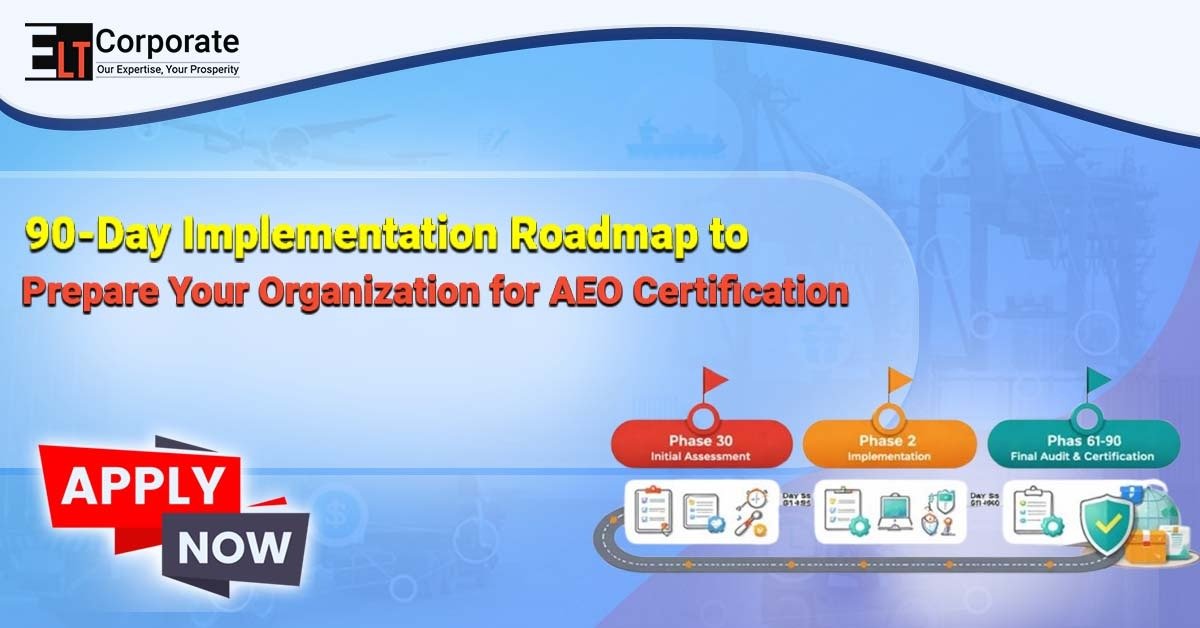
Your 90-Day AEO Preparation at a Glance
| Phase | Days | Key Actions | Output |
| Phase 1: Assessment | 1–30 | Eligibility check, SCN audit, compliance review, financial assessment, security gap analysis | Gap report — know exactly where you stand |
| Phase 2: Remediation | 31–60 | Close compliance gaps, upgrade security infrastructure, prepare SOPs, process maps, site layouts, complete all Annexures | Complete, inspection-ready documentation dossier |
| Phase 3: Submission | 61–90 | Mock inspection, final dossier review, portal submission, post-submission monitoring | Application submitted — CBIC review initiated |
Common Roadblocks That Extend the 90-Day Timeline
- SCN discovered late — If a disqualifying SCN surfaces in Week 1, the 90-day clock effectively pauses until it is resolved. Start Week 1 immediately.
- CCTV installation delays — Physical security upgrades take time to procure and install. Start security gap remediation in Week 5 at the latest.
- Bank solvency certificate delays — Some banks take 2–3 weeks to issue. Request in Week 3 so it is ready for Week 8.
- Business partner AEO status gaps (T3) — If key logistics partners lack AEO-LO status, they need to apply separately — which is its own multi-month process. Identify T3 partner gaps in Week 1 and initiate their AEO-LO applications immediately.
- DSC not ready — The authorised signatory’s Digital Signature Certificate must be registered on the AEO portal before submission. Procure in Week 1 if not already available.
The Bottom Line
Ninety days is enough time to take a business from zero AEO preparation to a complete, submission-ready application — if the 90 days are used systematically.
The businesses that struggle are the ones that spend 80 days on the easy parts (filling forms) and 10 days on the hard parts (closing compliance gaps, building SOPs, preparing for site inspection). The roadmap above inverts that — front-loading the difficult, high-stakes work so that by the time you submit, CBIC is reviewing a genuinely strong application.
Start Day 1 this week. Your AEO certification — and everything that comes with it — is 90 days away.
Need Help Executing This Roadmap?
We work with businesses at every stage of this process — from Week 1 eligibility assessment to final submission and inspection preparation. If you would rather spend your 90 days running your business while we build your AEO application, we can help with that too.
- Eligibility and SCN assessment
- Compliance gap analysis and remediation guidance
- Complete Annexure preparation (A, B, C, D, E, F)
- SOP and process map drafting
- Mock inspection and site readiness preparation
- Portal submission and post-submission query handling