
International trade offers exciting opportunities, but businesses involved in importing and exporting often face challenges such as customs delays, complicated documentation, cargo inspections, and unexpected logistics expenses. These challenges can affect delivery schedules, increase operational costs, and create uncertainty for manufacturers and businesses.
This is where AEO certification in India becomes valuable.
The Authorised Economic Operator (AEO) program is a trusted-trader initiative introduced by Indian Customs to recognise businesses that maintain strong compliance standards and secure international supply chains.
Whether you are an importer, exporter, manufacturer, or logistics service provider, understanding AEO registration in India can help you identify opportunities to improve customs clearance efficiency, reduce certain compliance-related costs, and strengthen your business reputation.
In this guide, we explain everything you need to know about AEO certification, including its types, eligibility requirements, benefits, documentation, and application procedure.
What Is AEO Certification in India?
AEO stands for Authorised Economic Operator. It is a voluntary certification program administered by the Central Board of Indirect Taxes and Customs (CBIC), under the Department of Revenue, Ministry of Finance, Government of India.
The program recognizes businesses involved in international trade that demonstrate reliable customs compliance, proper record management, financial soundness, and, where applicable, effective supply chain security measures.
The main purpose of AEO certification in India is to develop a trusted relationship between Customs authorities and businesses.
Instead of treating every shipment in the same way, Customs can provide additional facilitation to eligible, compliant businesses through a risk-based approach.
For example, an importer regularly bringing goods with AEO registration in India into India may experience delays due to customs procedures. With appropriate AEO status, the business may qualify for priority processing, reduced interventions, and other facilitation measures.
However, AEO certification does not eliminate Customs obligations or guarantee that every shipment will be cleared without examination.
Why Is AEO Registration in India Important for Importers and Exporters?
International trade depends heavily on AEO certification in India for the timely movement of goods. Even a small delay at a port or airport can affect production schedules, customer commitments, and working capital.
For businesses managing frequent shipments, predictable customs clearance is particularly important.
AEO status can help AEO registration in India eligible companies improve operational efficiency by providing access to prescribed trade facilitation benefits.
Some practical advantages include:
- Better predictability in import and export clearance.
- Reduced routine Customs interventions based on risk assessment.
- Potential savings in logistics and cargo-handling expenses.
- Improved coordination with Customs authorities.
- Enhanced credibility with international trading partners.
- Access to certain financial and procedural benefits depending on the certification tier.
For growing businesses, AEO registration in India can therefore become an important part of long-term supply-chain planning.
Types of AEO Certification in India: T1, T2, T3, and LO
The Indian AEO program provides different AEO registration in India certification categories based on the applicant’s business activities and compliance maturity.
Understanding these categories helps businesses choose the appropriate certification.
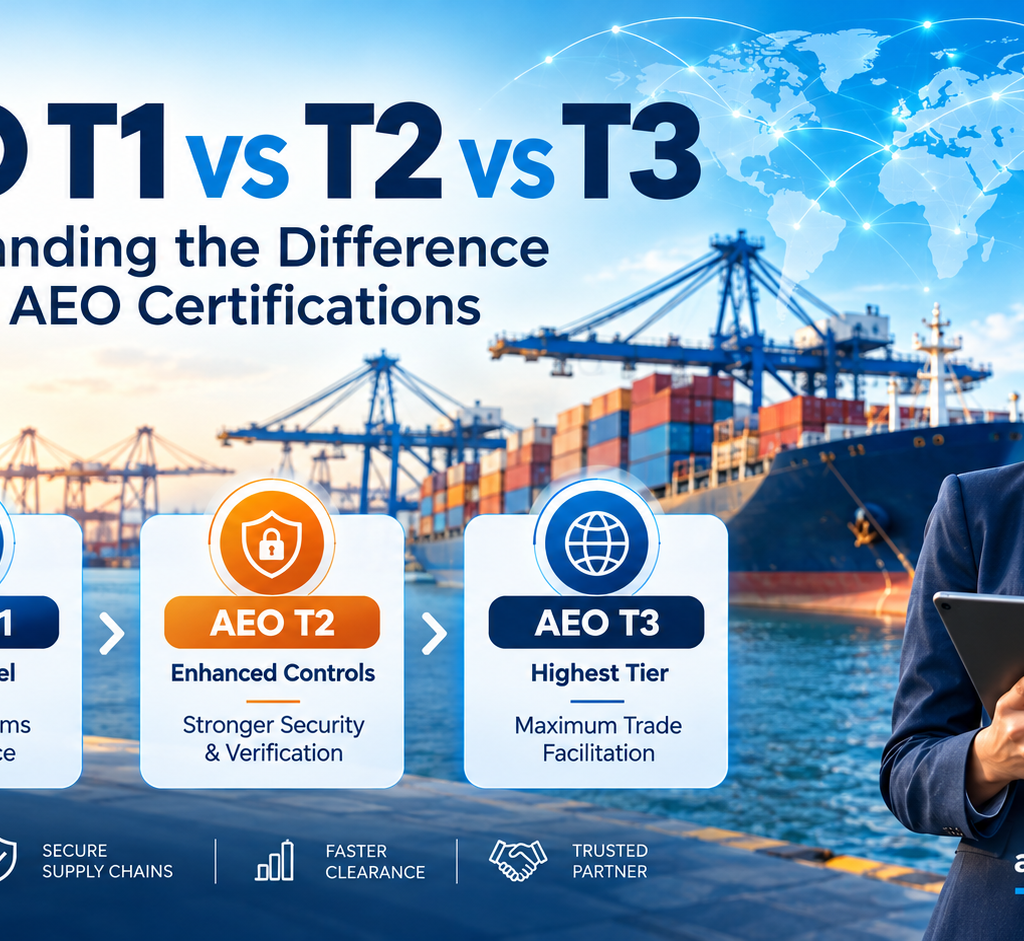
1. AEO T1 Certification
AEO T1 is the entry-level certification available to eligible importers and exporters.
It focuses primarily on the applicant’s compliance, AEO registration in India history, record management, and financial solvency.
Key benefits may include faster customs facilitation, direct port delivery or direct port entry where applicable, and reduced bank guarantee requirements.
AEO T1 is often an AEO registration in India practical starting point for eligible businesses entering the program.
2. AEO T2 Certification
AEO T2 provides enhanced benefits for AEO registration in India for businesses demonstrating stronger compliance systems and supply chain security controls.
In addition to applicable T1 benefits, T2 status offers facilities such as priority customs assessment, reduced bank guarantee requirements, and deferred customs duty payment for eligible importers.
The certification process involves more detailed verification of the applicant’s operations, procedures, and security arrangements.
3. AEO T3 Certification
AEO T3 represents the highest certification tier for eligible importers and exporters.
It is intended for businesses that satisfy the prescribed advanced requirements, including qualifying T2 status and other applicable conditions.
Benefits include the highest level of customs facilitation, extensive bank guarantee exemptions, and additional priority treatment.
4. AEO LO Certification
AEO LO is designed for eligible logistics operators and other international supply-chain participants.
These may include customs brokers, freight forwarders, custodians, terminal operators, and warehouse operators.
It focuses on compliance and security practices relevant to logistics activities.
| Certification | Suitable Applicants | Major Advantages |
| AEO T1 | Eligible importers and exporters | Basic customs facilitation and reduced bank guarantees |
| AEO T2 | Importers and exporters with stronger controls | Enhanced facilitation and deferred duty benefits |
| AEO T3 | Eligible advanced T2 holders | Highest facilitation and extensive exemptions |
| AEO LO | Eligible logistics operators | Logistics-related customs facilitation |
Choosing the right category depends on business eligibility, existing compliance systems, and operational requirements.
Eligibility Criteria for AEO Registration in India
Before applying, businesses must determine whether they satisfy the prescribed eligibility requirements.
Although the exact criteria depend on the AEO category, several important conditions generally apply.
1. Involvement in International Trade
The applicant must be involved in the international supply chain and undertake customs-related activities in India.
Eligible entities may include importers, exporters, and specified logistics service providers.
2. Business Operating History
Generally, applicants should have undertaken business activities for at least three financial years.
Eligible MSMEs may benefit from relaxed requirements, including a reduced operating-history condition of two financial years.
3. Customs Transaction Requirements
Generally, applicants must have handled at least 25 customs documents during the preceding financial year, including the prescribed minimum number of Bills of Entry or Shipping Bills.
Eligible MSMEs may qualify under a relaxed requirement of 10 Customs documents.
4. Customs Compliance Record
Applicants must demonstrate satisfactory compliance with applicable Customs laws and regulations.
The authorities may examine past violations, penalties, investigations, and the overall compliance history.
5. Proper Record Management
Businesses should maintain reliable commercial, accounting, and customs records.
Records must support verification of import-export transactions and demonstrate effective internal controls.
6. Financial Solvency
Applicants must satisfy the applicable financial solvency requirements and demonstrate their ability to meet financial obligations.
7. Security and Internal Controls
For certification categories requiring detailed security validation, applicants must demonstrate appropriate premises security, cargo protection, personnel controls, and business-partner security procedures.
Businesses planning AEO registration in India should evaluate these requirements before submitting their application.
Documents Required for AEO Certification in India
Documentation is one of the most important parts of the certification process.
Incomplete or inconsistent documents can result in AEO registration in India, departmental queries, and delays.
The following is a practical checklist of documents that may be required depending on the certification category and business profile.
Business Registration Documents
- Import Export Code (IEC) certificate.
- GST registration certificate.
- PAN of the applicant entity.
- Certificate of Incorporation, partnership deed, or other constitution document.
- Registered office and business premises details.
- AAuthorisationof the person submitting the application.
Customs and Trade Documents
- Details of import and export transactions.
- Bills of Entry and Shipping Bills.
- Customs compliance history.
- Details of customs-related notices, investigations, or proceedings, where applicable.
- Information regarding major products and international trade activities.
Financial Documents
- Audited financial statements.
- Balance sheets and profit-and-loss statements.
- Financial solvency information.
- Applicable financial declarations and supporting records.
Operational and Security Documents
- Standard Operating Procedures (SOPs).
- Organisational structure and responsibilities.
- Premises layout and access-control arrangements.
- Cargo-handling and storage procedures.
- Employee identification and security procedures.
- Business-partner verification procedures.
- Internal audit and corrective-action records, where applicable.
The exact documentation depends on whether the applicant is applying for T1, T2, T3, or LO certification.
Preparing the documents systematically can make AEO registration in India more efficient and reduce the possibility of avoidable queries.
Step-by-Step Process for AEO Registration in India
The application process is conducted through the AEO registration in India designated Indian Customs AEO portal.
Although specific requirements vary between certification categories, the general procedure is as follows.
Step 1: Check Eligibility
Begin by evaluating the business’s operating history, customs transactions, compliance record, and financial position.
Identify the AEO registration in India appropriate certification tier.
Step 2: Prepare Required Documents
Collect the necessary company, customs, financial, and operational documents.
Ensure that information such as AEO registration in India, business name, IEC, GST details, and addresses is consistent.
Step 3: Register on the AEO Portal
Visit the official Indian Customs AEO registration portal and complete the applicant registration process.
Provide the required business details and create the necessary login credentials.
Step 4: Submit the Application
Complete the relevant application form, upload supporting documents, and submit the prescribed declarations.
Carefully review the information before final submission.
Step 5: Departmental Scrutiny
The AEO authorities examine the application and supporting documents.
If clarification or additional information is required for AEO registration in India, the applicant must respond appropriately.
Step 6: Verification and Validation
Depending on the certification category, Customs authorities may conduct detailed verification, including an on-site validation visit.
During verification, officials may examine AEO registration records in India, security arrangements, operational procedures, and actual implementation of documented controls.
Step 7: Certification Decision
After satisfactory evaluation and approval, the applicant receives the relevant AEO certificate.
The business must continue complying with the program’s requirements to retain its status.
Professional assistance with AEO registration in India can be useful where applicants need support with documentation, internal compliance reviews, SOP preparation, and departmental clarifications.
Major Benefits of AEO Certification in India
AEO certification offers practical benefits that can support international trade operations.
However, the exact facilities available depend on the certification tier and applicable Customs conditions.
Faster Customs Clearance
Certified businesses receive prescribed facilitation that AEO registration in India may reduce cargo release time and improve shipment predictability.
Reduced Bank Guarantee Requirements
Eligible AEO registration in India holders may receive partial or complete relief from certain customs bank guarantee requirements.
The extent of relief depends on the certification tier and applicable exceptions.
Deferred Customs Duty Payment
Eligible AEO T2 and T3 importers can benefit from deferred payment of customs duty under the notified rules.
These advantages make AEO registration in India relevant for companies seeking more efficient and reliable international trade operations.
How Long Does AEO Certification Take?
The processing time depends on the certification category, application completeness, and verification requirements.
For AEO T1, the prescribed processing target is generally 30 days after receipt of complete information and documents.
Eligible MSME applications may benefit from shorter processing targets, including 15 working days for T1 and three months for T2, subject to the applicable conditions.
AEO T2 and LO applications can take longer because they involve detailed scrutiny and validation.
Applicants should remember that these are procedural targets rather than guaranteed approval timelines.
Incomplete documentation, delayed clarifications, and validation scheduling can extend the process.
Common Mistakes to Avoid During AEO Application
Many businesses experience avoidable delays because they begin the application process without properly reviewing their eligibility or documentation.
Common mistakes include:
- Selecting an unsuitable certification category.
- Submitting incomplete financial or Customs records.
- Providing inconsistent company information.
- Preparing SOPs that do not reflect actual business operations.
- Failing to disclose relevant compliance matters.
- Delaying responses to departmental queries.
- Being unprepared for an on-site validation visit.
A structured internal compliance review before submission can significantly improve application readiness.
How Can ELT Corporate Help With AEO Certification?
Applying for AEO status requires more than completing an online form. Businesses must understand eligibility conditions, prepare supporting documents and demonstrate compliance with the applicable Customs requirements.
At ELT Corporate Private Limited, we provide regulatory and customs compliance consultancy services to businesses involved in international trade.
Our AEO consultancy support can include:
- Preliminary eligibility assessment.
- Guidance on selecting the appropriate AEO category.
- Documentation and application preparation.
- Review and development of relevant SOPs.
- Compliance gap assessment.
- Assistance with departmental queries.
- Preparation support for Customs validation.
- Guidance on certification upgrades and renewals.
Whether your business is applying for its first AEO certificate or considering an upgrade, professional guidance can help make the process more organised and transparent.
For assistance with AEO registration in India, visit https://aeocertificate.com/ to learn more about our consultancy services.
Conclusion
In today’s competitive international market, efficient customs clearance and dependable supply chain operations are important for business growth.
AEO certification in India provides eligible importers, exporters, and logistics operators with an opportunity to strengthen customs compliance, improve operational predictability, and access valuable trade facilitation benefits.
From faster cargo processing to reduced bank guarantee requirements and international recognition, the program can offer meaningful advantages to businesses engaged in cross-border trade.
However, successful certification requires careful eligibility assessment, accurate documentation, and continued compliance with the applicable requirements.
If your organisation is planning to apply for AEO registration in India, choosing the correct certification tier and preparing a well-documented application are essential first steps.
Frequently Asked Questions
Q1. Is AEO certification mandatory in India?
No. AEO certification is a voluntary program. Eligible businesses can apply to obtain the prescribed Customs facilitation benefits.
Q2. Who can apply for AEO certification?
Eligible importers, exporters, manufacturers engaged in international trade, Customs brokers, freight forwarders, and other specified supply chain operators can apply under the appropriate category.
Q3. Can MSMEs apply for AEO certification?
Yes. Eligible MSMEs can apply and may benefit from relaxed transaction and business-history requirements under the applicable provisions.
Q4. What is the difference between AEO T1 and AEO T2?
AEO T1 is the entry-level certification, while AEO T2 involves stronger compliance and security requirements and offers additional facilitation benefits.
Q5. Is AEO certification valid throughout India?
Yes. AEO status is recognised at Customs stations across India, subject to the conditions governing individual benefits.