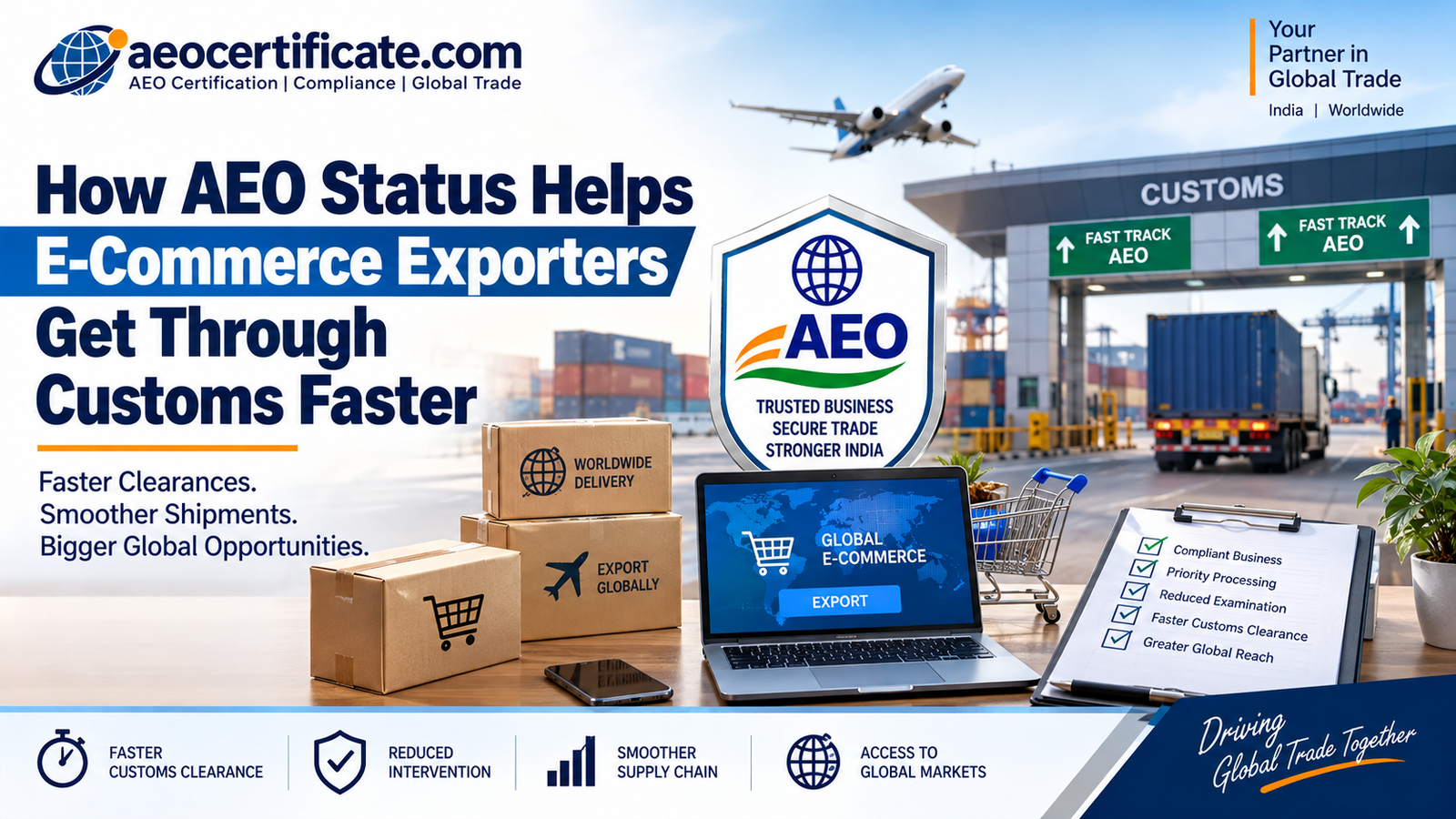
The rapid growth of e-commerce has transformed international trade, allowing Indian businesses to sell products directly to customers across the world. However, international e-commerce exporters often face challenges involving Customs clearance, shipment delays, documentation errors, logistics expenses, and regulatory compliance.
AEO status for e-commerce exporter businesses can help address these challenges by providing access to customs facilitation benefits under India’s Authorised Economic Operator (AEO) Programme.
Administered by Indian Customs under the Central Board of Indirect Taxes and Customs (CBIC), the AEO program recognizes eligible businesses that demonstrate Customs compliance, financial solvency, proper record management, and applicable supply-chain security standards.
For e-commerce businesses handling frequent international shipments, AEO status can support faster and more predictable customs processing, improved supply chain efficiency, and stronger global trade operations.
AEO Status for E-Commerce Exporters—What Is AEO Certification?
AEO status for e-commerce exporters refers to AEO recognition obtained by an eligible business engaged in international e-commerce exports.
AEO stands for Authorised Economic Operator, a voluntary trusted-trader programme designed to facilitate legitimate international trade.
Businesses obtaining AEO certification demonstrate compliance with prescribed requirements, including:
- Customs compliance
- Financial solvency
- Record management
- Internal controls
- Supply-chain security, where applicable
- Operational transparency
AEO-certified exporters can receive Customs facilitation benefits depending on their certification tier and applicable Customs regulations.
AEO Status for E-Commerce Exporters—Why Is It Important?
International e-commerce businesses frequently handle multiple shipments involving different products, overseas customers, and logistics partners.
AEO status for e-commerce exporter businesses can be valuable because customs delays may affect delivery commitments, inventory management, and customer satisfaction.
E-commerce exporters commonly face challenges such as
- Delays in customs clearance
- Incorrect export documentation
- Frequent shipment examinations
- Coordination difficulties with logistics partners
- Unexpected storage expenses
- Shipment tracking problems
- Compliance-related queries
AEO certification encourages businesses to establish stronger internal systems and can provide applicable customs facilitation.
AEO Status for E-Commerce Exporters—How It Helps Speed Up Customs Clearance
One of the major benefits of AEO status for e-commerce exporter businesses is improved customs clearance efficiency.
AEO-certified entities are recognized as trusted participants in international trade.
Depending on the certification tier, applicable facilitation can include:
Reduced Customs Examination
AEO-certified exporters may receive reduced routine examination based on customs risk-management parameters.
Priority Customs Processing
Certain AEO categories receive priority treatment under specified Customs procedures.
Faster Document Processing
Properly maintained documentation and applicable Customs facilitation can help reduce avoidable delays.
Improved Shipment Predictability
More predictable clearance procedures can assist businesses in planning international dispatches.
However, AEO certification does not guarantee that every shipment will be cleared without examination or delay.
AEO Status for E-Commerce Exporters – Major Benefits for Online Businesses
AEO status for e-commerce exporter businesses offers several potential advantages.
1. Faster Customs Facilitation
Eligible AEO exporters can receive facilitated customs treatment according to their certification tier.
2. Reduced Compliance Risks
AEO preparation encourages systematic documentation, internal reviews, and compliance procedures.
3. Better Logistics Efficiency
Improved customs predictability can help businesses coordinate international transportation.
4. Improved Customer Experience
More reliable shipping schedules can support better communication with overseas customers.
5. Stronger International Credibility
AEO recognition demonstrates that the business has satisfied applicable Customs trusted-trader requirements.
6. Better Supply-Chain Security
Advanced AEO tiers encourage stronger cargo, employee, business-partner, and information-security controls.
AEO Status for E-Commerce Exporters – Who Can Apply?
AEO status for e-commerce exporter businesses is available to eligible entities undertaking international trade activities.
Potential applicants include:
- Online retail exporters
- E-commerce brands
- Direct-to-consumer exporters
- Manufacturers selling internationally
- Export trading companies
- Businesses exporting through online marketplaces
- Cross-border e-commerce businesses
However, selling products through an online marketplace does not automatically establish AEO eligibility.
Applicants must satisfy the applicable Customs requirements, including relevant transaction and compliance criteria.
AEO Status for E-Commerce Exporter – Eligibility Requirements
Before applying for AEO Status for E-Commerce Exporter, businesses should evaluate their eligibility.
Important areas include:
Customs Compliance: The applicant should demonstrate satisfactory compliance with applicable Customs requirements.
Financial Solvency: The company should satisfy prescribed financial requirements.
Record Management: Import/export and commercial records should be properly maintained.
Internal Controls: The business should maintain procedures for accurate Customs declarations and documentation.
Supply-Chain Security: Advanced certification categories require appropriate security controls.
The exact eligibility requirements depend on the selected AEO tier and current CBIC guidelines.
AEO Status for E-Commerce Exporter – Documents Required
Documentation plays an important role in obtaining AEO status for e-commerce exporters.
Depending on the business and certification tier, relevant documents may include:
- Import Export Code (IEC)
- GST registration
- PAN
- Company incorporation documents
- Business profile
- Organization chart
- Export transaction records
- Shipping Bills
- Commercial invoices
- Packing lists
- Financial statements
- Customs compliance history
- Export-related SOPs
Applicants should ensure that their documents are accurate, complete, and consistent.
AEO Status for E-Commerce Exporter – Role of Logistics Partners
Logistics providers are important participants in international e-commerce exports.
AEO status for e-commerce exporter businesses should be supported by appropriate coordination with:
- Customs brokers
- Freight forwarders
- Courier service providers
- Shipping companies
- Airlines
- Warehouse operators
- Transporters
- Fulfilment partners
Businesses should establish procedures for selecting logistics partners, communicating shipment information, reviewing documentation, and resolving discrepancies.
AEO certification does not replace the need for proper coordination with these service providers.
AEO Status for E-Commerce Exporter – Supply-Chain Security Requirements
Supply chain security becomes particularly important for advanced AEO status for e-commerce exporter certification.
Businesses may need to implement controls relating to:
- Warehouse security
- Cargo handling
- Employee identification
- Visitor management
- Access restrictions
- CCTV surveillance
- Shipment integrity
- Business-partner security
- IT security
- Incident reporting
For AEO-T2 applicants, actual implementation of security procedures is important during verification.
AEO Status for E-Commerce Exporter – Importance of IT Security
E-commerce businesses rely heavily on digital platforms for order processing, inventory management, payment records, customer information, and shipping documentation.
Therefore, AEO status for e-commerce exporters should include appropriate information security practices.
Important measures can include:
- Role-based access
- Strong passwords
- Multi-factor authentication
- Data backups
- Restricted administrator access
- Firewall protection
- Endpoint security
- Employee access management
- Cybersecurity awareness
- Incident-response procedures
These controls help protect customs and commercial information from unauthorized access or misuse.
AEO Status for E-Commerce Exporter – Government Fees and Consultancy Costs
The cost of AEO Status for E-Commerce Exporter certification depends primarily on professional assistance and implementation requirements.
Government Application Fee: NIL
Indian Customs does not charge a government application fee for filing an AEO application.
However, exporters may incur expenses relating to:
- Professional consultancy
- Compliance gap assessment
- SOP preparation
- Documentation
- Employee training
- Security improvements
- IT security upgrades
- Verification preparation
These expenses vary according to the business’s size, operations, and existing compliance systems.
AEO Status for E-Commerce Exporters – Importance for Cross-Border Online Sellers
Cross-border e-commerce has created opportunities for Indian businesses to reach international customers without establishing physical retail stores overseas.
However, international shipping requires accurate Customs declarations, proper documentation, and coordination with logistics providers.
AEO status for e-commerce exporter businesses can support more efficient international trade operations through applicable customs facilitation and stronger compliance systems.
Online exporters handling regular international orders may benefit from improved shipment predictability, better documentation, and more systematic logistics management.
AEO Status for E-Commerce Exporters – How AEO Reduces Customs Delays
One of the major advantages of AEO status for e-commerce exporter businesses is access to facilitation measures available under the applicable certification tier.
Customs authorities use risk-management systems to determine the level of examination required for shipments.
Eligible AEO-certified businesses can receive reduced routine intervention and priority treatment under specified Customs procedures.
This can help exporters:
- Improve shipment planning
- Reduce avoidable clearance delays
- Coordinate international dispatches
- Improve delivery predictability
- Manage customs documentation efficiently
- Reduce uncertainty in international logistics
However, customs examination may still occur where required by applicable regulations or risk parameters.
AEO Status for E-Commerce Exporters – Importance for Small and Medium Online Businesses
AEO status for e-commerce exporter businesses is not relevant only to large multinational companies.
Eligible small and medium-sized exporters can also consider AEO certification when their international trade activity satisfies the applicable requirements.
SMEs can use the AEO preparation process to improve:
- Customs compliance
- Export documentation
- Record management
- Employee responsibilities
- Logistics coordination
- Internal controls
- Supply-chain security
For growing online brands, these improvements can help establish a stronger foundation for international expansion.
AEO Status for E-Commerce Exporter – Role in International Marketplace Exports
Businesses exporting products through international online marketplaces must coordinate orders, shipping, documentation, and customer deliveries.
AEO status for e-commerce exporter companies can support more structured customs procedures for eligible exporters.
Important areas include:
- Accurate product descriptions
- Correct HS classification
- Proper export invoices
- Shipping documentation
- Customs declarations
- Export compliance
- Logistics-partner coordination
- Record retention
AEO certification does not replace marketplace policies or other export requirements, but it can complement the company’s broader compliance framework.
AEO Status for E-Commerce Exporter – Importance of HS Code Classification
Correct Harmonized System (HS) classification is an important part of customs compliance.
Businesses pursuing AEO status for e-commerce exporters should maintain appropriate procedures for classifying their products.
Online exporters may sell multiple categories of goods, including clothing, accessories, home products, electronics, handicrafts, and consumer goods.
Incorrect classification can create customs queries, duty-related issues, or shipment delays.
Businesses should maintain a process covering:
Product Identification → Technical Review → HS Classification → Documentation → Verification → Periodic Review
Proper classification helps support accurate customs declarations.
AEO Status for E-Commerce Exporters – Export Packaging and Labelling Compliance
Packaging and labelling are important considerations for AEO status for e-commerce exporter businesses.
Products exported internationally may be subject to destination-country packaging, labelling, safety, or product-specific requirements.
Exporters should review:
- Product identification
- Country-of-origin declarations
- Product-specific labels
- Packaging specifications
- Shipping marks
- Applicable regulatory warnings
- Destination-country requirements
- Packaging integrity
AEO certification does not replace product-specific regulatory approvals or destination-country compliance obligations.
AEO Status for E-Commerce Exporter – Warehouse and Fulfilment Centre Security
E-commerce exporters often operate warehouses or fulfillment centers where products are stored, packed, and dispatched.
For advanced AEO status for e-commerce exporter certification, appropriate warehouse security controls can become important.
Relevant measures may include:
- CCTV surveillance
- Restricted access
- Employee identification
- Visitor registers
- Cargo-handling procedures
- Dispatch authorization
- Inventory controls
- Loading and unloading procedures
- Incident reporting
- Security training
These controls help protect shipment integrity and reduce supply-chain risks.
AEO Status for E-Commerce Exporter – Role of Courier and Freight Partners
International e-commerce shipments are frequently handled by courier companies, freight forwarders, and other logistics service providers.
AEO status for e-commerce exporter businesses should maintain appropriate oversight of their shipping partners.
Important practices include:
- Selecting reliable logistics providers
- Providing accurate shipment information
- Reviewing Customs documentation
- Monitoring shipment discrepancies
- Maintaining dispatch records
- Reporting shipment incidents
- Evaluating partner performance
AEO status does not automatically extend the exporter’s certification benefits to every shipment handled by an unrelated logistics provider; applicable procedures and the declared exporter must be considered.
AEO Status for E-Commerce Exporter – Customs Compliance for High-Volume Shipments
Businesses handling large numbers of international orders may face greater challenges in maintaining consistent Customs documentation.
AEO status for e-commerce exporters can encourage exporters to establish standardized processes for high-volume transactions.
Such processes can include:
- Automated order records
- Invoice verification
- Product classification controls
- Shipping documentation review
- Export declaration reconciliation
- Shipment tracking
- Record retention
- Periodic compliance audits
Strong internal controls can reduce documentation errors and improve operational consistency.
AEO Status for E-Commerce Exporters – Importance of Export Documentation
Accurate documentation is essential for AEO status for e-commerce exporter businesses.
E-commerce exporters may process numerous international orders involving different products, values, destinations, and customers.
Documentation errors can lead to customs queries or shipment delays.
Businesses should maintain appropriate controls over:
- Product descriptions
- HS classification
- Export invoices
- Packing lists
- Shipping Bills
- Declared values
- Country-of-origin information
- Applicable export restrictions
- Supporting regulatory documents
A systematic documentation process can reduce avoidable compliance errors.
AEO Status for E-Commerce Exporters – Common Mistakes to Avoid
Businesses seeking AEO status for e-commerce exporters should avoid:
- Applying without checking eligibility
- Selecting the wrong certification tier
- Submitting incomplete documentation
- Incorrect HS classification
- Inconsistent company information
- Weak export records
- Generic SOPs
- Inadequate security controls
- Missing employee training
- Poor logistics partner management
- Delayed responses to Customs queries
Conducting a pre-application compliance assessment can help identify these issues.
AEO Status for E-Commerce Exporter—How ELT Corporate Can Assist
ELT Corporate can assist businesses seeking AEO Status for E-Commerce Exporter certification in India.
Professional assistance can include:
- AEO eligibility assessment
- Selection of appropriate AEO tier
- Customs compliance review
- Gap analysis
- Documentation preparation
- SOP development
- Application filing support
- Customs query handling
- Supply-chain security assessment
- Verification readiness
- Corrective-action support
- Post-certification compliance guidance
The objective is to help businesses establish a sustainable customs compliance framework supporting international e-commerce operations.
Conclusion
AEO status for e-commerce exporter businesses can play an important role in improving customs efficiency, strengthening compliance, and supporting international business growth.
For online exporters handling frequent cross-border shipments, Customs delays and documentation errors can affect delivery timelines, operating costs, and customer satisfaction.
AEO certification provides eligible businesses with trusted-trader recognition and access to customs facilitation according to their certification tier.
By maintaining accurate export documentation, strong internal controls, secure cargo-handling procedures, and effective logistics coordination, e-commerce exporters can improve their readiness for international trade.
Businesses planning to expand globally should therefore consider AEO status for e-commerce exporters as part of a long-term strategy for more reliable customs operations, stronger supply-chain security, and sustainable international growth.
Frequently Asked Questions
Q1. What is AEO status for e-commerce exporters?
It is AEO recognition obtained by eligible e-commerce exporters meeting prescribed customs requirements.
Q2. Is AEO certification mandatory?
No, the AEO program is voluntary.
Q3. Does AEO help with faster customs clearance?
Yes, applicable AEO facilitation can improve clearance efficiency and predictability.
Q4. Can online sellers apply for AEO?
Eligible online exporters can apply, subject to the applicable Customs criteria.
Q5. Is there a government application fee?
No, filing an AEO application does not attract a government application fee.
Q6. Which AEO tier is suitable for e-commerce exporters?
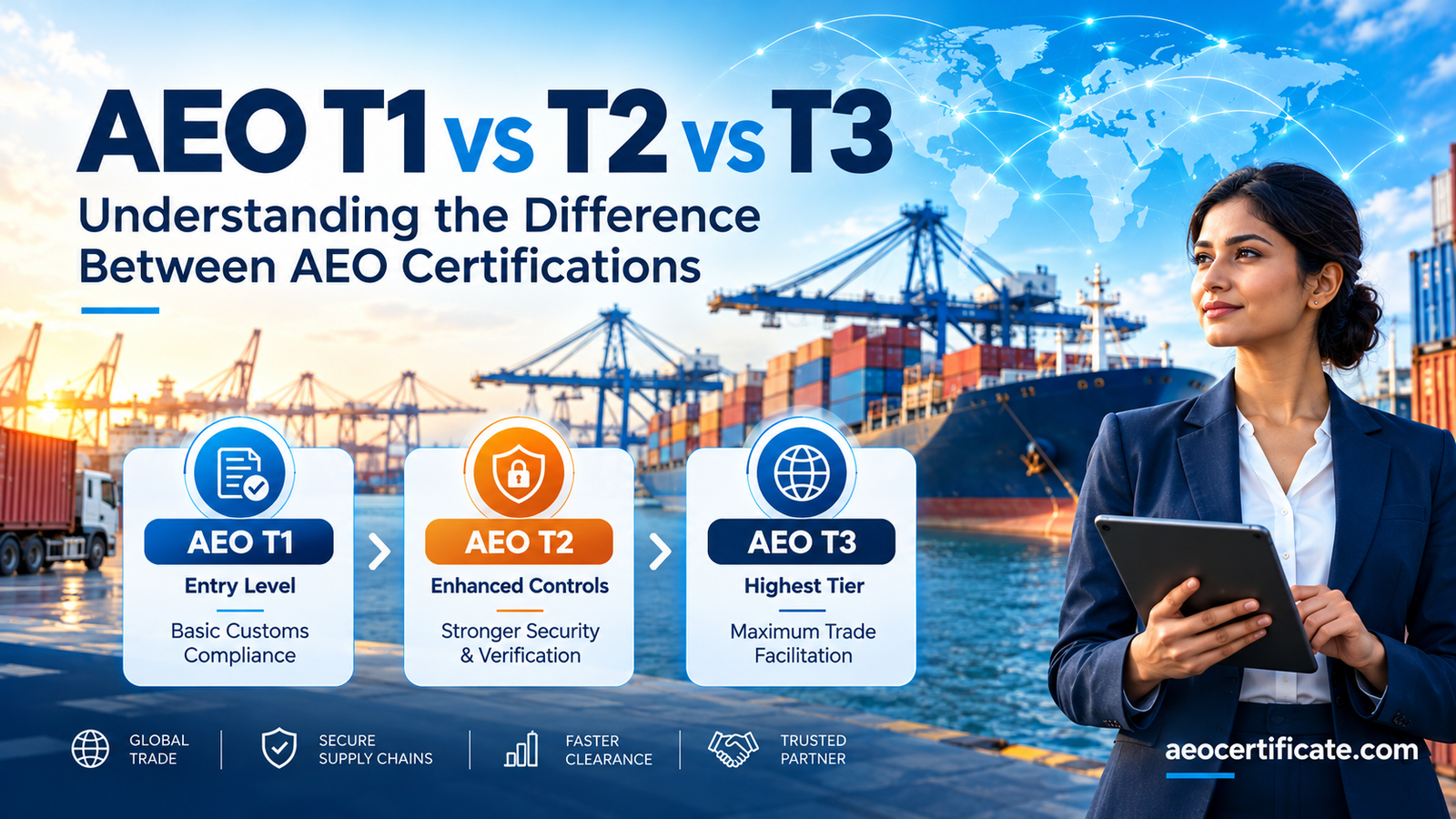
Eligible exporters can evaluate AEO-T1 or T2 based on their compliance maturity and applicable requirements.