Customs difficulties that businesses that trade internationally are confronted with include problems with valuation, classification, document discrepancies, duty disputes, and investigations. Such difficulties can delay shipments and cause liabilities and penalties for the business.
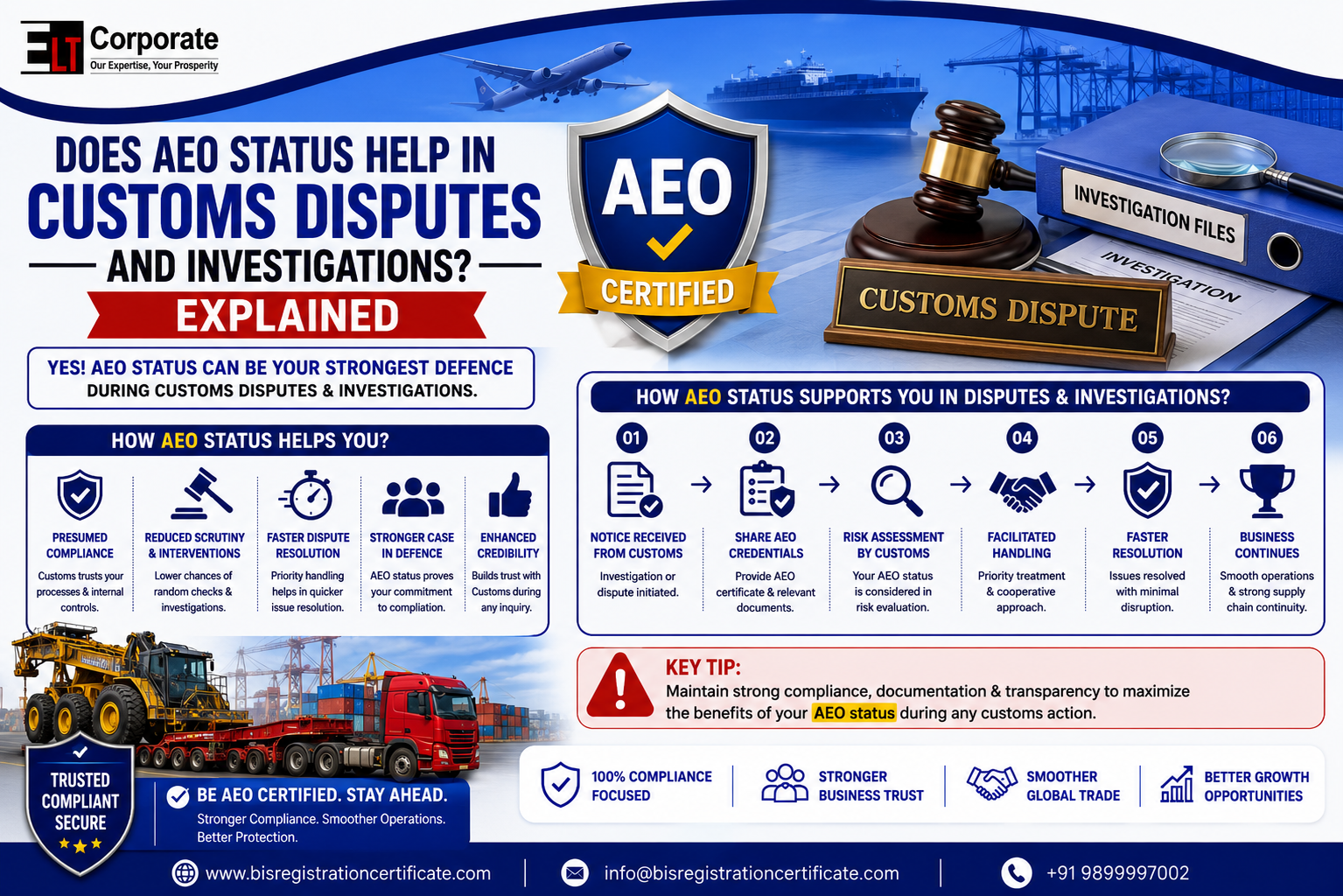
The role of AEO status in customs disputes is highly significant, as it recognizes the companies that exhibit high levels of customs compliance, a secure chain of custody, and transparency in their trading practices.
It is not possible to avoid customs disputes and investigations entirely through AEO status; however, it will help to build credibility, show commitment to compliance, and foster good relationships with the customs authority.
What Is AEO Status in Customs Disputes?
AEO status in customs disputes pertains to the benefits and compliance recognition of businesses that have authorized economic operator status when they are confronted with disputes concerning customs.
A business that has Authorised Economic Operator status is considered a trusted business partner since it adheres to:
- Customs process regulations
- Documentation processes
- Supply chain security measures
- Compliance procedures
In case a customs dispute happens, the AEO status can help the business in its case, as it proves that the organization adheres to compliance standards.
| Area | Impact of AEO Status |
| Customs Relationship | Builds trust with customs authorities |
| Compliance History | Demonstrates responsible trade practices |
| Documentation | Shows systematic record maintenance |
| Risk Management | Indicates a preventive compliance approach |
Does AEO Status in Customs Disputes Provide Legal Protection?
A misconception exists regarding AEO certification, which implies that being an AEO gives total protection from customs disputes or inspections.
AEO status in customs disputes does not mean:
- No customs inspections
- No investigations
- No penalties
- No compliance tests
Customs authorities are still able to investigate any AEO-certified company on various grounds, such as
- Improper declaration
- Misclassification of goods
- Issues regarding duty avoidance
- Fraud cases
The benefit of being an AEO is a show of the company’s dedication to compliance.
How AEO Status in Customs Disputes Helps Businesses
1. Develops Greater Trust with Customs Authorities
One of the main benefits of AEO status in customs disputes is the trust that businesses develop with customs authorities.
The AEO-certified business has already been evaluated in terms of:
- Compliance record with customs regulations
- Financial stability
- Operational controls
- Security measures
This way, the customs authorities will be able to take into consideration the company’s compliance record when handling the dispute.
2. Supports Better Handling of Customs Investigations
In case of customs investigations, firms have to produce:
- Documentation for import/export
- Business documentation
- Details of classification
- Procedure documentation
- Transaction documentation
Firms that are AEO-certified usually have better documentation procedures.
| Without a Strong Compliance System | With the AEO Compliance System |
| Difficulty locating records | Proper document availability |
| Delayed responses | Faster regulatory response |
| Higher compliance risks | Better internal controls |
Role of AEO Status in Customs Disputes Related to Classification Issues
Classification disputes are some of the most common customs disputes between importers and exporters.
These include, but are not limited to:
- Incorrect HSN classification
- Product description dispute
- Interpretation dispute in relation to tariff headings
Although AEO Status in Customs Disputes does not settle classification disputes automatically, it encourages a transparent process whereby an enterprise may prove its:
- Classification process
- Technical documents
- Intra-organization process
- Consultation records with experts
The customs authorities will be assured of the compliance-based approach adopted by the organization.
AEO Status in Customs Disputes Related to Valuation Issues
Valuation-related customs disputes may arise because of:
- Transaction value
- Transactions between parties
- Payments made by way of royalties
- Additional costs
Companies certified as AEOs normally have better business and financial documentation, which assists in valuation validation.
Such supporting documents may comprise:
- Purchasing contracts
- Supplier invoices
- Proof of payment
- Costing reports
- Transfer pricing documentation
Does AEO Status Protect Against Customs Penalties?
AEO status in customs cases will not protect you from any penalties.
But your AEO status could help you defend yourself by stating that:
- It was an unintentional mistake.
- Your company complies with regulations.
- The violation was not intentional.
Customs could take into account all of the facts surrounding the case.
AEO Status in Customs Disputes: Importance During Customs Audits
Customs audits examine whether businesses are following applicable trade regulations.
During audits, authorities may review:
| Audit Area | Verification |
| Import Records | Accuracy of declarations |
| Documentation | Availability of supporting records |
| Compliance Procedures | Internal controls |
| Security Measures | Supply chain protection |
| Financial Records | Transaction accuracy |
Companies with AEO status in customs disputes generally have established systems that help them manage audit requirements efficiently.
How Businesses Can Use AEO Compliance During Customs Disputes
It is vital for businesses to practice good compliance in order to gain full advantage from AEO compliance.
Maintain Complete Records
Business organizations should update:
- Documents on import/export
- Customs communication
- Compliance report
- Internal audit reports
- Internal Audit
Conduct Internal Reviews
Regular reviews help identify:
- Classification problems
- Missing documents
- Gaps in processes
- Employee Training
Train Employees
Employees handling customs activities should understand:
- Customs regulations
- Documents needed
- Responsibilities
Limitations of AEO Status in Customs Disputes
Despite being useful in many ways, companies need to know about some of the disadvantages of AEO status.
AEO in Customs Disputes will:
- Not override any customs laws
- Stop you from taking any legal action
- Strip the authorities of any investigating powers
- Ensure that you always win in the dispute
- Substitute for professional legal advice
Best Practices to Maintain AEO Status During Customs Disputes
To protect their AEO benefits, companies should follow these practices:
| Best Practice | Benefit |
| Regular compliance audits | Identifies potential issues |
| Maintain updated SOPs. | Ensures consistent processes |
| Proper employee training | Reduces operational mistakes |
| Accurate documentation | Supports dispute resolution |
| Immediate corrective action | Maintains customs confidence |
Future Importance of AEO Status in Customs Disputes
Given the rise in international trade regulations, customs authorities around the world are concentrating on creating secure and compliant supply chains.
Organizations that have AEO status in customs disputes are better prepared, as they have:
- Stronger compliance mechanisms
- Effective documentation procedures
- Good customs relations
- Reduced risks
Due to growing regulations in global trade, trusted trader programs like AEO will become even more relevant in the future.
How AEO Certification Improves Compliance Before Disputes Occur
By far the most important thing about having AEO status in customs disputes is the element of prevention.
Applying for the AEO certification helps to establish systems for:
- Monitoring compliance
- Operating standards
- Training employees
- Auditing risks
AEO Status in Customs Disputes: Role in Risk Management
AEO status in customs disputes involves the identification and management of business risks associated with trading operations.
The risk management system encompasses:
- Identification of compliance risks
- Monitoring changes in the regulatory framework
- Ensuring accuracy of documentation
- Internal audits
- Error corrections
This ensures that companies do not get involved in customs disputes again and again.
Future Importance of AEO Status in Customs Disputes
The world of global trade is growing more focused on compliance. Risk-based strategies are being used by customs agencies around the world, where reliable companies are offered better treatment.
In this scenario, AEO status in Customs Disputes will keep getting more important because it signifies:
- Business integrity
- Compliance readiness
- Secure supply chains
- Transparent business transactions
Firms engaged in international business dealings can leverage AEO certification as an advantage in their customs dealings.
Can Customs Cancel AEO Status Due to Disputes?
Yes, customs can investigate or suspend the AEO status when a compliance failure arises.
These can be for reasons like
- Serious customs violation
- Fraudulent practices
- Repetitive non-compliance
- Security breach
Thus, compliance should continue to be an ongoing process, even after gaining AEO certification.
Importance of AEO Status for Importers and Exporters
The AEO status in customs disputes is very advantageous for businesses engaged in international commerce.
Advantages include:
- Increased customs credibility
- Enhanced compliance reputation
- Enhanced document management
- Decreased operational risks
- Enhanced international business reputation
Some industries that benefit from the program include:
- Engineering companies
- Heavy machinery manufacturers
- Automobile companies
- Pharmaceutical exporters
- Electronics manufacturing
- Project cargo transporters
AEO Status in Customs Disputes: Protecting Businesses
The Role of AEO Status in Customs Disputes demonstrates the way Authorised Economic Operator (AEO) status assists in handling customs disputes owing to improved compliance measures, proper documentation, and fair trading.
Many customs disputes are caused by problems such as misclassification, valuation, mistakes in documents, duties levied, and investigations related to compliance. In spite of the fact that AEO status in Customs Disputes does not guarantee total protection from customs investigation or penalties, AEO status allows organizations to prove their credibility through structured compliance methods and efficient internal controls.
It should be noted that AEO companies are recognized as trustworthy trading partners owing to the implementation of the following systems:
- Customs compliance management system
- Document keeping system
- Supply chain security system
- Risk assessment process
- Employee training and awareness process
- Internal audit process
These compliance systems will be of great help for organizations in case of customs disputes.
AEO Status in Customs Disputes: Managing Customs Challenges in Global Trade
AEO Status in Customs Disputes outlines how Authorised Economic Operator (AEO) status is useful to organizations engaged in international trade by providing them with effective ways of dealing with customs problems through enhanced systems for compliance, transparency, and risk management.
There are many customs issues encountered in global trade activities, including problems related to incorrect classification, valuation, documents, duties, investigations, and delays in the shipment of cargo. These issues can impact the continuity of business and add financial risks for importers, exporters, manufacturers, and logistics providers.
The AEO Status in Customs Disputes offers an organization a better compliance edge since it proves that the organization complies with the accepted customs procedures and has effective internal controls in place. While AEO status cannot prevent customs disputes, it can help companies gain credibility in customs issues.
Documentation Required for AEO Status in Customs Disputes
Documentation is very important for AEO status in customs disputes, as it shows how compliant and transparent the company has been and how well it controls its operations internally.
Required Documents:
- Certificate of Incorporation / Registration Certificate
- PAN Card of the company
- GST Registration Certificate
- Import Export Code (IEC) Certificate
- Memorandum & Articles of Association (MOA & AOA)
- Partnership Deed / LLP Agreement (where applicable)
- Company Organization Structure
- Details of Directors / Partners / Authorized Persons
Importance of AEO Status in Customs Disputes for Global Traders:
Global organizations have been increasingly subjected to customs disputes on account of intricate trade policies and supply chain risks. Firms with AEO status are in a better position to deal with this issue, as they already have:
- Proper import/export documentation
- Standard operating procedures (SOPs)
- Compliance measures
- Training programs
- Secured supply chain management
In case of any customs dispute, such measures can aid organizations in coping effectively.
Conclusion
Although AEO does not guarantee the prevention of customs disputes or investigations, it offers an advantageous situation because it proves that the company is compliant, transparent, and a responsible trader.
For importers, exporters, manufacturers, or logistics companies, the AEO Status in Customs Disputes status can help them to have a good position during a customs dispute, as it enables them to establish good relations with customs authorities and to handle their investigation effectively.
All business entities that engage in international trade must think about obtaining AEO certification.
Frequently Asked Questions
Q1. What is AEO Status in Customs Disputes?
AEO status in customs disputes refers to the advantage of AEO recognition during customs audits, investigations, and compliance issues.
Q2. Does AEO status stop customs investigations?
No, AEO status does not prevent investigations but helps demonstrate compliance and transparency.
Q3. How does AEO status help during customs disputes?
It supports businesses through better documentation, compliance records, and trusted trader recognition.
Q4. Can AEO status reduce customs penalties?
AEO status does not remove penalties but may help prove good-faith compliance.
Q5. Which disputes can AEO status support?
It can help in classification issues, valuation disputes, documentation errors, and customs audits.
Q6. What documents are important during customs disputes?
Important documents include invoices, Bills of Entry, Shipping Bills, SOPs, audit reports, and compliance records.
Q7. Does AEO guarantee success in customs disputes?
No, AEO status strengthens the compliance position but does not guarantee a favourable decision.
Q8. Can customs cancel AEO status?
Yes, AEO status may be suspended or cancelled for serious violations or non-compliance.