
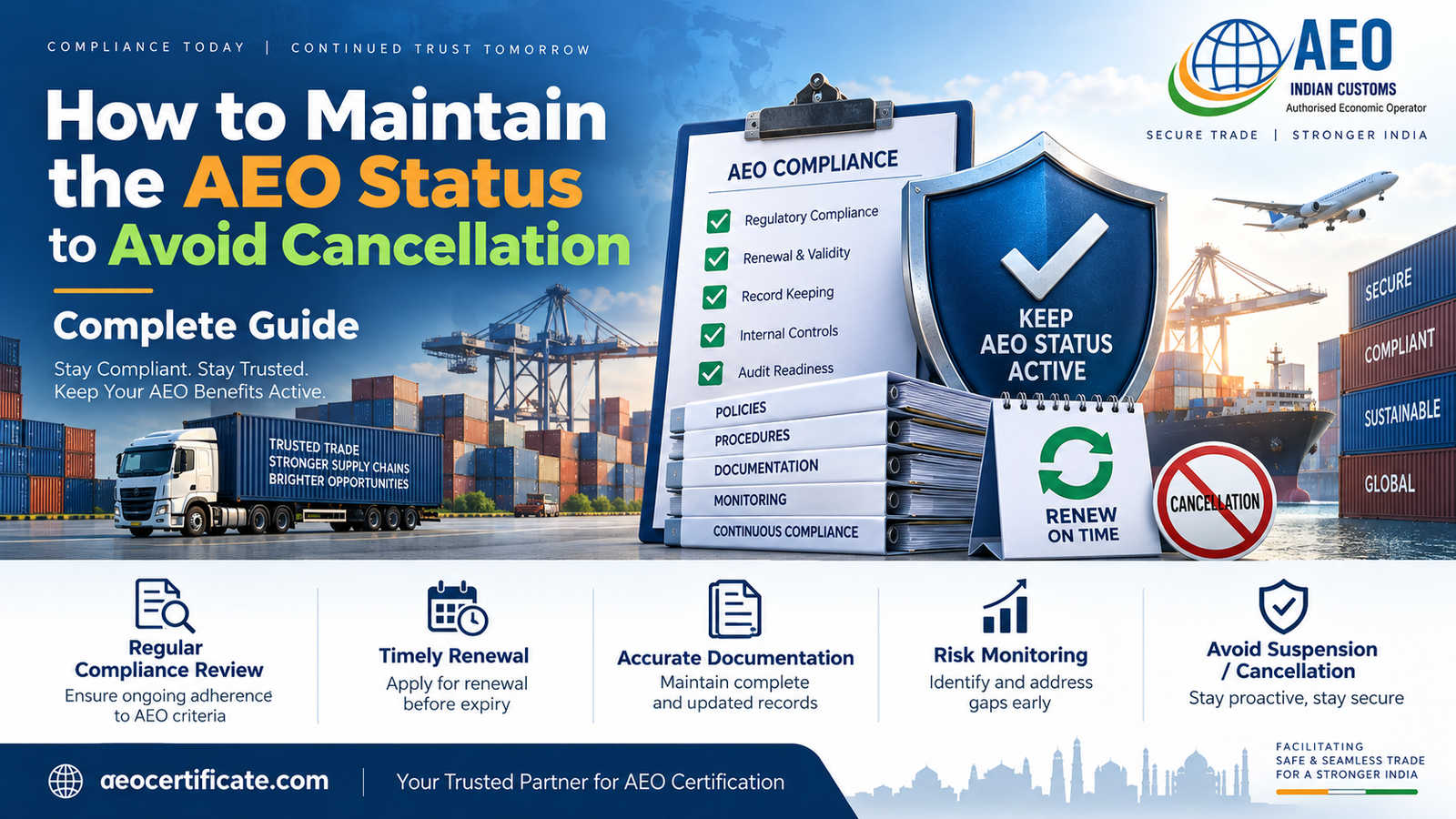
Obtaining an Authorised Economic Operator (AEO) certificate is a significant achievement for businesses involved in international trade. However, maintaining the certification is equally important to continue enjoying its benefits.
The AEO Status Maintenance process requires businesses to follow customs regulations, maintain strong security measures, update documentation, and fulfill ongoing compliance obligations.
Failure to maintain these requirements may result in suspension, downgrading, or revocation of AEO certification, affecting Customs clearance benefits and international trade operations.
In India, the AEO Programme is administered by the Central Board of Indirect Taxes and Customs (CBIC) to recognize businesses that demonstrate reliable customs compliance and secure supply chain practices.
This complete guide explains how businesses can ensure effective AEO status maintenance, avoid certificate cancellation, and continue enjoying AEO benefits.
What Is AEO Status Maintenance?
AEO Status Maintenance refers to the continuous compliance activities undertaken by AEO-certified businesses to retain their authorized status under the Indian Customs AEO Programme.
An AEO certificate is not simply a one-time approval. Certified businesses must continue meeting the standards and conditions under which their certification was granted.
Important requirements include:
- Maintaining satisfactory customs compliance.
- Following documented security and operational procedures.
- Keeping accurate commercial and financial records.
- Reporting significant business changes.
- Monitoring international supply chain security.
- Completing applicable declarations and renewal procedures.
- Cooperating with AEO reviews and verification activities.
Effective AEO status maintenance helps businesses demonstrate their continued reliability as trusted international trade partners.
Why Is AEO Status Maintenance Important for Businesses?
AEO-certified companies receive various benefits depending on their certification category, including simplified Customs procedures, faster cargo clearance, reduced routine examinations, and other trade facilitation measures.
However, these advantages depend on the continued validity of their certification.
Proper AEO status maintenance helps businesses:
- Avoid Certificate Revocation: Continuous monitoring reduces the risk of serious compliance failures.
- Maintain Customs Benefits: Eligible businesses can continue receiving applicable trade facilitation advantages.
- Reduce Operational Disruptions: Strong documentation and compliance systems help prevent unnecessary Customs-related delays.
- Strengthen International Credibility: Maintaining AEO status demonstrates commitment to secure and compliant trade practices.
- Improve Supply Chain Efficiency: Well-maintained security and operational procedures support predictable cargo movement.
Key Requirements for Successful AEO Status Maintenance
Businesses should establish an internal compliance system covering important AEO requirements.
1. Maintain Proper Customs Compliance
Customs compliance is one of the most important requirements for AEO Status Maintenance.
Businesses should ensure that import and export declarations accurately reflect product descriptions, classification, valuation, origin, and applicable duties.
Companies must also maintain proper records of bills of entry, shipping bills, invoices, and other trade documents.
Any identified Customs errors should be investigated and appropriately corrected.
Under AEO status maintenance, voluntary disclosure of Customs-related errors, supported by investigation and corrective action, is an important compliance measure.
2. Maintain Financial Solvency
Financial reliability is essential for continued AEO eligibility.
Businesses should maintain accurate AEO status maintenance financial statements, proper accounting records, and evidence of their ability to meet financial obligations.
Companies should regularly monitor financial risks that may affect their solvency and maintain the relevant supporting documentation.
3. Maintain Supply Chain Security
Effective security arrangements are essential, particularly for higher AEO certification categories.
Businesses should maintain appropriate security measures for warehouses, manufacturing facilities, cargo handling areas, and transportation operations.
These measures may include AEO status maintenance surveillance systems, access restrictions, visitor management, cargo inspection procedures, and documented incident reporting.
4. Maintain Accurate Business Records
Proper record management is another essential aspect of AEO status maintenance.
Organizations should preserve relevant commercial records, customs declarations, invoices, shipping documents, security logs, and internal compliance reports for the applicable statutory retention periods.
Documents should be organized and readily available for departmental review.
How Regular Internal Audits Improve AEO Status Maintenance
Regular internal audits are among the most effective ways to maintain AEO certification and prevent compliance-related issues.
An internal audit helps businesses identify weaknesses in Customs documentation, financial records, security procedures, and operational controls before they become serious regulatory problems.
For effective AEO status maintenance, businesses should conduct periodic reviews of the following areas:
- Accuracy of import and export documentation.
- Correct customs classification and valuation.
- Compliance with applicable customs duties and procedures.
- Implementation of warehouse and cargo security measures.
- Maintenance of financial and commercial records.
- Employee awareness of Customs compliance responsibilities.
- Implementation of corrective actions from previous audits.
Businesses should prepare an internal audit report documenting identified deficiencies, corrective actions, responsible personnel, and target completion dates.
Although an internal audit schedule should reflect the company’s risk profile, quarterly reviews can be a practical management approach for organizations handling frequent international shipments.
Importance of Risk Management in AEO Status Maintenance
Effective risk management is essential for businesses involved in international trade.
Risks such as incorrect customs declarations, cargo theft, unauthorized warehouse access, documentation errors, and supply chain disruptions can affect a company’s compliance performance.
A structured AEO Status Maintenance program should include a system for identifying, assessing, and controlling these risks.
For example, a company importing electronic components may face risks involving incorrect HSN classification, customs valuation, or incomplete shipment documentation.
Similarly, an exporter handling sensitive pharmaceutical products may need enhanced controls for shipment integrity, authorized access, and transportation security.
Businesses should maintain a risk register documenting AEO Status Maintenance identified risks, their likelihood, potential consequences, and proposed control measures.
Regular risk reviews help organizations adapt their security and compliance systems to changing operational circumstances.
Role of Employee Training in AEO Status Maintenance
Employee training plays a vital role in maintaining customs compliance and supply chain security.
Even businesses with strong documentation systems may face compliance problems if employees are unfamiliar with applicable procedures.
An effective AEO Status Maintenance training program should cover customs documentation, cargo handling, security responsibilities, incident reporting, and relevant changes in regulations.
Training should particularly focus on employees working in import-export operations, logistics, warehousing, finance, and regulatory compliance.
Organizations should maintain records of training sessions, attendance, learning materials, and employee assessments.
Periodic refresher training helps ensure that established procedures are consistently followed.
Digital Record Management for Effective AEO Status Maintenance
Maintaining accurate and accessible records is essential for demonstrating continued compliance.
Businesses can strengthen AEO status maintenance by implementing digital document management systems.
Such systems can help organizations organize:
- Bills of Entry and Shipping Bills.
- Commercial invoices and packing lists.
- Import and export licences.
- Customs correspondence.
- Financial statements and statutory records.
- Security inspection reports.
- Internal audit findings.
- Employee training records.
- Corrective and preventive action reports.
Electronic record management can improve document retrieval, reduce administrative errors, and support compliance verification.
However, digital records must remain secure, accurate, and accessible throughout the applicable retention period.
How Corrective and Preventive Actions Support AEO Status Maintenance
Corrective and Preventive Action (CAPA) systems help businesses address compliance deficiencies and prevent similar problems from occurring again.
A practical CAPA process for AEO Status Maintenance includes identifying the problem, investigating its root cause, implementing corrective measures, and verifying their effectiveness.
For example, if an internal audit identifies repeated errors in Customs declarations, the business should investigate whether the issue results from incorrect product information, inadequate employee training, or insufficient document verification.
Appropriate corrective measures may include AEO Status Maintenance revising documentation procedures, introducing additional checks, or providing targeted employee training.
Maintaining documented evidence of these actions helps demonstrate that the organization actively monitors and improves its compliance systems.
How to Prepare for Customs Verification During AEO Status Maintenance
AEO-certified organizations may undergo departmental reviews to verify continued compliance with the conditions of certification.
Businesses should therefore remain prepared to AEO status maintenance demonstrate that their security measures, operational procedures, and regulatory controls are functioning effectively.
Important preparations include:
- Keeping relevant customs and commercial records updated.
- Maintaining current security plans and operational procedures.
- Ensuring responsible employees understand AEO requirements.
- Reviewing previous compliance findings and corrective actions.
- Maintaining records of significant business changes.
- Ensuring that reported information remains accurate.
The frequency and scope of departmental reviews depend on the applicable AEO framework and certification category.
Strong AEO status maintenance practices help businesses demonstrate ongoing compliance during such assessments.
Impact of AEO Cancellation on International Trade Operations
Loss of AEO certification can affect a business’s Customs facilitation arrangements and create additional operational challenges.
Depending on the certification category and circumstances, businesses may lose applicable benefits such as reduced routine examinations, preferential cargo processing, or concessions relating to bank guarantees.
The resulting operational impact may include increased cargo handling, longer clearance procedures, additional administrative work, and changes to cash flow requirements.
For companies managing high-volume international shipments, these changes may significantly affect logistics planning.
Therefore, investing in preventive AEO status maintenance can help businesses protect their operational efficiency and maintain long-term regulatory reliability.
Reporting Business Changes Under AEO Status Maintenance
Businesses holding AEO certification must notify the AEO Programme Team of significant changes that may affect their certification.
These changes may include:
- Changes in the legal entity.
- Changes in company name or business address.
- Changes in business activities.
- Changes in accounting or computer systems.
- Changes in senior personnel responsible for Customs matters.
- Addition or closure of locations involved in international supply chain operations.
Such changes should be reported as soon as they become known or within 14 days of taking place, as prescribed under Circular No. 33/2016-Customs.
Where the legal entity itself changes, a fresh AEO status maintenance in the name of the new entity is required.
Timely communication with customs authorities is therefore an important part of AEO status maintenance.
How to Avoid AEO Certificate Cancellation Through AEO Status Maintenance
Businesses can reduce the risk of losing their certification by following a structured compliance management approach.
Step 1: Conduct Regular Internal Compliance Audits
Conduct periodic reviews of Customs declarations, documentation, financial controls, and supply chain security.
Internal audits help identify non-compliance before AEO status maintenance becomes a serious regulatory issue.
Step 2: Update Standard Operating Procedures
Review and update relevant Standard Operating Procedures (SOPs) whenever business processes, Customs requirements, or security AEO status maintenance arrangements change.
Ensure employees understand their responsibilities.
Step 3: Maintain an AEO Compliance Register
Develop a centralized register covering reporting obligations, compliance reviews, important customs communications, certificate validity, and corrective actions.
This helps prevent missed deadlines and incomplete compliance activities.
Step 4: Train Employees Regularly
Employees involved in import, export, warehousing, security, and customs AEO status maintenance documentation should receive appropriate training.
Training helps reduce documentation errors and strengthen operational security.
Step 5: Monitor Regulatory Changes
Businesses should regularly review applicable circulars, Customs notifications, and updates published on the official AEO portal.
Keeping internal procedures aligned with current requirements supports effective AEO status maintenance.
Step 6: Address Non-Compliance Promptly
When a compliance issue is identified, investigate its cause and implement appropriate corrective and preventive actions.
Maintain written evidence of the corrective measures undertaken.
Reasons for Suspension or Revocation During AEO Status Maintenance
AEO certification may be suspended, downgraded, or revoked under the conditions specified in the applicable AEO framework.
Important circumstances include:
Non-Compliance with Certification Conditions: Failure to continue meeting prescribed eligibility or security standards may lead to suspension.
Serious Customs Violations: Certain serious allegations, including fraud, forgery, or outright smuggling, may result in revocation under the prescribed rules.
Failure to Correct Compliance Deficiencies: Where certification is suspended for non-compliance, failure to take satisfactory remedial measures within the prescribed 60-day period may lead to revocation.
Suspension of Underlying Licences: Certain logistics operators, customs brokers, or warehouse operators may face AEO suspension if their relevant basic licence is suspended.
Voluntary Surrender: An AEO holder may request revocation of its certification.
It is important to understand that every customs query or show cause notice does not automatically result in cancellation. The consequences depend on the nature of the matter and the applicable AEO provisions.
A proactive AEO status maintenance strategy helps businesses recognize and address compliance risks early.
What Happens If AEO Status Maintenance Requirements Are Not Met?
If an AEO certificate is suspended, the business may lose access to applicable AEO benefits during the suspension period.
Under the prescribed framework, the AEO Programme Manager may restore status where satisfactory remedial measures are taken within 60 days in cases involving non-compliance with certification conditions.
Where AEO status is revoked, restrictions on reapplication may also apply.
Under Circular No. 33/2016-Customs, the specified reapplication restrictions are:
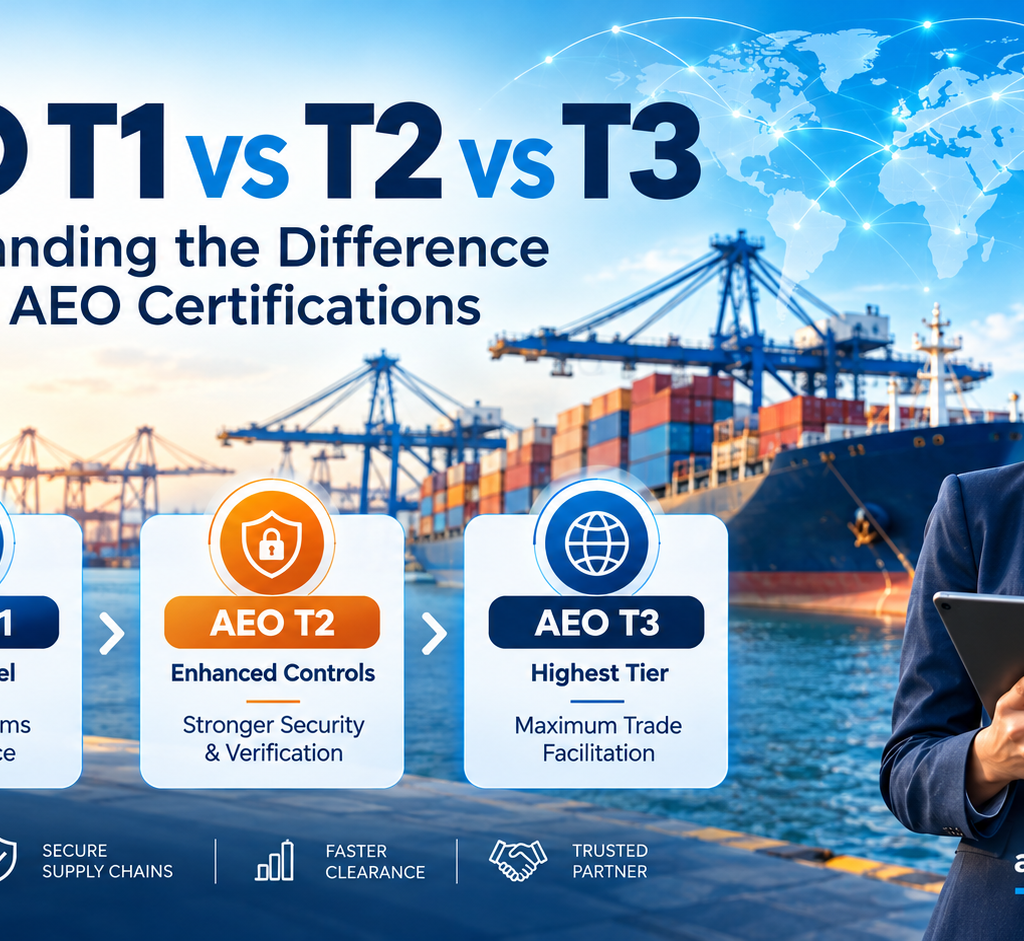
- AEO-T1 and AEO-T2: One year from the date of revocation.
- AEO-T3 and AEO-LO: Three years from the date of revocation.
These consequences highlight why businesses should prioritize preventive compliance instead of waiting for regulatory action.
Best Practices for Long-Term AEO Status Maintenance
Businesses can strengthen their certification compliance by developing a practical AEO management framework.
Recommended practices include assigning an internal AEO compliance coordinator, maintaining updated security plans, reviewing business partner reliability, conducting periodic employee training, and documenting corrective actions.
Companies should also review their compliance performance against the standards applicable to their certification category.
An effective internal monitoring system makes AEO status maintenance more manageable and helps businesses prepare for departmental reviews.
How ELT Corporate Supports AEO Status Maintenance
Maintaining an AEO certificate requires continuous attention to Customs compliance, documentation, security procedures, and regulatory reporting.
ELT Corporate Pvt. Ltd. provides professional regulatory consultancy services to businesses seeking assistance with AEO certification and ongoing compliance.
Our AEO Status Maintenance support includes:
- Review of existing AEO certification and compliance requirements.
- Identification of documentation and operational compliance gaps.
- Assistance with AEO renewal and revalidation documentation.
- Guidance on reporting significant business changes.
- Preparation and review of relevant compliance documents.
- Support in addressing departmental queries.
- Assistance with corrective action documentation.
- Guidance on maintaining internal AEO compliance systems.
Through a structured approach, ELT Corporate helps businesses strengthen regulatory preparedness and reduce avoidable compliance risks.
Conclusion
AEO status maintenance is essential for businesses seeking to preserve their trusted trader recognition and continue benefiting from simplified customs procedures.
By maintaining accurate documentation, implementing effective security controls, reporting business changes, and meeting applicable renewal obligations, businesses can significantly reduce the risk of certificate suspension or revocation.
A proactive compliance strategy not only protects AEO certification but also strengthens operational efficiency and long-term international trade reliability.
ELT Corporate Pvt. Ltd. offers professional assistance for AEO certification, renewal, compliance reviews, and ongoing AEO status maintenance.
Frequently Asked Questions
Q1. Is AEO Status Maintenance mandatory?
Yes. Certified businesses must continue meeting the applicable eligibility, compliance, and security requirements to retain their AEO status.
Q2. Can an AEO certificate be cancelled?
Yes. AEO certification may be revoked under the circumstances specified in the applicable CBIC framework.
Q3. When should significant changes be reported for AEO Status Maintenance?
Relevant business changes should be reported as soon as known or within 14 days of the change taking place.
Q4. Can suspended AEO status be restored?
Yes. Restoration may be considered when the prescribed conditions are satisfied, and the competent authority is satisfied with the corrective measures.
Q5. Does AEO Status Maintenance require regular audits?
Regular internal compliance reviews are strongly recommended. Departmental reviews and verification may also occur under the applicable certification framework.