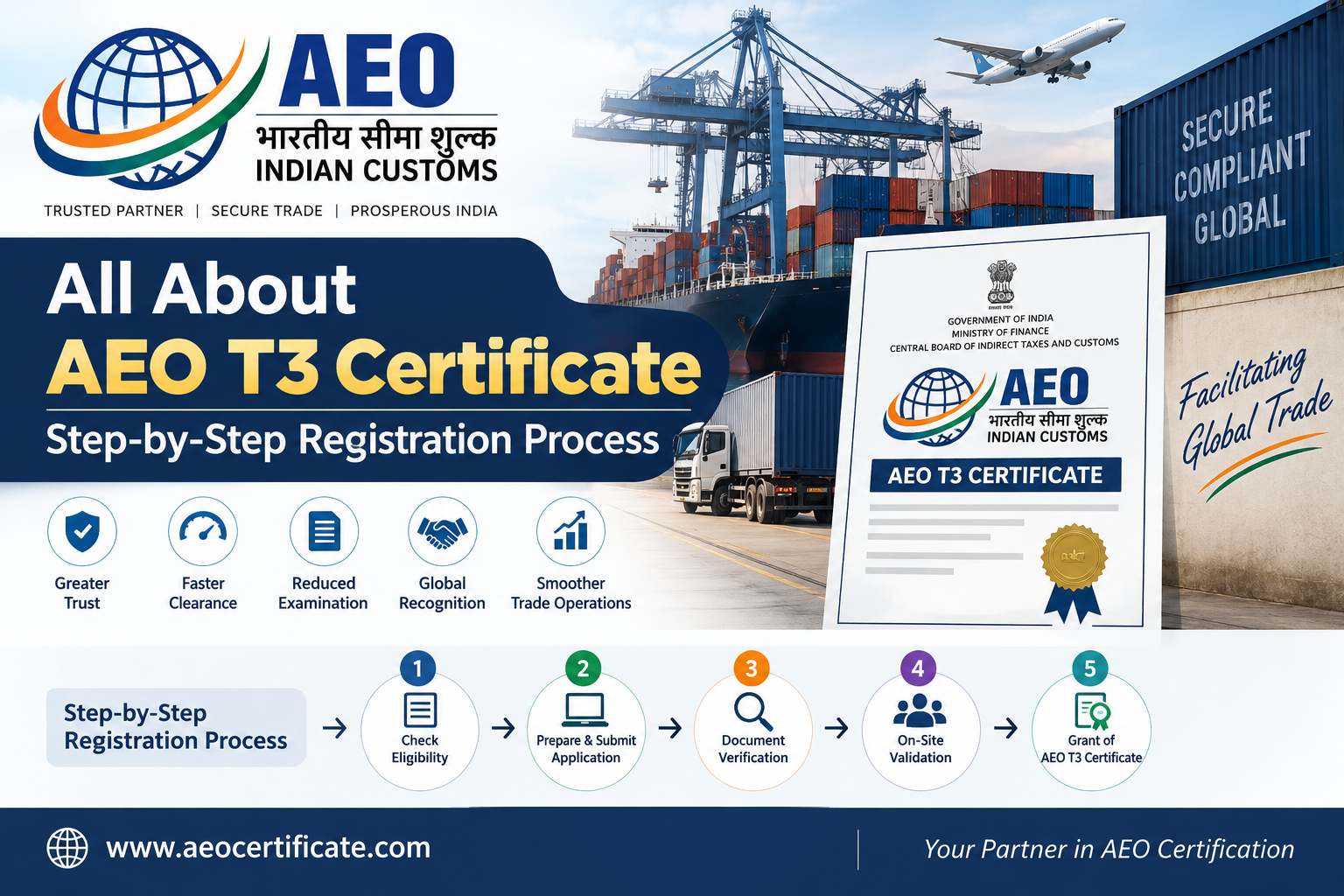
The AEO T3 Certificate is the highest level of Authorised Economic Operator (AEO) certification available to eligible importers and exporters under the Indian Customs AEO Programme. It recognizes businesses that demonstrate strong compliance with customs regulations, reliable internal controls, financial stability, and high standards of supply chain security.
The AEO Program, administered by the Central Board of Indirect Taxes and Customs (CBIC), aims to facilitate international trade while strengthening the security of global supply chains.
For businesses involved in international trade, obtaining an AEO certification in India can provide significant advantages, including enhanced customs facilitation, reduced cargo examination, improved operational efficiency, and priority treatment in customs-related processes.
This guide explains the eligibility criteria, documentation requirements, benefits, and step-by-step registration process for obtaining an AEO T3 Certificate in India.
What Is an AEO T3 Certificate?
The AEO T3 Certificate is the highest tier of certification under India’s three-tier AEO program for importers and exporters.
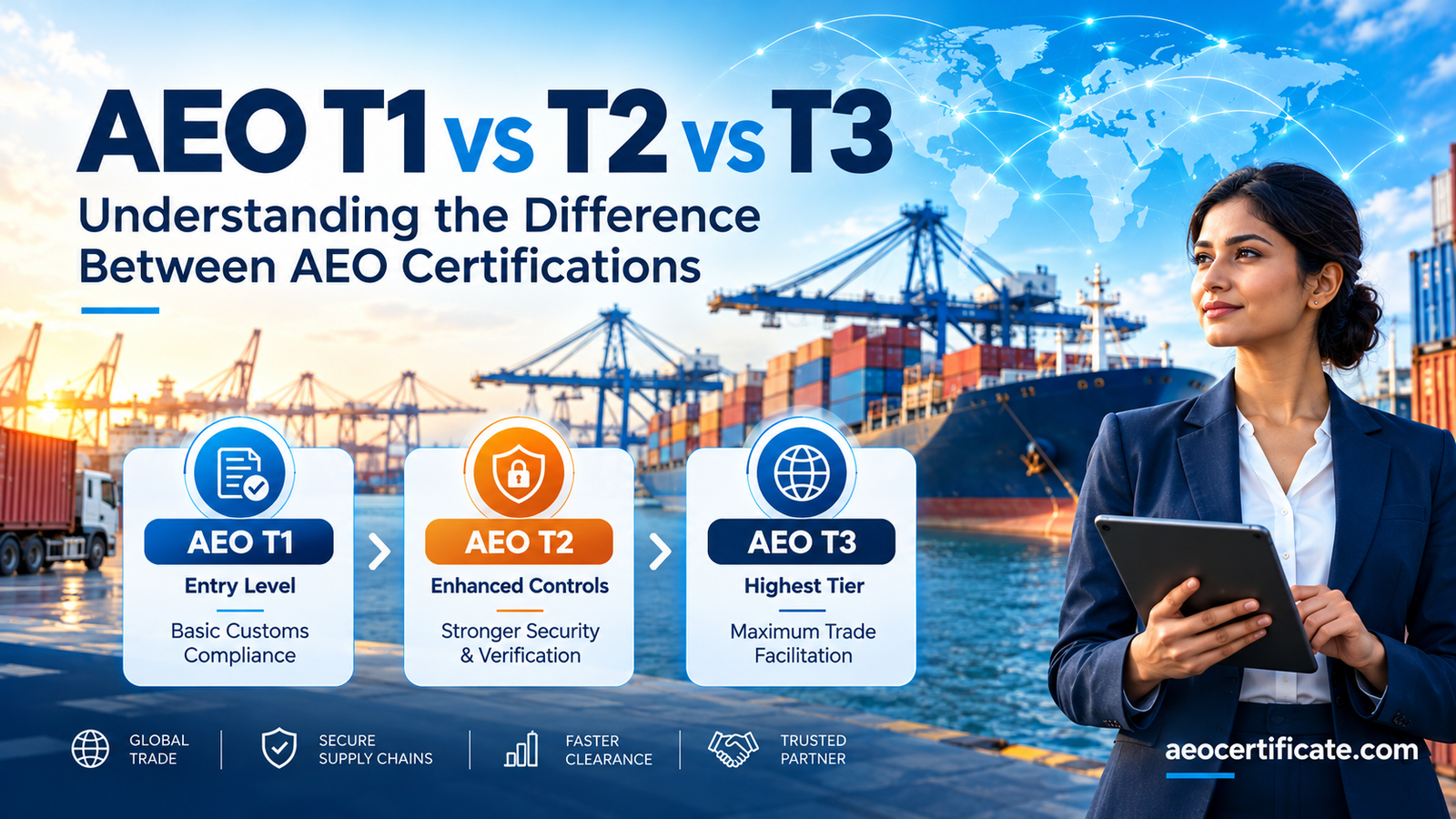
The program includes three certification levels:
- AEO T1: Entry-level certification focusing primarily on customs compliance and basic eligibility.
- AEO T2: Advanced certification involving more comprehensive compliance checks and supply chain security requirements.
- AEO T3: Highest-tier certification recognizing businesses with a mature compliance framework and demonstrated supply chain security standards.
An AEO certification in India indicates that a business has achieved a high level of trustworthiness in its customs operations.
Unlike basic registration or licensing, AEO certification is a voluntary accreditation program that provides customs facilitation benefits to qualifying businesses.
Why Is the AEO T3 Certificate Important for Importers and Exporters?
The AEO T3 Certificate is particularly valuable for businesses handling frequent international shipments, large import-export volumes, or complex global supply chains.
International trade involves multiple regulatory requirements, customs procedures, documentation obligations, and cargo security risks.
AEO T3 certification helps businesses demonstrate that their operations meet recognized customs compliance and supply chain security standards.
Major advantages include improved predictability in customs procedures, reduced operational disruptions, better coordination with customs authorities, and greater credibility with international business partners.
For organizations seeking long-term growth in global trade, the AEO certification in India can become an important part of their regulatory compliance and logistics strategy.
AEO T3 Certificate Eligibility Criteria
Businesses applying for an AEO T3 Certificate must satisfy the eligibility requirements prescribed under the Indian Customs AEO Programme.
AEO T3 is an upgrade pathway for eligible AEO T2 holders rather than a normal entry-level certification.
The principal eligibility routes include:
- Holding AEO T2 status continuously for at least two years.
- Holding AEO T2 status for a shorter period while satisfying the prescribed alternative eligibility conditions, including qualifying as an AEO-certified entity under another customs administration with which India has a Mutual Recognition Agreement, where applicable.
- Maintaining a satisfactory customs compliance record.
- Demonstrating appropriate financial solvency and reliable record management.
- Maintaining documented internal controls and supply chain security procedures.
Businesses must also disclose material changes in their AEO certification in India operations, premises, ownership, or security arrangements that could affect their certification.
How the AEO T3 Certificate Improves Supply Chain Efficiency
International supply chains face challenges such as shipment delays, customs examinations, documentation errors, and unexpected operational costs.
The AEO T3 Certificate helps eligible businesses address these challenges through enhanced customs facilitation.
Improved Shipment Planning with an AEO T3 Certificate
Reduced customs interventions, where applicable, can make shipment schedules more predictable and support inventory management.
Lower Operational Costs Through AEO T3 Certificate Benefits
Efficient cargo clearance may reduce avoidable storage, demurrage, and detention costs. Actual savings depend on shipment characteristics and operating conditions.
Greater International Trade Reliability with an AEO T3 Certificate
AEO accreditation demonstrates that the business maintains recognized compliance and security standards, potentially strengthening relationships with global supply chain partners.
AEO T3 Certificate Compliance Requirements After Approval
Obtaining an AEO T3 Certificate does not eliminate the responsibility to maintain customs compliance.
Certified businesses should continue to:
- Maintain accurate import-export records and customs declarations.
- Implement effective cargo and premises security controls.
- Conduct regular internal compliance assessments.
- Maintain employee awareness and training programs.
- Inform customs authorities of material changes where required.
- Address identified security or compliance deficiencies promptly.
- Maintain financial solvency and appropriate business records.
Failure to maintain the AEO certification in India prescribed standards may result in suspension, downgrading, or revocation of certification, depending on the circumstances and applicable procedures.
Common Mistakes to Avoid During AEO T3 Certificate Registration
Many applicants experience delays because of avoidable documentation and compliance issues.
Incomplete application details: Missing information or inconsistent business records can lead to departmental queries.
Outdated security procedures: Security SOPs should reflect actual operational practices rather than merely describing theoretical controls.
Insufficient financial documentation: Financial information and the prescribed solvency certification must be accurate and properly supported.
Unresolved compliance issues: Applicants should evaluate outstanding customs matters and their implications before filing.
Inadequate internal coordination: Customs, finance, logistics, warehouse, and compliance teams should work together during the application process.
A structured readiness assessment can help businesses prepare a more complete AEO T3 Certificate application.
How ELT Corporate Helps with AEO T3 Certificate Registration
ELT Corporate Pvt. Ltd. provides consultancy assistance to businesses seeking an AEO T3 Certificate under the Indian Customs AEO Programme.
Our consultancy services include:
- Eligibility Assessment: Reviewing the company’s existing AEO status and applicable eligibility requirements.
- Documentation Assistance: Preparing and reviewing application documents, declarations, and supporting records.
- Compliance Gap Analysis: Identifying gaps in customs compliance, internal controls, and supply chain security.
- Application Filing Support: Assisting with submission through the prescribed AEO application process.
- Departmental Query Support: Preparing responses to clarifications and additional information requests.
- Post-Certification Guidance: Helping businesses understand continuing compliance responsibilities.
Our objective is to simplify the AEO T3 Certificate application process while helping businesses maintain strong regulatory compliance.
Importance of AEO T3 Certificate for Indian Importers and Exporters
The AEO T3 Certificate plays an important role in strengthening India’s international trade ecosystem. Businesses engaged in frequent import and export activities often encounter complex customs procedures, extensive documentation requirements, and supply chain challenges.
The AEO certification in India recognises businesses that have demonstrated a high level of customs compliance, financial stability, and supply chain security.
For Indian importers and exporters, obtaining this certification can offer several advantages:
- Greater predictability in customs clearance procedures.
- Reduced customs interventions under applicable risk-based procedures.
- Improved coordination across international supply chains.
- Enhanced credibility among overseas business partners.
- Access to additional customs facilitation benefits.
By obtaining an AEO T3 Certificate, eligible businesses can strengthen their position as reliable participants in international trade.
How AEO T3 Certificate Supports International Trade Facilitation
The AEO certification in India is designed to facilitate legitimate international trade while maintaining appropriate customs security standards.
Customs authorities use risk management systems to identify shipments that require additional scrutiny. Businesses with recognized AEO status may receive enhanced facilitation because they have demonstrated compliance with prescribed standards.
For AEO T3-certified businesses, this may result in smoother cargo movement, reduced administrative delays, and more efficient customs processing.
The AEO T3 Certificate also encourages companies to maintain transparent documentation and secure cargo-handling practices.
These measures contribute to a more reliable trading environment for importers, exporters, logistics providers, and international business partners.
Role of Internal Audits in AEO T3 Certificate Registration
Internal audits are an important part of maintaining the compliance standards expected from applicants seeking an AEO T3 Certificate.
A well-structured internal audit program helps businesses identify weaknesses before they become significant regulatory concerns.
An internal audit for AEO T3 readiness should evaluate:
- Accuracy of import-export declarations and records.
- Compliance with applicable customs regulations.
- Implementation of documented security procedures.
- Employee training and awareness.
- Cargo handling and warehouse security.
- Business partner screening and verification.
- Corrective and preventive action procedures.
Regular internal audits also help companies demonstrate that their compliance systems are functioning effectively.
Businesses applying for an AEO T3 Certificate should maintain proper audit records and evidence of corrective actions taken against identified deficiencies.
How AEO T3 Certificate Strengthens Business Credibility
The AEO T3 Certificate can enhance a company’s reputation as a secure and compliant international trading partner.
Global buyers and suppliers increasingly value organizations that maintain AEO certification in India reliable logistics systems and strong regulatory compliance practices.
AEO T3 accreditation demonstrates that the certified business has undergone assessment under the Indian Customs AEO Programme.
This recognition may help companies:
- Strengthen relationships with international suppliers.
- Build confidence among overseas customers.
- Demonstrate commitment to secure supply chain management.
- Improve their reputation in competitive export markets.
- Support long-term international business relationships.
Although the AEO T3 Certificate does not guarantee new business opportunities, it can serve as a valuable indicator of an organization’s compliance maturity.
AEO T3 Certificate and Mutual Recognition Arrangements
Mutual Recognition Arrangements (MRAs) are agreements between customs administrations that recognize eligible Authorized Economic Operators certified under their respective programs.
The AEO T3 Certificate may help qualifying businesses access customs facilitation benefits in partner countries where applicable MRAs are operational.
These arrangements are intended to promote secure international trade and improve cooperation between customs authorities.
Potential benefits include reduced customs interventions, improved risk assessment, and enhanced recognition of compliant traders.
However, the exact benefits depend on the relevant MRA, participating countries, operational procedures, and eligibility conditions.
Businesses holding an AEO T3 Certificate should verify the current arrangements and applicable benefits before planning international shipments.
AEO T3 Certificate and Digital Customs Compliance
Digitalization is transforming customs procedures, documentation management, and international trade operations.
Businesses seeking an AEO T3 Certificate can benefit from adopting reliable digital compliance systems.
Electronic document management helps companies maintain organized records of import-export transactions, customs declarations, invoices, shipping documents, and compliance reports.
Digital systems can also improve traceability and facilitate timely retrieval of records during customs assessments.
Organizations can strengthen their AEO certification in India readiness through:
- Secure electronic recordkeeping.
- Controlled access to compliance documentation.
- Digital tracking of customs-related activities.
- Automated compliance reminders.
- Electronic audit trails.
- Secure backup and recovery procedures.
A well-managed digital compliance framework supports the operational reliability expected of AEO T3 Certificate holders.
Eligibility Criteria for an AEO T3 Certificate
To qualify for an AEO T3 Certificate, applicants must satisfy the eligibility requirements prescribed under the Indian Customs AEO Programme.
Existing AEO T2 Certification
An applicant generally must have held AEO T2 status continuously for at least two years. An alternative eligibility route is available where all business partners in the international supply chain hold AEO T2 or AEO-LO status, subject to the applicable conditions.
Strong Customs Compliance Record
The applicant should demonstrate consistent compliance with customs laws, accurate declarations, proper recordkeeping, and satisfactory handling of regulatory obligations.
Financial Solvency
Applicants must demonstrate financial stability. The prescribed solvency certificate from the statutory auditor is an important documentation requirement for AEO T3 applicants.
Effective Security Management
The company should maintain documented procedures for premises security, cargo handling, employee screening, access control, and supply chain risk management.
Reliable Internal Controls
Businesses seeking an AEO T3 Certificate must maintain effective internal controls and demonstrate that their operating procedures are implemented consistently.
Documents Required for AEO T3 Certificate Registration
Preparing accurate documentation is essential for successful AEO T3 certificate registration.
The documentation checklist generally includes:
- Existing AEO T2 Certificate and relevant certification history.
- Import Export Code (IEC), PAN, and business registration documents.
- Company profile and details of business operations.
- Customs compliance records and import-export transaction information.
- Audited financial statements and statutory auditor’s solvency certificate.
- Standard Operating Procedures (SOPs) covering customs compliance and cargo security.
- Internal audit reports and corrective action records.
- Details of business partners and their AEO status, where applicable.
- Premises security and access control documentation.
- Details of significant changes since the previous AEO assessment.
The applicant must submit the prescribed annexures and supporting AEO certification in India evidence applicable to its circumstances. Additional documents may be requested during verification.
Step-by-Step AEO T3 Certificate Registration Process
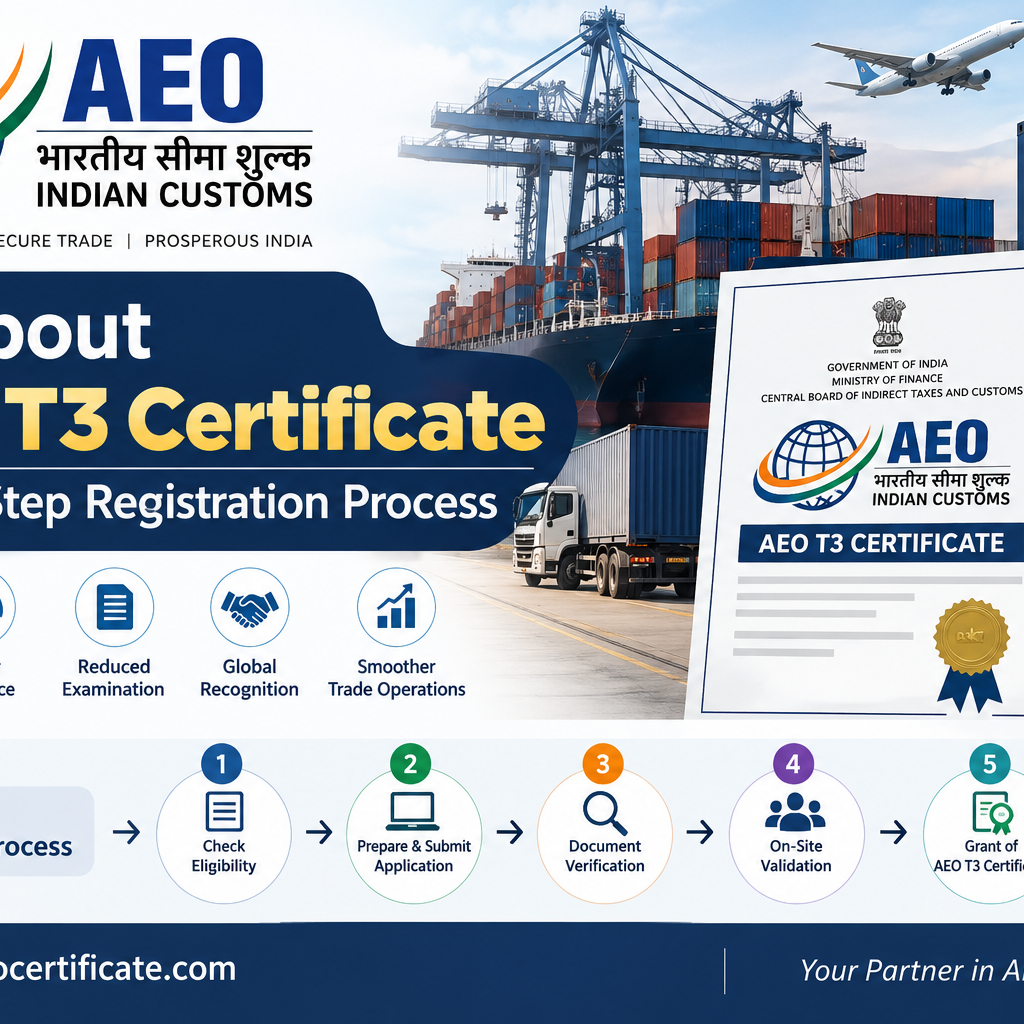
The AEO T3 Certificate registration process involves eligibility verification, documentation, application submission, customs scrutiny, and final approval.
Step 1: Check AEO T3 Certificate Eligibility
Verify the existing AEO T2 status, applicable qualifying period, business partner status, and customs compliance history.
Step 2: Prepare AEO T3 Certificate Documents
Compile financial AEO certification in India records, security SOPs, compliance evidence, existing certification details, and updated company information.
Step 3: Submit the AEO T3 Certificate Application.
AEO India Portal
Log in, select the applicable application process, complete the prescribed details, and submit supporting documents.
Step 4: Customs Verification and Assessment
Customs authorities examine the application and may seek clarifications or conduct additional verification, including premises assessment where necessary.
Step 5: Respond to AEO T3 Certificate Queries
Submit complete responses to departmental queries, provide supporting evidence, and address identified compliance gaps.
Step 6: Obtain the AEO T3 Certificate
After successful assessment and approval, the competent authority grants AEO certification in India status. The business must continue meeting the certification requirements.
The government provides an official
AEO T2/T3 Online Application Filing Guide
AEO T3 Certificate Registration Timeline and Validity
The AEO T3 Certificate assessment timeline depends on the applicant’s eligibility, previous certification history, completeness of documentation, and any significant changes in business operations.
For eligible applicants holding AEO T2 status continuously for at least two years, the official AEO guidance indicates an approximately 30-day processing timeline, subject to applicable conditions. Additional verification can affect the actual time required.
The AEO certification in India generally has a validity of five years, subject to continued compliance and applicable renewal provisions.
Common Challenges in AEO T3 Certificate Registration
Businesses applying for an AEO T3 Certificate may encounter several challenges:
- Incomplete documentation or outdated compliance records.
- Differences between submitted information and actual operational practices.
- Inadequate evidence of supply chain security controls.
- Unresolved customs compliance issues.
- Weak internal audit and corrective action procedures.
- Delays in responding to customs authorities.
Conducting a comprehensive internal readiness assessment before applying can help identify deficiencies and reduce avoidable delays.
Why Choose Professional Consultants for AEO T3 Certificate Registration?
Professional assistance can simplify the AEO T3 Certificate registration process by helping businesses understand complex requirements and prepare accurate applications.
Experienced AEO consultants can assist with eligibility evaluation, documentation review, SOP preparation, compliance gap assessments, application filing, and responses to departmental queries.
Consultants can also help businesses prepare for customs verification and develop practical corrective action plans.
Although consultants cannot guarantee AEO certification in India or government processing timelines, their involvement can reduce documentation errors and improve application readiness.
Conclusion
The AEO certification in India is a valuable accreditation for established importers and exporters seeking greater efficiency, credibility, and predictability in international trade.
With enhanced customs facilitation, stronger supply chain security, and potential financial and operational benefits, the certification can support long-term business growth.
However, obtaining an AEO T3 Certificate requires strong compliance practices, accurate documentation, and proper understanding of Indian Customs requirements.
Businesses should assess their eligibility carefully and prepare thoroughly before submitting an application.
Frequently Asked Questions
Q1. What is an AEO T3 Certificate?
The AEO T3 Certificate is the highest certification tier for eligible importers and exporters under India’s Authorized Economic Operator Programme.
Q2. Can a company directly apply for an AEO T3 Certificate?
Generally, no. AEO T3 is intended for existing AEO T2 holders who meet the prescribed eligibility conditions.
Q3. How long is the AEO T3 Certificate valid?
The AEO T3 Certificate generally remains valid for five years, subject to continued compliance and applicable conditions.
Q4. Does an AEO T3 Certificate eliminate all customs inspections?
No. AEO T3 provides enhanced facilitation, but customs authorities may still conduct inspections or checks based on specific intelligence, legal requirements, or identified risks.
Q5. Is professional consultancy mandatory for AEO T3 Certificate registration?
No. Businesses may apply independently. However, professional consultants can help with documentation, compliance assessment, and application preparation.