In international trade, customs clearance speed plays a crucial role in maintaining efficient supply chain operations. Delays in customs clearance can increase logistics costs, affect delivery schedules, and impact customer satisfaction. Businesses involved in import and export activities are continuously looking for ways to improve compliance, reduce risks, and achieve smoother trade operations.
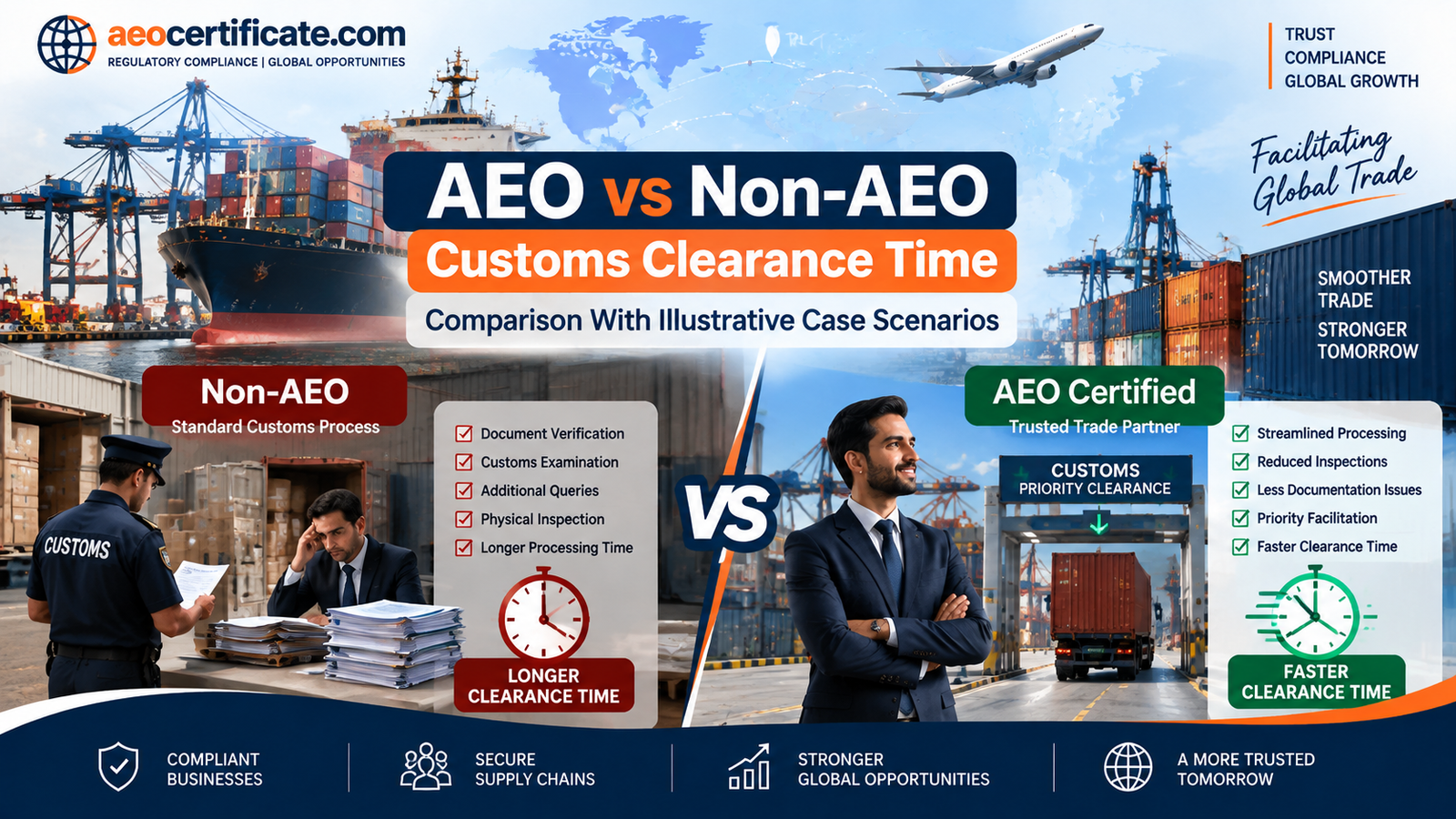
The difference between AEO vs. non-AEO customs clearance time has become an important topic for exporters, importers, manufacturers, and logistics companies. AEO (Authorized Economic Operator) certification recognizes businesses that maintain strong customs compliance, secure supply chain practices, and reliable operational systems.
While both AEO-certified and non-AEO businesses can conduct international trade, their customs experience may differ due to factors such as compliance history, risk assessment, documentation accuracy, and customs facilitation measures.
This blog explains the comparison between AEO and non-AEO businesses, including illustrative case scenarios showing how AEO certification can support efficient customs clearance.
What is AEO Certification?
AEO (Authorized Economic Operator) is a globally recognized customs compliance program introduced under the World Customs Organization (WCO) SAFE Framework of Standards.
An AEO-certified company is considered a trusted trade partner because it demonstrates:
- Strong customs compliance practices
- Secure supply chain management
- Proper documentation systems
- Risk management procedures
- Transparent business operations
In India, the AEO program is implemented by Indian Customs under the CBIC to provide facilitation benefits to eligible businesses.
The certification is available in different levels:
AEO T1 Certification
Focuses on basic customs compliance and security requirements.
AEO T2 Certification
Requires stronger compliance systems and supply chain security controls.
AEO T3 Certification
Represents an advanced level of compliance maturity.
Understanding AEO vs Non-AEO Customs Clearance Time helps businesses evaluate the value of becoming a trusted trade partner.
What is an AEO business?
An AEO business is a company that has successfully obtained Authorized Economic Operator certification after demonstrating compliance with customs and security requirements.
Examples include:
- Exporters
- Importers
- Manufacturers
- Logistics providers
- Customs brokers
- Warehouse operators
AEO-certified businesses generally maintain structured systems for:
- Documentation management
- Customs compliance
- Supply chain security
- Internal controls
What is a Non-AEO Business?
A non-AEO business refers to companies that conduct international trade without AEO certification.
These businesses can legally import and export goods; however, they may not receive the same level of customs facilitation available to AEO-certified entities.
Their customs clearance experience may depend on:
- Shipment risk assessment
- Documentation accuracy
- Nature of goods
- Customs examination requirements
AEO vs Non-AEO Customs Clearance Time: Key Differences
The comparison of AEO vs. non-AEO customs clearance time depends on multiple factors, including customs procedures, shipment type, documentation accuracy, and regulatory requirements.
| Factor | AEO Certified Business | Non-AEO Business |
| Compliance Recognition | Recognized as a trusted trade partner | Standard trade status |
| Risk Assessment | May receive risk-based facilitation | Subject to normal assessment procedures |
| Documentation Process | Structured compliance systems | Depends on internal processes |
| Customs Interaction | More predictable procedures | May involve additional verification |
| Supply Chain Controls | Strong security framework | Varies by business |
AEO certification does not eliminate customs requirements but helps businesses establish a stronger compliance profile.
How AEO Certification Helps Improve Customs Clearance Efficiency
Customs authorities evaluate businesses based on compliance history and risk factors.
1. Better Compliance Recognition
AEO-certified companies demonstrate:
- Accurate documentation
- Regulatory awareness
- Established internal procedures
The AEO vs Non-AEO Customs Clearance Time comparison highlights how compliance readiness can influence customs processing efficiency.
2. Reduced Documentation Issues
Incorrect documentation is one of the common reasons for shipment delays.
AEO-certified companies generally maintain:
- Document verification procedures
- Standard operating procedures
- Employee training systems
This helps reduce errors related to:
- Invoices
- Shipping documents
- Customs declarations
- Product details
3. Improved Supply Chain Security
International trade involves multiple AEO vs. non-AEO customs clearances, including suppliers, transporters, warehouses, and customs authorities.
AEO certification encourages companies to maintain:
- Secure cargo handling
- Controlled access systems
- Shipment monitoring procedures
- Reliable business partner management
Strong supply chain practices support smoother customs operations.
AEO vs Non-AEO Customs Clearance Time: Illustrative
A company imports electronic components from an overseas supplier.
Non-AEO Company:
The company submits import documents, but AEO vs. non-AEO customs clearance time customs authorities require additional verification due to:
- Incomplete product information
- Documentation clarification
- Additional assessment requirements
The shipment may experience additional processing time before clearance.
AEO Certified Company:
The AEO-certified importer maintains:
- Proper documentation systems
- Regular compliance records
- Verified supply chain procedures
The shipment moves through customs procedures with better compliance confidence.
Key Difference:
The major advantage is not automatic clearance AEO vs. non-AEO customs clearance time, but improved trust, documentation quality, and compliance preparedness.
AEO vs Non-AEO Customs Clearance Time: Illustrative Case Scenario 2
An Indian manufacturer exports machinery parts to an international buyer.
Non-AEO Exporter:
Possible challenges:
- Manual document verification
- Additional queries
- Longer coordination between departments
AEO Exporter:
The company has:
- Document control procedures
- Trained employees
- Established export compliance systems
This supports smoother export processing.
Business Impact:
Faster and more predictable processes can help businesses AEO vs. non-AEO customs clearance time maintain better delivery commitments with international customers.
Factors That Affect Customs Clearance Time
Although AEO certification provides compliance advantages, customs clearance time depends on several factors:
1. Accuracy of Documentation
Incorrect information can result in:
- Queries
- Amendments
- Additional verification
2. Nature of Goods
Certain goods may require additional regulatory checks due to:
- Product classification
- Licenses
- Regulatory requirements
3. Customs Location
Clearance procedures may vary depending on:
- Port
- Airport
- Customs station
- Trade volume
4. Compliance History
Businesses with consistent compliance records, AEO vs. non-AEO customs clearance time may have smoother interactions with customs authorities.
Benefits of AEO Certification Beyond Clearance Time
The value of AEO certification extends beyond customs processing.
1. Improved Business Credibility
AEO status helps businesses demonstrate reliability to:
- International buyers
- Supply chain partners
- Global companies
2. Stronger Market Position
Companies can use AEO certification as a credibility factor during:
- Vendor evaluations
- International partnerships
- Export discussions
3. Better Risk Management
AEO certification encourages companies to develop:
- Compliance systems
- Security procedures
- Internal controls
4. Global Trade Opportunities
Businesses with strong compliance frameworks may find it easier to participate in international supply chains.
Why Exporters and Importers Should Consider AEO Certification
Companies involved in international trade operate in a highly competitive environment. Customers expect reliable delivery, transparent processes, and secure supply chains.
The AEO vs Non-AEO Customs Clearance Time comparison shows that AEO certification can help businesses create more structured and reliable customs operations.
Businesses should consider AEO certification if they:
- Regularly import or export goods
- Face frequent customs procedures
- Want to improve compliance standards
- Work with international customers
- Aim to strengthen supply chain credibility
How to Apply for AEO Certification in India
The general process includes:
Step 1: Eligibility Assessment
Review whether the business meets AEO requirements.
Step 2: Documentation Preparation
Prepare:
- Company documents
- Customs records
- Financial information
- Security procedures
- SOPs
Step 3: Application Submission
Submit the application through the applicable customs process.
Step 4: Assessment and Verification
Customs authorities review compliance systems and business practices.
Step 5: Grant of AEO Status
Eligible businesses receive AEO certification.
Professional assistance from an AEO consultant can help businesses prepare documentation and improve application readiness.
AEO vs Non-AEO Customs Clearance Time: Role of Risk Management in Customs Procedures
Customs authorities follow a risk-based assessment AEO certification system to ensure secure and efficient international trade. The customs clearance process depends on factors such as compliance history, accuracy of documentation, nature of goods, and previous trade records.
AEO-certified companies establish structured compliance systems that help customs authorities identify them as reliable trade partners. These companies generally maintain proper records, internal controls, and security procedures, which support smoother customs interactions.
The comparison of AEO vs. non-AEO customs clearance time shows that risk management plays an important role in improving predictability and reducing operational challenges during international shipments.
AEO vs Non-AEO Customs Clearance Time: Impact on Import and Export Operations
International businesses depend on efficient customs procedures to maintain uninterrupted supply chains. Any delay in AEO certification during customs clearance can affect production schedules, inventory management, and customer commitments.
For importers, delayed clearance may result in additional storage costs and supply chain disruption. Exporters may face challenges in meeting delivery timelines and maintaining customer satisfaction.
Understanding AEO vs. non-AEO customs clearance time helps businesses evaluate how compliance systems can support better trade operations and improved shipment management.
AEO vs Non-AEO Customs Clearance Time: Importance of Documentation Accuracy
Documentation accuracy is one of the most important factors affecting customs clearance. Incorrect or incomplete documents may result in AEO certification customs queries, additional verification, or processing delays.
Common documentation issues include:
- Incorrect product description
- Wrong classification details
- Missing supporting certificates
- Invoice discrepancies
- Incorrect shipment information
AEO-certified businesses generally maintain document verification systems, standard operating procedures, and compliance reviews that help reduce documentation-related issues.
The AEO vs Non-AEO Customs Clearance Time comparison highlights the importance of maintaining proper documentation practices for efficient international trade.
AEO vs Non-AEO Customs Clearance Time: Effect on Supply Chain Security
Modern international trade requires secure supply chain management. Businesses must ensure that goods move safely from suppliers to customers without unnecessary risks.
AEO certification focuses on strengthening supply chain security through:
- Secure cargo handling
- Controlled access systems
- Reliable business partner management
- Employee awareness
- Shipment monitoring procedures
Companies with strong security practices can create more reliable trade processes. This makes supply chain security an important factor when understanding AEO vs. non-AEO customs clearance time.
AEO vs Non-AEO Customs Clearance Time: Role of Customs Brokers and Logistics Providers
Customs brokers and logistics providers play an important role in managing import and export procedures. They assist businesses with AEO certification, including documentation preparation, customs filings, and coordination with authorities.
AEO-certified companies often maintain better coordination systems with their logistics partners due to established compliance procedures.
For businesses involved in global trade, understanding AEO vs. non-AEO customs clearance time helps identify the importance of collaboration between companies, customs brokers, and logistics providers.
AEO vs Non-AEO Customs Clearance Time: Cost Impact on Businesses
Customs clearance delays can increase operational expenses for businesses. Even a small delay may affect logistics planning and overall AEO certification supply chain costs.
Possible cost impacts include:
- Warehouse charges
- Container detention charges
- Inventory holding costs
- Additional administrative work
- Production delays
AEO certification helps businesses create organized compliance systems that may support smoother customs operations.
The AEO vs Non-AEO Customs Clearance Time analysis helps businesses understand how better compliance management can improve operational efficiency.
AEO vs Non-AEO Customs Clearance Time: Benefits for MSME Exporters
Many small and medium enterprises are entering international markets. For MSMEs, building trust with overseas customers and supply chain partners is essential.
AEO certification can help MSMEs demonstrate:
- Strong compliance practices
- Professional business systems
- Secure supply chain management
- Reliable trade operations
The AEO vs Non-AEO Customs Clearance Time comparison is especially useful for MSMEs planning to expand their import-export activities.
AEO vs Non-AEO Customs Clearance Time: Importance for E-Commerce Exporters
Cross-border e-commerce businesses operate with high AEO certification shipment volumes and strict delivery expectations. Timely customs processing is important for maintaining customer satisfaction.
E-commerce exporters can benefit from developing structured systems for:
- Shipment documentation
- Product information management
- Regulatory compliance
- Logistics coordination
Understanding AEO vs. non-AEO customs clearance time helps online exporters evaluate the importance of trusted trade practices.
AEO vs Non-AEO Customs Clearance Time: Compliance Culture and Business Growth
AEO certification is not only related to customs procedures but also encourages companies to develop a strong compliance culture.
Businesses adopting compliance-focused practices can improve:
- Internal monitoring
- Employee awareness
- Documentation control
- Risk management
The discussion of AEO vs. non-AEO customs clearance time shows that long-term business growth depends on maintaining reliable and transparent trade practices.
Common Misconceptions About AEO Certification
Many businesses have misconceptions regarding AEO certification and customs clearance.
Some common misunderstandings include:
AEO certification guarantees immediate customs clearance.
AEO certification supports trade facilitation but does not remove customs requirements or regulatory checks.
Only large companies can apply for AEO certification.
Eligible businesses of different sizes involved in international trade can apply if they meet the required conditions.
AEO certification is only useful for exporters.
Importers, manufacturers, logistics providers, and other supply chain participants can also benefit from AEO certification.
Future of AEO Certification and Trusted Trade in India
International trade is moving towards digital systems, risk-based assessment, and secure supply chains. Customs authorities worldwide are encouraging businesses to adopt transparent and compliant operations.
AEO certification supports this approach by promoting trusted relationships between customs authorities and businesses.
The future comparison of AEO vs. non-AEO customs clearance time will continue to remain important as global trade becomes more technology-driven and compliance-focused.
Is Your Business Ready for AEO Certification?
Before applying for AEO certification, businesses should evaluate their compliance readiness.
Important areas include:
- Import-export history
- Customs compliance records
- Financial stability
- Documentation systems
- Security procedures
- Internal SOPs
- Employee training
- Supply chain controls
A proper readiness assessment helps businesses understand their current compliance position and prepare effectively for AEO certification.
AEO vs Non-AEO Customs Clearance Time: How Customs Risk Rating Affects Shipment Processing
Customs authorities use risk assessment methods to identify shipments requiring additional verification. The risk rating may depend on:
- Compliance history of the business
- Accuracy of previous declarations
- Nature of imported/exported goods
- Regulatory requirements
- Past customs violations
This section can explain how trusted trader programs like AEO help businesses maintain a positive compliance profile and improve customs process predictability.
AEO vs Non-AEO Customs Clearance Time: Difference in Physical Examination of Goods
Physical examination of shipments is one of the factors that may influence customs clearance duration.
Explain:
- Why customs authorities conduct inspections
- Factors that trigger examination
- Difference between risk-based assessment and routine checks
- How proper documentation helps reduce unnecessary delays
Add a comparison between AEO and non-AEO shipment handling procedures.
AEO vs Non-AEO Customs Clearance Time: Impact of Compliance History on Customs Trust
A company’s previous customs record plays an important role in establishing trust.
Discuss:
- Regular compliance with customs regulations
- Timely filing of documents
- Proper duty payment records
- History of accurate declarations
Explain how compliance history becomes an important factor while comparing AEO vs. non-AEO customs clearance time.
AEO vs Non-AEO Customs Clearance Time: Importance of Standard Operating Procedures (SOPs)
AEO certification encourages businesses to create documented processes for international trade activities.
Cover:
- Import/export SOPs
- Document approval process
- Employee responsibilities
- Internal audit procedures
- Corrective action systems
Explain how SOP-driven operations help businesses handle customs procedures efficiently.
AEO vs Non-AEO Customs Clearance Time: Role of Technology in Customs Compliance
Technology has transformed international trade management.
Discuss:
- Digital documentation systems
- ERP integration
- Automated compliance checks
- Shipment tracking systems
- Data management
Explain how technology adoption supports better customs preparedness and affects AEO vs. non-AEO customs clearance time.
AEO vs Non-AEO Customs Clearance Time: Impact on Inventory Management
Explanation:
Customs clearance delays directly affect inventory planning.
Discuss:
- Raw material availability
- Production continuity
- Safety stock requirements
- Warehouse planning
Explain how predictable customs processes help companies optimize inventory management.
AEO vs Non-AEO Customs Clearance Time: Benefits for Manufacturing Companies
Manufacturers importing raw materials or exporting finished goods depend heavily on customs efficiency.
Cover:
- Reduced supply chain uncertainty
- Better production planning
- Improved vendor coordination
- International customer confidence
Explain why manufacturing companies should evaluate AEO certification.
AEO vs Non-AEO Customs Clearance Time: Importance for Pharmaceutical and Medical Device Exporters
Healthcare products require strict documentation and regulatory compliance.
Discuss:
- Product certifications
- Regulatory documents
- Shipment traceability
- International customer requirements
Explain how strong compliance systems support medical device and pharmaceutical exporters.
AEO vs Non-AEO Customs Clearance Time: The Role of Financial Compliance and Business Stability
Financial stability is an important consideration for trusted trade programs.
Discuss:
- Proper financial records
- Regular customs transactions
- Duty payment capability
- Business continuity planning
Explain how financial discipline supports AEO readiness.
AEO vs Non-AEO Customs Clearance Time: Difference Between Trusted Trader and Regular Trader
Explain the concept of trusted traders under global customs frameworks.
Cover:
- Meaning of Authorized Economic Operator
- Relationship between customs authorities and businesses
- Compliance-based facilitation
- International recognition
AEO vs Non-AEO Customs Clearance Time: How AEO Certification Supports Global Business Expansion
International buyers prefer working with companies having reliable compliance systems.
Discuss:
- Foreign buyer confidence
- International supply chain participation
- Vendor qualification requirements
- Global trade partnerships
AEO vs Non-AEO Customs Clearance Time: Challenges Faced by Non-AEO Businesses
Discuss common operational challenges:
- Lack of documented processes
- Inconsistent compliance practices
- Documentation errors
- Higher dependency on manual verification
Explain how businesses can overcome these challenges by improving compliance systems.
AEO vs Non-AEO Customs Clearance Time: Preparation Before Applying for AEO Certification
Create a practical guide covering:
- Internal compliance review
- Document preparation
- SOP development
- Security assessment
- Employee training
- Gap analysis
This section can target searches related to AEO certification preparation.
AEO vs Non-AEO Customs Clearance Time: How AEO Helps Improve International Supply Chain Reputation
Businesses today compete not only on price but also on reliability.
Discuss how AEO certification helps companies demonstrate:
- Compliance commitment
- Supply chain security
- Operational transparency
- Professional business practices
Documents Required for AEO Certification in India
Businesses applying for AEO vs. non-AEO customs clearance time need to prepare various documents to demonstrate their customs compliance, financial stability, supply chain security, and internal control systems.
The commonly required documents include
Company Basic Documents
- Certificate of Incorporation / Partnership Deed / Proprietorship Proof
- PAN Card of the company
- GST Registration Certificate
- Import Export Code (IEC)
- Company profile and business details
- Organization structure and key management details
AEO vs Non-AEO Customs Clearance Time: Comparison of Short-Term and Long-Term Benefits
Create a balanced comparison:
Short-term benefits:
- Better documentation control
- Improved customs coordination
- Process standardization
Long-term benefits:
- Stronger business reputation
- Better global partnerships
- Improved supply chain maturity
Conclusion
The comparison of AEO vs. non-AEO customs clearance time highlights the importance of compliance, documentation accuracy, and supply chain security in international trade.
AEO certification does not mean that shipments automatically receive clearance without any checks. However, it helps businesses establish themselves as trusted trade partners by maintaining strong compliance systems and secure operational practices.
Companies with AEO certification generally focus on:
- Better documentation management
- Improved customs compliance
- Strong internal controls
- Secure supply chain operations
- Risk management practices
For importers, exporters, manufacturers, and logistics providers, obtaining AEO certification can support smoother trade operations and improve confidence among customers and business partners.
In today’s competitive global market, businesses that invest in compliance systems and transparent trade practices are better prepared to manage international supply chain challenges.
Frequently Asked Questions
Q.1 What is AEO certification?
AEO (Authorized Economic Operator) is a customs compliance certification for trusted businesses involved in international trade.
Q.2 What is the difference between AEO and non-AEO customs clearance time?
AEO-certified businesses may experience more predictable customs procedures due to better compliance systems, while non-AEO businesses follow standard customs processes.
Q.3 Does AEO certification guarantee faster customs clearance?
No, AEO certification does not guarantee immediate clearance but supports trade facilitation through improved compliance recognition.
Q.4 Who can apply for AEO certification in India?
Importers, exporters, manufacturers, logistics providers, customs brokers, and eligible supply chain participants can apply.
Q.5 Is AEO certification mandatory in India?
No, AEO certification is voluntary for businesses engaged in international trade.
Q.6 What are the main benefits of AEO certification?
AEO certification helps improve compliance management, supply chain security, business credibility, and customs facilitation.
Q.7 Can MSMEs apply for AEO certification?
Yes, eligible MSMEs involved in import and export activities can apply for AEO certification.