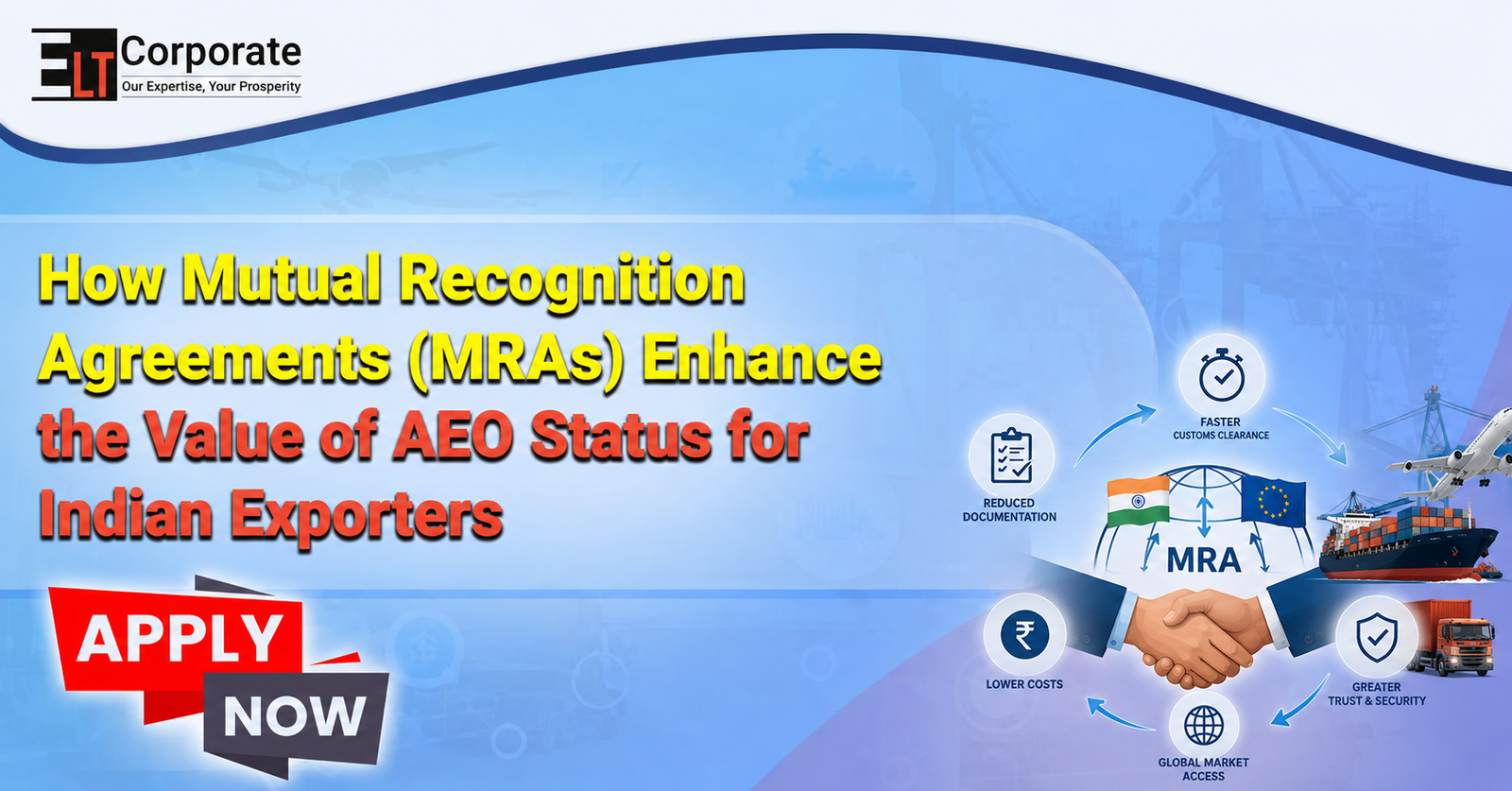
When an Indian business earns AEO Certification under the Authorised Economic Operator Programme administered by CBIC, it gains a powerful set of domestic facilitation benefits, it gains a powerful set of domestic facilitation benefits — faster clearance, fewer inspections, deferred duty payment, and priority treatment within India’s customs system. But for exporters, the most transformative dimension of AEO certification often lies outside India’s borders entirely — in the form of Mutual Recognition Agreements (MRAs).
An MRA is a formal arrangement between the customs administrations of two countries under which each country agrees to recognise the other’s AEO (or equivalent trusted trader) certification — extending reciprocal facilitation benefits to certified businesses on both sides of the trade relationship. For an Indian exporter, this means that the trust your business has earned with Indian Customs can translate directly into facilitation benefits when your goods arrive in a partner country’s jurisdiction — without that country needing to independently re-establish trust in your supply chain from scratch.
This guide explains what MRAs are, which countries currently have MRAs with India, how they specifically enhance the value of AEO status for Indian exporters, and what businesses need to do to actually capture these benefits in practice.
What is a Mutual Recognition Agreement (MRA)?
A Mutual Recognition Agreement is a bilateral arrangement between the customs authorities of two countries, under the framework established by the World Customs Organization’s (WCO) SAFE Fraprogramme mework of Standards. Under an MRA:
- Each country’s customs authority agrees to recognise the AEO Certification or equivalent trusted trader certification granted by the other country’s customs authority.
- AEO-certified businesses from one country receive defined facilitation benefits when their goods are imported into, or pass through, the partner country
- The two customs administrations agree to exchange information about their respective AEO programmes, certification criteria, and AEO-certified entities to support the mutual recognition arrangement
- Benefits are typically reciprocal — meaning Indian AEO holders benefit when exporting to the partner country, and the partner country’s AEO holders benefit when exporting to India
The foundational principle is straightforward: if Country A’s customs authority has already verified that a business meets rigorous security and compliance standards (through its own AEO certification process), Country B’s customs authority does not need to independently re-verify that same business from the ground up. This eliminates duplicate verification effort and accelerates trade — which is precisely the WCO SAFE Framework’s core objective.
India’s Current AEO Mutual Recognition Agreements
As of the current framework, India has signed AEO Mutual Recognition Agreements with the following countries and customs territories:
South Korea
India and South Korea signed an AEO MRA recognising each country’s AEO certification under their respective trusted trader programmes. South Korea’s domestic programme is administered by the Korea Customs Service (KCS) under its AEO framework.
Hong Kong
India has an AEO MRA with Hong Kong, recognising Hong Kong’s Customs and Excise Department’s trusted trader programme alongside India’s AEO certification.
Taiwan
India’s AEO MRA with Taiwan recognises Taiwan’s AEO programme, administered by Taiwan Customs, providing reciprocal facilitation for trade between the two markets.
United States of America
India has an MRA arrangement with the United States, recognising the Customs-Trade Partnership Against Terrorism (C-TPAT) programme — the US equivalent of AEO — alongside India’s AEO certification. Given the scale of India-US bilateral trade, this MRA is particularly significant for Indian exporters.
Important note: The list of countries with which India has signed AEO MRAs may expand over time as CBIC continues to negotiate additional bilateral and multilateral recognition arrangements. Always verify the current list of MRA partner countries through official CBIC and ICEGATE communications, as this is one of the more dynamic aspects of the AEO programme.
How MRAs Specifically Enhance the Value of AEO Status for Indian Exporters
Enhancement 1 — Reciprocal Facilitation at the Destination Customs Authority
Without an MRA, an Indian exporter’s AEO Status and Trusted Trader Programme Certification carry weight only within India’s own customs system — it has no formal standing with a foreign customs authority. With an MRA in place, an Indian AEO certificate holder exporting to South Korea, Hong Kong, Taiwan, or the USA can expect the destination country’s customs authority to extend recognised facilitation benefits — based specifically on the exporter’s AEO status, independently verified and communicated through the MRA’s information-exchange mechanism.
This is the central enhancement: your AEO status stops being a purely domestic credential and becomes a passport to facilitation in four additional jurisdictions — without requiring separate certification processes in each of those countries.
Enhancement 2 — Reduced Inspection and Examination Rates at Destination
Just as AEO certification reduces your examination rate within India, MRA recognition means your goods are statistically less likely to be selected for physical examination by the partner country’s customs authority upon arrival. For Indian exporters shipping to the USA, South Korea, Hong Kong, or Taiwan, this translates into:
- Faster release of goods at the destination port or airport
- Reduced risk of inspection-related delays affecting downstream delivery commitments to your overseas buyer
- Lower exposure to inspection-related costs (unpacking, repacking, demurrage at the destination)
Enhancement 3 — Faster Customs Clearance at Destination, Improving Buyer Relationships
For exporters, customs delays at the destination are not just an operational cost — they directly affect your relationship with overseas buyers. A shipment held up in US Customs and Border Protection (CBP) examination, or delayed at Korea Customs Service clearance, reflects poorly on the exporter even when the delay is not the exporter’s fault.
MRA-enabled facilitation reduces this risk — supporting more reliable, predictable delivery performance to overseas buyers, which strengthens your reputation as a dependable supplier and can be a meaningful factor in retaining and growing buyer relationships in MRA partner markets.
Enhancement 4 — Competitive Differentiation in MRA Partner Markets
For Indian exporters competing against suppliers from non-MRA countries for business in the USA, South Korea, Hong Kong, or Taiwan, AEO-MRA recognition is a genuine competitive differentiator. A buyer in these markets sourcing from multiple countries may experience materially faster, more predictable clearance from an Indian AEO-MRA-recognised supplier compared to a non-certified competitor — particularly relevant in industries where supply chain reliability is itself a competitive factor (electronics, automotive components, pharmaceuticals, time-sensitive consumer goods).
Enhancement 5 — Strengthened Position in C-TPAT-Aligned US Supply Chains
The US C-TPAT programme has historically placed significant emphasis on supply chain security expectations for its certified importers — who in turn often prefer or require their overseas suppliers to demonstrate equivalent security and compliance standards. For Indian exporters supplying C-TPAT-certified US importers, holding Indian AEO certification — recognised under the India-US MRA — provides a credible, mutually understood basis for satisfying the US importer’s supply chain security expectations, without requiring the Indian exporter to undergo a separate, US-specific certification process.
This is particularly valuable for Indian exporters in sectors with significant US buyer relationships — textiles and garments, pharmaceuticals, engineering goods, gems and jewellery, and IT hardware — where the buyer’s own C-TPAT obligations create a natural alignment with AEO-certified Indian suppliers.
Enhancement 6 — Reduced Duplicate Compliance Burden
Without MRA recognition, an Indian exporter wanting to demonstrate trusted trader credentials to buyers or customs authorities in South Korea, Hong Kong, Taiwan, or the USA would, in principle, need to navigate each country’s own certification or vetting process independently — a duplicative, resource-intensive undertaking. MRA recognition eliminates this duplication: a single Indian AEO certification, maintained to Indian standards, is accepted as the basis for facilitation in all four MRA partner jurisdictions.
This is a significant efficiency gain for exporters with diversified markets across multiple MRA partner countries — the compliance investment you make for Indian AEO certification serves multiple export markets simultaneously, rather than requiring separate compliance investments for each.
Enhancement 7 — Strengthened Negotiating Position with Foreign Buyers and Logistics Partners
AEO-MRA recognition gives Indian exporters a verifiable, third-party-validated credential to present in commercial negotiations with overseas buyers, freight forwarders, and logistics partners in MRA countries. Rather than asserting your own compliance and security standards, you can point to a government-to-government recognised certification — a more credible and persuasive basis for commercial trust-building than self-declared compliance claims.
Sector-Specific Relevance of MRA Benefits for Indian Exporters
Textiles and Garments
India’s textile and garment exports to the USA represent one of the largest bilateral trade flows covered by the India-US MRA. Garment exporters benefit from faster CBP clearance, supporting tight retail delivery schedules — particularly relevant for fashion and seasonal merchandise where delays can mean missed retail selling windows.
Pharmaceuticals and Healthcare Products
Indian pharmaceutical exports to the USA — one of India’s most significant pharmaceutical export markets — benefit from AEO-MRA recognition through faster FDA-coordinated customs clearance processes, where time-sensitive pharmaceutical cargo benefits significantly from reduced dwell time.
Gems and Jewellery
India’s gems and jewellery exports to the USA, Hong Kong, and other markets benefit from AEO-MRA facilitation — particularly valuable given the high value and security sensitivity of this cargo category, where both speed and security assurance matter significantly to buyers.
Engineering Goods and Auto Components
Indian engineering and auto component exporters supplying US and South Korean automotive and industrial supply chains — often themselves subject to stringent supply chain security expectations from their OEM customers — benefit from the AEO-MRA recognition as a credible basis for meeting these supply chain security expectations.
Electronics and IT Hardware
Indian electronics exporters to South Korea, Taiwan, Hong Kong (significant electronics trade and re-export hub), and the USA benefit from faster clearance for time-sensitive technology products with rapid product life cycles, where delivery delays can have outsized commercial impact.
Chemicals and Specialty Chemicals
Chemical exporters benefit from AEO-MRA recognition particularly given the additional regulatory and security scrutiny chemical cargo often attracts — AEO-MRA recognition can meaningfully reduce this scrutiny at destination.
What Indian Exporters Need to Do to Actually Capture MRA Benefits
Holding AEO certification alone does not automatically guarantee that every customs officer at every port in South Korea, Hong Kong, Taiwan, or the USA will recognise and apply MRA benefits without any action on the exporter’s part. Capturing the full value of MRA recognition requires deliberate steps:
Step 1 — Confirm and Communicate Your AEO Status Clearly in Export Documentation
Ensure that your AEO certification number and status are clearly referenced in your export documentation — commercial invoices, shipping documents, and communications with your customs broker and the overseas buyer’s customs clearance agent. While the MRA mechanism is fundamentally a government-to-government information exchange, practical recognition at the point of clearance is supported by clear documentation referencing your AEO status.
Step 2 — Inform Your Overseas Buyer and Their Customs Broker
Proactively inform your overseas buyer (and their customs clearance agent or broker in the destination country) that you hold Indian AEO certification recognised under the relevant MRA. This allows the buyer’s customs broker to flag the shipment appropriately and apply for any facilitation benefits available under the MRA at the time of import declaration in the destination country.
Step 3 — Maintain Consistent, Verifiable AEO Status
MRA-based recognition depends on your AEO certification remaining valid and in good standing. Any suspension, lapse, or cancellation of your Indian AEO status will also affect your standing for MRA-based recognition in partner countries — reinforcing the importance of the ongoing compliance maintenance discussed elsewhere in AEO guidance.
Step 4 — Understand the Specific Benefits Under Each MRA
The specific facilitation benefits under each MRA (USA, South Korea, Hong Kong, Taiwan) may differ somewhat based on the terms negotiated in each bilateral agreement. Understanding the specific mechanics of each MRA — what benefits apply, how they are triggered, and what (if any) additional documentation or notification is required — helps ensure you are positioned to benefit fully from each relevant agreement.
Step 5 — Work with Logistics Partners Who Understand MRA Mechanics
Engage freight forwarders, customs brokers, and logistics partners — both in India and in the destination country — who are familiar with AEO-MRA recognition mechanics. A logistics partner unfamiliar with the MRA framework may fail to flag or claim available benefits on your behalf, even when you are fully entitled to them.
Step 6 — Monitor for MRA Expansion and New Agreements
CBIC continues to negotiate additional MRAs with other trading partners over time. Staying informed about new MRA agreements as they are signed allows you to identify new opportunities to leverage your existing AEO certification in additional export markets — without requiring any additional certification effort on your part.
MRAs as a Strategic Factor in AEO Tier and Investment Decisions
For Indian exporters evaluating whether to pursue AEO certification (or which tier to target), the relevance of existing MRAs is a meaningful strategic input:
If your export business has significant volume to South Korea, Hong Kong, Taiwan, or the USA: The MRA-derived benefits substantially strengthen the business case for AEO certification — the facilitation benefits extend beyond Indian customs and apply meaningfully to a significant share of your export trade.
If your export business is concentrated in markets without current MRA coverage (EU, ASEAN beyond existing FTA mechanisms, Africa, Middle East, Latin America): The MRA dimension of AEO certification currently provides no direct benefit for your specific trade corridors — though the domestic AEO benefits (faster Indian export clearance, self-sealing, reduced inspection) remain fully relevant regardless of destination market. The MRA consideration should not be the deciding factor for exporters in non-MRA corridors, but it should be weighed honestly rather than oversold.
If your export markets are diversified across both MRA and non-MRA countries: AEO certification delivers full domestic benefits across all your export activity, plus the additional MRA-specific benefits for the portion of your trade flowing to MRA partner countries — making the overall value proposition stronger than for a purely non-MRA-focused exporter, even if MRA benefits apply to only part of your trade.
The Broader Trajectory — MRAs as an Evolving Framework
India’s AEO MRA programme reflects a broader global trend toward customs administrations recognising each other’s trusted trader programmes as a mechanism to facilitate legitimate trade while maintaining security. As global supply chains become more complex and security-conscious, and as more countries develop mature AEO-equivalent programmes, the potential for India to expand its MRA network continues to grow.
For Indian exporters building a long-term AEO compliance strategy, it is worth considering not just the current MRA landscape, but the trajectory — an exporter investing in AEO certification today is building a credential whose international recognition value may continue to expand as India negotiates additional MRAs over time. This forward-looking perspective is particularly relevant for exporters in growth markets where India does not yet have an MRA but bilateral trade and diplomatic relationships suggest the possibility of future recognition arrangements.
Common Misconceptions About AEO-MRA Benefits
Misconception 1 — “AEO certification gives me trusted trader status in every country I export to”
This is incorrect. AEO-MRA recognition is strictly limited to countries with which India has signed a specific MRA — currently South Korea, Hong Kong, Taiwan, and the USA. For all other export markets, your Indian AEO certification provides no formal recognition by the destination country’s customs authority, though the underlying compliance and security practices you have built remain valuable in their own right.
Misconception 2 — “MRA benefits are automatic and require no action from the exporter”
While the MRA mechanism itself operates as a government-to-government information exchange, practical realisation of benefits is supported by clear documentation, buyer/broker awareness, and consistent communication of your AEO status — as outlined in the action steps above. Treating MRA benefits as entirely passive can result in under-realisation of the value available.
Misconception 3 — “MRA recognition means I will never face customs examination in the partner country”
MRA recognition reduces the statistical likelihood and generally improves the treatment of AEO-certified shipments — it does not provide blanket immunity from examination. Partner country customs authorities retain discretion to examine any shipment based on their own risk assessment, intelligence, or random selection processes, even for MRA-recognised AEO holders.
Misconception 4 — “The MRA benefit is the same regardless of which AEO tier I hold”
While this guide does not detail the precise tier-specific mechanics of each MRA (which are governed by the specific bilateral agreement terms), in general, higher AEO tiers in India (T2, T3) reflect a more rigorous and comprehensive compliance and security profile — and may correspondingly support a stronger basis for recognition and facilitation under MRA arrangements, though exporters should not assume tier-equivalence is automatic or identical across all four MRA partners.
Frequently Asked Questions
Q1. Does my AEO certification automatically register me for MRA benefits, or do I need to apply separately?
The MRA mechanism operates through information exchange between CBIC and the partner country’s customs authority based on your existing AEO certification — there is generally no separate application required specifically for MRA recognition. However, practical realisation of benefits is supported by clear documentation and communication with your overseas buyer’s customs broker, as detailed in this guide.
Q2. Which AEO tier do I need to benefit from MRA recognition?
MRA benefits are generally available to certified AEO holders, though the specific terms of facilitation may vary by agreement and tier. Higher tiers (T2, T3) reflect more comprehensive compliance and security profiles that may support stronger facilitation outcomes. Exporters should clarify the specific tier-related mechanics for each MRA relevant to their export markets, as this guide provides general principles rather than the precise bilateral agreement terms.
Q3. If my main export market is the European Union, does AEO certification still make sense, given there’s no India-EU AEO MRA currently?
Yes — the absence of an EU MRA does not eliminate the value of AEO certification for EU-focused exporters. The full suite of domestic AEO benefits (faster Indian export clearance, self-sealing, reduced inspection at Indian customs, deferred duty if importing as well) remains fully available and valuable regardless of your export destination. The MRA-specific enhancement discussed in this guide is an additional benefit for exporters trading with MRA partner countries — not a prerequisite for AEO certification to be worthwhile.
Q4. Will India sign additional AEO MRAs with other countries in the future?
CBIC continues to negotiate AEO mutual recognition with additional trading partners as part of its ongoing trade facilitation strategy, consistent with the broader global trend under the WCO SAFE Framework. The specific countries and timing of future MRAs are determined by bilateral negotiations and are subject to change — always verify the current list of MRA partners through official CBIC and ICEGATE sources rather than relying on a static list.
Q5. How do I prove my AEO-MRA status to a customs broker or buyer in South Korea, Hong Kong, Taiwan, or the USA?
Provide your AEO certificate number and certification details to your overseas buyer and their customs clearance agent, and ensure your export documentation clearly references your AEO status. The formal recognition mechanism operates through CBIC’s information exchange with the partner country’s customs authority, but clear communication of your status supports smoother practical recognition at the point of import clearance.
Q6. Does the India-US MRA help with all types of US Customs and Border Protection (CBP) scrutiny, or just certain types?
The MRA framework is specifically structured around customs-administered trade facilitation and security-related treatment — generally covering aspects like examination rates and clearance prioritisation tied to supply chain security recognition. It does not exempt shipments from other forms of regulatory scrutiny that may apply under different US agencies (such as FDA review for pharmaceuticals or food products, or other agency-specific import requirements) which operate under separate regulatory frameworks independent of the customs-to-customs MRA mechanism.