Blog

Your blog category

Logistics KPIs After AEO Certification
Blog

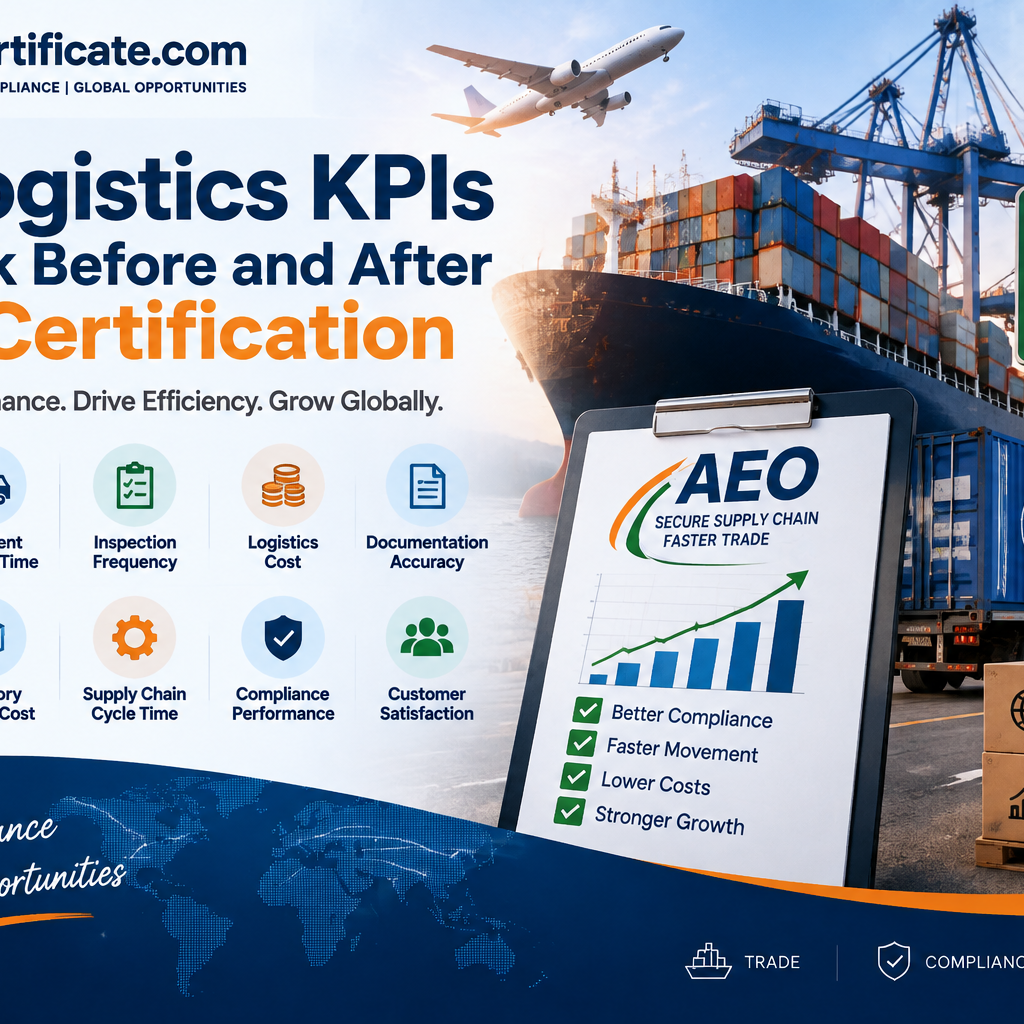
10 Logistics KPIs to Track Before and After AEO Certification

The Authorized Economic Operator (AEO) Certification introduced by Indian Customs is an important compliance program that recognizes businesses having strong customs compliance systems, secure supply chains, and effective internal controls. AEO-certified companies receive various facilitation benefits, including faster customs processing, reduced physical examination, priority handling, and improved credibility with regulatory authorities. However, obtaining AEO Certification is not only about receiving approval from customs authorities. The actual value of certification can be measured only when businesses evaluate its impact on their daily operations. This is where logistics KPIs After AEO Certification it becomes extremely important. By tracking logistics performance indicators before and after AEO Certification, companies can understand how certification has improved their customs operations, transportation efficiency, inventory management, compliance performance, and customer satisfaction. A structured KPI monitoring system allows organizations to compare previous performance levels with post-certification results and identify opportunities for continuous improvement. What Are Logistics KPIs? Logistics Key Performance Indicators (KPIs) are measurable values used by organizations to evaluate the effectiveness and efficiency of their supply chain and logistics activities. In international trade operations, logistics KPIs after AEO Certification, help businesses monitor various activities such as Customs clearance performance Shipment movement efficiency Transportation management Delivery reliability Inventory utilization Documentation accuracy Compliance performance Customer satisfaction For companies that have obtained AEO Certification, monitoring logistics KPIs after AEO Certification helps demonstrate whether the organization is actually achieving operational benefits from improved customs compliance and supply chain management. Why Is Tracking Logistics KPIs After AEO Certification Important? Many companies consider AEO certification only a regulatory requirement, but it is also a business improvement opportunity. The certification encourages companies to develop better internal processes, maintain accurate documentation, improve security controls, and establish a reliable supply chain framework. Tracking Logistics KPIs After AEO Certification helps companies measure: Reduction in customs clearance time Improvement in shipment release speed Reduction in unnecessary inspections Better documentation accuracy Lower logistics expenses Improved delivery performance Enhanced customer confidence Without measuring these parameters, businesses cannot determine the actual operational impact of AEO Certification. Comparison of Logistics Performance Before and After AEO Certification  Performance Area  Before AEO Certification  After AEO Certification  Customs Processing  Standard customs procedures with regular assessment  Faster processing through trusted trader benefits  Shipment Clearance  Higher possibility of delays  Improved clearance efficiency  Physical Examination  More dependency on inspection procedures  Reduced inspection dependency based on risk assessment  Documentation Control  Higher chances of errors  Better internal documentation systems  Supply Chain Visibility  Limited monitoring  Improved tracking and reporting  Logistics Cost  Additional expenses due to delays  Better cost optimization    1. Customs Clearance Time Customs clearance time is one of the most important logistics KPIs after AEO Certification because it directly impacts the overall supply chain cycle. Customs clearance time refers to the duration between submission of customs documents and final release of goods by customs authorities. Before AEO Certification, companies may experience longer clearance timelines due to: Document verification requirements Physical examination procedures Additional communication with customs officials Risk assessment processes After achieving AEO status, companies generally focus on maintaining strong compliance practices, accurate documentation, and secure supply chain procedures, which logistics KPIs after AEO certification can support smoother customs operations. Formula: Customs Clearance Time = Date and Time of Cargo Release – Date and Time of Customs Filing Regular monitoring of this KPI helps companies identify whether their customs operations are becoming faster and more efficient. 2. Shipment Release Time Shipment Logistics KPIs After AEO Certification: Release time measures how quickly goods are released after completing customs procedures. For importers and exporters, every additional hour of shipment delay can increase costs through: Warehouse charges Demurrage charges Production delays Transportation rescheduling AEO-certified businesses should monitor shipment release time regularly to evaluate improvements achieved through better compliance practices. Key Factors Affecting Shipment Release: Accuracy of customs declarations Proper classification of goods Availability of supporting documents Compliance history of the organization 3. Customs Inspection Frequency Physical inspection of shipments can affect supply chain speed and increase operational expenses. One of the expected benefits of improved customs compliance is better risk-based processing. Companies should measure: Inspection Frequency = Number of Physically Inspected Shipments ÷ Total Shipments × 100 Example: Before AEO Certification: Total shipments: 1,000 Inspected shipments: 200 Inspection Rate = 20% After AEO Certification: Total shipments: 1,000 Inspected shipments: 80 Inspection Rate = 8% Tracking inspection frequency helps businesses understand the impact of their compliance improvements. 4. Logistics Cost Per Shipment Logistics cost is a critical business logistics KPI after AEO Certification because transportation and customs-related expenses directly affect profitability. Total logistics cost may include: Freight charges Transportation expenses Port handling charges Warehouse costs Documentation expenses Delay-related costs Formula: Logistics Cost Per Shipment = Total Logistics Expenses ÷ Number of Shipments After AEO Certification, companies should compare their logistics expenses to identify improvements resulting from: Faster movement of goods Reduced waiting time Better planning Improved process control 5. On-Time Delivery Performance Customer satisfaction depends heavily on timely delivery. On-time delivery measures whether shipments reach customers according to committed schedules. Formula: On-Time Delivery Rate = Number of Shipments Delivered on Time ÷ Total Shipments × 100 AEO Certification can support improved delivery reliability by reducing customs-related delays and improving supply chain predictability. Companies should maintain monthly records of: Delivery commitments Actual delivery dates Delay reasons Corrective actions 6. Inventory Holding Cost Inventory holding cost represents logistics KPIs after AEO Certification, the expenses associated with storing goods before they are used or delivered. Delays in customs clearance can increase inventory blockage and working capital requirements. Inventory holding costs include: Warehouse charges Insurance cost Storage expenses Capital investment blockage Formula: Inventory Holding Cost = Average Inventory Value × Holding Cost Percentage Monitoring this KPI helps businesses understand how improved logistics performance impacts financial efficiency. 7. Supply Chain Cycle Time Supply chain cycle time measures the total time required from order placement to final delivery. It includes: Supplier processing time Transportation time Customs clearance time Warehouse processing Final delivery A reduction in cycle time improves: Production planning Customer service Cash flow management Business competitiveness Companies should include supply chain

AEO Certification for Textile Exporters
Blog

How Textile and Apparel Exporters Can Use AEO to Speed Up Shipments

The textile and apparel industry operates on strict delivery timelines. Exporters supplying garments, fabrics, home textiles, and fashion products to international buyers must ensure that shipments reach customers within committed deadlines. Even a small delay in customs clearance can impact buyer relationships, production cycles, and future orders. For textile exporters, adopting a strong customs compliance system is becoming increasingly important. AEO Certification for Textile Exporters provides a structured framework that helps businesses improve supply chain security, strengthen customs compliance, and achieve smoother export operations. The Authorized Economic Operator (AEO) Programme is a trusted trader programme administered by Indian Customs that recognises businesses with strong compliance records and secure international supply chain practices. Eligible exporters can receive various customs facilitation benefits that help improve shipment predictability. For textile and apparel exporters dealing with large export volumes, AEO certification can become a strategic advantage by reducing operational uncertainty and supporting faster movement of goods. What is AEO Certification for Textile Exporters? AEO Certification for Textile Exporters is a customs certification granted to exporters who demonstrate compliance with customs laws, proper record management, financial reliability, and supply chain security practices. The certification is based on the concept of creating a partnership between customs authorities and compliant businesses. Instead of treating every shipment with the same level of scrutiny, trusted operators may receive facilitation benefits based on their compliance status. Textile exporters involved in: Garment exports Fabric exports Home textile exports Textile machinery exports Apparel manufacturing and international supply chains can evaluate their eligibility for AEO certification. The AEO India program recognizes different categories and tiers depending on the applicant’s compliance maturity and business profile. Why Textile Exporters Need Faster Customs Clearance The textile export business depends heavily on AEO Certification for Textile Exporters heavily on timelines because: International buyers work on seasonal collections Fashion products have fixed launch schedules Retail supply chains require accurate delivery commitments Delays can increase logistics costs Late shipments can affect buyer confidence Exporters supplying international brands often manage: High-volume shipments Multiple containers Tight vessel schedules Seasonal production cycles AEO certification helps exporters establish reliable customs processes and improve shipment management. How AEO Certification Helps Textile Exporters Speed Up Shipments 1. Faster Customs Clearance One of the major advantages of AEO Certification for Textile Exporters is improved customs facilitation. AEO-certified businesses may receive benefits such as faster processing and reduced delays due to their recognised compliance status. For textile exporters, this means: Reduced shipment waiting time Better export schedule planning Improved supply chain efficiency Faster movement of goods AEO Tier benefits include customs facilitation measures such as faster clearances and Direct Port Entry benefits for eligible exporters, subject to applicable conditions. 2. Reduced Risk of Shipment Delays Export delays commonly occur due to: Documentation errors Incorrect declarations Compliance issues Verification requirements Missing records AEO certification encourages exporters to maintain: Proper documentation systems Internal compliance checks Standard operating procedures Record management practices This reduces the chances of shipment interruptions. 3. Better Supply Chain Control Textile exports involve multiple stakeholders: Manufacturers Suppliers Job workers Transporters Freight forwarders Customs brokers AEO Certification for Textile Exporters encourages businesses to create a secure supply chain management system. Exporters should maintain: Vendor verification procedures Transportation security controls Access control systems Shipment tracking processes Data security measures A strong supply chain system supports smoother export operations. 4. Improved Buyer Confidence International buyers prefer suppliers who maintain reliable compliance systems. AEO certification demonstrates that the exporter follows: Customs compliance practices Document control procedures Security standards Risk management systems For textile exporters competing in global markets, this AEO Certification for Textile Exporters can strengthen credibility with international customers. 5. Better Preparedness for International Trade Requirements Many global buyers focus on: Supply chain security Traceability Compliance management Ethical sourcing AEO certification supports exporters in developing structured processes that align with international trade expectations. India also participates in AEO Mutual Recognition Arrangements (MRAs), where compatible trusted-trader programs may recognize each other’s standards for eligible operators. AEO Certification and Textile Export Supply Chain Security A textile export supply chain involves multiple stages: Raw Material Supplier ↓ Manufacturing Unit ↓ Quality Inspection ↓ Packaging ↓ Warehouse ↓ Transportation ↓ Customs Clearance ↓ International Buyer AEO Certification for Textile Exporters focuses on securing each stage of this supply chain. Businesses should evaluate risks related to: Unauthorized access Documentation errors Cargo security Information protection   How AEO Helps Textile Exporters Compete in Global Markets The textile export market is highly competitive, with exporters from countries such as India, Bangladesh, Vietnam, and China competing for international buyers. Global buyers increasingly evaluate suppliers based on: Delivery reliability Compliance practices Supply chain transparency Risk management By obtaining AEO Certification for Textile Exporters, businesses can demonstrate that they follow internationally aligned customs compliance practices. Future of AEO Certification for Textile Exporters in India India’s textile export sector is expanding with increasing global demand for: Sustainable textiles Quality manufacturing Reliable supply chains As international trade becomes more compliance-focused, trusted trader programmes like AEO are becoming increasingly important. For textile exporters planning long-term international growth, establishing a strong customs compliance framework can support smoother operations and better supply chain management. Importance of SOPs for AEO Certification in Textile Industry Standard Operating Procedures (SOPs) are an important part of AEO compliance. Important SOPs for textile exporters may include: Export Documentation SOP Covers: Invoice preparation Shipping bill filing Customs documentation review Record maintenance Supplier Management SOP Includes: Supplier verification Vendor approval process Supplier monitoring Security SOP Includes: Employee access control Visitor management Cargo security procedures Incident Management SOP Includes procedures for: Security incidents Documentation errors Compliance issues Common Mistakes Textile Exporters Should Avoid During AEO Application 1. Applying Without Compliance Assessment Many exporters submit applications without evaluating their existing processes. A pre-application gap assessment helps identify improvement areas. 2. Missing Documentation Incomplete records may delay the review process. Exporters should maintain organized: Financial records Customs records SOP documents Security procedures 3. Lack of Employee Awareness AEO compliance involves different departments. Employees handling: Export documentation Warehouse operations Logistics should understand their responsibilities.

AEO Certification for Chemical Exporters
Blog

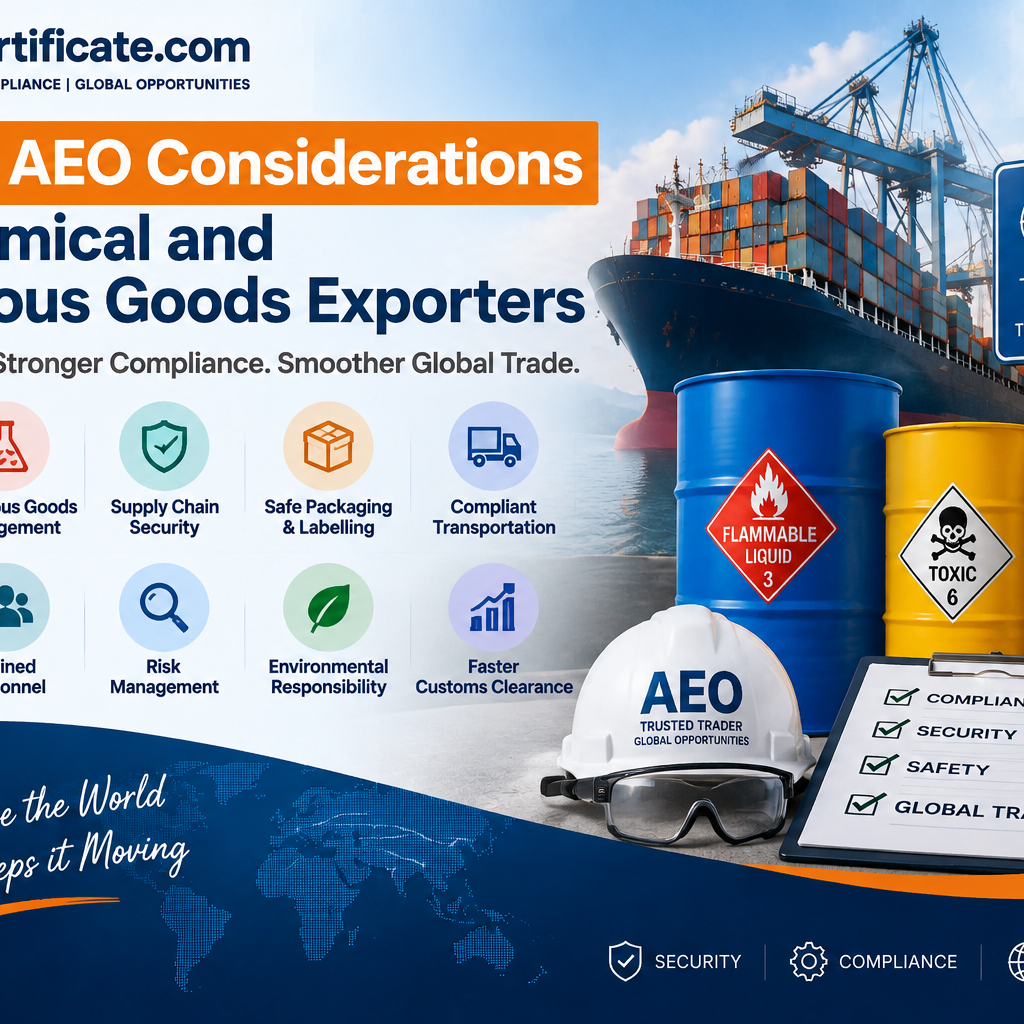
Special AEO Considerations for Chemical and Hazardous Goods Exporters

The chemical and hazardous goods industry is one of the most sensitive sectors in international trade due to the nature of products involved, strict safety requirements, and complex regulatory obligations. Exporters dealing with chemicals must ensure that their supply chain remains secure, compliant, and transparent while meeting customs and international trade requirements. In this environment, AEO Certification for Chemical Exporters plays an important role by helping businesses establish strong customs compliance systems, improve supply chain security, and develop efficient export processes. The Authorized Economic Operator (AEO) program recognizes businesses that maintain proper internal controls, secure logistics operations, and effective compliance management systems. For chemical and hazardous goods exporters, AEO certification requires special attention because these products involve higher risks related to storage, transportation, handling, documentation, and environmental safety. Companies must demonstrate that they have appropriate systems in place to manage these risks effectively. AEO Certification for Chemical Exporters is not only a customs recognition but also a framework that supports better risk management, operational efficiency, and global business credibility. Understanding AEO Certification for Chemical Exporters Chemical exporters deal with a wide range of products, including industrial chemicals, specialty chemicals, solvents, pharmaceutical ingredients, and AEO Certification for Chemical Exporters for other hazardous substances. Due to their sensitive nature, these products require additional controls throughout the supply chain. Unlike general goods, chemical shipments require proper classification, safety documentation, secure transportation, and specialized handling procedures. Any mistake in documentation, packaging, or transportation can lead to shipment delays, regulatory issues, or safety risks. Through AEO Certification for Chemical Exporters, companies can demonstrate that they follow structured compliance procedures and maintain a secure supply chain from manufacturing to final export. AEO certification encourages chemical companies to establish better systems for customs documentation, employee training, warehouse security, transportation management, and internal monitoring. Importance of AEO Certification for Chemical Exporters The chemical industry operates under strict regulatory requirements because hazardous goods can impact safety, security, and the environment. Customs authorities and international buyers prefer dealing with companies that have reliable compliance systems. AEO Certification for Chemical Exporters helps businesses create confidence among customs authorities, logistics partners, and global customers by showing that the organization follows internationally recognized supply chain security practices. AEO-certified chemical exporters can improve their operational efficiency by reducing documentation errors, improving shipment planning, strengthening internal controls, and maintaining better communication between manufacturers, AEO Certification for Chemical Exporters, customs brokers, and logistics providers. The certification also supports companies in developing a proactive approach toward compliance instead of managing issues after they occur. Key Benefits:  Area  Benefit of AEO Certification  Customs Clearance  Better customs facilitation and predictable processing  Compliance  Improved documentation and record management  Supply Chain  Enhanced security controls  Risk Management  Better identification and prevention of risks  Business Reputation  Increased trust among global customers    Special Considerations for Chemical and Hazardous Goods Exporters 1. Proper Classification of Hazardous Goods One of the most important aspects of AEO Certification for Chemical Exporters is accurate product classification. Chemical products must be correctly identified according to: HS Codes Hazard classification UN numbers Chemical categories Applicable regulatory requirements Incorrect classification can result in: Customs delays Shipment rejection Penalties Compliance issues Chemical exporters should maintain a proper classification system supported by technical documents. 2. Strong Documentation Management System Documentation accuracy is a critical requirement for chemical exporters. Trade value declaration  Shipment details  Chemical safety information  Product quality verification  Regulatory compliance  Export movement records  Important documents include AEO-certified chemical companies should maintain proper document control procedures to ensure accuracy and availability during customs verification. 3. Hazardous Material Storage and Handling Controls Chemical exporters must maintain secure storage facilities. Important considerations include: Proper segregation of chemicals Temperature control systems Fire safety measures Restricted access areas Emergency response procedures For AEO Certification for Chemical Exporters, companies should demonstrate that their facilities have appropriate security and safety measures. 4. Supply Chain Security Management AEO certification focuses heavily on supply chain security. Chemical exporters should evaluate security controls related to: Manufacturing facilities Warehouses Transport providers Logistics partners Customs brokers Security measures may include: Access control systems CCTV monitoring Visitor management Employee verification Shipment tracking 5. Employee Training and Awareness Employees involved in chemical exports should understand: Hazard identification Documentation requirements Safety procedures Customs compliance Emergency response Training records should be maintained as evidence of compliance. AEO-certified companies should conduct regular training programs for: Warehouse staff Export documentation teams Logistics personnel Security teams Comparison: Normal Chemical Exporter vs. AEO-Certified Chemical Exporter  Parameter  Normal Chemical Exporter  AEO-Certified Chemical Exporter  Compliance System  Basic compliance  Structured compliance framework  Documentation  Transaction-based  Controlled documentation system  Security Controls  Limited  Enhanced supply chain security  Risk Management  Reactive approach  Preventive approach  Customs Relationship  Standard process  Trusted trader relationship    How AEO Certification Improves Chemical Export Operations AEO Certification for Chemical Exporters provides a structured approach to improve international trade operations. It helps companies achieve: Better Shipment Planning Improved documentation and compliance systems reduce uncertainty. Reduced Operational Risks Risk identification systems help prevent compliance failures. Improved Customer Confidence International buyers prefer suppliers with strong compliance practices. Better Supply Chain Control Companies gain improved visibility over manufacturing, storage, and transportation activities. Challenges Faced by Chemical Exporters While Obtaining AEO Certification 1. Complex Documentation Requirements Chemical companies need extensive records related to products, safety, and compliance. 2. Multiple Regulatory Requirements Companies must coordinate between: Customs regulations Safety regulations Environmental requirements Transportation requirements 3. Maintaining Continuous Compliance AEO certification requires ongoing monitoring and improvement. Best Practices for Chemical Exporters Applying for AEO Certification Companies should: Create documented SOPs Conduct regular internal audits Train employees regularly Maintain updated chemical records Monitor logistics partners Review security procedures periodically Hazardous Goods Storage and Handling Requirements Storage and handling of hazardous chemicals: AEO Certification for Chemical Exporters requires strict safety and security measures. Chemical exporters must ensure that their warehouses follow appropriate safety practices and maintain controlled access. Proper segregation of chemicals, safety equipment availability, fire protection systems, emergency response procedures, and restricted access controls are important elements of a secure chemical supply chain. During the AEO assessment process, companies should be

AEO Status Maintenance in india 2026
Blog

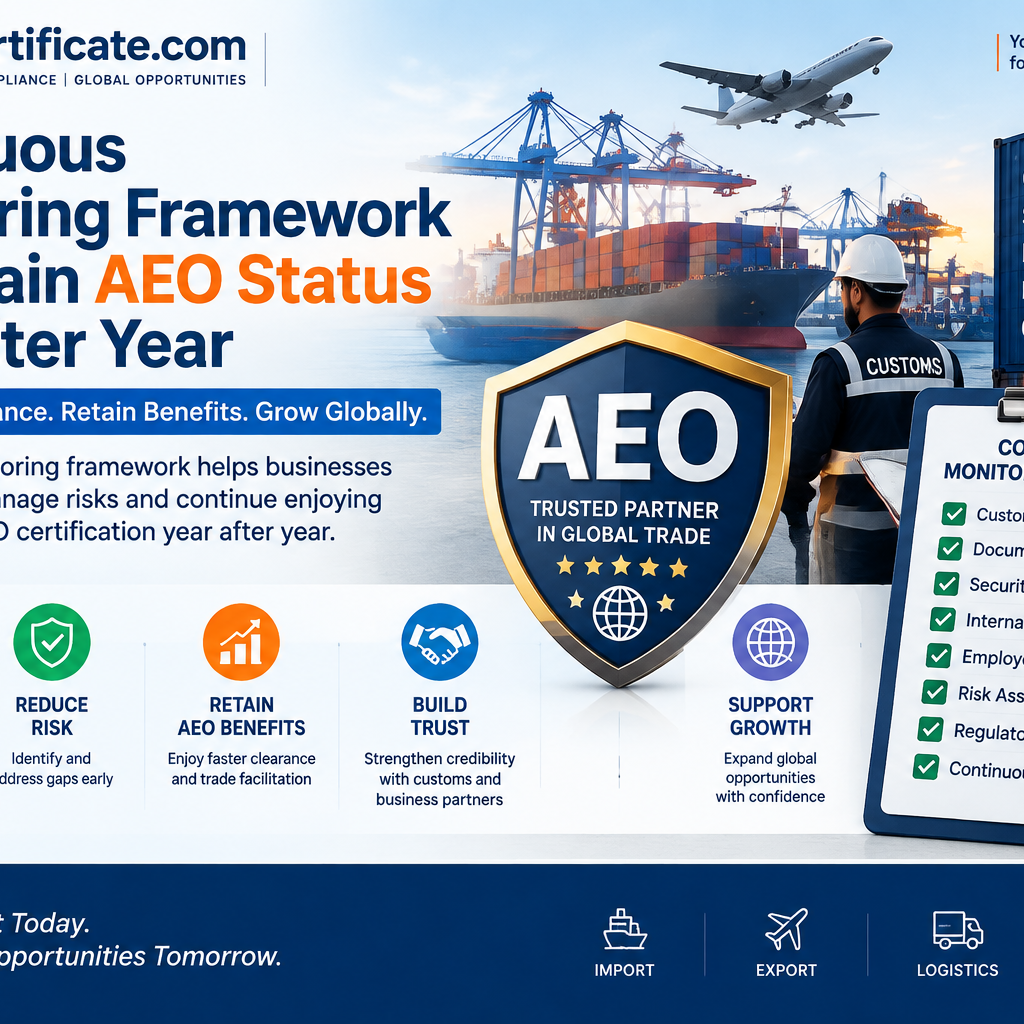
Continuous Monitoring Framework to Sustain AEO Status Year After Year

Obtaining an Authorised Economic Operator (AEO) Certification from CBIC is a significant achievement for businesses involved in international trade. However, receiving the certificate is only the beginning of a long-term compliance journey. Businesses must establish a structured AEO Status Maintenance system to ensure continuous compliance, preserve benefits, and remain prepared for future CBIC reviews. AEO certification is not a one-time approval. It requires continuous monitoring of customs compliance, internal controls, security procedures, documentation, and supply chain activities. Companies that implement a strong AEO Status Maintenance framework can reduce compliance risks and ensure uninterrupted benefits associated with AEO certification. This guide explains the complete continuous monitoring framework, documentation requirements, compliance activities, and best practices required for AEO Status Maintenance year after year. Why AEO Status Maintenance is Important Many companies focus extensively on obtaining AEO certification but fail to maintain the required compliance standards after approval. A proper AEO status maintenance framework helps businesses: Maintain continuous customs compliance Avoid regulatory issues and penalties Keep documentation updated Identify compliance gaps early Improve supply chain security Prepare for CBIC verification and reviews CBIC expects AEO-certified businesses to maintain documented processes, compliance records, and security controls even after certification. A company should treat AEO compliance as an ongoing management system rather than a one-time certification activity. What is AEO Status Maintenance? AEO Status Maintenance refers to the continuous activities performed by an AEO-certified organization to ensure that it continues meeting the eligibility, compliance, financial, and security requirements prescribed under the AEO Program. It includes: Monitoring customs transactions Reviewing import-export documentation Maintaining SOPs Conducting internal audits Updating compliance records Managing supply chain risks Reporting significant changes Training employees A successful AEO status maintenance system ensures that the organization remains ready for CBIC assessment at any time. Why Continuous Monitoring is Important for AEO Status Maintenance AEO certification represents trust between customs authorities and businesses. Maintaining this trust requires continuous monitoring of operational activities. A strong AEO status maintenance framework helps businesses: 1. Maintain Customs Compliance Companies must ensure that import and export activities comply with applicable customs procedures, documentation requirements, and regulatory obligations. Regular compliance reviews help identify errors before they become major issues. 2. Keep Documentation Updated AEO compliance depends heavily on proper records and evidence. Businesses should regularly review: Import-export documents Customs declarations Supplier records Customer records SOPs Internal compliance reports 3. Strengthen Supply Chain Security Supply chain security is an important part of AEO compliance. Companies should continuously monitor: Warehouse security Employee access controls Visitor management Transportation security Vendor compliance 2. Documentation Control System A proper documentation system is essential for effective AEO status maintenance. Companies should maintain updated records of: Company Documents Certificate of Incorporation GST Registration IEC Certificate PAN Details Board resolutions Customs Documents Import documentation Export documentation Bill of Entry records Shipping Bills Customs communication Compliance Documents SOP manuals Risk assessment reports Internal audit reports Corrective action records Security Documents Security policies Employee verification records Access control records 3. Periodic Risk Assessment Risk assessment is a continuous requirement for businesses maintaining AEO certification. Companies should evaluate risks related to: Customs Risk Incorrect classification Wrong valuation Documentation errors Supply Chain Risk Supplier reliability Transportation risks Warehouse security Technology Risk Data security System access control Cybersecurity measures Regular risk assessment strengthens the overall AEO Status Maintenance framework. 4. Employee Training and Awareness Employees play an important role in maintaining AEO compliance. Companies should conduct regular training regarding: Customs procedures Documentation practices Security requirements Compliance reporting Fraud prevention Training records should be properly maintained as evidence of compliance. 5. SOP Review and Process Improvement Standard Operating Procedures (SOPs) should not remain unchanged after obtaining AEO certification. Businesses should periodically review: Import process SOP Export process SOP Vendor management SOP Security SOP Document retention SOP Any operational changes should be incorporated into updated SOPs. 6. Monitoring Regulatory Changes Customs regulations and procedures may change over time. A proper AEO status maintenance framework should include: Monitoring CBIC notifications Reviewing customs circulars Updating internal procedures Training employees about changes The official AEO India portal provides notifications, circulars, SOPs, checklists, and other resources for AEO entities. AEO Status Maintenance Checklist Businesses should regularly verify the following: ✅ Valid AEO certificate records maintained ✅ Customs compliance reviewed periodically ✅ Import-export documentation updated ✅ SOPs reviewed and revised ✅ Employee training conducted ✅ Security systems monitored ✅ Vendor compliance checked ✅ Internal audits completed ✅ Corrective actions documented ✅ Regulatory updates tracked Common Challenges in AEO Status Maintenance 1. Lack of Continuous Compliance Review Many companies focus only on certification and do not conduct periodic reviews. Solution: Establish monthly or quarterly compliance monitoring. 2. Outdated Documentation Changes in business operations without updating SOPs can create compliance gaps. Solution: Maintain document version control. 3. Employee Awareness Issues Employees handling customs operations may not understand AEO requirements. Solution: Conduct regular compliance training. 4. Poor Record Management Incomplete records may create difficulties during verification. Solution: Implement structured digital record management systems. Benefits of Effective AEO Status Maintenance A strong AEO status maintenance system provides several advantages: Continued Customs Facilitation Businesses can continue benefiting from AEO-related facilitation measures. Reduced Compliance Risk Regular monitoring helps prevent regulatory issues. Better Supply Chain Control Improved security and documentation strengthen business operations. Faster Internal Decision Making Organized compliance records CBIC helps management make informed decisions. How an AEO Certificate Helps with AEO Status Maintenance Maintaining AEO certification requires continuous compliance monitoring and documentation management. The AEO Certificate provides professional assistance for businesses looking to maintain their AEO compliance framework. Services include: AEO Compliance Review Evaluation of existing compliance systems Identification of gaps Corrective action planning Documentation Support Assistance with: SOP preparation Compliance records Audit documentation Process manuals Internal AEO Audit Assistance Support for: Compliance assessment Risk review Documentation verification Renewal Preparation Assistance with preparing updated records and compliance evidence before renewal requirements. AEO Status Maintenance After Certification: Year-Wise Compliance Approach Obtaining AEO certification provides businesses with recognition as trusted trade partners; however, maintaining this recognition requires a structured compliance approach. AEO status maintenance should be

Surgical LED Light CDSCO License
Blog

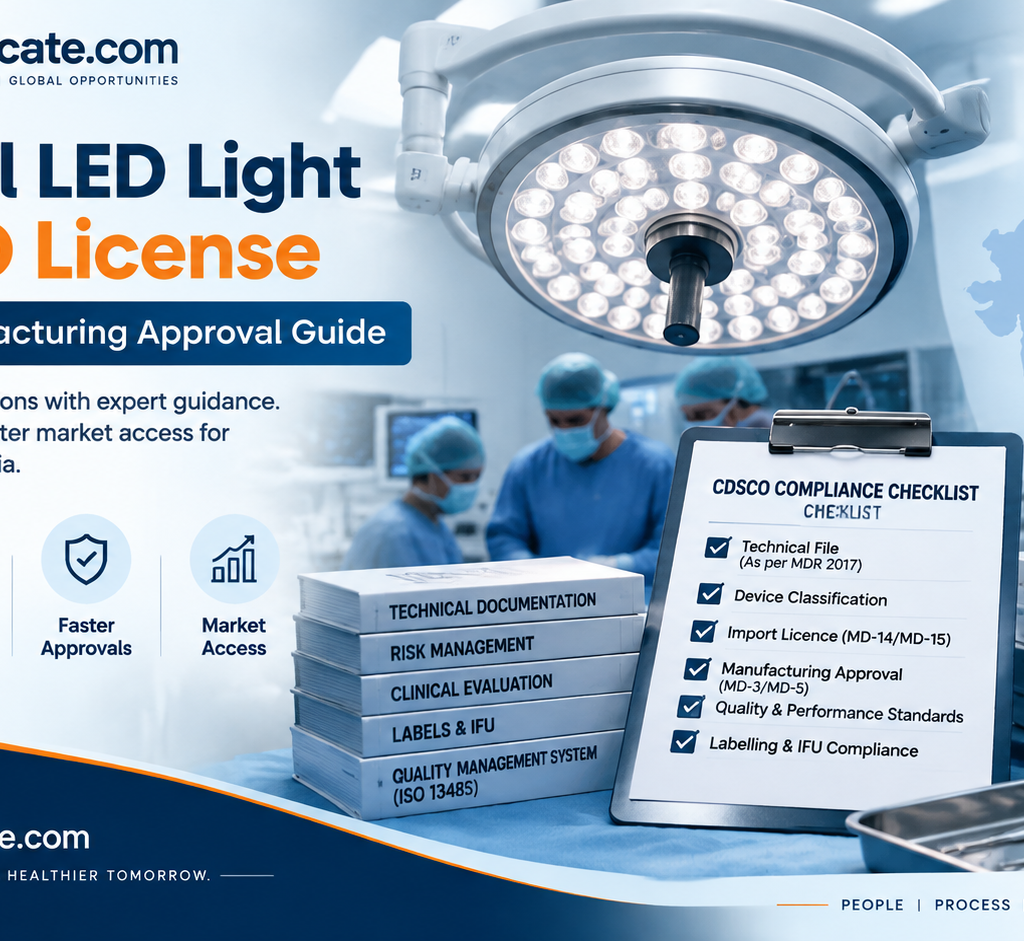
Surgical LED Light CDSCO License — Import & Manufacturing Approval Guide

Surgical LED lights are essential medical devices used in hospitals, operating theaters, and healthcare facilities to provide high-intensity illumination during surgical procedures. With increasing demand for advanced medical equipment in India, manufacturers and importers must understand the regulatory requirements before selling or distributing these devices. Obtaining a Surgical LED Light CDSCO License is an important regulatory step for businesses involved in importing or manufacturing surgical lighting systems in India. The Central Drugs Standard Control Organisation (CDSCO) regulates medical devices in India under the Medical Devices Rules, 2017. Medical devices are regulated based on their intended use and risk classification. This guide explains the complete process, documentation, and compliance requirements for obtaining a Surgical LED Light CDSCO License. What is a surgical LED light? A surgical LED light is a specialized medical illumination device designed to provide focused, shadow-free lighting during surgical procedures. These lights are commonly used in: Operation theaters Hospitals Surgical centers Emergency departments Dental procedures Examination rooms Key features of surgical LED lights include: High-intensity illumination Adjustable brightness Heat reduction technology Colour temperature control Shadow management Sterilizable handles Ceiling, wall, or mobile mounting options Because surgical LED lights support medical procedures, they may fall under medical device regulations requiring CDSCO compliance. Why is a Surgical LED Light CDSCO License Required? The Surgical LED Light CDSCO License ensures that medical lighting equipment available in the Indian market meets required safety, quality, and performance standards. CDSCO regulates medical devices under the Medical Devices Rules, 2017, including requirements related to import and manufacturing permissions. A valid surgical LED light CDSCO license helps: Ensure patient safety Verify product quality Maintain regulatory compliance Build trust among hospitals and healthcare providers Legally market surgical lighting equipment in India CDSCO Classification of Surgical LED Light Before applying for a surgical LED light CDSCO License, manufacturers and importers must determine the applicable medical device classification. Medical devices in India are classified according to risk levels: Class A – Low Risk Class B – Low to Moderate Risk Class C – Moderate High Risk Class D – High Risk The classification depends on factors such as Intended purpose Duration of use Invasiveness Patient contact Device characteristics The correct classification determines the applicable approval pathway. Surgical LED Light CDSCO License for Importers Companies importing surgical LED lights into India require appropriate CDSCO approval before commercial distribution. The Surgical LED Light CDSCO License import process generally involves: Step 1: Identify Device Classification The importer must identify the medical device category and applicable regulatory requirements. Step 2: Appoint Indian Authorized Agent Foreign manufacturers must appoint an authorized Indian representative for CDSCO communication and regulatory procedures. Step 3: Prepare Technical Documentation The importer must compile complete product and manufacturer details. Step 4: Submit CDSCO Application Import applications are submitted through the CDSCO online medical device portal. CDSCO provides an online system for medical device applications and licensing processes. Step 5: Review and Approval After document review and regulatory evaluation, CDSCO may grant the required import license. Surgical LED Light CDSCO License for Manufacturers Indian manufacturers producing surgical LED lights must obtain manufacturing approval under applicable medical device regulations. The manufacturing approval process includes: Establishing manufacturing facility compliance Preparing quality documentation Meeting applicable regulatory requirements Submitting manufacturing application forms Obtaining a manufacturing license Manufacturers should ensure that production processes follow applicable quality and safety standards. Documents Required for Surgical LED Light CDSCO License The documentation required for a surgical LED light CDSCO License may include: Manufacturer Documents Manufacturer details Manufacturing facility information Manufacturing license (if applicable) Quality management system documents ISO 13485 certification (where applicable) Product Documents Product name and model details Device specifications Product description Intended use Technical literature Product catalogue User manual Label and packaging details Technical Documents Risk analysis report Performance evaluation documents Electrical safety test reports Biocompatibility information (where applicable) Stability information Clinical evaluation documents (where applicable) Import Documents Free Sale Certificate Power of Attorney Manufacturer authorization letter Import details Regulatory certificates from the exporting country Company Documents Company registration documents PAN and GST details Import Export Code (IEC) Authorized representative details Surgical LED Light CDSCO License: Regulatory Framework in India The medical device industry in India is regulated under the Medical Devices Rules, 2017, which provide requirements related to manufacturing, importing, distribution, and licensing of medical devices. CDSCO acts as the regulatory authority for medical devices in India. For companies dealing with surgical illumination equipment, obtaining a Surgical LED Light CDSCO License helps ensure that the product complies with applicable safety and performance requirements before entering the Indian healthcare market. The regulatory framework focuses on: Device classification Safety and performance evaluation Quality management systems Technical documentation Import and manufacturing approvals Post-market compliance Types of Surgical LED Lights Covered Under CDSCO Compliance Before applying for a surgical LED light CDSCO License, businesses should understand the different types of surgical lighting products available in the market. Common categories include: Ceiling-Mounted Surgical LED Lights These are permanently installed lights used in operating theatres. Features: High illumination intensity Adjustable light positioning Shadow reduction technology Sterile handle design Mobile Surgical LED Lights Portable surgical lights used in hospitals, clinics, and emergency areas. Features: Easy movement Battery backup options Flexible positioning Minor Surgical LED Lights Used for: Examination procedures Minor surgeries Outpatient departments Dental Surgical LED Lights Used in dental clinics and specialized healthcare environments. Each category should be evaluated based on intended use before applying for a Surgical LED Light CDSCO License. Quality Management System Requirements for Surgical LED Light CDSCO License A strong quality management system is an important part of medical device compliance. Manufacturers applying for a Surgical LED Light CDSCO License should maintain proper quality procedures related to: Manufacturing controls Product testing Risk management Complaint handling Corrective and preventive actions Device traceability Many medical device manufacturers maintain ISO 13485-based quality systems to support regulatory compliance. Technical File Requirements for Surgical LED Light CDSCO License A technical file is one of the most important parts of the Surgical LED Light CDSCO License application. It generally includes: Product Description Details

AEO Certification Benefits in india 2026
Blog

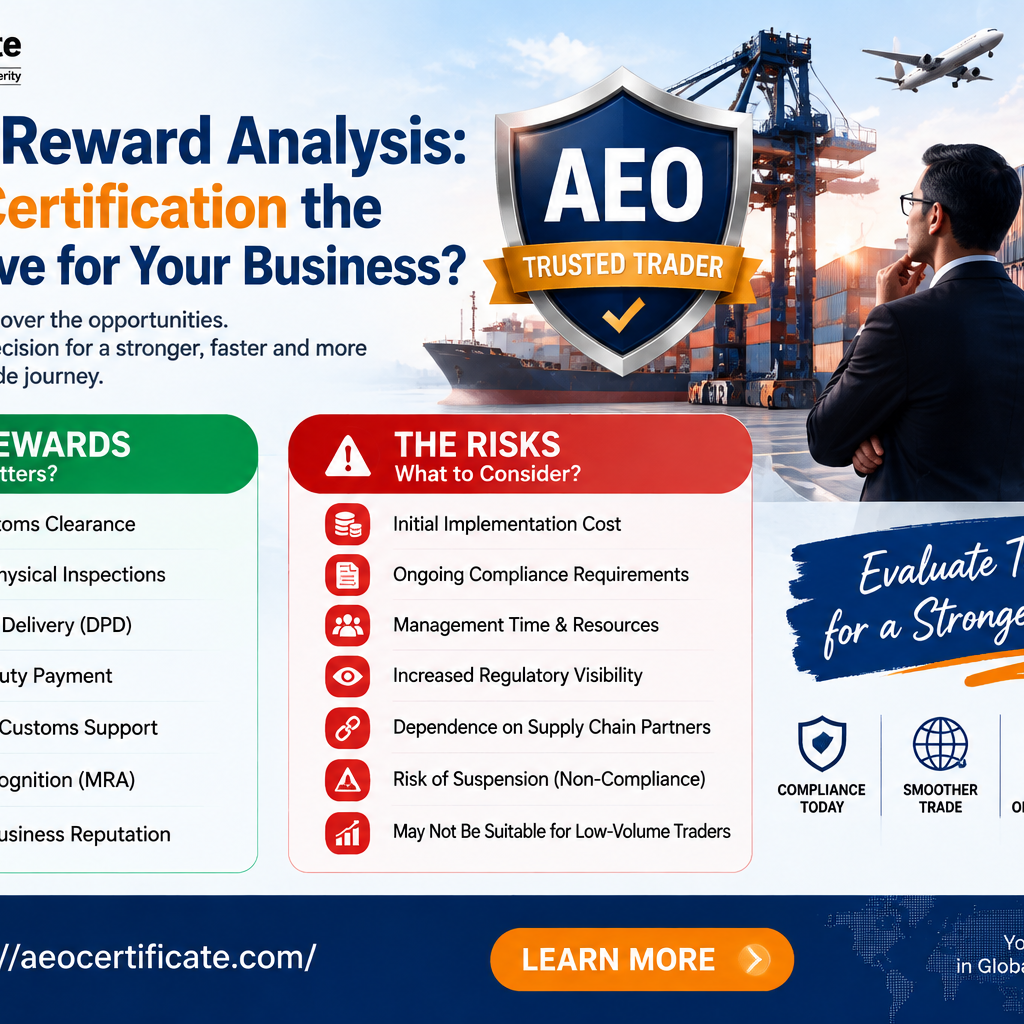
Risk vs Reward Analysis: Is AEO Certification the Right Move for Your Business?

Every importer, exporter, customs broker, and international trade professional is talking about AEO Certification Benefits because businesses are looking for ways to make customs faster, make supply chains safer, and get an edge in trade. The Authorised Economic Operator (AEO) Certification program that Indian Customs started gives trusted businesses benefits, such as quicker customs clearance, fewer inspections, the ability to pay duties later, and better trust with world trade partners. A business gets it and then ignores it. AEO certification needs money for compliance systems, paperwork, safety steps, internal checks, and constant monitoring. So before you apply, a business must look at the picture. AEO Certification benefits the cost, the risks, and the long‑term business value. Understanding AEO Certification and Its Business Impact AEO certification is a partnership between customs authorities and businesses that follow compliance standards and have secure supply chain practices. Many businesses think AEO certification is an approval process. It is actually about creating a long-term compliance system that includes: Standard Operating Procedures (SOPs) Internal compliance checks Security management systems Employee awareness programs Vendor and supply chain monitoring Management-level supervision AEO Certification Benefits: Understanding the Reward Side 1. Faster Customs Clearance One of the AEO Certification benefits is faster processing of import and export shipments. AEO-certified businesses receive priority treatment under customs procedures. This means they get priority handling when goods arrive at ports or inland container depots.This benefit is especially valuable for: – companies – Medical device importers – Electronics businesses – Automotive manufacturers – Businesses dealing with time-sensitive shipments For companies that AEO Certification benefits each year, even a small drop in clearance time can make a big difference. It helps cut down on: – Demurrage charges – Detention costs – Warehouse expenses – Supply chain delays For businesses that only send AEO Certification benefits, the financial impact may not be as strong. Faster clearance might help. The savings could be smaller. 2. Reduced Physical Examination of Shipments Another important AEO Certification benefits examination under the Risk Management System (RMS).  Physical inspections can cause: Delays in getting clearance Extra costs for handling Risks of damaging the packaging Disruptions in operations For companies that handle expensive or delicate items, less frequent inspections offer a lot of value in their operations. Businesses that import or export a lot generally get benefits because the savings add up across many shipments. 3. Direct Port Delivery (DPD) and Self-Sealing Benefits For AEO holders, direct AEO Certification benefits can make a big difference in how efficiently goods move. These benefits help companies: Avoid handling at the container freight station. Cut down on the number of times goods are moved. Make it easier to plan when products go out. Keep the number of times cargo is touched to a minimum. For big companies that are close to major ports, this can be one of the best advantages of getting AEO Certification. 4. Improved Cash Flow Through Deferred Duty Payment If you hold an AEO Certification benefits, you can enjoy deferred duty payment benefits. This lets you keep cash on hand and use it wisely. The benefit is not about lowering the amount of customs duty you owe. This benefit is particularly useful for: Importers who bring in expensive goods Businesses that import regularly Companies that handle peaks in demand The benefit is not about lowering the amount of customs duty you owe. It is about paying that duty, which gives you more time to use your money. 5. Dedicated Customs Relationship Support AEO Certification benefits may receive support from customs authorities, and I have seen many AEO-certified businesses benefit. This support can help AEO-certified businesses resolve: Documentation queries Classification issues Procedural concerns Businesses with product portfolios often find this support valuable. AEO Certification Benefits and Risks: Looking at the Investment Side Even though the benefits are good, companies need to know what comes with AEO certification. 1. Cost of Preparing the Application Fees that the government charges are usually not the main cost. The main money spent is on: Help from consultants Making the paperwork Creating operating procedures Involving workers inside the company Improving security systems Companies should think if the AEO Certification Benefits are worth all these initial costs. 2. Continuous Compliance Maintenance AEO Certification Benefits monitoring. Businesses must maintain: – Updated SOPs – Internal audits – Security controls – Employee training – Vendor monitoring – Compliance records A mistake is to treat AEO certification as a one‑time project. The real value comes when businesses keep strong compliance systems running all the time. 3. Management Time and Internal Resources I see that AEO certification needs help from: Management teams Compliance departments Logistics teams Finance departments Warehouse teams For small businesses without dedicated compliance resources, AEO Certification Benefits may become challenging.  Risks Associated With AEO Certification Risk 1: Application Delays or Rejection If the documentation is incomplete, if there are gaps in compliance, or if the security systems are not strong enough, the approval process may be delayed. Businesses can reduce this risk through: Pre-application gap analysis Compliance review Proper documentation preparation Risks Associated With AEO Certification Risk 2: Increased Regulatory Visibility AEO-certified businesses operate under compliance expectations. Material changes, such as: Ownership changes Compliance issues Operational modifications may require reporting. Businesses must be prepared for increased responsibility. AEO Certification. Risk 3: Supply Chain Partner Dependency AEO compliance also depends on partners such as – Customs brokers – Freight forwarders – Warehousing partners – Suppliers AEO Certification Benefits supply chain partner can impact overall AEO status. Risk 4: Suspension or Cancellation Impact Loss of AEO status can affect: – Business reputation – Customer confidence – Supply chain credibility Therefore, businesses should apply for AEO Certification Benefits. Risk 5 — Suspension or Cancellation Consequences If your AEO status is suspended or cancelled due to a compliance failure (yours or a partner’s), the reputational consequence can exceed the simple loss of facilitation benefits. A publicly known AEO certification benefits customers and suppliers by signalling your broader compliance posture. A reputational risk that did not exist

AEO Internal Control Procedures
Blog

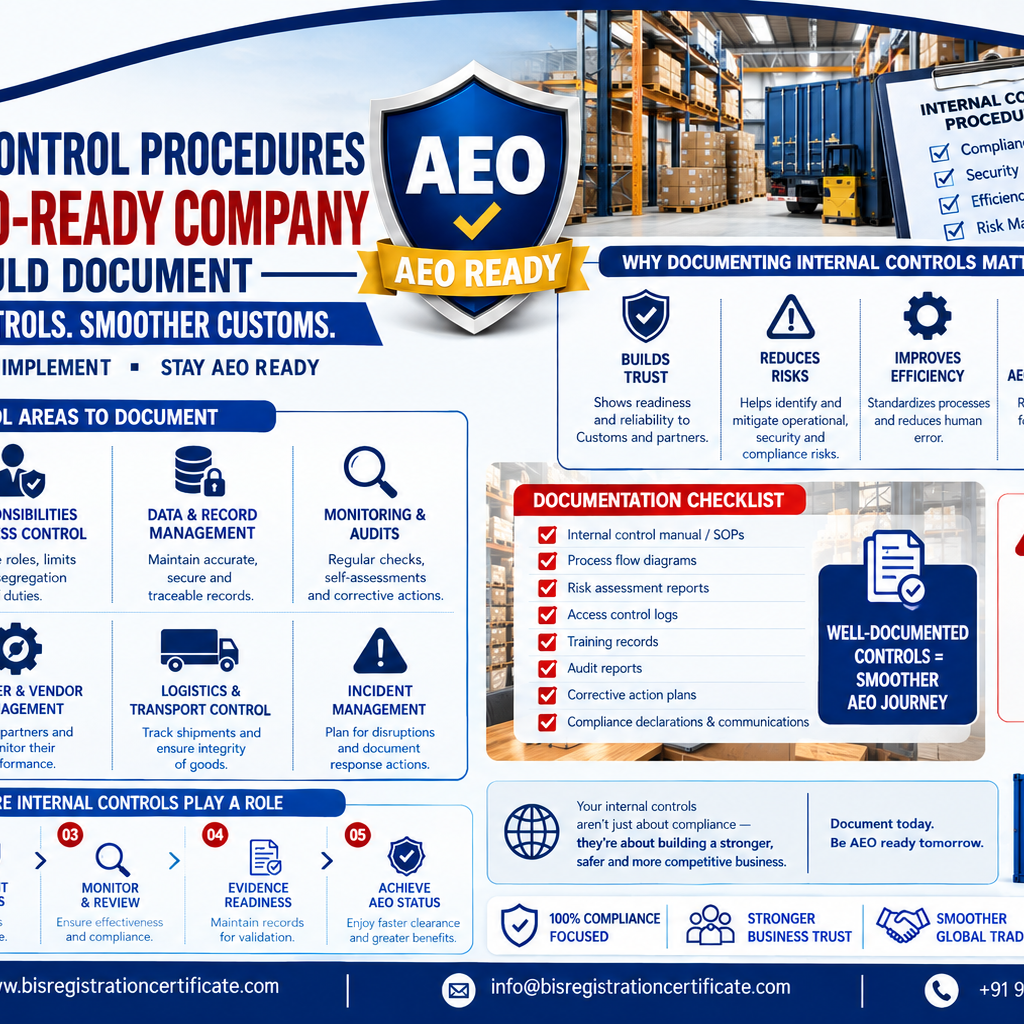
Internal Control Procedures Every AEO-Ready Company Should Document

CBIC’s AEO Program checks your business not by what you do, but by whether you can prove what you do consistently and in a way that AEO Internal Control Procedures to the finish of your trade. During the AEO assessment, a visit and regular checks by CBIC’s AEO Programme Management Team (APMT) look for proof of documented procedures—written, approved, put into action, and kept up. If your company has customs rules but cannot show them in written form, it will have a hard time with the AEO assessment. If your company writes down rules but does not follow them, the inspectors will see it during the visit. The only steady way to keep the AEO certificate is to have a compliance plan where what is written and what is done match exactly. This guide lists every internal control step that a company is ready for, which AEO should write down organized by category. It explains why each step is needed, what it should include, and how it should be kept up. I hope this guide helps you keep your AEO certification strong. The Relationship Between AEO Internal Control Procedures and AEO Certification Before you start looking at the procedure inventory, it is important to know what CBIC wants when it asks for documented controls. What CBIC Assesses – A good system for managing transport records: AEO record-keeping must be organized, easy to find, and easy to audit. – Internal control and compliance procedures: An AEO must have written processes that make sure customs rules are followed everywhere in the AEO. – Security standards: An AEO must have written procedures for physical, personnel, cargo, and IT security. – Financial solvency: An AEO must have written procedures showing AEO Internal Control Procedures and pay duties on time. Why Documentation Matters More Than Intent Many businesses follow customs rules perfectly. But following rules because of instinct, habit, or an expert’s skill is not a systematic way. AEO Internal Control Procedures. That means procedures must be: Written down: So that any trained person can use them, not just the one expert who knows the process. Approved: By management, showing that the organization is committed. Communicated: So all relevant staff know what is expected. Followed: Every time, not when it is convenient. Reviewed: Regularly to keep up with new regulations and changes in how we work. Audited: Inside the organization so that weak spots are fixed by AEO Internal Control Procedures. A documented procedure is what separates a culture of compliance from compliance that happens by accident. CATEGORY 1. CUSTOMS COMPLIANCE PROCEDURES This is the closely watched category in AEO evaluation. Every process that deals with how your customs declarations are made, checked, submitted, and fixed must be written down. Procedure 1.1. Customs Declaration Preparation and Review SOP Purpose: To make sure every import Bill of Entry and export Shipping Bill submitted on your behalf is correct. Follow AEO Internal Control Procedures when it is sent. What to write down: Who starts the process of preparing the declaration (the customs or logistics team, or based on CHA instructions) The information that is needed. Invoice, packing list, bill of lading or air waybill, certificate of origin, import licence, MSDS (for dangerous goods), and any special documents for the product How the HS code (ITC HS classification) is decided for each product. Including who has the power to confirm the classification How the value declared is checked. Transaction value versus customs valuation methods Why it is important for AEO: Misclassifying HS codes and making valuation mistakes are the common reasons for customs problems. Procedure 1.2. HS Code Classification Procedure Purpose: To create a written process for correctly putting all imported and exported goods into the right category under the ITC HS (Indian Trade Classification Harmonised System). Who is allowed to decide and check HS classifications? The way the classification is done. How the tariff schedule, classification rules, General Rules of Interpretation (GRIs), chapter notes, and explanatory notes are used How to use binding tariff information, customs advance rulings, or earlier classification decisions The way to AEO Internal Control Procedure rulings for unclear products How the decisions about classification are kept. The classification register or database The way classifications are changed when tariff schedules are updated (usually with every Union Budget) How CHA is told about the confirmed classifications Why it’s important for AEO: HS code errors. Even if they are not meant to be. Can lead to missing duties, fines, and SCNs. A written classification procedure shows AEO Internal Control Procedures in a supported way. Not by chance. Procedure 1.3. Procedure for Customs Valuation To make sure that the customs value is the Internal AEO Internal Control Procedures value or the correct alternative method as per the Customs Valuation Rules. What to document: How additional costs are added to the transaction value. Such as freight, insurance, commissions, royalties and assistance. Situations that lead to using other methods of valuation (Rules 4 through 9). How the prices on invoices are checked against purchase orders and contract prices. A record of the decisions made for each import. Procedure 1.4. Country of Origin Determination and Certificate of Origin (CoO) Procedure To make sure that the country is the Internal AEO Internal Control Procedures origin (CoO) used for duty claims under India’s FTAs is genuine, valid, and properly applied. What to document: How the origin of each imported product is found. Product‑specific rules (PSRs) that are applied Process to check the authenticity and validity of CoOs that are received from suppliers Process to handle expired, incorrect, or disputed CoOs Record of CoOs that are received and applied by shipment Why it matters for AEO: Incorrect preferential duty claims that are based on invalid CoOs can lead to large post‑import duty demands and penalties. A documented CoO verification procedure is required. CATEGORY 2 FINANCIAL RECORD-KEEPING PROCEDURES | AEO Internal Control Procedures To make sure that every payment for goods in the country is properly recorded, matches what was said on the customs forms, and follows the rules

AEO Compliance Strategy
Blog

Choosing Supply Chain Partners That Support Your AEO Compliance Strategy

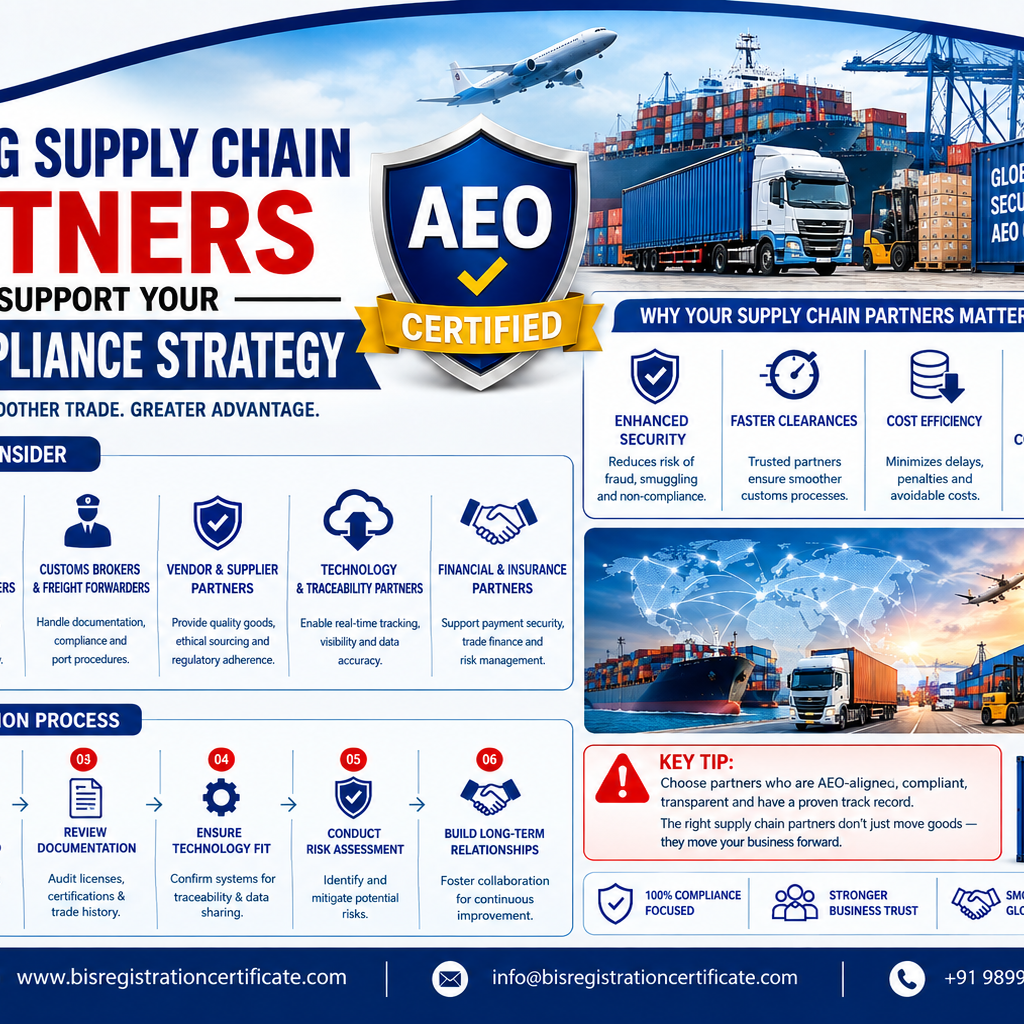
Earning an Authorised Economic Operator (AEO) certificate from India’s Central Board of Indirect Taxes and Customs (CBIC) is a significant achievement. It signals to customs authorities worldwide that your business operates to the highest standards of compliance, security, and transparency in international trade. Your customs declarations are only as accurate as the commercial documents your suppliers send you. Your cargo security is only as strong as the sealing practices of the freight forwarder who loaded your container. Your post-market vigilance depends on the integrity of the customs broker who filed your Bill of Entry. This is why choosing supply chain partners that actively support your AEO Compliance Strategy is not a peripheral concern—it is a core strategic imperative for every AEO-certified or AEO-aspiring business. Why Supply Chain Partner Selection Matters for AEO Compliance Strategy The AEO program evaluates holistically—not just your internal operations, but your entire supply chain ecosystem. CBIC’s AEO Compliance Strategy requires applicants to: Assess the security practices of key supply chain partners Prefer trading with AEO Compliance Strategy or equivalently vetted partners where possible Establish contractual security requirements on partners Demonstrate awareness of your supply chain’s risk profile This means that when CBIC evaluates your AEO application—or reviews your compliance during a periodic audit—they are not just looking at what happens inside your four walls. The AEO Compliance Supply Chain Ecosystem — Who Are Your Key Partners? Before developing a partner selection framework, it is important to map the full ecosystem of supply chain partners whose actions directly impact your AEO compliance: 1. Overseas Suppliers and Manufacturers Foreign suppliers are the origin point of your import supply chain. Their commercial documentation—invoices, packing lists, certificates of origin, and product specifications—forms the basis of your customs declarations. 2. Customs Brokers and Customs House Agents (CHAs) Your CHA, or customs broker, files your import Bills of Entry and export Shipping Bills. They are the most direct influencer of your customs compliance record—the accuracy of HS code classification. 3. Freight Forwarders Freight forwarders manage the physical movement of your goods—booking cargo space, coordinating with carriers, preparing shipping documentation, and managing the AEO Compliance Strategy. Their security practices, cargo handling standards, and AEO compliance. 4. Carriers—Shipping Lines, Airlines, Road Transporters Carriers are responsible for the physical security of your cargo in transit. For importers, the carrier’s track record for container integrity, seal maintenance, and incident reporting matters. Building Your AEO-Aligned Partner Selection Framework for AEO Compliance Strategy A systematic, documented approach to supply chain partner selection is not just good business practice—it is an AEO program requirement. AEO Compliance Strategy evidence that you have a structured process for assessing and managing supply chain partner risk. Here is how to build it. Framework Component 1 — Define Your Partner Compliance Criteria Before evaluating any partner, establish clear, written criteria that a supply chain partner must meet to be considered AEO-compliant. These criteria should be calibrated to the partner’s role in your supply chain and their proximity to your cargo or customs documentation. Legal compliance—no criminal convictions or serious regulatory violations Business legitimacy—verifiable registration, licences, and tax compliance Financial stability—ability to meet financial obligations and operational continuity Honest and transparent business practices—no record of fraud or deceptive conduct Role-Specific Criteria: Valid Customs Broker License under Customs Brokers Licensing Regulations (CBLR), 2018 Clean regulatory record—no licence suspension, revocation, or serious penalty orders Proven HS code classification competence in your product categories AEO-LO certification (where available)—strong positive indicator References from existing importers/exporters in your industry Framework Component 2—AEO and Equivalent Trusted Trader Status—The Gold Standard The single most reliable indicator that a supply chain partner shares your commitment to compliance and security is their own AEO certification or equivalent trusted trader program membership. In India: AEO-LO certification from CBIC is available to logistics operators, including customs brokers, freight forwarders, custodians, terminal operators, and warehouse keepers. An AEO-LO certified partner has been independently evaluated by CBIC. Internationally: India’s MRAs with South Korea, Hong Kong, Taiwan, and the USA mean that suppliers and logistics partners in these countries who hold AEO Compliance Strategy status—Korea’s AEO program (KCSA), Hong Kong’s CTPAT-equivalent, and Taiwan’s AEO. Practical prioritization strategy: When all other factors are equal, always prefer a supply chain partner who holds AEO or equivalent trusted trader status over one who does not. When you must work with non-AEO-certified partners. Framework Component 3 — Due Diligence Process for New Partners Every new supply chain partner should go through the diligence and AEO Compliance Strategy before any shipments or declarations are made through their services. A robust due diligence process includes: Step 1—Preliminary Screening Verify business registration and licences (customs broker licence, warehouse licence, freight forwarder registration, factory licence, etc.) Check for any public records of regulatory violations, penalty orders, or licence suspensions Verify that the entity is not on any AEO Compliance Strategy (OFAC, UN Security Council, India’s MEA sanctions lists) or on CDSCO/customs authority watchlists Check for AEO or equivalent trusted trader certification Step 2—Compliance Questionnaire: a structured compliance questionnaire: Overview of their compliance management system Description of their physical security measures (for partners handling cargo) Personnel security screening practices IT security and data protection measures Step 3—Document Verification and Verify Copies of Key Documents: Customs Broker Licence or equivalent regulatory authorisation ISO/quality certifications AEO-LO certificate (where available) Latest compliance AEO Compliance Strategy Insurance certificates (cargo liability, professional indemnity) Step 4—Site Visit: Physical security infrastructure (CCTV, access control, perimeter security) Cargo handling practices Documentation management systems Staff security awareness Framework Component 4 — Contractual Security and Compliance Requirements Your selection framework must be backed by contractual commitments. A supply chain partner who verbally agrees to AEO Compliance Strategy obligations is a compliance liability—not an asset. Key requirements for AEO-aligned supply chain agreements: Compliance Representation and Warranty: The partner represents and warrants that they hold all required licences and regulatory authorizations and that they comply with the AEO Compliance Strategy and regulations. AEO / Security Standard Commitment: The partner commits to maintaining their own compliance and security standards at a level consistent with

Documents Required for AEO Certification in India.
Blog

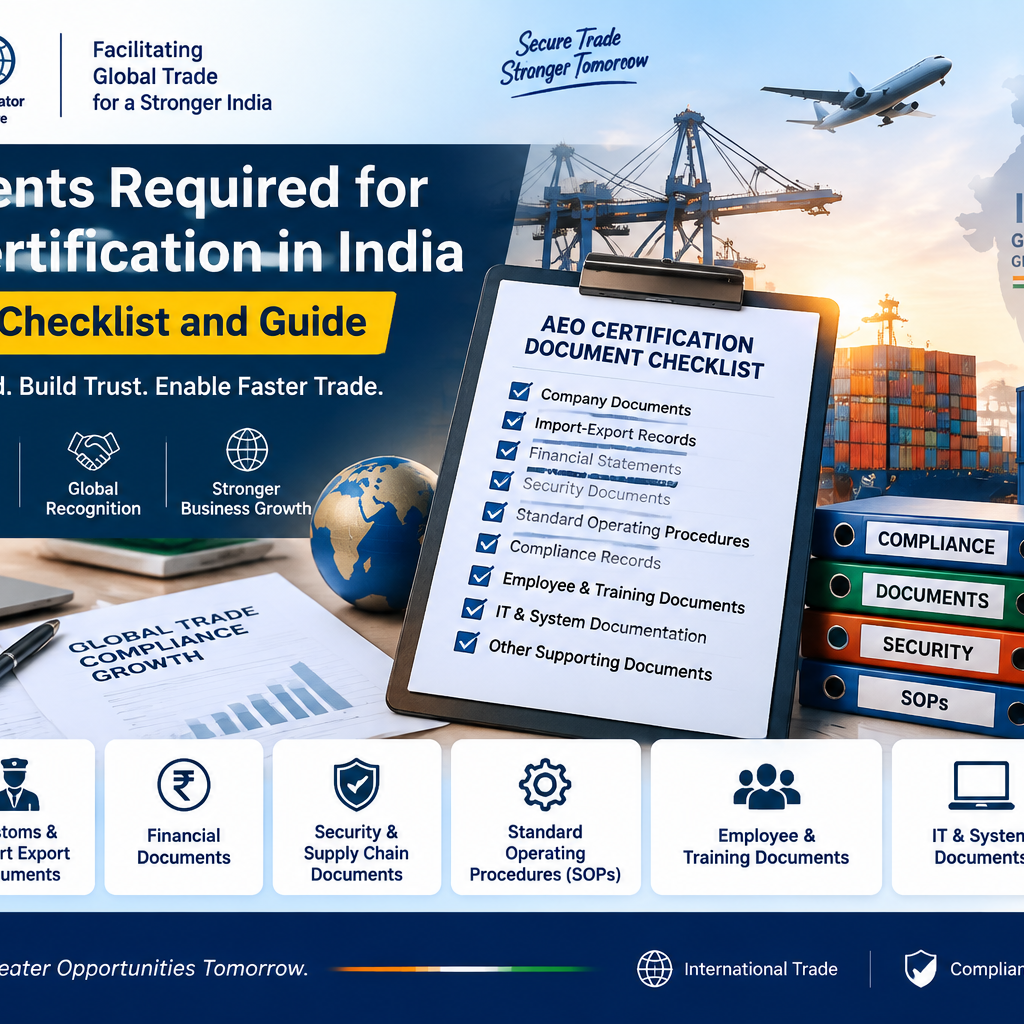
Documents Required for AEO Certification in India — Complete Checklist and Guide

The Documents required for AEO certification in India play a crucial role in obtaining Authorised Economic Operator (AEO) status from Indian Customs. Businesses involved in international trade, including importers, exporters, manufacturers, logistics providers, customs brokers, and other supply chain participants, must prepare accurate documentation to demonstrate compliance, financial stability, customs history, and supply chain security. The AEO Programme is managed by Indian Customs under CBIC to recognize businesses that maintain strong compliance standards and secure international supply chain practices. A complete and properly prepared document package helps reduce delays during the application process and improves the chances of successful AEO certification. What is AEO Certification in India? Authorised Economic Operator (AEO) Certification is a recognition provided by customs authorities to businesses that demonstrate compliance with customs regulations, financial reliability, and supply chain security standards. The Indian AEO Programme provides different certification levels, including AEO-T1, AEO-T2, AEO-T3, and AEO-LO, depending on the applicant category and compliance level. AEO-certified businesses may receive benefits such as Faster customs clearance Reduced customs intervention Priority processing Improved supply chain reliability Better credibility in international trade Why Are Documents Required for AEO Certification in India Important? The Documents required for AEO Certification in India help customs authorities evaluate: Customs compliance history Financial records Internal control systems Security procedures Supply chain management Employee responsibilities Risk management practices Proper documentation demonstrates that the applicant follows secure and transparent trade practices. Documents Required for AEO Certification in India The following are the major categories of documents generally required for AEO certification: 1. Company Registration Documents Applicants need to submit basic business registration documents, including: Certificate of Incorporation Partnership deed (for partnership firms) LLP agreement (where applicable) Memorandum and Articles of Association GST Registration Certificate PAN Card of the company Import Export Code (IEC) Company profile These documents establish the legal identity of the applicant. 2. Customs and Import Export Compliance Documents For Documents required for AEO Certification in India, customs compliance records are extremely important. Required documents may include: Import documentation records Export documentation records Bill of Entry details Shipping Bill records Customs duty payment records Customs declarations Previous customs correspondence Details of customs violations (if applicable) Applicants should maintain proper records of international trade activities. 3. Financial Documents Required for AEO Certification Financial stability is an important evaluation factor for AEO certification. Financial documents may include: Audited financial statements Balance sheets Profit and loss statements Income tax returns GST returns Bank details Financial solvency information These documents help demonstrate the applicant’s financial reliability. 4. Security and Supply Chain Documents Security compliance is one of the important parts of the AEO certification. The Documents required for AEO Certification in India may include: Physical Security Documents Warehouse security procedures Office security policies Access control procedures CCTV monitoring details Visitor management records Cargo Security Documents Cargo handling procedures Transportation security policy Shipment monitoring process Container security procedures Employee Security Documents Employee verification process Background verification policy Training records Employee access control procedures 5. Standard Operating Procedures (SOPs) SOP documentation is one of the most important parts of the AEO certification process. Businesses should prepare SOPs related to: Import procedures Export procedures Customs documentation process Inventory management Vendor management Transportation process Security controls Record maintenance Risk management Well-documented SOPs demonstrate that the company has structured internal processes. 6. Customs Compliance History Documents Applicants may need documents showing their compliance record. These include: Previous customs audits Customs notices (if any) Penalty details (if applicable) Compliance corrective actions Internal audit reports A clean compliance history supports the AEO certification. 7. Employee and Organization Documents Businesses should maintain: Organization structure Employee responsibility chart Key employee details Training records Compliance officer details Contact details of authorized persons These documents help AEO certification Customs understand operational responsibility. 8. Technology and Record Management Documents Modern businesses should provide details regarding their IT systems. Documents may include: ERP system details Customs filing software details Data security policy User access control policy Backup procedures Electronic record management process 9. Previous Certifications and Licences Applicants may submit: ISO certificates Quality certifications Security certifications Industry-specific approvals Other compliance certificates These documents support the company’s compliance framework. Common Mistakes While Preparing Documents Required for AEO Certification in India   1. Submitting Incomplete Documentation Missing documents can delay the AEO certification application review process. 2. Lack of Proper SOPs Many businesses fail to prepare detailed operational procedures. 3. Incorrect Customs Records A mismatch between trade records and submitted information can create compliance issues. 4. Poor Security Documentation AEO certification requires strong supply chain security practices. 5. Ignoring Document Updates Businesses should ensure all submitted documents contain current information. AEO Certification Application Supporting Documents Along with the application, businesses may need supporting documents such as Company profile Business activity details Organizational structure Customs transaction details Security policies SOP documents Compliance declarations Supporting certificates All information provided for AEO certification should be accurate and consistent. How to Prepare Documents for AEO Certification Successfully? Follow these steps: Step 1: Understand AEO Requirements Identify the applicable AEO category and documentation requirements. Step 2: Collect Business Documents Prepare company registration and financial documents. Step 3: Prepare SOPs Create detailed procedures for trade operations and security controls. Step 4: Review Customs Compliance History Check previous import/export records. Step 5: Submit Application Complete the application with accurate supporting documents. How AEO Certificate India Helps With Documentation Support Preparing the AEO certification can be complex because businesses must organize multiple categories of records, SOPs, security documents, and compliance evidence. AEO Certificate India provides professional assistance for businesses seeking AEO certification support. Services include: AEO Certification Consultancy Expert guidance on eligibility, documentation requirements, and application procedures. Documentation Preparation Support Assistance in preparing: Application documents SOPs Compliance records Security documentation Supporting reports AEO Application Filing Assistance Support for preparing and submitting AEO certification applications. Compliance Gap Analysis Review of existing processes to identify areas requiring improvement before application submission. AEO Renewal Support Assistance with maintaining compliance and renewal-related requirements. Complete AEO Certification Documentation Process in India The process of preparing the Documents required for

AEO Site Audit by CBIC
Blog

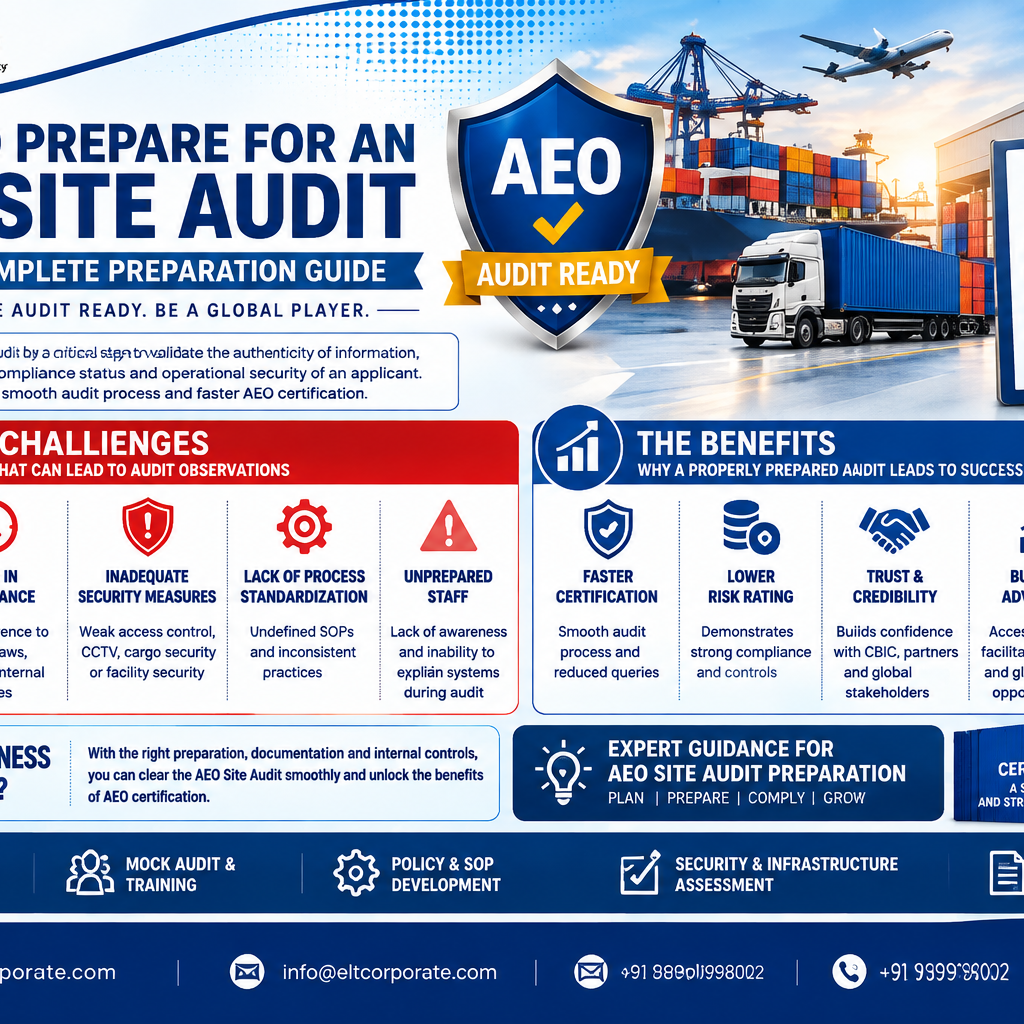
How to Prepare for an AEO Site Audit by CBIC — Complete Preparation Guide

The AEO Site Audit by CBIC is an important part of the Authorized Economic Operator (AEO) certification process for businesses involved in international trade activities. The AEO program recognizes businesses that maintain strong customs compliance, secure supply chain practices, and effective internal control systems. The program is administered by the Central Board of Indirect Taxes and Customs (CBIC) in India. For companies applying for higher AEO certification levels, preparation for the AEO Site Audit by CBIC is essential because customs officials evaluate business processes, security measures, documentation systems, and compliance practices. A well-prepared organization can demonstrate transparency, reliability, and readiness during the audit process. What is an AEO Site Audit by CBIC? An AEO Site Audit by CBIC is a physical verification process where customs authorities review the applicant’s operational procedures, security controls, and compliance systems. During the audit, CBIC officers may examine: Company infrastructure Import-export records Customs compliance history Supply chain security measures Employee verification procedures IT security systems Cargo handling processes Warehouse security Documentation controls The objective of the AEO Site Audit by CBIC is to verify whether the applicant maintains the required standards for becoming a trusted trade partner. Why is the AEO Site Audit by CBIC Important? The AEO Site Audit by CBIC helps customs authorities assess whether an applicant has: ✔ Effective customs compliance procedures✔ Secure supply chain management✔ Proper documentation systems✔ Risk management practices✔ Internal monitoring mechanisms AEO Site Audit by CBIC is based on trust between customs and businesses involved in global trade. The Indian AEO program includes different certification levels such as AEO T1, AEO T2, and AEO T3. AEO Site Audit by CBIC: Corrective Action Management If CBIC identifies observations during the audit, businesses should respond properly. The corrective action process includes: Understanding the observation Identifying the root cause Implementing corrective measures Documenting improvements Providing supporting evidence A structured corrective action in an AEO Site Audit by CBIC demonstrates continuous improvement. Role of SOPs in AEO Site Audit by CBIC Standard Operating Procedures (SOPs) play a critical role during the AEO Site Audit by CBIC. Companies should maintain SOPs for: Import-export operations Customs compliance Cargo handling Warehouse management Security controls Employee access Incident reporting Well-documented SOPs help demonstrate that business processes are controlled and consistently followed. Continuous Compliance After AEO Certification Preparing only for the AEO Site Audit by CBIC is not enough. After obtaining AEO certification, businesses should continue maintaining: Updated security procedures Regular internal reviews Employee training Compliance monitoring Proper record maintenance AEO certification requires ongoing commitment to AEO Site Audit by CBIC compliance and supply chain security. Why Choose an AEO Certificate for AEO Site Audit by CBIC Preparation? Businesses preparing for the AEO Site Audit by CBIC often require expert assistance with documentation, compliance assessment, and audit readiness. The AEO Certificate provides professional AEO compliance services, including: AEO Certification Consultancy Support for businesses applying for AEO certification. AEO Documentation Preparation Assistance with: Application documentation Self-assessment forms SOP preparation Compliance records AEO Site Audit by CBIC Preparation Support Services include: Pre-audit assessment Compliance gap analysis Mock audit support Documentation review AEO Renewal and Compliance Support Assistance in maintaining AEO Site Audit by CBIC after certification. Importance of Management Support During AEO Site Audit by CBIC Senior management involvement improves audit readiness. Management should support: Compliance policies Security investments Employee training Internal monitoring Process improvements AEO compliance requires organization-wide participation. AEO Site Audit by CBIC: Security Measures Companies Should Maintain Security is a major evaluation area. Companies should implement: Physical Security CCTV surveillance Security guards Entry restrictions Visitor logs Information Security Password policies User permissions Data backup Cybersecurity controls Transportation Security Verified transporters Vehicle monitoring Shipment tracking AEO Site Audit by CBIC Preparation Checklist Proper preparation is the key to successfully completing an AEO Site Audit by CBIC. Businesses should prepare the following areas before the audit. 1. Review AEO Eligibility Requirements Before facing the AEO Certification, companies should confirm that they meet the basic eligibility requirements. Important factors include: Business establishment in India Customs-related activities Satisfactory compliance history Financial stability Proper customs documentation CBIC guidelines specify eligibility conditions for entities applying under the AEO program. 2. Prepare Complete AEO Documentation Documentation is one of the most important areas during an AEO Site Audit by CBIC. Companies should maintain: Company Documents Certificate of Incorporation PAN Card GST Registration Certificate Import Export Code (IEC) Organization structure Company profile Customs Documents Bills of Entry Shipping Bills Customs declarations Import-export records Duty payment records Customs correspondence Financial Documents Audited financial statements Balance sheets Profit and loss statements Bank details Compliance Documents Internal compliance policies SOP manuals Risk management documents Audit reports 3. Prepare Supply Chain Security Documents During the AEO Site Audit by CBIC, supply chain security is a major focus area. Companies should maintain procedures related to: Cargo Security Cargo handling procedures Container security process Loading and unloading controls Seal management system Warehouse Security CCTV monitoring Restricted access areas Visitor records Security monitoring Transportation Security Transporter verification Vehicle tracking process Route monitoring procedures 4. Employee Security and HR Documentation CBIC may review employee-related security measures during the AEO Site Audit by CBIC. Companies should maintain: Employee background verification records Identity verification process Training records Security awareness programs Employee access control records 5. IT Security Preparation for AEO Site Audit by CBIC Modern businesses depend heavily on digital systems. During the AEO Certification, companies should demonstrate proper IT security controls. Important documents include: IT security policy User access controls Password management policy Data backup procedures Cybersecurity measures ERP system controls 6. Customs Compliance Management System A strong customs compliance system improves readiness for the AEO Site Audit by CBIC. Companies should maintain: Customs compliance checklist Classification procedures Valuation procedures Record retention policy Internal review mechanism Error correction procedures 7. Conduct an Internal Mock AEO Audit Before the actual AEO Certification, companies should conduct an internal assessment. A mock audit helps identify: Missing documents Process gaps Security weaknesses Documentation issues Employee awareness gaps The internal review should cover all areas that CBIC officers may

Scroll to Top