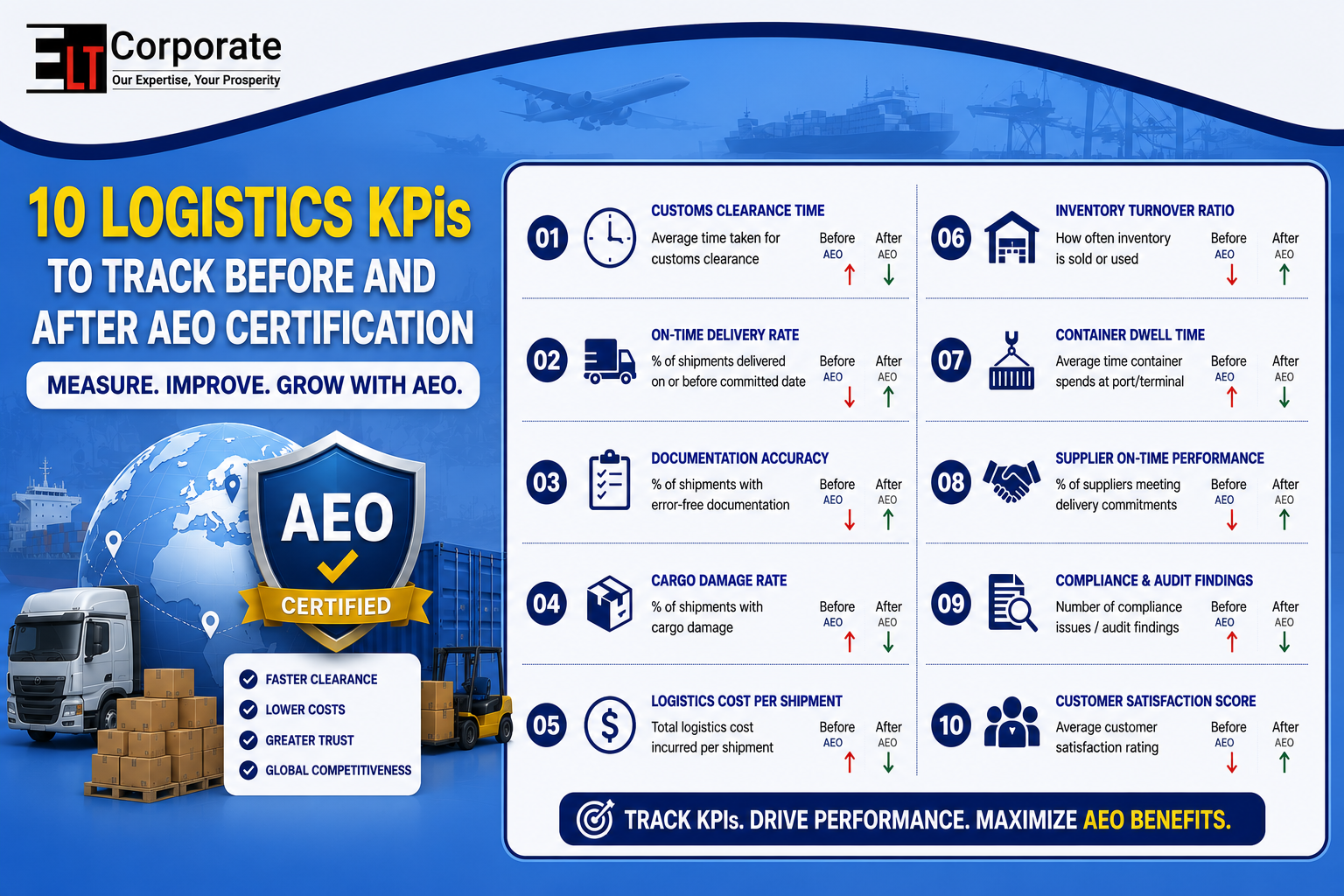
India’s logistics industry is in the middle of a defining shift. With the government’s push for reduced logistics costs — from 14% of GDP toward the global benchmark of 8% — and Indian exports targeting $2 trillion by 2030, logistics companies are under pressure to deliver faster, cleaner, and cheaper.
In this environment, one certification is quietly separating the logistics operators that clients trust — from those they replace: AEO-LO (Authorized Economic Operator — Logistics Operator) certification.
As of 2026, hundreds of logistics operators across India hold AEO-LO status, and the number continues to grow. The gap between AEO-certified and non-certified logistics companies is becoming increasingly visible in client acquisition, customs treatment, and competitive positioning.
This guide is written specifically for freight forwarders, customs brokers, warehouse operators, terminal operators, and 3PL providers — the logistics companies that power India’s trade — to explain what AEO-LO is, what it delivers, who qualifies, and why 2026 is the right time to apply.
What Is AEO-LO? The Logistics-Specific Tier of India’s AEO Programme
The AEO (Authorized Economic Operator) programme is administered by the Central Board of Indirect Taxes and Customs (CBIC), based on the World Customs Organization’s SAFE Framework of Standards. The programme recognises businesses that maintain high standards of customs compliance, financial solvency, and supply chain security — and rewards them with significant trade facilitation benefits.
While importers and exporters apply for AEO-T1, T2, or T3, logistics operators have a dedicated single-tier certification: AEO-LO — designed specifically for the operational realities and compliance requirements of the logistics industry.
| Who AEO-LO Is For | Examples |
| Logistics Providers | Freight forwarders, 3PL operators, multi-modal transport companies |
| Customs Brokers | Custom House Agents (CHAs) licensed under CBLR 2013 |
| Warehouse Operators | Public and private bonded warehouses, CFS operators |
| Terminal Operators / Custodians | Port terminals, ICDs, air cargo terminals, Free Trade Warehousing Zones |
Key distinction: AEO-LO is valid for 5 years — compared to 3 years for AEO-T1 and T2. This longer validity period reflects the programme’s recognition that logistics operators who meet the standard are committed, long-term compliance partners.
Why AEO-LO Is Becoming a Business Necessity — Not Just a Compliance Badge
AEO-LO certification is not mandatory for logistics operators in India. But “not mandatory” is increasingly irrelevant when the market is making it a de facto requirement in two specific ways:
1. AEO-T3 Clients Require AEO-Certified Partners
This is the most immediate and direct commercial pressure. AEO-T3 applicants are encouraged to work with secure and compliant supply chain partners, including AEO-certified logistics operators. As more companies pursue higher AEO tiers, businesses increasingly prefer logistics partners that already maintain recognised compliance and security standards. Key logistics partners — customs brokers, freight forwarders, warehouse operators — must hold AEO-LO status for their clients to qualify for T3.
What this means commercially: as more large manufacturers and trading companies pursue AEO-T3 status, they will actively prefer — and in many cases require — AEO-LO certified logistics partners. Logistics companies without AEO-LO certification are being filtered out of T3 client supply chains. This is not a future risk. It is happening now, across India’s major exporting sectors.
2. Global Companies Expect AEO-Equivalent Standards
International shippers — particularly from markets with mature AEO programmes (US C-TPAT, EU AEO, South Korea, Singapore) — routinely evaluate their Indian logistics partners against AEO or equivalent security and compliance standards. By adhering to AEO-LO’s stringent standards, logistics operators ensure secure multi-channel and multi-region movement of cargo for customers and benefit from ease of facilitation in countries with whom India has signed the Mutual Recognition Agreement. For logistics companies handling international cargo, AEO-LO is the credential that communicates global-standard compliance to international clients.
What AEO-LO Actually Delivers: The Specific Benefits
1. Faster Customs Clearance — Across All Ports and Stations
AEO certificate is valid at all Customs stations in India, which means AEO status holders will receive its benefits at all ports, airports, and land Customs stations. For logistics operators working across multiple ports — JNPT, Chennai, Mundra, Kolkata, IGI Air Cargo, ICD Tughlakabad — this uniform treatment across all stations is a significant operational advantage. This can help cargo move more efficiently across different customs stations.
2. Direct Port Entry (DPE) and Direct Port Delivery (DPD)
AEO-LO certification provides access to Direct Port Delivery (DPD) for import containers and Direct Port Entry (DPE) for export containers, thus reducing turnaround time and enabling faster movement of goods through customs stations. For freight forwarders and 3PL operators, DPE and DPD eliminate the Container Freight Station (CFS) step for eligible cargo — reducing dwell time, cutting demurrage risk, and improving delivery reliability for clients.
3. Waiver of Bank Guarantee Under HCCAR 2009
AEO-LO certified operators benefit from waiver of bank guarantee under Handling of Cargo in Customs Area Regulations 2009. For custodians and terminal operators who are required to furnish bank guarantees as a condition of their HCCAR authorisation, this waiver directly frees capital and reduces the cost of operations.
4. Extended Custodian Approval — 10 Years
AEO-LO certified operators benefit from extension of approval for custodians under Regulation 10(2) of the Handling of Cargo in Customs Area Regulation 2009 for a period of 10 years. Standard custodian approvals require more frequent renewal — AEO-LO significantly extends this, reducing administrative overhead for terminal operators and CFS custodians.
5. Extended CBLR Licence Validity for Customs Brokers
AEO-LO certified operators benefit from extended validity (till validity of AEO status) of licenses granted under Regulation 9 of the CBLR 2013. For Custom House Agents, this means your CBLR licence remains valid for the full 5-year AEO-LO period — eliminating the friction of interim renewal cycles.
6. Waiver of Antecedent Verification for Warehouse Licences
AEO-LO certified operators benefit from waiver of antecedent verification envisaged for grant of licence for warehouse under Circular 26/2016, waiver of solvency certificate requirement under Circular 24/2016, and waiver of security for obtaining extension in warehousing period under Circular 21/2016. For warehouse operators managing bonded or public warehouses, these waivers reduce the ongoing compliance burden significantly.
7. Waiver of Security for Sensitive Goods Warehousing
AEO-LO certified warehouse operators also benefit from waiver of security required for warehousing of sensitive goods — enabling these operators to handle higher-value, higher-risk cargo categories with reduced financial security requirements.
8. Transit Cargo Facilitation
AEO-LO certified operators benefit from exemption from permission on a case-to-case basis in case of transit of goods. In case of international transshipped cargo (Foreign to Foreign), for pre-sorted containers where cargo does not require segregation, ramp-to-ramp or tail-to-tail transfer of cargo can be effected without Customs escorts. For freight forwarders handling transshipment cargo, this is a significant operational advantage — eliminating the customs escort requirement for eligible transshipment operations.
9. MRA Benefits for Internationally Operating Logistics Companies
India’s Mutual Recognition Arrangements (MRAs) with South Korea, Hong Kong, and Singapore (signed May 2026) mean AEO-LO certified Indian logistics operators gain recognition from partner countries’ customs administrations. For freight forwarders and 3PLs operating corridors to these markets, AEO-LO status translates into expedited treatment and reduced inspection frequency on the destination end — directly improving service delivery for clients on these trade lanes.
Real-World Validation: DP World’s AEO-LO Certification
The business case for AEO-LO is not theoretical. DP World received AEO-LO accreditation from CBIC, with the certification streamlining clearance procedures at all customs stations across India for a period of five years.
DP World’s Vice-President framed the certification’s value clearly: “In today’s volatile environment of global trade, this certification will underline and enhance DP World’s credentials as a reliable and secure logistics provider with deep expertise in ensuring efficient cross-border trade.”
DP World’s experience confirms what smaller logistics operators are beginning to discover: AEO-LO is not just a compliance achievement — it is a client-facing trust credential that directly supports business development in competitive trade lanes.
AEO-LO Eligibility: What Logistics Companies Need to Qualify
Before applying, verify your eligibility against CBIC’s requirements:
| Eligibility Criterion | Requirement |
| Legal establishment | Must be legally established in India |
| Business operations | Minimum 3 years of business operations |
| Customs document volume | Minimum 25 customs documents (Shipping Bills / Bills of Entry) in last financial year |
| Supply chain involvement | Must be part of an international supply chain |
| Compliance record | Clean record — no significant Show Cause Notices in last 3 years |
| Financial solvency | Positive net worth — ability to meet customs duties and obligations |
| Security standards | Adequate physical security, cargo handling protocols, and IT security |
| Entity scope | AEO-LO can only be given to the whole legal entity — not separately to subsidiaries |
How AEO-LO Differs from AEO-T1/T2 for Exporters and Importers
| Factor | AEO-T1 / T2 (Importers/Exporters) | AEO-LO (Logistics Operators) |
| Who applies | Importers and exporters | Freight forwarders, CHAs, warehouses, terminals |
| Tiers | Three tiers (T1, T2, T3) | Single tier (LO) |
| Validity | 3 years (T1/T2) — 5 years (T3) | 5 years |
| Site inspection | T2/T3 — mandatory physical inspection | Mandatory physical on-site audit within 90 days |
| Sector-specific benefits | Deferred duty, bank guarantee reduction, drawback priority | HCCAR waiver, CBLR extension, custodian extension, warehouse waivers |
| Role in T3 ecosystem | T3 requires AEO partners | AEO-LO is the credential T3 clients need from their logistics partners |
Step-by-Step: How to Apply for AEO-LO Certification
1. Eligibility Assessment and Compliance Review
Verify your document volume (25+ customs documents), operational years (3+), and compliance record. Pull your complete Show Cause Notice history for the last 3 years. Check your CBLR licence status (for customs brokers) and any HCCAR authorisations. Identify and resolve any compliance gaps before applying.
2 Security Infrastructure Audit
Assess your physical security against AEO requirements — access control, CCTV coverage of cargo areas and entry/exit points, visitor management, cargo handling and sealing procedures, vehicle entry/exit logs, and IT security. For the AEO-LO physical site inspection, every security statement in your annexure must be physically evidenced in your facility.
3 Prepare Documentation — Annexures A, B, and C
Complete the applicable AEO-LO annexures: Annexure A (main application), Annexure B (Security Questionnaire — mandatory for LO), and Annexure C (compliance and financial declarations). Prepare supporting documents: facility site layout including cargo areas, import/export process map, security SOPs, financial statements, and solvency certificate.
4 Submit on AEO Portal
Register and submit the complete application electronically at www.aeoindia.gov.in. Upload your DSC (Digital Signature Certificate) of the authorised signatory, select AEO-LO as your category, fill entity details, and upload all annexures and supporting documents. Note your acknowledgement number after submission.
5 Physical Site Inspection
For AEO-T2/LO, customs officials conduct a mandatory physical on-site audit within 90 days to validate security protocols. Prepare your facility before the notice arrives — conduct a mock inspection against your Annexure B responses, ensure all SOPs are accessible and signed, brief your operations team on what to expect. A failed inspection requires a re-inspection scheduling cycle — adding months.
6 Certification Issued — Activate Benefits Immediately
Once certified, your AEO-LO certificate is valid for 5 years and recognised at all customs stations in India. Immediately notify your customs authority and relevant ports to activate DPE/DPD privileges. For CBLR-licensed customs brokers, notify CBIC for the extended licence validity. For warehouse operators, apply for the HCCAR bank guarantee waiver and antecedent verification exemptions — these do not activate automatically.
The Competitive Landscape: What Non-Certified Logistics Companies Are Losing
The business impact of not holding AEO-LO is becoming measurable across three dimensions:
Losing T3-Aspirant Clients
As documented above, AEO-T3 applicants must demonstrate that key logistics partners are AEO certified. A freight forwarder or customs broker without AEO-LO is ineligible to be a preferred partner for any client pursuing T3 status. With a growing number of T3-certified companies in India and more applying every month, this is an active and growing commercial exclusion.
Losing Contracts to AEO-LO Certified Competitors
AEO certification assists in gaining customers’ trust, making international alliances, and procuring new contracts. When a pharma exporter, an auto components manufacturer, or a gems and jewellery exporter is evaluating logistics partners, an AEO-LO certified company offers a verifiable compliance credential that non-certified competitors cannot match.
Higher Operational Costs Per Consignment
AEO certification results in fewer delays, detention, warehousing fees, document preparation, and administrative expenses. Non-AEO logistics operators face higher inspection frequency, longer port dwell times, and more CFS handling requirements — all of which translate into higher per-consignment costs that either squeeze margins or are passed to clients.
FAQs
We are a customs broker — do we need CBLR licence renewal separately if we get AEO-LO?
No — AEO-LO extends your CBLR licence validity to match the AEO-LO validity period (5 years). You do not need to pursue separate renewal during the AEO-LO validity period. This is one of the most administratively valuable benefits for customs brokers specifically.
We only handle domestic logistics — does AEO-LO apply to us?
AEO-LO requires involvement in an international supply chain — movement of goods to/from ports, bonded warehouses, or customs areas. If your operations are purely domestic with no customs interface, AEO-LO may not be relevant. However, many logistics companies handle both domestic and international segments — if your company touches customs-cleared cargo at any point, AEO-LO applies.
Can our subsidiary apply for AEO-LO separately?
No. AEO-LO can only be given to the whole legal entity of an organisation — not separately to subsidiaries of a group company. If your group has multiple legal entities, each must apply independently under its own legal identity and registration details.
How long does AEO-LO certification take?
Typically 3–6 months from submission to certification — including document review, deficiency response (if any), and physical site inspection scheduling. A complete, well-prepared application with no deficiencies moves significantly faster. The physical on-site audit is scheduled within 90 days of application acceptance.
Is AEO-LO valid at all ports and customs stations in India?
Yes. AEO certificate is valid at all customs stations in India — seaports, airports, ICDs, and land customs stations. Your AEO-LO benefits apply uniformly whether you are operating at JNPT Mumbai, ICD Tughlakabad Delhi, Chennai Sea Port, or any other customs station in the country.
The Bottom Line: Why 2026 Is the Right Year to Apply
AEO-LO certification for logistics companies sits at the intersection of regulatory smart positioning, commercial advantage, and operational efficiency — and 2026 is the right year to act for three specific reasons:
- The T3 requirement is real and growing: 212 T3 companies and thousands more pursuing T2 and T3 — all creating demand for AEO-LO certified logistics partners. Every month you delay is another month of contracts going to certified competitors.
- India’s MRA network is expanding: Singapore (May 2026), South Korea, and Hong Kong — with USA, UAE, and EU in negotiation. As MRA coverage grows, the trade lanes where AEO-LO delivers international clearance benefits multiply. Early certification positions you for benefits on corridors that are not yet in the MRA network.
- Port infrastructure is modernizing: India’s port modernization — Digital India integration, AEO digital systems, on-arrival clearance regulations — is making AEO-LO benefits increasingly operational. The DPE and DPD benefits are becoming faster and more reliable as port digital infrastructure matures.
For logistics companies that handle international cargo, AEO-LO is the most effective single investment you can make in compliance credibility, client retention, and operational efficiency — all in one 5-year certification.
We Help Logistics Companies Get AEO-LO Certified
We provide end-to-end AEO-LO certification support for freight forwarders, customs brokers, warehouse operators, and terminal operators across India:
- Eligibility assessment and SCN compliance review
- Physical security gap analysis against CBIC AEO-LO standards
- Complete Annexure A, B, and C preparation
- Facility site layout, process maps, and SOP drafting
- Mock site inspection preparation
- AEO portal submission and deficiency response handling
- Post-certification benefit activation — HCCAR waiver, CBLR extension, DPE/DPD
Book your free AEO-LO eligibility assessment today and position your logistics business as a trusted global trade partner.