
The Authorized Economic Operator (AEO) program is an important initiative introduced by the Central Board of Indirect Taxes and Customs (CBIC) to strengthen international supply chain security and promote efficient customs procedures in India.
Businesses involved in importing, exporting, manufacturing, logistics, warehousing, and other international trade activities can apply for AEO status if they meet the prescribed eligibility and compliance requirements.
However, obtaining an AEO certificate involves more than submitting an application and uploading documents. Depending on the category, the applicant may also need to undergo a detailed site verification conducted by the AEO Program Team.
The AEO Certification Site Verification Process helps authorities examine whether the information provided in the application matches the company’s actual business operations, internal controls, record-keeping systems, and applicable security arrangements.
For businesses applying for AEO-T2 or AEO-LO certification, physical verification is an important part of the assessment. Companies should understand what happens during the visit, which documents they should maintain, and how to prepare their premises.
In this guide, we will explain the complete AEO Certification Site Verification Process, important verification areas, required documents, common mistakes, and practical preparation tips to help businesses work towards obtaining an AEO certificate.
What Is the AEO Certification Site Verification Process?
The AEO Certification Site Verification Process is an assessment conducted by the designated AEO Program Team to verify the information and supporting documents submitted by an applicant.
The purpose is to determine whether the business follows the compliance, operational, financial, and security practices required under the applicable AEO category.
During the verification visit, the team may examine the company’s:
- Business premises and operational activities.
- Import-export documentation and customs records.
- Accounting and logistics systems.
- Internal control procedures.
- Cargo handling and storage arrangements.
- Employee and visitor access controls.
- Computer and information security.
- Financial solvency information.
- Supply chain security arrangements.
The verification process helps establish whether the company’s documented procedures are actually implemented in its daily operations.
An AEO certificate is granted only after the competent authority is satisfied that the applicant meets the applicable requirements.
Which AEO Categories Require Site Verification?
Before understanding the AEO Certification Site Verification Process, businesses should know that the verification requirements differ according to the certification category.
1. AEO-T1 Certification
AEO-T1 is an entry-level certification category for eligible importers and exporters.
Under the current Indian AEO Certification Site Verification Process guidance, AEO-T1 applications generally do not require a physical premises verification visit.
However, applicants must still satisfy the prescribed eligibility, legal compliance, financial solvency, and record-management requirements to obtain an AEO certificate.
2. AEO-T2 Certification
AEO-T2 is a higher certification category involving additional compliance and security requirements.
The AEO Certification Site Verification Process is an important part of the AEO-T2 application assessment.
The AEO Program Team visits the relevant business premises to examine the applicant’s records, security arrangements, internal controls, and operational practices.
3. AEO-T3 Certification
AEO-T3 is an advanced certification category available to eligible existing AEO-T2 holders.
Businesses that have continuously held AEO-T2 status for at least two years may qualify for the prescribed streamlined application process, subject to applicable conditions.
However, significant changes in business AEO Certification Site Verification Process activities, processes, or other relevant circumstances may result in physical verification being required.
4. AEO-LO Certification
AEO-LO certification is intended for eligible logistics operators and other qualifying supply chain participants.
These businesses may include:
- Customs brokers.
- Freight forwarders.
- Warehouse operators.
- Custodians.
- Terminal operators.
- Other eligible logistics service providers.
The site verification process examines whether their operational facilities and security systems meet the applicable AEO requirements.
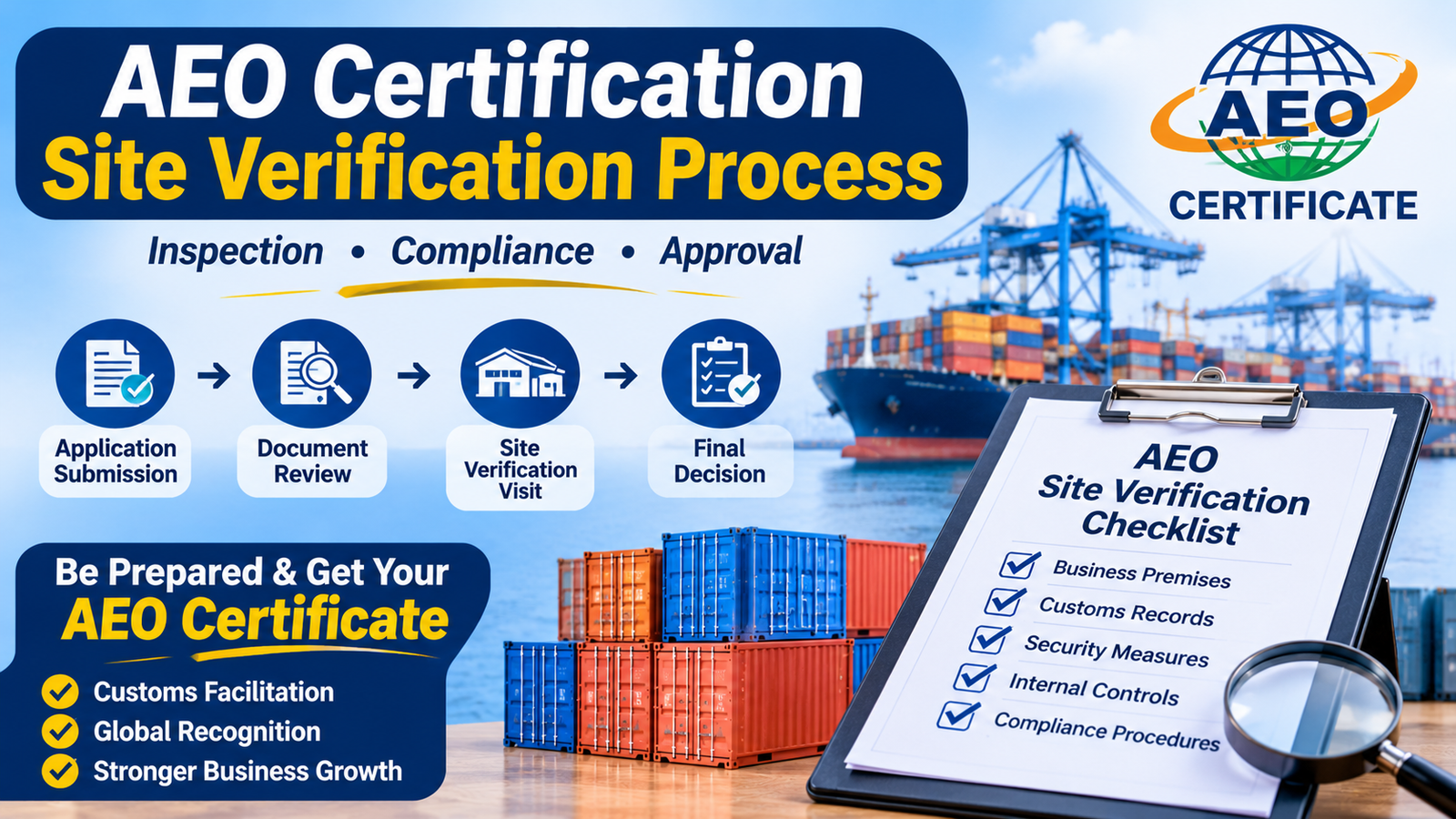
Step-by-Step AEO Certification Site Verification Process in India
Understanding each stage of the AEO Certification Site Verification Process helps businesses prepare their documents and premises properly.
Step 1: Submission of the AEO Application
The first step is submitting the AEO application through the official AEO portal along with the required information and supporting documents.
The application generally includes:
- Business registration information.
- Import Export Code (IEC), where applicable.
- Financial information.
- Customs compliance details.
- Operational information.
- Security-related information, as applicable.
- Relevant declarations and supporting documents.
Applicants should ensure that all AEO Certification Site Verification Process information is accurate and consistent.
Step 2: Initial Application Review
After submission, the AEO Program Manager reviews the application and supporting information.
The purpose of this stage is to check whether the applicant has provided the necessary information and meets the applicable preliminary requirements.
If any documents or details are missing, additional clarification may be requested.
Step 3: Assignment of the AEO Program Team
For applications requiring physical verification, an AEO Program Team is assigned to examine the applicant’s business operations.
The team coordinates with the applicant to schedule the AEO Certification Site Verification Process schedule the verification visit.
The date of the visit is decided in consultation with the applicant.
Step 4: Scheduling the Site Verification Visit
Once the verification team is assigned, the applicant is informed about the visit arrangements.
Businesses should make sure that relevant departments and responsible employees are available during the scheduled visit.
The company should also arrange access to its records, operational facilities, and applicable security systems.
Step 5: Physical Verification of Business Premises
This is one of the most important stages of the AEO Certification Site Verification Process.
The verification team visits the relevant premises to assess whether the information provided in the application is accurate.
The team may examine:
- Office and warehouse facilities.
- Cargo handling and storage areas.
- Entry and exit arrangements.
- Employee access controls.
- Visitor management systems.
- CCTV and monitoring arrangements, where applicable.
- Computer and document security.
- Import-export operations.
- Internal compliance procedures.
The scope of inspection depends on the applicant’s business activities and the AEO category.
Step 6: Review of Documents and Internal Procedures
During the visit, the team may examine AEO Certification Site Verification Process different records to verify that the company’s procedures are implemented consistently.
Examples include
- Customs-related transaction records.
- Import and export documents.
- Accounting records.
- Logistics records.
- Security policies.
- Employee training records.
- Incident reports.
- Internal audit records.
- Business partner information.
The team may also speak with management and employees to understand their responsibilities and operational procedures.
Step 7: Findings and Corrective Actions
If the verification team identifies gaps or areas requiring clarification, these may be recorded for further action.
The applicant may be asked to provide additional information, supporting records, or evidence that identified deficiencies have been addressed.
In certain exceptional circumstances, the AEO Certification Site Verification Process may be stopped by mutual agreement to allow additional information to be submitted or minor issues to be rectified, following the applicable procedure.
Step 8: Verification Report and Final Decision
After completing the verification, the AEO Program Team prepares its report and recommendation.
The competent authority reviews the findings and determines whether the applicant satisfies the applicable requirements.
If the application is approved, the business receives its AEO certificate according to the relevant certification procedure.
What Do AEO Verification Officers Check During a Site Visit?
The AEO Certification Site Verification Process covers several important areas of business operations.
Here are the major areas that businesses should prepare for.
1. Customs Compliance and Transaction Records
The verification team may examine whether the company follows applicable customs requirements.
This may include:
- Import documentation.
- Export documentation.
- Bills of Entry.
- Shipping Bills.
- Customs declarations.
- Previous customs-related violations, if any.
- Corrective actions taken for earlier errors.
The objective is to understand the company’s customs compliance practices and record management.
2. Accounting and Financial Systems
Financial stability is an important consideration under the AEO program.
The team may examine relevant financial AEO Certification Site Verification Process statements, accounting systems, and supporting records to understand the company’s financial position.
Businesses should maintain organized financial documents and ensure that the information provided in their application is accurate.
3. Cargo Security and Storage Facilities
Cargo handling and storage arrangements are important elements of supply chain security.
The team may examine:
- Cargo storage areas.
- Warehouse access arrangements.
- Goods receiving procedures.
- Dispatch procedures.
- Cargo movement records.
- Storage security arrangements.
- Identification and handling of goods.
Companies should ensure that relevant security procedures are documented and followed.
4. Employee and Visitor Security
Businesses should maintain appropriate employee and visitor management procedures.
Depending on the nature of AEO Certification Site Verification Process operations, this may include employee identification, authorization procedures, visitor registers, access restrictions, and employee security awareness.
5. Computer and Information Security
The AEO Certification Site Verification Process may also cover the protection of business information and computer systems.
The company should maintain suitable arrangements for:
- User access management.
- Password security.
- Data protection.
- Backup procedures.
- Protection of customs-related records.
- Access to confidential business information.
6. Internal Control and Standard Operating Procedures
The company should have documented procedures covering important activities.
These may include customs documentation, cargo movement, supplier management, access control, incident reporting, and record retention.
The team may check whether AEO Certification Site Verification Process employees understand and follow these procedures.
Documents Required for AEO Certification Site Verification
Proper documentation is essential for completing the AEO Certification Site Verification Process.
Businesses should organize their documents before the scheduled visit.
The following checklist provides examples of records that may be relevant.
| Document Category | Examples of Documents |
| Company Documents | Certificate of Incorporation, PAN, GST Certificate |
| Import-Export Records | IEC, Bills of Entry, Shipping Bills |
| Financial Records | Balance Sheet, Profit and Loss Statement, ITR |
| Accounting Records | Accounting policies and transaction records |
| Security Documents | Premises security procedures and access policies |
| Cargo Records | Cargo movement and storage records |
The exact document checklist depends on the AEO category, applicable guidelines, and the nature of the applicant’s business.
Common Mistakes to Avoid During the AEO Site Verification Process
Businesses sometimes face difficulties during the AEO Certification Site Verification Process because their actual operations do not fully match the information submitted in their application.
Here are some common mistakes to avoid.
1. Incomplete Documentation
Missing customs records, financial statements, security policies, or operational records can create difficulties during verification.
2. SOPs Without Implementation Evidence
Having written Standard Operating Procedures is not enough.
Businesses should maintain AEO Certification Site Verification Process records, logs, approvals, and other evidence showing that these procedures are actually followed.
3. Weak Access Control
Unrestricted access to offices, warehouses, cargo areas, or sensitive information may create security concerns.
4. Poor Employee Awareness
Employees responsible for customs, logistics, security, and documentation should understand their duties and relevant procedures.
5. Inconsistent Information
Differences between application details, financial records, IEC information, and actual business operations may lead to additional questions.
6. Ignoring Corrective Actions
Businesses should properly address previously identified AEO Certification Site Verification Process compliance or operational gaps and maintain evidence of the action taken.
How to Prepare Your Business for AEO Certification Site Verification
Preparation is important for completing the AEO Certification Site Verification Process smoothly.
Businesses can follow these practical recommendations:
- Review the submitted AEO application and supporting documents.
- Verify that company information is accurate and consistent.
- Organize import-export and customs-related records.
- Maintain updated financial and accounting documents.
- Prepare written SOPs for important business activities.
- Review office, warehouse, and cargo security arrangements.
- Check employee and visitor access procedures.
- Maintain evidence of employee training and security awareness.
- Review computer and information security practices.
- Assign responsible employees to coordinate with the verification team.
A well-organized business can demonstrate its compliance practices more effectively during verification.
How Can ELT Corporate Help with AEO Certification Site Verification?
Preparing for AEO certification involves understanding customs requirements, maintaining appropriate documentation, and implementing suitable operational and security procedures.
Businesses may find it challenging to manage these requirements without professional guidance.
ELT Corporate provides regulatory compliance consultancy and documentation support to help businesses understand the requirements associated with AEO Certification Site Verification Process.
Our assistance can include:
- AEO Eligibility Assessment: Reviewing business activities and helping identify the appropriate AEO certification category.
- Documentation Preparation: Helping organize business, financial, customs, and compliance-related documents.
- Compliance Gap Assessment: Reviewing existing documentation and identifying areas that may require improvement.
- SOP Documentation Support: Assisting businesses in organizing written procedures for relevant operational and compliance activities.
- Site Verification Preparation: Helping companies understand the verification requirements and prepare relevant records and evidence.
- Application Support: Providing assistance with application-related documentation and clarification requirements.
With professional guidance, companies can approach the AEO Certification Site Verification Process in a more organized manner.
ELT Corporate helps businesses understand applicable compliance requirements and prepare for the AEO certification journey.
Visit: https://aeocertificate.com/
Conclusion
The AEO Certification Site Verification Process is an important assessment for eligible AEO-T2 and AEO-LO applicants in India. It helps authorities verify whether businesses follow the prescribed customs compliance, internal control, financial, operational, and supply chain security requirements.
Preparing for verification requires more than collecting documents. Businesses should ensure that their actual procedures match the information submitted in their applications and that appropriate records are maintained.
From cargo security and employee access management to customs documentation and accounting systems, every relevant area should be reviewed before the verification visit.
Obtaining an AEO Certification Site Verification Process can help eligible businesses access applicable customs facilitation benefits and strengthen their position in the international supply chain.
If your company is planning to apply for an AEO certificate or needs assistance preparing for site verification, connect with ELT Corporate for professional consultancy and documentation support.
Website: https://aeocertificate.com/
Frequently Asked Questions
Q1. What is the AEO Certification Site Verification Process?
The AEO Certification Site Verification Process is an assessment conducted by the AEO Programme security arrangements.
Q2. Is physical verification mandatory for AEO certification?
Physical verification is generally part of the application process for AEO-T2 and AEO-LO.
Q3. What do officers check during an AEO site visit?
The team may examine customs records, accounting systems, and cargo movement logistics processes.
Q4. How long does AEO site verification take?
Under the prescribed process, the AEO Certification Site Verification Process Team is expected to visit relevant premises for verification requirements.
Q5. What documents are required during AEO site verification?
Commonly relevant documents include business registration records, IEC, GST details, and movement records.